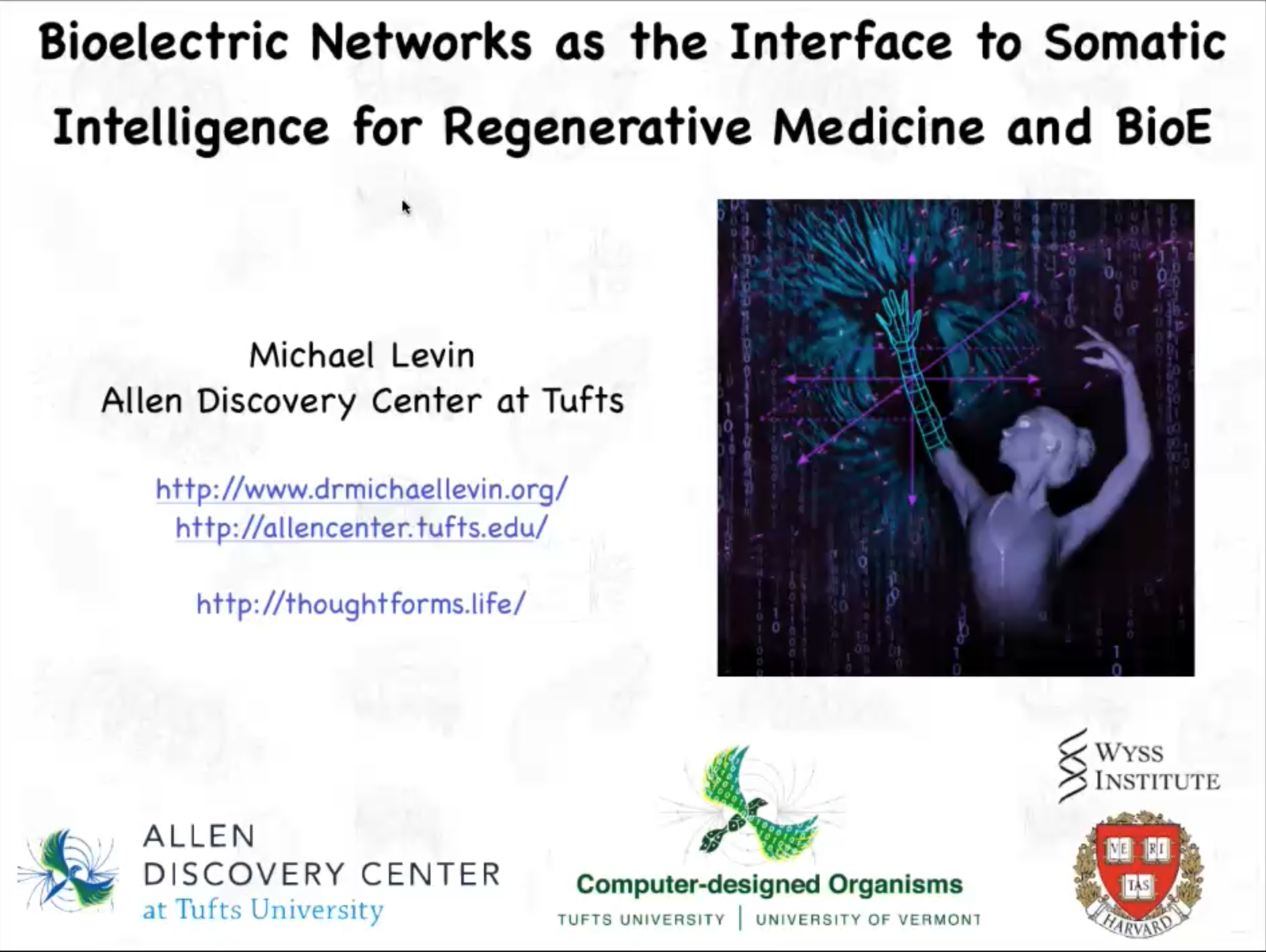
The following is a ~`1 hour talk I gave to undergraduate students at Tufts’ Biomedical Engineering Department, for a class on regenerative medicine.
Here is a brief Q&A that followed, with text transcription by an AI tool made for me by Nick Sheuko:
Q> One question I have pertains to the head shape of the planarians you were discussing. I understand that retaining their memory can be useful, but why is it important to have the same head shape? Why do we use this technology to create identical head shapes?
A> In the example I showed, we were able to persuade cells of a specific species to adopt the head shape of a different species. This is significant not because we want to replicate someone else’s head shape, but because it demonstrates that our genetics, or our “hardware,” does not determine our morphogenetic and functional destiny. It shows that while DNA provides us with hardware that defaults to a specific shape, that shape can be reprogrammed. This means that the same hardware can be reprogrammed to create a completely different shape. This has implications for regenerative medicine and bioengineering, as it means we don’t need to alter genetics or use gene therapy to change shape. Once we understand this process, we can use chemical, biophysical, biomechanical, and bioelectric signals to instruct cells to build whatever we want. This could be used to correct a birth defect, regrow an organ, grow an organ in a dish, create lab-grown food with a specific structure, or even create a biobot. In the future, we may even be able to choose our own physical form. To do this, we need to understand how to reprogram what cells build.
Q> I also worked with planarians in my undergraduate studies. We encountered a problem when working with gene expressions and creating two-headed planarians. Usually, a tail would regenerate from the blastema, but they would have two heads on the head side, not two heads on top and bottom. You mentioned that the success rate is 100%, is that correct?
A> The success rate for a standard planaria to correctly build the right number of heads is almost 100%. However, the success rate for creating the various forms I showed is not 100%. For example, when we used a reagent to temporarily close down some of the electrical synapses, 70% of the animals developed two heads and 30% did not. We initially thought that the one-headed ones were unaffected by the drug, but further experiments showed that these one-headed animals, which we call “cryptic worms,” are actually a third outcome. They have a single head and appear normal, but they are actually uncertain about how many heads they should have. If you recut them, each fragment will independently decide to have either one or two heads and this destabilized morphology is heritable across future generations of cutting and regeneration. We have modeled this as a perceptual bistability (like a Necker cube, or the faces/vase image) of the cellular collective intelligence.
Q> I’m curious about how you determine what chemicals or stimuli are needed to cause a certain change.
A> There are two general paths we are taking. One is creating detailed computational models of the physiology. If we have a good model of the electric circuit, we can invert that model and determine what stimulation is needed for a specific outcome. The other path is to treat this as a behavioral science problem and train the tissue. We may be able to use stimuli that are not as complicated as they would be if we were trying to directly target the low-level electrophysiology.
Q> When do you expect this research to be applied to larger animals, like humans? What are the challenges in regenerating a lost limb, and when would be the best time to start treatment?
A> We have already induced leg regeneration in adult frogs, and we are currently working with mice. One of the biggest challenges is that mammals live in dry air, which makes it difficult for the ion currents needed to set up the correct bioelectric state to flow. To address this, we have developed a wearable bioreactor that creates a supportive, aqueous environment for the wound. There are also issues with blood flow, infection, and inflammation. As for timing, based on our frog data, I believe that eventually it will work well after an injury, although it may be necessary to reopen the wound. As for when this will be available for humans, I can’t give a specific timeframe, but I think we will see it in our lifetime.
Q> I’m curious about the interplay between the bioelectrical signals you are giving the organism and the underlying molecular biology. What is the relationship with epigenetics and transcription factors?
A> The bioelectrical signals are upstream of the molecular biology. The electric circuit makes a decision about what it’s going to be (a head or a tail) in about three hours. It takes about 24 hours for the transcription factors to kick in and for the morphogens to become redistributed and for the chromatin modifications to take place. All of these are important for actually building the limb and are downstream of the bioelectrical signals.
Further reading:
1. Mathews, J., et al., Cellular signaling pathways as plastic, proto-cognitive systems: Implications for biomedicine. Patterns (N Y), 2023. 4(5): p. 100737. https://www.ncbi.nlm.nih.gov/pubmed/37223267
2. Lagasse, E. and M. Levin, Future medicine: from molecular pathways to the collective intelligence of the body. Trends Mol Med, 2023. https://www.ncbi.nlm.nih.gov/pubmed/37481382
3. Pezzulo, G. and M. Levin, Re-membering the body: applications of computational neuroscience to the top-down control of regeneration of limbs and other complex organs. Integr Biol (Camb), 2015. 7(12): p. 1487-517. http://www.ncbi.nlm.nih.gov/pubmed/26571046
4. Levin, M., Bioelectric signaling: Reprogrammable circuits underlying embryogenesis, regeneration, and cancer. Cell, 2021. 184(4): p. 1971-1989. https://www.ncbi.nlm.nih.gov/pubmed/33826908
5. Davies, J. and M. Levin, Synthetic morphology with agential materials. Nature Reviews Bioengineering, 2023. 1: p. 46-59. https://www.nature.com/articles/s44222-022-00001-9


Leave a Reply