I often start some of my talks by showing a slide of this engraving (Adam naming the animals, etching by G. Scotin and J. Cole after H. Gravelot and J.B. Chatelain, 1743):

There are two interesting and related things it introduces, one of which I think is a major error for us to transcend, and the other is a deep truth for us to learn.
The error is that what we have here is a story of discrete natural kinds. Each animal is a discrete species, clearly different from the others and unchanging. Now that we have a better understanding of chimerization, bioengineering, and morphogenesis, it’s clear that there are no such hard boundaries – everything can be changed, along a smooth continuum. The features of any organism can be changed slowly and gradually, making it impossible to say when one species ends and another begins. The definition of species in terms of reproductive isolation can be useful in evolutionary biology and ecology, but I don’t think it’s fundamental as it relies on the contingent vagaries of behavioral compatibility and the chromosomal dance of fertilization, not what’s truly interesting about how cells with specific types of molecular hardware end up making specific anatomical and behavioral outcomes. Here’s a schematic from a paper with Josh Bongard reminding us how biology can be modified at any level of its organization:

We need to transcend shallow and increasingly irrelevant binary categories, which are destroyed by the continuum of beings that do not neatly fit into any of them. Our world will increasingly contain hybrids, chimeras, cyborgs, and all manner of novel life forms that were no-where on the tree of life with us. Interestingly, there are ancient traditions that took this important point very seriously, for example:

discussed in this paper (credits: A, a representation of the Devourer, who waited to eat the hearts of sinners in the afterlife’s Hall of Judgment. Papyrus of Ani, ~1275 BC; photograph from British Museum; B, Matsya (fish) Avatar of Vishnu. Nineteenth century lithograph. From Wikipedia. C, Oannes, a Mesopotamian mythological being who brought civilization to mankind. Curious creatures in zoology, by John Ashton (1890), p. 209).
What’s deep and interesting about the original Judeo-Christian biblical story is this: why is Adam the one naming the animals? Why couldn’t God or the Angels name them – why did Adam have to be the one to do it? I think we can take two lessons from this. First, because in many traditions, “naming” something is a very profound act: finding (or discovering) the name for something means knowing its true nature. It was important that Adam go through that process. And indeed, in the coming decades, we are going to have to name (in this deep sense of working to understand their true nature) a very wide range of unconventional beings that will stretch the old categories lazily accepted by our cognitive system from a time where natural evolution was the only game in town. Moreover, we are beginning to see that the standard, reliable forms produced by development from a given genome fool us into a false sense of understanding and determinism, which has to be transcended by a better comprehension of the plasticity and cellular agency of living beings without genomic modification (see for example here and here). “Developmental constraints” and limited “competency” of cells and tissues are, I think, largely constraints and limited competency of us as scientists, not of the material itself.
Second, because Adam and his descendants are the one who’s going to be living with these creatures, and so it is his responsibility to understand the agential beings in his world. This paper, written with Wesley Clawson, discusses these issues in detail, and illustrates how the “endless forms most beautiful” – Darwins’s phrase that marvels at the diversity of natural life – are just a tiny corner of the astronomical space of possible bodies and minds, which will be increasingly explored in the coming decades.

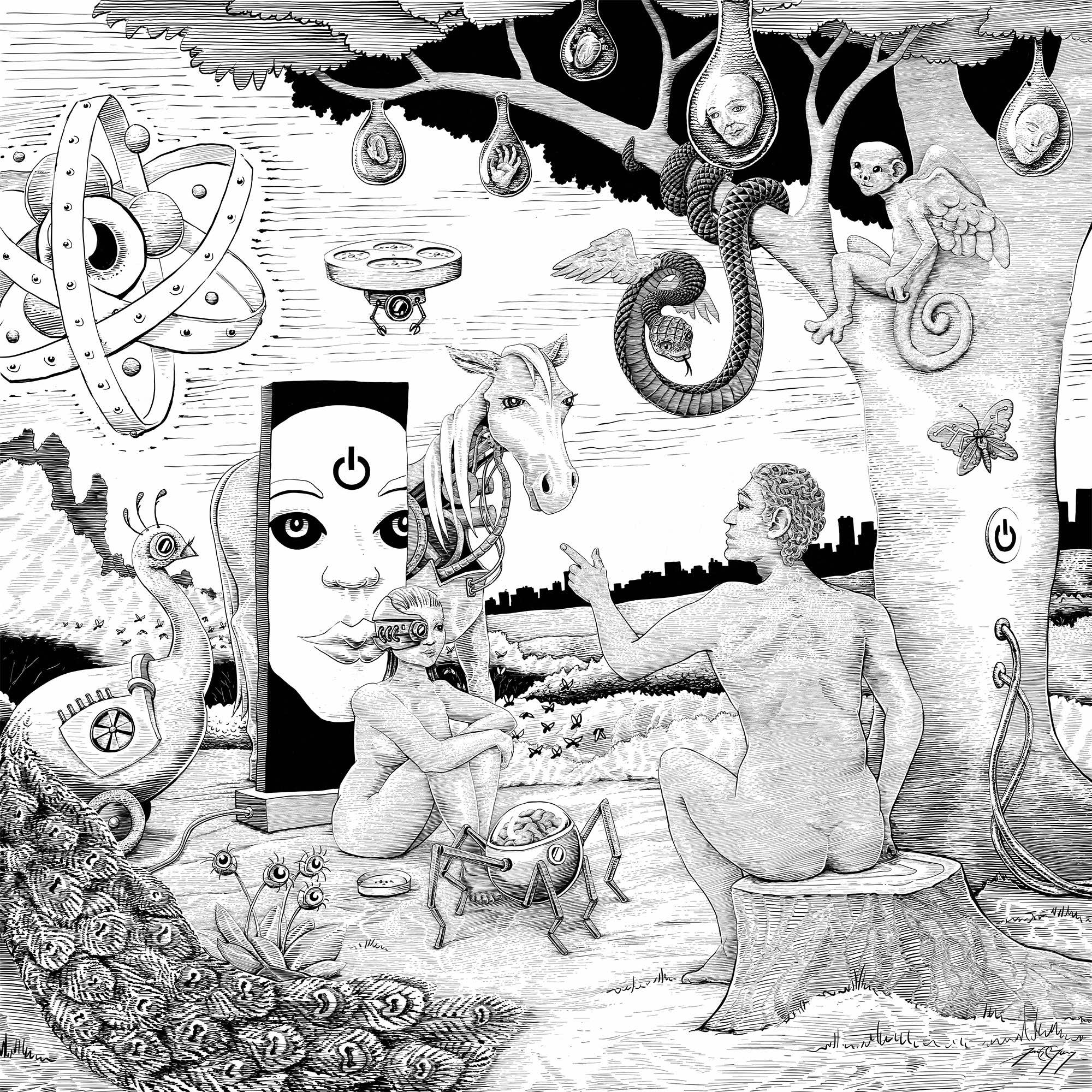
The Xenobots, Anthrobots, and many other novel constructs that reveal the plasticity and interoperability of life are just early steps, along with the field of Artificial Life, AI, and human augmentation. Thus, I asked the incredibly talented Jeremy Guay to re-imagine the classic Garden of Eden painting from this perspective (described in more detail here and here):

AI, in the sense of software language models, is just a warm-up for a much weirder future that includes freedom of embodiment and truly diverse intelligence (the kind that will make our descendants laugh out loud at current hand-wringing over today’s mild body changes and differences among v1.0 humans). This rendition of a future school class trip photo doesn’t even begin to cover it:

We need to remember that the special anthropocentric glow, so prevalent in everyday discussions and philosophy of “the mind” (as the modern, adult, homo sapiens mind) is not discrete, is not privileged, and is (and always has been) up for improvement:

Schematics and illustrations by Jeremy Guay. School trip image by Midjourney.


.jpg)
Leave a Reply