Oné R. Pagán,and I are writing a book, for general audiences, on bioelectricity (a bit more description is here).
The personal update is this. Having taken a few days off from meetings and email (a “retreat”, but I didn’t use that defeatist framing – it was an attack!), I wrote first drafts of the Introduction, Foreword, and 3 chapters. Not having to look at the clock, to attend events that start at specific times, is magical for getting into the flow. About 35,000 words done so far. We’ll see if it’s any good, no one has read it yet.
Working on it has led me to some thoughts on the future of books in general.
One thing that frustrates me is the linear nature of the medium. I’m telling a story in a specific scope, with no way for readers with different levels of interest in different parts to dive in and follow rabbit-holes as needed. Sure, we can use footnotes, but that is only one extra level. What I’m looking for is hypertext or html, with the infinite capacity to “choose your own adventure” through a tree or web of connected ideas, but of course traditional book publishers don’t facilitate that. I started to think about how to negotiate this kind of format for the next one, but it occurred to me that this may all soon be irrelevant.
I was mentally complaining about the fact that the readers will be at different levels – some will be biologists, others will be computer science professionals, and others will be humanities-oriented. At all different levels, any piece of text is either too opaque and needs more explanations of each point, or conversely, to peppered with the obvious and giving the familiar reader too low a rate of new ideas. Why do we have to pick one level and stick with it? Why can’t it be customized? And it will be. The “book” of the future comes with an AI that can tell you the story at whatever level of detail, in whatever length, you happen to want.
[ let’s not get stuck on the fact that early-2024’s AI’s are not quite up to the task; even if you think that today’s Large Language Models are an off-ramp to the true intelligence needed to properly translate a book, let’s consider the future. It’s pretty likely that eventually, some kind of knowledge appliance (be it digital, software, biological-AI hybrid, whatever) will exist ]
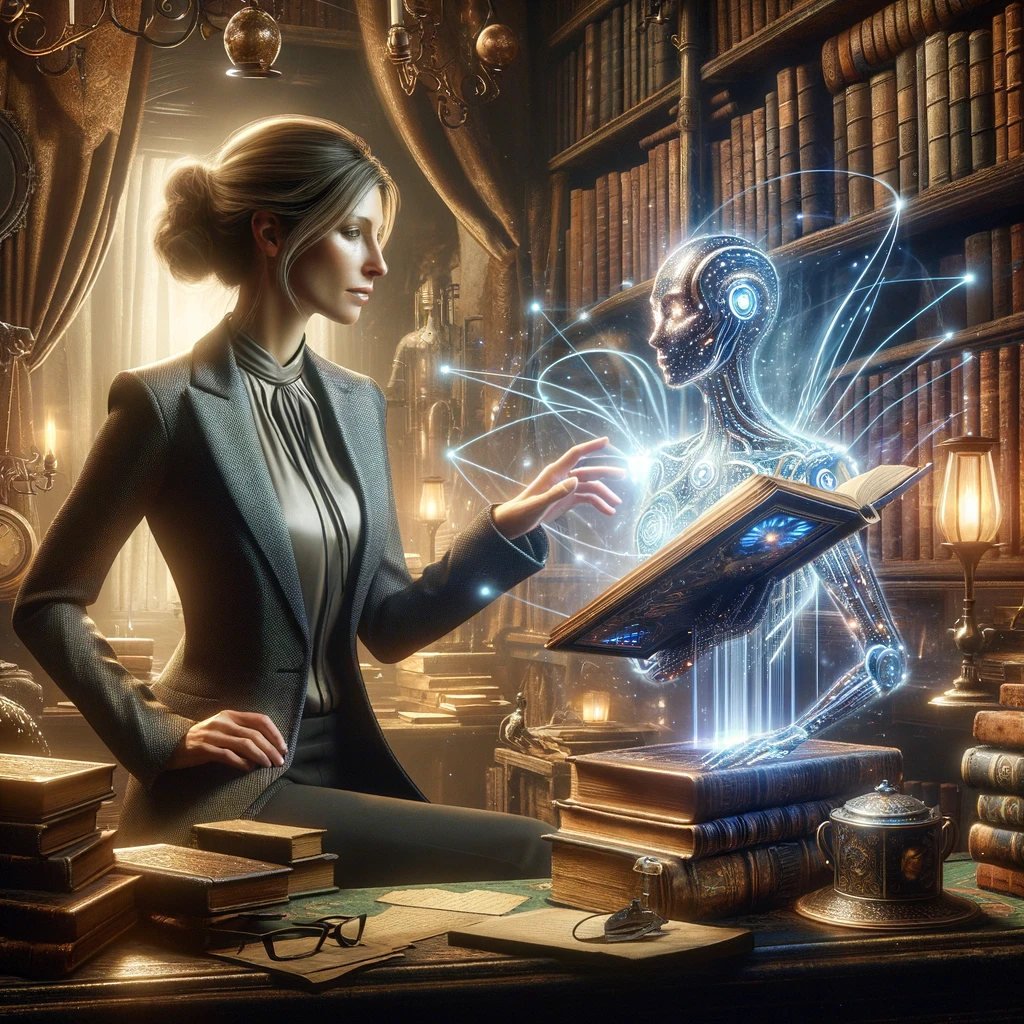
I am guessing that the books we buy in the future will come with an AI which not only talks to you about the given book (answering questions, prodding for your own ideas, etc.) but will also talk to other books. You’ll leave in the morning and schedule a playdate between two of your books and two books someone else’s ebook library, with instructions to tell you about the best 5 ideas they came up with while you were out.
But then something else occurred to me. Think of the history of ideas. Originally, if you wanted to transmit a story or information to someone, you talked to them face to face – there was no technology beyond language, and you had to personally do whatever it took to ensure faithful transmission of information. Maybe you had disciples and some rules around how information got passed down to and from them.
Eventually, writing and print appeared, which introduced a layer of insulation between the storyteller and reader. You didn’t see the author, you couldn’t ask them questions, all you had was their work product – to interpret, change, and pass on (or not) as you saw fit.
Maybe in the future, that insulation gets thicker, in the sense that eventually people may mostly interact with the Informational Wrappers over books. Sure, brilliant writers will always have fans who want to read the original text, exactly as it was set down. But most of us, especially those writing technical or non-fiction material, may find that the vast majority of readers are consuming our books by telling them “I have interest in XYZ, with education level ABC, and I’ve got 8 hours to spend on this book – go, tell me what I need to know.”
If this is true, then the whole process of writing a book – wrestling over specific wording as we write – may also be a relic of the past, if you know from the start that people will not see your original. Maybe, now that we have a more active (and someday, agential) medium for the ideas than paper or passive bits in a Word document, we can go back to the old version of story-telling: personal instruction. Remove the paper middleman between the writer and the AI who will eventually translate the story for all audiences. Have the Knowledge Helper read the source material, and talk to them as you would to your best protégée, to make sure they got it right and grok all the points you wanted to make. It’s too soon right now, and so I will continue to battle the static document, to force it to at least approximate what I want to say, to all the diverse people I would like to reach. But I think someday, it is inevitable that we come full circle: instead of trying to transmit our ideas through the flat inertia of the blank page, one way to give birth to a book will be to converse with an artificial being whose job and immense talent it will be to preserve, transmit, customize, and maybe transmute knowledge.


Leave a Reply