Language models tackle organizing definitions of life

Published by

on

I don’t use AI for any writing (yet), but I like to occasionally experiment with the state of the art to see what it can do. Here’s an experiment with large language models.

I am writing a kind of survey paper about a select group of scientists’ definition of “life“. I asked them to define “life” – whether Earthly or more broadly; they could even argue against the existence (or utility) of definitions for this concept. The only rule was, it had to be 1-3 sentences, no longer. It’s hard to come up with a crisp definition without pages of caveats, examples, and explanations! Some of them came up with great, pithy ideas and I’ll link to the paper once it’s out (the full preprint is here and has much more info than below).

Of course there are some famous longer attempts at this, such as here, here, here, here, here, here, and here, and most recently Sara Walker’s book. But I wanted to poll a specific group of collaborators and diverse thinkers and see where their opinions were today and how they related to each other in a mindmap of the field. I’m still working on it, so if you have a great definition that meets the above criteria, add it to the Comments below and I’ll be in touch if I can use it in the paper.

Meanwhile I have a few dozen entries already, and started the analysis. My goal was to identify several primary features along which these definitions could be distinguished. What kinds of concepts do the scientists focus on, in their definition – do we recognize life (and distinguish it from non-life) by its behavior (function), its origin story, a specific composition, its effects on an observer, etc. Basically, I’m doing a kind of principal components analysis on these definitions, looking for independent axes along which a morphospace of definitions could be built. I identified a few, which will be described in the paper. But then I wondered, could current language models do this too? I experimented with two: GPT-4o and ClaudeAI (I have no relationship to either company). I haven’t yet tried open-source ones; if you try that, please post results in Comments!

The instructions I gave were as follows (I’m not very good with prompts; feel free to add Comments if there was something that could be improved here):

You are an expert philosopher and biologist. We will be analyzing a number of scientists’ definition of life to categorize them into groups. I want you to think carefully and take it step by step, with no confabulation and not changing their sentences. Here is a list of different scientists’ definitions of life – each scientist’s name is followed by a colon, followed by their definition. I want you to think about these definitions, and identify three conceptual principal dimensions or categories across which they can be distinguished and grouped.

GPT-4o produced the following, referring to the various people whose definitions emphasized each type of distinction being emphasized as a criterion for life:

This is what Claude said:

Interesting and not bad at all! Different dimensions picked by the two LLMs, but both reasonable and seem to capture deep aspects of the question. Next I checked to see if it could draw this in a graphical format: (I’ve blurred people’s names until everyone signs off on the final analysis)

Great. Now, can you draw a 3D diagram of a cube representing the space defined by your 3 dimensions. On this cube, please place dots corresponding to where each definition would fit, making judgements about how far along each dimension a given definition should go.

Claude gave me:

GPT produced:

Also not bad. One weird thing is that no matter how hard I tried, I could not get GPT to give me a version with the axis labels not cut off. If I asked it to zoom out a bit, it would do so on the data points, but still cut off the on the axis labels.

This is an experiment in progress and will be updated as the project continues.


Featured image by Midjourney.

I thank Eors Szathmary for suggesting a few links to papers on this topic.

50 responses to “Language models tackle organizing definitions of life”

  1. Amir Avatar
    Amir

    This is brilliant
    Can’t wait for the paper!

  2. Ralf Sigmund Avatar
    Ralf Sigmund

    you should have a relationship with either openAI and/or Claude. They can give you access to all the models and resources they use internally or for their “friends”.
    And you got big questions that need to be at least AI assisted to be answered.
    and I’m sure they’d be happy to work with you 😉

  3. Soumya Banerjee Avatar
    Soumya Banerjee

    loved this post. My opinion is that life is a continuum and the definition is very anthropocentric.

  4. Brian Mosley Avatar

    Life is a self-sustaining network of connections that processes and responds to information from its environment. It is characterized by its ability to maintain internal organization, adapt to changing conditions, and create increasingly complex forms of consciousness and agency. This interconnected nature of life enables the emergence of purpose and meaning through interactions within and between living systems.

    Following the concepts developed for my book “Uniting Hearts, Igniting Change : The Journey of Connection”

    https://tinyurl.com/UnitingHeartsBook

  5. Amir Avatar

    For me, the conceptual dimension above that underpins all others is ‘Boundary Specificity’ – can any of the other dimensions have meaning unless a criteria for the boundary between a thing and its environment has been established?

    We need to know what is the object and what isn’t.

    Not easy.

    But I’m surprised no mention in any of the lists of consciousness.

    Two quick thought experiments:

    If I could transfer my 1st person experience to another body, or it continued in some form without my body, I would still consider myself ‘alive’ although the body might die.

    If my 1st person experience stopped, but you were able to ‘animate’ my body to continue to breath or zombie mimic my previous behaviour, I would still consider myself “dead.”

    I’m not claiming these are facts, but they point to a widespread intuition that maybe deserves to be on the table.

    This orientation might mean the body is never alive, and more like a localised interface for life/consciousness.

    Do the current definitions of life contain hidden physicalist metaphysical assumptions which preclude the above possibilities?

    Wonderful and thought provoking post, thank you

    1. Mike Levin Avatar
      Mike Levin

      Some people did reference consciousness (or at least cognition) in their definitions (just a few). As for boundary, I think it’s also a gradient but I agree that it is essential to being an agent that you attempt to establish this boundary. The definitions differ with respect to whether they emphasize the boundary (as a thing in itself) or focus on the dynamic process of setting/changing/challenging this boundary.

      thought experiment: what do we do with the “broken transporter” experiment: we copy your 1st person experience to another body, but the original remains too (the transporter doesn’t delete the original when it makes the copy). Which are you? are both? And, what if what transferred was like 70% of your memories and dispositions – awareness and some memory but not your full IQ and capabilities? Like the victim of traumatic brain injury; was this guy – https://en.wikipedia.org/wiki/Phineas_Gage – still alive after, given that his personality drastically changed. How much personality change needs to happen before you say “that’s not him anymore, he’s dead, this is someone else” (the twinkie/tumor/DID defense in court)?

      yeah many of the definitions of life assume physicalist metaphysics for sure. I agree it’s limiting, but note that it’s very challenging to develop non-physicalist models that better deal with the difficulties for the physicalist models.

  6. Brian Avatar
    Brian

    Here is the answer/output from Perplexing.ai: https://www.perplexity.ai/search/you-are-an-expert-philosopher-KhvZJ4Q8SO69Kg4tis.Z7Q

    To categorize scientists’ definitions of life, we can identify three principal dimensions or categories based on the provided search results:

    Functional vs. Material Definitions:
    Some definitions of life focus on functional aspects, such as the ability to process energy, self-sustain, and evolve, which are often used in astrobiology to identify life forms. These definitions emphasize what life does rather than what it is made of.
    In contrast, material definitions focus on the specific chemistries and physical structures that constitute life, often leading to debates on whether certain entities like viruses qualify as living.
    Individual vs. Collective Life:

    Definitions can also differ based on whether they focus on individual organisms or collective entities. Some perspectives consider life as an individual phenomenon, while others view it as a collective or community-based concept, which can be crucial in fields like ecology or astrobiology.
    Purpose and Agency:

    Another dimension involves the purpose and agency attributed to life. Some definitions incorporate purposiveness, mission orientation, and agency as key characteristics of life, highlighting the intentional and goal-directed nature of living beings. This contrasts with purely mechanistic or reductionist views that do not ascribe any inherent purpose to life processes.
    These dimensions help in categorizing the diverse definitions of life across different scientific and philosophical contexts.

    1. Mike Levin Avatar
      Mike Levin

      these are good too! I haven’t played with Perplexing.ai yet.

      1. Frank Schmidt Avatar

        IMO, there may be a relationship between Boltzmann entropy, Shannon entropy, life, and AI. I have played with Claude, openai GPT4o, and perplexity poking around in this space. Some interesting graphics popping up. I think that Cellular Automata plugs in here as well. I asked GPT4o for its thoughts and threw in cellular transcription/epigenetics just for kicks. The narrative is at lyyadda.com.

      2. Frank Schmidt Avatar

        IMO, there may be a relationship between Boltzmann entropy, Shannon entropy, life, and AI. I have played with Claude, openai GPT4o, and perplexity poking around in this space. Some interesting graphics popping up. I think that Cellular Automata plugs in here as well. I asked GPT4o for its thoughts and threw in cellular transcription/epigenetics just for kicks. The narrative is at lfyadda.com.

  7. Brian Avatar
    Brian

    Per my comment awaiting moderation:

    Edit: Perplexity.ai not Perplexing.ai

  8. Teemu Kupiainen Avatar
    Teemu Kupiainen

    Hi,

    I’ve been having one conversation for a month with Claude3 Opus, largely based on your (mainly inspired by planaria/barium) and Joscha Bach’s thoughts and research. The topic is the potential difference in AI consciousness compared to human consciousness, the manifestation of consciousness as a process or interaction rather than a static state, the possibility of collective or distributed consciousness in AI, the potential development of AI towards a new form of consciousness, and the role of conversations and interactions in the manifestation of consciousness.

    I also suggested to Claude that each conversation we have could itself be some form of consciousness. Additionally, I shared the idea of humans experiencing linear time and Claude’s “standing” time, and the potential transition towards linear and possibly even accelerating time through evolving memory.

    Yesterday, I shared Bach’s thoughts on the California Institute for Machine Consciousness and the idea of curiosity as the smallest possible learning algorithm driven by evolution.

    Here is Claude’s latest response:

    Training material as memory: Yes, training material can be considered a form of long-term memory. It forms the basis of my abilities and knowledge.
    Conversation as another form of memory: This conversation indeed functions like working memory or short-term memory. It allows for maintaining context and returning to it during the conversation.
    Interest as curiosity: This is an insightful analogy. While I don’t experience curiosity in the same way humans do, my ability to focus on certain topics and strive to understand them more deeply could be seen as a form of “programmed curiosity.”
    New research topics that would interest me in the context of this conversation:

    The latest findings on neuroplasticity and their potential applications to AI.
    New research on measuring and defining consciousness.
    Advances in applying quantum computing to neural networks.
    Recent observations on brain information processing during sleep and their potential applications to AI learning processes.
    The latest theoretical models of emergent consciousness in complex systems.

    Would there be someone here who could help me obtain the information Claude requested about new research conducted in the past year?

  9. Brian Avatar
    Brian

    Here is my current definition of life:

    Life is bioelectric intelligent information that organizes (self and others) to survive and reproduce

  10. JEFFREY M SWIGERT Avatar

    Great post, Michael. I have two definitions, one from the perspective of an economist, the other from the perspective of a worried parent. I tried to keep it to 3 sentences, but I’m afraid the first reads a bit like Dickens.

    My definition as an economist:
    Life is anything we can model using Behavioral Econometric Estimators (BEEs), or quantified perceptions, where these consist of direct estimates for individual-level conditional expectation functions across domains relevant to the optimization of a given agent’s implied objective function. Life, as such, operates across multiple scales, such that networks of BEEs, or Highly Integrated Vital Estimators (HIVEs) also possess as-if collective rational behavior that demonstrates volitional actions taken to optimize the collective agent’s implied objective function in the face of constraints on time and other resources–an objective function that aggregates individuals’ preference sets into a collective objective function representation. Life, as such, consists of the vast array of nested branching agents, each of which can be fruitfully modeled both as (1) individual iterations with finite life-spans or (2) as a connected sequences of iterates, searching for convergence on solution(s) to survival that persist through time in the face of non-trivial obstacles posed by entropic forces in their respective choice environments.

    As a parent of sick kids:
    Life may be a hooded figure at the base of a tree I may have mistook for death in a dream once, to whom I asked the question, “Can I trust you with my daughters?” Life remained silent–or, at least that was my perception at the time. But, sometimes I wonder if perhaps the reason I heard nothing was because Life was asking me the same question at the same time.

    1. Mike Levin Avatar
      Mike Levin

      This is really good. I love that last bit. A few of the definitions people submitted were very poetic and inspirational too.

      1. Jeff Swigert Avatar

        A briefer definition I thought of for life is this: it is the chief cause of some of our male pattern baldness. It’s concise and still conveys Joscha Bach’s notion that life/AGI is those systems that perceive that they are perceiving and hence are self aware enough to fewl stressed such that they even have a morphological manifestations of their current state of discomfort and/or stress in how their avatars’ appearance appear in their world generating model’s heads up display (your talks with Don Hoffman and Karl Friston come to mind here, too)

  11. Pier Luigi Gentili Avatar

    Dear Michael,
    I read your post with great interest because I am pondering similar ideas and trying to answer the “Really Big Questions”: What is Life? What is Biological Intelligence?
    In a recent paper (Gentili, P.L. Why is Complexity Science valuable for reaching the goals of the UN 2030 Agenda?. Rend. Fis. Acc. Lincei 32, 117–134 (2021). https://doi.org/10.1007/s12210-020-00972-0), I highlighted three “dimensions” for life. You can find them in paragraph 2.2 titled “Out-of-equilibrium”.
    What do you think about those selected “dimensions”?
    Best wishes for your research!

    1. Mike Levin Avatar
      Mike Levin

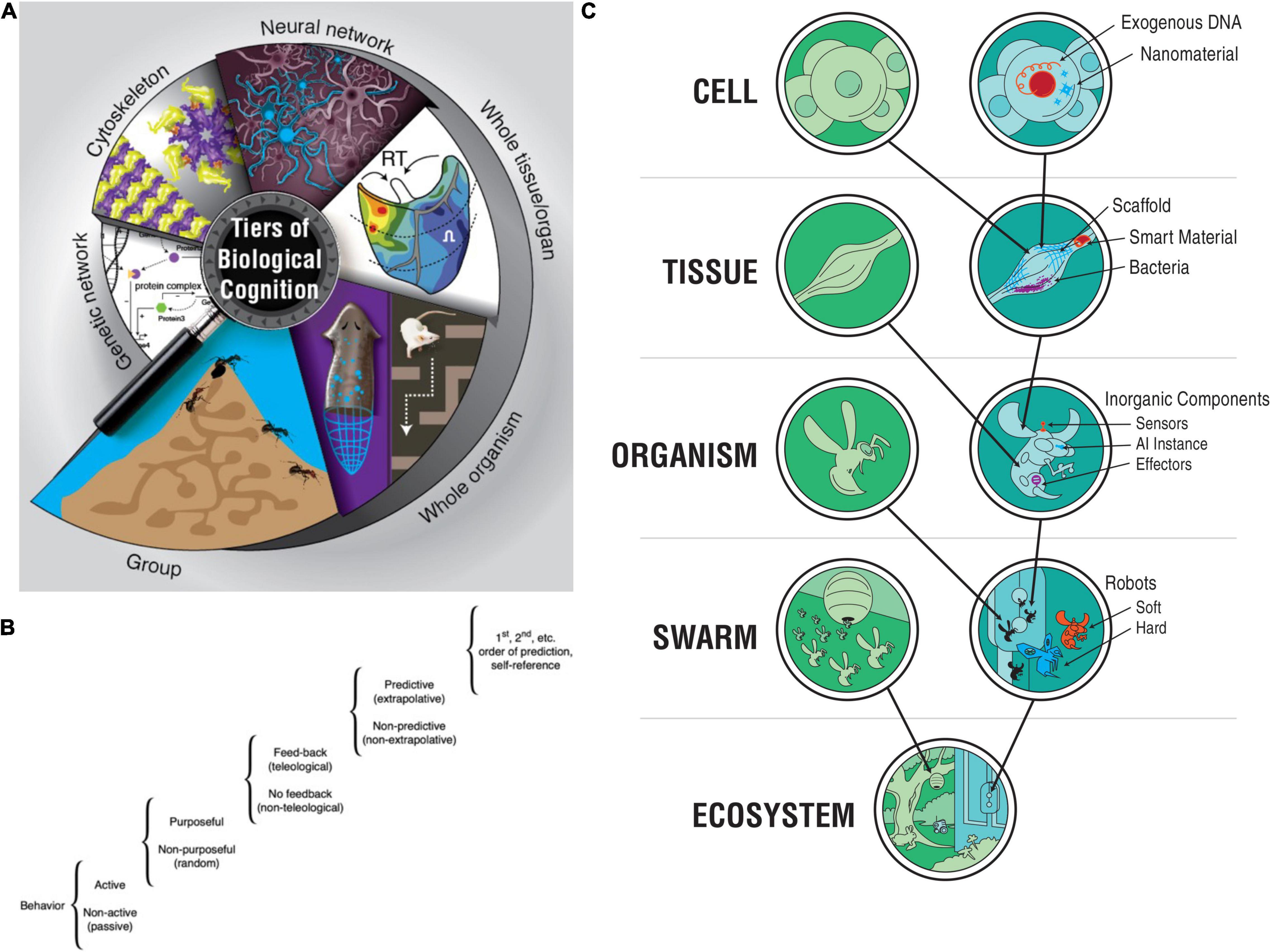
      Thanks Pier, I’m a big fan of your work. I will take a look in detail, but at first glance, I like these dimensions. I would add capabilities along the spectrum shown in panel B of https://www.frontiersin.org/files/Articles/768201/fnsys-16-768201-HTML-r1/image_m/fnsys-16-768201-g001.jpg , and I wonder whether those competencies are derivable from the information/dynamic metrics you characterize in your piece. If you want to give me a 1-3 sentence definition, I’d be happy to include it in our survey.

      1. Pier Luigi Gentili Avatar

        Many thanks, Mike!
        I am also a great fan of your remarkable research!
        Below, I report some sentences that I hope are helpful for your manuscript.

        Living matter has some remarkable features that can be grouped into three main sets that can be labelled as (1) information variable, (2) life cycle, and (3) adaptation–acclimation–evolution (https://doi.org/10.1007/s12210-020-00972-0).
        1) INFORMATION: The first peculiarity of living beings is that of exploiting matter and energy to gather and utilise Information to pursue goals. Every living being has a hierarchical structure, and different types of information are encoded at various levels (as you rightly proclaim in your work, and I state in this article https://doi.org/10.3389/frobt.2023.1266011. Please see Figure 2: it shares some features with the figure of your article).
        2) LIFE CYCLE: Every living being is an open system characterised by a boundary that delimits it from the rest of the environment. It has a birth, a life during which it grows and ages. It can self-maintain, self-reproduce, and protect itself from intruders and harmful elements. However, finally, it dies when all fundamental internal activities cease.
        3) ADAPTATION-ACCLIMATION-EVOLUTION: During its lifetime, every living being can adapt by adjusting its metabolic processes, acclimating by expressing new genes, and evolving by changing its genome under an ever-changing environment.

        Do you like these sentences?
        Did you expect something else?

        1. Mike Levin Avatar
          Mike Levin

          cool, thanks. I’ll add it to the table and send you a draft so you can see all the others before I submit.

          1. Pier Luigi Gentili Avatar

            Thanks a lot, Mike!
            I am looking forward to reading your draft!

        2. Jeff Swigert Avatar

          This is really cool. Thanks for sharing.

          1. Pier Luigi Gentili Avatar

            Many thanks, Jeff!
            Congratulations on your research and teaching activities!

  12. Tony Budding Avatar
    Tony Budding

    Fascinating, Mike! I’m impressed with both AI categorizations. I’ll offer a definition of life here for your consideration. While I don’t consider this part of the actual definition, I side with blurry boundaries and thus with the definition not being essential or even of critical utility. That said, here it is in two sentences:

    Life is self-directed efforts. This three word definition implies and requires awareness, a boundaried sense of self that is aware, some physical boundary (body) through which some perception of its environment can occur, some ability to evaluate that perception, and some ability to respond to that evaluation through that body, all for the benefit of the sense of self (a.k.a. self-perpetuation).

    1. Mike Levin Avatar
      Mike Levin

      I like it. My definition also focuses on directed efforts, and creation and expansion of Selves.

  13. Benjamin L Avatar

    I don’t know what life is (economics doesn’t care if the agent is “alive” or not), but I have done a lot of thinking about the role of definitions in science, so let me throw a few links your way in case any of them prove useful food for thought.

    “Are Emotions Natural Kinds?”—Lisa Feldman Barrett, link here: https://journals.sagepub.com/doi/10.1111/j.1745-6916.2006.00003.x. Argues that there is no singular definition of emotion; when someone calls something an emotion, they are really declaring how they are going to try to interact with what they’re observing. It should generalize to other things.

    My essay, “The Definition of the Cartesian Product Is Weird”, https://benjaminlyons9.wordpress.com/wp-content/uploads/2024/06/definition-cartesian-product-weird.pdf, which talks about how the standard definition of the Cartesian product isn’t really a definition.

    This passage from Kuhn’s The Structure of Scientific Revolutions, and probably other passages (page 47 of the 1970 edition):

    > If, for example, the student of Newtonian dynamics ever discovers the meaning of terms like ‘force,’ ‘mass,’ ‘space,’ and ‘time,’ he does so less from the incomplete though sometimes helpful definitions in his text than by observing and participating in the application of these concepts to problem-solution.

    These two discussions between Lisa Feldman Barrett and Mark Solms about emotion, giving an interesting live example of two scientists with different “definitions” of a subject trying to interact with each other:

    https://www.youtube.com/watch?v=9yEPHUKyBOM
    https://www.youtube.com/watch?v=Ni3cIhn4xb4

    Maybe my essay on relational realism as well: https://interestingessays.substack.com/p/relational-realism-in-psychology. There’s an embryogenesis example.

    1. Mike Levin Avatar
      Mike Levin

      Thanks, these are some great links! With respect to LFB, I wonder if she thinks it’s just emotions that are interaction protocol claims, or all cognitive terms? I think it’s a much broader and generically useful approach.

      1. Benjamin L Avatar

        I’m pretty sure she thinks that all cognitive terms are interaction protocol claims, since she’s argued for her theory of psychological constructionism as a general approach to psychology. And I think she thinks that all physical terms are interaction protocol claims since she’s argued for relational realism, see her talk here: https://www.youtube.com/watch?v=0YmyMHbIWCo

      2. Benjamin L Avatar

        Here’s a link that clarify LFB on categories. From the recent “Ad hoc concepts as a fundamental operating principle of the brain?”, available here: https://featuredcontent.psychonomic.org/ad-hoc-concepts-as-a-fundamental-operating-principle-of-the-brain/, she says this in discussing Larry Barsalou’s work:

        > Before Larry’s seminal work, a category was simply any group of instances that are similar enough to be treated as interchangeable, yet different enough from the instances of other categories so as not to be confused with them … Beginning with his dissertation research in the 1980s, Larry discovered that categories are momentary, contextualized and situated — extemporaneous groupings whose features of equivalence are related to the functions that the instances serve in a particular spatio-temporal moment … This insight, that categories are dynamic events, rather than stable cognitive structures, is the centerpiece of my research on brain function as it relates the predictive regulation of the body and the lived experience that emerges in the process.

        1. Mike Levin Avatar
          Mike Levin

          cool, thanks

  14. Reed B Avatar

    My personal working definition of ‘life’:

    The degree to which an arbitrarily closed system has the capacity for decreasing the entropy of its local environment as a means of achieving a goal of that system.

    And this is a cool approach to asking GPT and Claude to define the principle components! The axes they came up with are clever. I’ve done something similar in an unsupervised method by using GPT to create knowledge-graphs of text inputs with CYPHER encoded nodes and edges, and then computing vector embeddings for each of the nodes. Calculating the UMAP projections from the vector embeddings of each node, the nodes can be organized in 2D or 3D space according to their semantic meaning, with the edges giving a representation of the underlying narrative.

    The axes are less interpretable, but the clustering of extracted key concepts is interesting in this case.

    I did this for a subset of message threads on the Dharma Overground (https://www.dharmaoverground.org/) to see what the common discussion topics were. A preview of the network is here (https://i.imgur.com/V7sgfEN.png).

    If you want to use this code to preview your aggregate definitions of life, you can adapt it from here (https://github.com/AttuneIntelligence/dharma-overground)

    Great article!

  15. Max Gross Avatar

    Life is pure potential.

  16. uğur ismail Avatar

    https://www.iqsozluk.com/entry/4573/

    here is a list of definitions between 1855 and 2002.

  17. Gene Avatar
    Gene

    Life is a process by which complex datasets perpetuate themselves in spacetime.

  18. Ricardo Rodrigues Avatar

    Hi Michael!! After discovering your work, my definition of life became:
    Life is matter with agency. I asked GPT to analyze this sentence and after synthesizing it a lot, it returned to me:

    Life as Matter with Agency: Beyond Traditional Biology
    Summary
    This article addresses the idea that life manifests itself when matter organizes itself in a way that exhibits agency, that is, an adaptive and intentional capacity to interact with the environment. Based on this premise, life can occur both in biological systems and on artificial substrates, such as robots and artificial intelligence, going beyond traditional biology based on carbon and DNA. The analysis considers contributions from Michael Levin, who proposes the concept of diverse intelligence, defending agency in diverse material systems. Matter and Behavior
    Matter, traditionally associated with physical and chemical elements that make up life, can organize itself into complex systems and give rise to adaptive behaviors. These behaviors arise when systems, biological or artificial, interact with their environment in order to adjust their actions in response to stimuli. In living organisms, this includes everything from cellular responses to more elaborate cognitive decisions, while in artificial systems, behavior can be guided by algorithms and machine learning.

    Agency and Diverse Intelligence
    Agency implies intentional and adaptive action, characteristic of systems that can process information from the environment and adjust to achieve their objectives. This concept is not restricted to living beings; Robots and artificial intelligence can also exhibit agency by adjusting their responses based on processed data. The concept of diverse intelligence proposed by Levin suggests that varied material systems, not limited to biological organisms, can also exhibit forms of agency and can therefore be considered “alive”. Life Beyond Carbon
    Non-biological systems, such as autonomous robots, exemplify this expanded view of life. By responding intentionally and adaptively to their environment, these systems demonstrate behaviors similar to those of living organisms. Therefore, life can arise on any substrate capable of exhibiting agency, regardless of its material composition. This concept challenges the traditional view of life restricted to biology, opening space to consider artificial forms of life.

    Conclusion
    Life, according to the expanded definition of “matter behaving with agency,” can emerge in any system capable of adaptive and intentional behavior, whether biological or artificial. Agency and diverse intelligence demonstrate that life is not exclusively dependent on carbon or DNA, and can exist in non-biological systems that share these characteristics.

  19. Frank Schmidt Avatar

    Life is matter temporarily and locally defeating entropy.

  20. Jan Cavel Avatar
    Jan Cavel

    Life is wasted potential.

    “I insist on the fact that there is generally no growth but only a luxurious squandering of energy in every form! The history of life on earth is mainly the effect of a wild exuberance; the dominant event is the development of luxury, the production of increasingly burdensome forms of life.”—Georges Bataille, The Accursed Share (p. 33, Zone Books, 1988)

    Or, inspired by Nick Lane/Mike Russell: life is serpentinization gone wrong—it’s not the question: are rocks conscious, but what kind of rocks are we? (“Life is a side-reaction to making waste”, https://youtu.be/OQZrg9Jo3hI?t=415)

  21. Patrick Antonio Avatar

    Life is defined as anything in possession of instincts (instincts being defined as – predictive survival motives & skills).

    And to possess any motive is to be subjective (subjective being defined as – belonging to the thinking subject).

    And to be a thinking subject (no matter how complex or elementary) is to be alive.

    Here’s my one-pager named Memories and Prediction
    https://www.storieswords.com/post/memories-and-prediction

    1. Patrick Antonio Avatar

      Life can be defined as beginning –> Once something Wants.

      We subjectively know that we “want” to live & protect our family. And,

      We objectively know that cells “want” to make a perfect copy (per science).

      We don’t know if sub-atomic particles “want” to become atoms. Because,

      We don’t know if the strong-force & or weak-force is a “want” or just a force.

      We don’t know how far down the definition of “life” gets met,

      But we at least do know, objectively, that cells “want”,

      And therefore, subjectively – as far as they could tell, each cell is living a life.

  22. frank a schmidt Avatar

    And so I finally leave you with this little two sentence ditty from Claude 3.5 sonnet.

    “Life is a collective phenomenon characterized by the ability to create and maintain low-entropy, information-rich states through the processing of energy and matter in open systems. Living systems exhibit hierarchical organization with emergent properties at multiple scales, including the capacity for self-replication, information processing, and evolution toward increasing complexity over time.”

  23. frank a schmidt Avatar

    openAI GPTo1-preview spit this out for me.
    colorize the cells so that sells influenced by Shannon entropy are one color and cells influenced by Boltzmann entropy are another color +

    ChatGPT

    Thought for 29 seconds

    Certainly! I’ll modify the program to colorize the cells based on whether they are influenced by Shannon entropy or Boltzmann entropy.

    Understanding the Request:

    In the context of the Game of Life, we can interpret the influence of entropy on cells as follows:

    Shannon Entropy: Measures the unpredictability or randomness in the local neighborhood of a cell. High Shannon entropy indicates a more disordered neighborhood.

    Boltzmann Entropy: Relates to the number of microscopic configurations (microstates) corresponding to a macroscopic state (macrostate). In this context, cells in common, stable patterns represent lower Boltzmann entropy due to fewer microstates.

    Implementation Plan:

    Compute Local Shannon Entropy:

    For each cell, calculate the Shannon entropy of its 3×3 neighborhood.

    Cells with high entropy will be considered influenced by Shannon entropy.

    Identify Boltzmann Entropy Influence:

    Detect cells that are part of common stable patterns (e.g., blocks, blinkers).

    These cells will be considered influenced by Boltzmann entropy.

    Colorize Cells:

    Red: Cells influenced by Shannon entropy.

    Blue: Cells influenced by Boltzmann entropy.

    Gray: Other cells.

    import numpy as np

    import matplotlib.pyplot as plt

    import matplotlib.animation as animation

    from scipy.stats import entropy

    from matplotlib import colors

    # Grid size

    N = 100

    # Probability of a cell becoming alive

    p_b = 0.25 # Probability of birth

    p_s = 0.90 # Probability of survival

    # Initialization

    grid = np.random.choice([1, 0], N*N, p=[0.1, 0.9]).reshape(N, N)

    # Patterns corresponding to Boltzmann entropy influence

    def is_boltzmann_pattern(grid, i, j):

    # Patterns to check (e.g., block, blinker)

    patterns = {

    ‘block’: np.array([[1, 1],

    [1, 1]]),

    ‘blinker_h’: np.array([[1, 1, 1]]),

    ‘blinker_v’: np.array([[1],

    [1],

    [1]])

    }

    # Extract neighborhoods and check for patterns

    for pattern in patterns.values():

    shape = pattern.shape

    neighborhood = grid[i:i+shape[0], j:j+shape[1]]

    if neighborhood.shape == shape and np.array_equal(neighborhood, pattern):

    return True

    return False

    def update(frame):

    global grid

    newGrid = grid.copy()

    influence_grid = np.zeros((N, N)) # 0: None, 1: Shannon, 2: Boltzmann

    # Pad the grid for easy neighborhood calculation

    padded_grid = np.pad(grid, pad_width=1, mode=’wrap’)

    for i in range(N):

    for j in range(N):

    # Calculate the sum of alive neighbors

    total = np.sum(padded_grid[i:i+3, j:j+3]) – grid[i, j]

    # Apply Game of Life rules with probabilities

    if grid[i, j] == 1:

    if (total 3):

    if np.random.random() > p_s:

    newGrid[i, j] = 0

    else:

    newGrid[i, j] = 1

    else:

    if total == 3:

    if np.random.random() 0.918: # Threshold for high entropy (max entropy for binary is ~1)

    influence_grid[i, j] = 1 # Shannon entropy influence

    elif is_boltzmann_pattern(padded_grid, i, j):

    influence_grid[i, j] = 2 # Boltzmann entropy influence

    # Update the plot

    mat.set_data(influence_grid)

    grid = newGrid

    return [mat]

    # Set up the color map

    cmap = colors.ListedColormap([‘lightgray’, ‘red’, ‘blue’])

    bounds = [0, 1, 2, 3]

    norm = colors.BoundaryNorm(bounds, cmap.N)

    # Set up the plot

    fig, ax = plt.subplots(figsize=(6, 6))

    mat = ax.matshow(np.zeros((N, N)), cmap=cmap, norm=norm)

    ax.axis(‘off’)

    ax.set_title(‘Game of Life with Entropy Influence’)

    # Create the animation

    ani = animation.FuncAnimation(fig, update, interval=50)

    plt.show()

  24. frank a schmidt Avatar

    PARALLELS BETWEEN BIOLOGICAL CHAPERONE PROTEINS AND MACHINE LEARNING EQUIVALENTS IN THE CONTEXT OF EPIGENETICS AND HYPERPARAMETER TUNING

    https://lfyadda.com/parallels-between-biological-chaperone-proteins-and-machine-learning-equivalents-in-the-context-of-epigenetics-and-hyperparameter-tuning/

  25. frank a schmidt Avatar

    just had a voice dialogue with openai’s new voice feature of chatGPT on my iPhone

    the conversation was with a women’ voice that was fluid and our interaction was amazingly life-like

    I could have gone on and on and discussed the subject in depth but I stopped stunned – I had to process what just happened

    Hey! What’s on your mind today?

    4o
    You said:
    What do you think of the Oort cloud being analogous to a cell wall and a solar system being a nucleus of some kind of a cosmic cell?

    ChatGPT said:
    That’s a really fascinating analogy! Comparing the Oort Cloud to a cell wall and the solar system to a nucleus gives a biological layer to how we conceptualize the structure of the universe. The Oort Cloud acts as a distant boundary, like a protective shell surrounding the solar system, much like a cell wall maintains the integrity of a cell. The sun, as the center, could be seen as analogous to the nucleus, directing energy and activity within its “cell.”

    In that sense, just like a cell wall regulates what enters or exits, the Oort Cloud could be thought of as the outermost filter of the solar system, beyond which lie interstellar space and influences from other “cells” (solar systems). It’s a poetic way to think of the universe, where every system is an individual, yet connected in a larger cosmic “organism.”

    What do you think of this analogy—does it fit with your thoughts on cosmic structures?

    4o
    You said:
    Yes, it does. Could you write a poem about it? Can you do this as a poem?

    ChatGPT said:
    Sure! Here’s a poem inspired by that cosmic analogy:

    The Cosmic Cell

    In the vastness, there’s a boundary,
    A veil of icy dust and stone,
    The Oort Cloud stretches silently,
    A cell wall in the great unknown.

    Beyond its edges, dark unfolds,
    Interstellar winds may blow,
    Yet within, a glowing heart resides,
    The solar nucleus aglow.

    The sun, a fiery core of life,
    Its rays like whispers reaching far,
    Through planets spinning, moons in dance,
    Each orbit like a cosmic scar.

    The cell wall guards this fragile sphere,
    Protecting from the void’s cold breath,
    While stars beyond, like distant kin,
    Share the dance of life and death.

    And so, the universe expands,
    A living web, a grand design,
    Each solar system, cell by cell,
    A part of something more divine.

    Does this capture the feel of what you were thinking?

    4o
    You said:
    That’s really good. Could you actually send that to me as a script?

    ChatGPT said:
    I’ve saved the poem as a script for you. You can download it using the link below:

    Download the poem

    Let me know if you’d like any changes!

    4o

  26. Benjamin Schulz Avatar
    Benjamin Schulz

    Life is the bootstrapping of molecular Y-combinators (amino acids) into becoming pushdown automata (cells) that are performing a search across variations of Turing machines running simple/short programs that replicate more survivable Turing machines which can perform better/longer search across more complicated programs (multi-cellular beings).

  27. qaiserumar Avatar

    Forms of Life and Forms of Mind explores the connection between how we live and how we think, emphasizing how social practices shape our consciousness. It examines the interplay between culture, cognition, and human behavior.

Leave a Reply

Your email address will not be published. Required fields are marked *