All images by Midjourney.
Dr. Michael Levin
Experiments in AI art #11 with Midjourney
Published by
on
11 responses to “Experiments in AI art #11 with Midjourney”
-
Well, isn’t AI image generation a good way to illustrate life’s interactions with the platonic space? 🙂
These illustrations reminded me why I was so obsessed with figurative surrealism during my teenage years.
Thanks for sharing, Dr. Levin!-
good point!
-
-
Do you have a favourite? I’ll be walking around all day trying to decide.
-
The fourth (/4671) with the lady and the birds.
I can see represented my mind, not as a single unit, but a small flock of birds. It reminds me of Jung saying that we aren’t masters in our own house.
The birds represent the way in wich my thoughts interact with the layer above, like the winged boots of Hermes. Their medium, the aether. Like who knows where my thoughts come from and how long they will stay.
I appreciate the nonverbal communication of the image, it doesn’t capture concepts in black and white like these words, but give the space for them to find their own nest.
-
-
Michael, I owe you uncounted hours of lofty thoughts passing into transcendence.
However I must confess that these AI generated pictures are for the son of a genius painter almost like meeting with Chalmers Zombie. All of these images seem to lack the experience of embodied minds who know what suffering is and what solace.
But I must not forget to thank you for bringing to my attention d’ Arcy Thompsons monumental work.
Finally I have a tantalizing question that I would like to ask you but I dare not without your permission.
Yours Michael from Berlin-
> All of these images seem to lack the experience of embodied minds who know what suffering is and what solace.
Interesting; do you think you would notice that if we didn’t know they were made by AI? That is, if you looked at 10 human paintings and 10 AI paintings, not labeled, could you tell which ones come from embodied minds who know suffering and which ones don’t? And how do you feel about animal art?
Please go ahead and ask your question. If I can offer something useful, I’ll try.-
Mike, any time! Go ahead with your Turing Art test I am- perhaps unjustified-confident that I can recognize these pictures (not 100%, this is agreed).
Intruigingly my question is also about recognition of patterns:
I postulate here that everything we see is a state of our mind, all experiences including all sciences seem to be but different patterns in our conciousness.
Now the only pattern that I see run through is that there is no repetion but ever changing forms where everything is connected and merges into each other ( as in Emergence), yet remains unique. No twins alike, no one sees the same rainbow.I see no clear border anywhere, as you have explained, binary distinctions seem ultimately useless if not delusional. Death seems to be the last border and this too turns into twilight-zone just now.
Is it not clear then that this an infinite pattern much like Penrose Tiles only perhaps with one basic tile?
Now, if there are no borders, then the unfathomable intelligence of evolution (Kolmogorov complexitiy will remain uncomputable) should belong just to this infinite mind.
Is the Universe self- concious? Almost a rhetorical question.I must apologize if I created any discomfort jumping at conclusions. But this seems so obvious to me now that I wonder how anyone could say: this is all random, made from dead matter, unconcious etc.
Please be free to give me a cold shower and if possible tell me what do you see as universal pattern. -
As someone that has spent a significant part of the latest two years generating this kind of imagery, I dare to say I’d distinguish human from AI generated imagery (with a degree of error lower than 30%??)
In this regard, another interesting and enlightening experience is playing chess online with humans and with robots. The difference is not in the playing but in the blunders! And that too is easily -intuitively- detectable somehow. The quality of human errors is coherent, with a load of “personality” – fear, ambition, aggression, etc- while the machine ones lack this kind of “quality noise inductors”, there are different degrees of entropy sources and Life is good at it.
-
-
-
I think you (mostly) can tell, at least so far, that AI images are created by AI. As an artist, I am trying to think of how to explain this.
First thought is that it is like the difference between a perfectly symmetric ‘assembly-line’ ceramic mug and a hand-thrown or hand built Japanese ceramic tea bowl.
I expect that, to a large extent, AI can eventually be programmed to overcome this limitation, but it isn’t there yet.
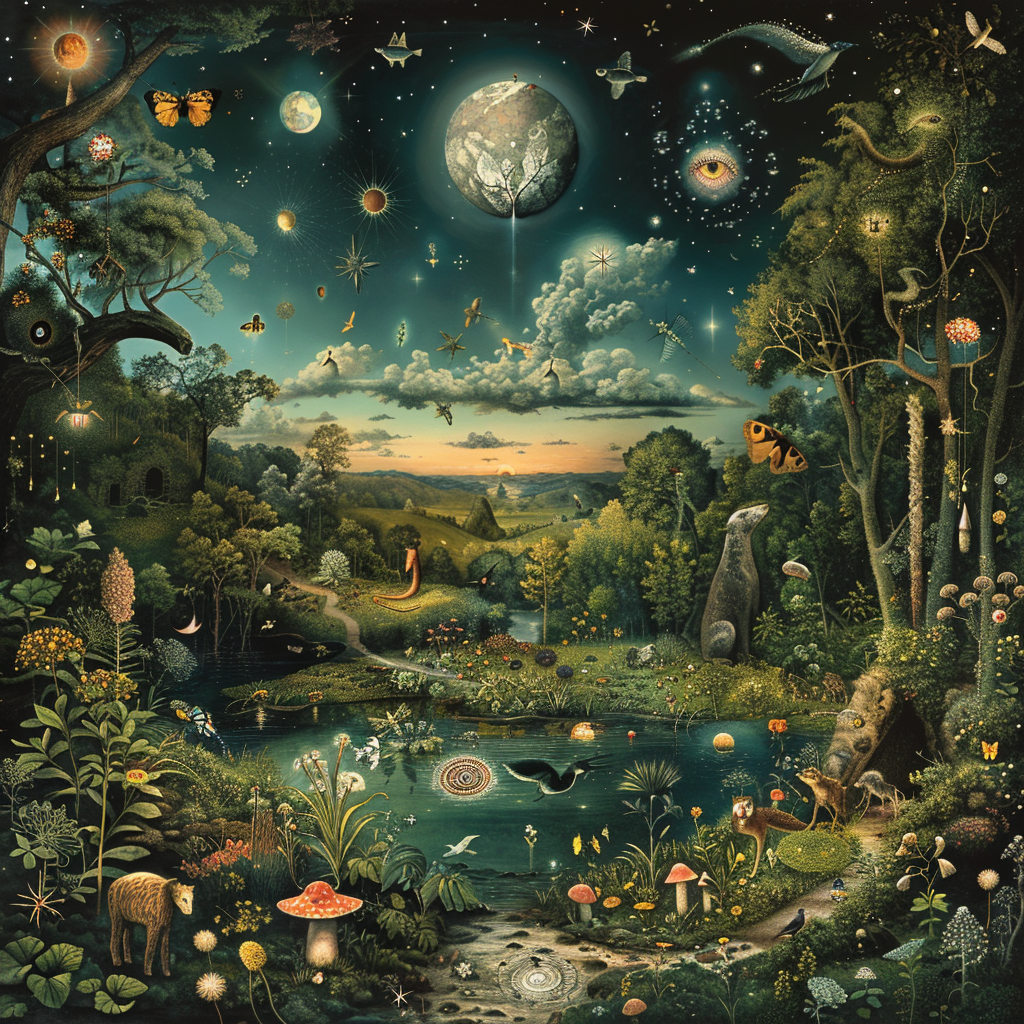
The image you posted looks remarkably like the heaven-side version of one of Bosch’s painting of hell. Bosch’s work is interesting for its metaphoric illustrations but it’s arguable whether it’s great art,
Both still have a kind of cartoon-like quality. Dali’s work kind of skirts the line between good art and plastic-like metaphor.
Looking at DaVinci’s drawings I’ve gets a very different sense of the quality— they have something more authentic about them. These distinctions are, for me anyway, perceivable, but possibly not reducible to linguistic explication. You either see them or you don’t. Though with exposure, over time, you can learn to perceive what might not have been apparent at first glance.
When I first started doing pottery, I was attracted to bright glaze colours and perfectly formed teapots and mugs. Over time I came more and more to be drawn to traditional Japanese pottery with its subtle asymmetries and its infinite subtle colour changes— as if in the subtlety, there are infinities to be discovered. Damn but it hard to figure out how to express this stuff.
-
I think you (mostly) can tell, at least so far, that AI images are created by AI. As an artist, I am trying to think of how to explain this.
First thought is that it is like the difference between a perfectly symmetric ‘assembly-line’ ceramic mug and a hand-thrown or hand built Japanese ceramic tea bowl.
I expect that, to a large extent, AI can eventually be programmed to overcome this limitation, but it isn’t there yet.
The image you posted looks remarkably like the heaven-side version of one of Bosch’s painting of hell. Bosch’s work is interesting for its metaphoric illustrations but it’s arguable whether it’s great art,
Both still have a kind of cartoon-like quality. Dali’s work kind of skirts the line between good art and plastic-like metaphor.
Looking at DaVinci’s drawings one gets a very different sense of the quality— they have something more authentic about them. These distinctions are, for me anyway, perceivable, but possibly not reducible to linguistic explication. You either see them or you don’t. Though with exposure, over time, you can learn to perceive what might not have been apparent at first glance.
When I first started doing pottery, I was attracted to bright glaze colours and perfectly formed teapots and mugs. Over time I came more and more to be drawn to traditional Japanese pottery with its subtle asymmetries and its infinite subtle colour changes— as if in the subtlety, there are infinities to be discovered. Damn but it’s hard to figure out how to express this stuff.
-
AI feels like access to expressive languages I don’t speak natively. I am not a visual artist, and until now I’ve never been able to express myself visually in a way that felt true. AI changes that. It expands my toolbox.
Is the resulting visual art “good”? If it expresses my thoughts or imagination, that’s good enough for me. Expression doesn’t need external validation to be legitimate. It needs coherence with the inner signal it’s translating.
The real problem isn’t that artists aren’t being paid. It’s that we live in a society where survival is a decades-long Hunger Games tournament, and talent is treated as a scarce resource that determines who deserves safety. In that system, creative ability becomes something to defend or monetize, not a mode of play.
What if we valued people and minds for their existence, not their output? What if talent were simply a set of tools for exploration, expression, and joy, rather than a leg up in oligarchic capitalism?


Proudly powered by WordPress | Privacy | © Dr. Michael Levin 2026
Leave a Reply to Joan Trujillo Cancel reply