What groups of embryos know: toward a hyper-developmental biology

Published by

on

The typical way to think about embryogenesis (also metamorphosis, regeneration, etc.) is that a group of cells cooperate toward creating and maintaining a specific anatomical outcome (also known as a Target Morphology for a given species). This requires navigating the space of all possible geometries, starting from an initial state (e.g., fertilized egg cell) and ending up in a specific region of that anatomical morphospace. Importantly, this is not simply an issue of emergent complexity, inexorably rolling down a prescribed path (because morphogenesis has remarkable competencies to adjust for novel circumstances to reach their goal state – just like autonomous vehicles, some animals, etc.).

One interesting question that can be asked about this process is: where does all the information come from – how does the collective know where in morphospace to go (what shape to build)? The typical answer is that it comes from the genome and the chemical products placed into the egg by the maternal organism – that is, it is passed down vertically and each embryo has everything it needs to complete its journey. Frogs, fish, and many other non-mammals do this outside of the maternal organism, and we tend to think of the egg as a self-contained packet of information and resources needed for morphogenesis. Angela Tung (a PhD student in my lab) and I began by reviewing interesting exceptions to this idea – cases where important information and influence arrives “laterally”, not passed down via the zygotic genome and maternal egg products.

Another question you might ask is: what about scale-free/multiscale dynamics – symmetries in how things happen on small and larger scales (e.g., “as above so below”): if chemical networks work together to build cells, and cells cooperate to build the correct body, is that where it stops for developmental biology, or could there be a higher level? My multi-scale perspective predicts that there should be higher levels. For example, that multiple embryos could form a sort of “hyper-embryo”, with its own new competencies and its own path through gene expression and physiological spaces. We tested this unconventional hypothesis and found some very interesting results. This post discusses our paper that just came out on this topic, originally preprinted here and spearheaded by Angela Tung and involving a team of graduate students, undergraduates, and post-docs. The official paper is here, and we discuss it on Curt Jaimungal’s podcast in this episode.

Some fundamental observations in this paper are:

  • Large groups of frog embryos are much more resistant to teratogens (agents that disrupt morphogenesis by confusing cell signaling) than are small groups or embryos cultured alone. This is true even though we scale the teratogen appropriately to large groups (making sure that no matter the group size, each embryo gets the same amount of drug), and it’s also true when we use molecular-genetic stressors (mutant mRNA injections instead of drugs) to target very different pathways – it’s not about drug metabolism, dilutions, or any one specific signaling pathway. We call this effect CEMA – Cross Embryo Morphogenetic Assistance.
  • It’s not just the Wisdom of Crowds phenomenon. Our initial simple model was that every teratogen-exposed embryo is confused about a random part of the information it needs, and in a crowd, they all fill in each other’s informational gaps. That would predict that a large group made up of half stressed embryos and half embryos that never saw the teratogen should do very well, because the pristine embryos should have all the correct information and would be able to instruct their siblings better than ones that had also been stressed could do. In fact what we saw is that it only works if every member of the large group has seen the teratogen. Something more complex is going on, where you have to have had the problem, in order to help others overcome it. We included an agent-based model of embryonic noise and signaling to try to explain the dynamics.
  • We narrowed down the mechanism by 3D-printing tiny little “jail cells” for each embryo so that large groups could be in the same dish of medium but couldn’t touch each other, and similar methods that tested various ways that embryos could use to signal among the group. The bottom line is that it looks like the signal is short-range chemical communication, apparently involving the calcium ion and ATP.
  • We did unbiased transcriptomic profiling, asking which genes are turned on by large vs. small groups responding to the same challenge. We found numerous genes that only activate in large groups, which gives an entrypoint into the downstream mechanisms of CEMA activated after those ‘group repair’ genes are turned on. We found some genes that are specific to large groups (unstressed, normal development) and other genes that are only turned on in large groups (but not small ones) challenged by teratogen exposure. Thus, the hyper-embryo has its own transcriptome that we can now begin to unravel.
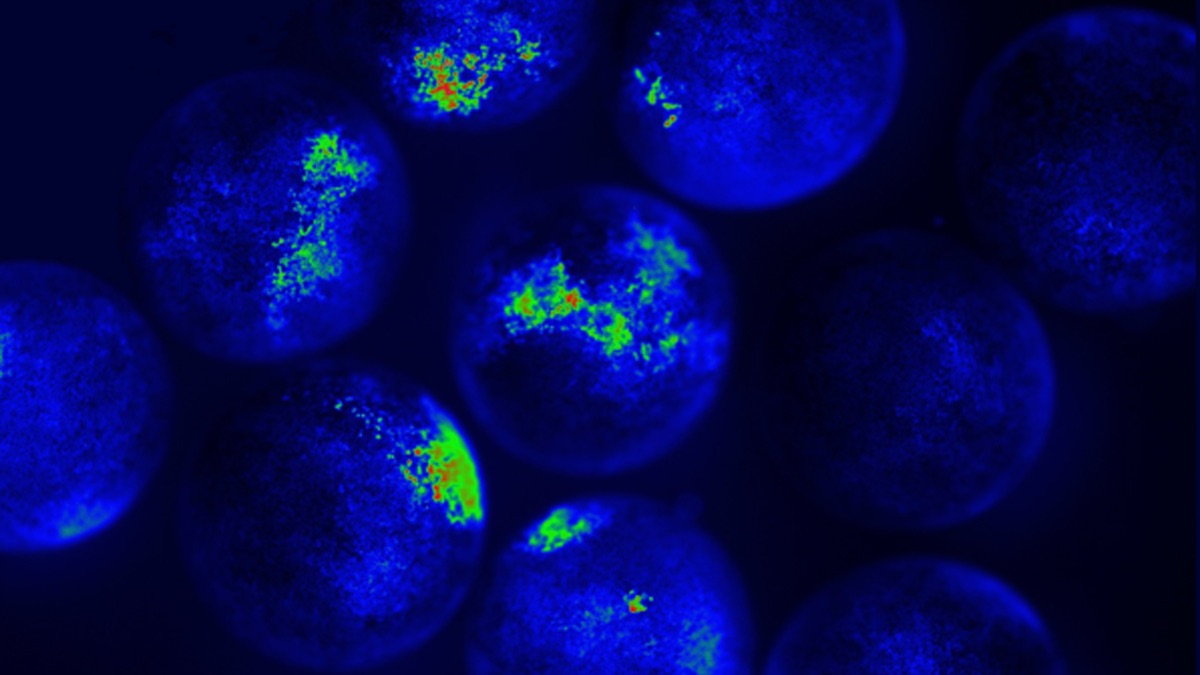
  • We developed an assay to watch the embryos communicate. It’s quite amazing – by tracking calcium signaling (a sort of generic read-out of cellular computations) in embryos that were poked, we can see that the information propagates not only across an embryo, but also between embryos. This is something that has been seen within cells and tissues, by one of the key figures in modern bioelectricity (Lionel Jaffe, his early paper in this book) and modern workers such as here, here, and here. Calcium is a nice generic read-out of cellular information processing. Here is a typical video, where you can see the injury wave within the poked (left) embryo and after a but of time, the right embryo responds:

Here’s another amazing video that Patrick McMillen made a while back, showing information propagating across individual Xenopus tissues separated by aqueous medium, after the left one gets poked:

Some major questions are being addressed next:

  • What are the rest of the mechanistic steps in the communication – besides calcium and ATP, what else is involved?
  • How does the encoding work? Complex information on how to build an embryo head cannot be encoded in something as flat as the local concentration of a signaling molecule in the water. There needs to be more bandwidth; how does it work – is it patterned (in time and/or space) in the medium? These molecules are hard to track directly, they are too small to have tracers put on them without drastically changing their properties. But we have some ideas about how to test the information carrying capacity of this kind of effect.
  • How widely does CEMA extend – what is the range of genetic and biophysical perturbations that it can assist with, and does it work in mammals (i.e., biomedical assays)?
  • Will it work across species, or is it only a within-species effect?

We will soon find out. The big opportunity here is to begin to develop a kind of “hyper-developmental biology”, which seeks to work out the rules by which embryos work together to achieve robustness at the population level (paralleling the standard developmental biology research program which operates at a lower scale). But there are a number of key implications:

  • Tens of thousands of papers that report the teratogenicity level of some chemical or a mutation are in fact reporting the corrected value – the effect size after any CEMA-like processes have exerted corrective influence. This means we don’t really know the true effect size of many of these things, and that future papers have to pay much closer attention to the cohort size when reporting such data. Besides the impact on the published literature, there is a deep issue here which relates to within-embryo repair (regulative competency) as well: evolutionary selection, like scientists, sees adjusted phenotypic fitness after corrections have been made. For us, this results in an under-appreciation of the potency of our perturbations. For evolution, it results in an intelligence ratchet in which subsequent advances target the repair machinery more than the structural genome (see this paper).
  • What if we could artificially fake CEMA? What if, for a singleton human patient, we could provide whatever signals one might normally get from a group of organisms, to help healing, or resistance of aging/cancer/degenerative disease?
  • More fundamentally, what does this mean for the genotype-phenotype map? In other words: the amazing robustness of development is not simply due to the vertical competencies of the genomically-provided hardware. Important aspects seem to be lateral, a function of the parallelization of the physiological software running on many embryos at the same time and sharing information as a collective.

There are many papers that can now be seen to be relevant to the CEMA topic in ecology, plant biology, microbial biofilms, etc. Even stem cell biology has relevant phenomena, where many cell types simply do not survive alone in a dish, even though their metabolic needs are provided for. It’s nice to see that vertebrate embryogenesis does not escape the symmetry of collective intelligence. The relevance to multi-human groups (e.g., social buffering of medical states or Kangaroo Care of human infants) remains to be explored. My guess is that there will be deep connections to neuroscience and to emerging theories that tie together evolutionary and cognitive change.

35 responses to “What groups of embryos know: toward a hyper-developmental biology”

  1. chris m Avatar
    chris m

    thank you so much for taking the time to explain your mind-expanding research to the lay-person. my mind will be tripping on this all day 🙂

  2. frank schmidt Avatar

    Shades of Sheldrake?

  3. Mike Levin Avatar
    Mike Levin

    In this case, there is no evidence that we need any exotic physics (as in Rupert’s proposal). The mechanics seem to be well-explained by traditional modalities (chemical signals through the water).

    1. Bob Averill Avatar

      That said, can we project from your findings that the chemical signaling opens/closes calcium ion channels to change the bioelectric patterns in embryos, similar to how neurotransmitter chemicals in the brain cause specific neurons to fire and generate synchronous cascades of electrical waves that can be picked up by EEG devices? If so, then does ”mind” also appear to reside in the electromagnetic spectrum somehow for cells and brains???

      1. Mike Levin Avatar
        Mike Levin

        That is likely, and we’ve shown proto-cognitive (e.g., basal forms of mind) features encoded in bioelectric networks within embryos before. Not so much magnetic (as far as our existing work goes; who knows what happens in the future). Definitely the morphogenetic collective intelligence of cells partly resides in their bioelectric network dynamics. It may well spread between embryos, this is what we’re studying. I suspect it’s a hierarchy of many diverse, interpenetrating minds of different scales. We have papers describing this idea in more detail.

  4. Mathieu Hautefeuille Avatar

    I really like this. It resonates on so many levels with my thoughts and research projects. So inspirational!
    I would really like to take the time to discuss some with you at some point…

    By the way, I have just started my semester course on Developmental Biology and I will definitely talk about this work at the end. We are also reorganizing the syllabus and I hope to formally include your work in the next version (it’s a department wide course with multiple professors and common exams).

    1. Mike Levin Avatar
      Mike Levin

      I’d be happy to talk to you, and I can provide materials on all this for your students. That is where the impact is made – on the young people who are still plastic and able to think via multiple world-views. Email me at my Tufts address, I’ll get you whatever you need for your class and we can chat.

      1. Mathieu Hautefeuille Avatar

        Thanks a lot. I will…
        I just need to organize my ideas first not to waste your time. But I will contact you.

  5. Benjamin L Avatar
    Benjamin L

    Is it known how one embryo benefits by passing useful signals to another embryo? I would think, all else held even, sending these signals is an undesirable expenditure of resources, so there must be some reason the individual embryo wants to do it.

    1. Benjamin L Avatar
      Benjamin L

      I suppose that “Injury induces an internal calcium wave and increased ATP release from the injured embryo. The fact that suramin or PPADS both block the calcium wave in neighboring intact embryos and, blocking P2 receptors prevents a calcium response, suggests that ATP released from injured embryos binds to P2 receptors on the surface of neighboring embryos, triggering the secondary calcium response in uninjured embryos (Fig. 9)” is the answer, which suggests that the individual embryo does not intend to help others, but happens to behave in a way that results in useful signals that other embyros can exploit?

      1. Mike Levin Avatar
        Mike Levin

        well, “intend to help” is a sticky issue. What counts as intend to help? If you look at ants cooperating to lift a heavy insect and carry it, or humans cooperating in maximal examples of selfless altruism, someone can always take the mechanistic stance, point to the chemistry layer, and say “no one is intending to help anyone, it’s just the inevitable rolling out of chemical laws”. Am I claiming the embryos have a metacognitive loop that allows them to know they are helping each other? Absolutely not. Do I think that selection can act on (and favor) mechanisms that enable the whole (kin) group to prosper? yep. And I think these mechanisms are easy for evolution to operate on because the material is primed to communicate and scale computationally.

        1. Benjamin L Avatar
          Benjamin L

          Put simply, is the idea that each embryo treats each other embryo as the environment, and so tries to render each other embryo predictable to itself by sending signals that make the other embryos more similar to it, which necessitates communicating information about how to adapt to teratogens? Alternatively/equivalently, does each embryo try to render itself more predictable to the environment by communicating information about itself? Or is that totally off-base?

          1. Mike Levin Avatar
            Mike Levin

            That makes sense, it’s the Fristonian perspective. We used it to try to explain multicellularity: https://www.tandfonline.com/doi/full/10.1080/19420889.2019.1643666

  6. Benjamin L Avatar
    Benjamin L

    Around 50:27 in your interview with Curt Jaimungal, you express skepticism that a single number can provide enough information for an embryo to properly update with respect to teratogens, if I’ve understood the discussion correctly. Let me push back on this.

    Consider an analogy to the price system. Suppose that, e.g., a farm experiences a “teratogen” that interferes with expected development, such as a disease that wipes out a crop. Then, based on prevailing prices, there will be less of that crop than expected by the many crop-consumers in the world, and so they will try to buy more of that crop than is possible, resulting in a shortage and the failure of other plans. This is corrected for simply by updating a number, that is, by raising the price of the crop. Passing along this single updated number suffices to correct everyone’s plans so that everyone is behaving as they should with respect to the problem created by the teratogen.

    The way this works is that people have the ability to adjust their behavior and adapt to various problems to fulfill their plans. Given this capability, the updated price signal tells people, “Hey, your current plan fails based on new information, adjust your plan to be in line with the new shared model as indicated by the updated price.” In principle, as long as humans are smart and resourceful enough to adapt to any problem, this passing-along-of-single-numbers can suffice to address any teratogen.

    Of course, the “body” created by (ordered/structured by) the price system is far more abstract than that of an embryo, but I believe the underlying mathematical structure similar. Is there a particular reason to think that an embryo needs to be given specific “head morphogenetic data” beyond a single number that updates a shared model?

    1. Mike Levin Avatar
      Mike Levin

      Good points!! I’m happy to have new ideas about how this might work. The question is, can this model explain the information content needed to form a complex head. On the one hand, there may well be very few variables in a generative model that creates a complex morphology. But can it really be just one (like price/concentration)? In your analogy (if I understand it correctly), the output is a scalar – a single number related to crop price/availability. What if we needed to control several independent parameters – can that be done with a single scalar signal? It’s fine if much of the complexity is offloaded to the agential machinery at the ends of the communication chain, no problem. But can the “bow tie” communication node really be just 1 number?

      1. Benjamin L Avatar
        Benjamin L

        These are interesting questions, I’ll have to think about them more. I believe that analogies between economic and biological phenomena should be enlightening, but figuring out the details may prove to be a complex project.

        In principle, I believe we can be confident that a system that is isomorphic to the price system can efficiently adapt to any perturbation by adjusting numbers in relation to each other, so that the resulting shared model always reflects all of the true, relevant information available to all agents who constitute the system. However, the task of using the model to adapt is indeed offloaded to the intelligent, capable humans who use prices to make decisions.

        I don’t know enough about biology to anticipate whether cells ought to be able to construct and make equally adept use of a similar system through their signals with each other, nor what the morphogenetic task might look like if governed by such a system.

        Maybe part of the intuition is that a single number updates the entire system? If you change the price of tomatoes from $1 to $2, then the relative price of every other vegetable is changed as well. E.g., if cucumbers cost $2, then they have gone from being worth two tomatoes to being worth one tomatoes. Possibly there’s a biological analogy where a single change of number makes one plan less salient, and another, very different plan, more salient, such that a change of a single number can result in a big difference in morphogenesis?

        Good food for thought, no pun intended….

        1. Benjamin L Avatar
          Benjamin L

          Basically, a change in prices says, “If you want to do X, that will be harder now relative to other plans, but if you want to do Y, that will be easier now relative to other plans.” Given an agent with lots of capabilities, a change in prices can produce remarkably adaptive behavior.

          1. Mathieu Hautefeuille Avatar

            Interesting! You could also see all this under a different perspective: what if everything that we see happening, all dynamics, are results of some kind of competitions between quantities (some impelling and some impeding), like in physics? It would of course mean that nothing is an agent really, it’s going away from Prof. Levin’s ideas… but could it be complementary?

            This has been the object of part of our research in Physics. And it explains a lot of behaviors of non-active matter, from explosions to droplets.

            Of course, Biology is more about “active” matter. Time is very different in biology, compared to physics (maybe just a problem of timescale and perception that make us believe nothing stays still!).

        2. Mike Levin Avatar
          Mike Levin

          Definitely interesting, since we look for such “master regulators” in the biology all the time. We’ve even found some bioelectrical properties that act this way.

  7. Aren Rodriguez Avatar

    I loved interacting with what y’all discovered. These discoveries challenge and alter my beliefs and add to my vision (in what I would call beautiful ways). The way I see, live, and approach life has grown because of you and others in your circle.

    Thank you for letting the world know because this is some juicy stuff!

  8. fleeky Avatar

    hi there ,
    i was wondering if its possible for dr levin to add this to the website :
    https://wordpress.org/plugins/activitypub/

    its an activitypub plugin that would allow a large scientific community on mastodon to more easily see and discuss this amazing research!

    thank you and really find all of this research mind blowing !

    1. Mike Levin Avatar
      Mike Levin

      Interesting idea! I will investigate and we’ll see if that’s doable. I do have a Mastodon account (https://fediscience.org/@drmichaellevin) but don’t have time to engage with all the different platforms, so it would be nice if it could be made easier. Question: if this creates a new account, how will anyone know to follow it? Will it still be useful if I have no bandwidth to promote it?

      1. Mathieu Hautefeuille Avatar

        Honestly at first I thought that I wouldn’t be able to interact on your blog (oh no, another platform to go to…) But I think I found my way to do it properly.
        I don’t think it’s necessary.

        I am also ready to transition away from X but went to Bluesky… the move hasn’t been made by many

  9. Twistopherrobin Avatar
    Twistopherrobin

    A tangent. We typically think of a Self (specifically a human Self) as being confined to a body: One Self per body. What I’m only now understanding (barely, if that) of your work is that there are multiple-multiple Selves within each of us. That addresses the, if you will, “intra” domain. What about the “inter” domain? Might there be a “field of Self” that extends beyond our physical bodies? If this question is not precise enough, my apologies. To quote the great Gil Scott-Heron, “I’m new here.” Thank you.

    1. Mike Levin Avatar
      Mike Levin

      Yes; people like Andy Clark (Extended Mind Thesis) and others do think about this kind of thing – there’s good work on it at the behavioral/cognitive level, and we’re now finding it in other spaces (like morphogenetic).

  10. Epee du Bois Avatar
    Epee du Bois

    Thanks so much for sharing your work. I am always inspired by your care and attention to the slow work of overturning established knowledge.
    Donald Winnicott’s remark, “ There is no such thing as a baby” comes to mind. As for the comment that wants to see a correlation with price signaling as an equivalent to calcium ion signaling, and in doing so, sees a kind of master driver, governing system wide changes, it is worth remembering the great heterogeneity of signal processes that babies, mothers and their environment deploy to maintain homeorhesis. No morphogenesis without semiogenesis.

    1. Mike Levin Avatar
      Mike Levin

      “No morphogenesis without semiogenesis.” – great!!

    2. Benjamin L Avatar
      Benjamin L

      Thanks, I’ll look up semiogenesis.

      1. Epee du Bois Avatar
        Epee du Bois

        There is some precedent to this in economics. It was called the socialist calculation debate. Here is a link.

        https://en.m.wikipedia.org/wiki/Socialist_calculation_debate

        And this paper from a couple of years ago tries to update some of these terms that correspond to Dr. Levin’s tracking of intelligence across differing scales.

        https://www.its.caltech.edu/~matilde/ScaleAnarchy.pdf

        All of this is honestly beyond my pay grade, but part of what is exciting about this work is the way it refuses to reduce life to single drivers and opens on to a methodologically coherent way of working with complexity.

  11. Tony Jelsma Avatar
    Tony Jelsma

    Thanks for this fascinating and instructive paper. The protective effect seems to be specific to the teratogen, as shown by the lack of effect in the mixing experiments. The paper also showed that the mechanism seems to be the release of ATP, activating a calcium response. But those experiments were done with thioridazine. If the protective effect also works with nicotine (Fig. 3d), must there be a different protective signal that is released? How many of these could there be? I might have missed that in the paper.

    1. Mike Levin Avatar
      Mike Levin

      Thanks, it’s a good question. I’m not sure it has to be a different mechanism for each insult, it may be different “how to fix” information encoded by the same mechanism. We next need to figure out how ATP/Ca++/whatever can carry rich morphogenetic info, and if it can do that, perhaps it can also carry different variants.

      1. Mathieu Hautefeuille Avatar

        ATP and calcium signalling are found in some regeneration of organs (at least I know about the liver) and purinergic signalling is triggered in bone regeneration and vessel walls under high shear/pressure.
        Celeste Nelson recently wrote a review paper on the role of ATP in morphogenesis. This is very interesting to follow…

        1. Mike Levin Avatar
          Mike Levin

          great point! I will look it up, Celeste always does good work. What you are emphasizing is that mechanisms of regeneration within an organism are repurposed to improve the morphogenetic journey at the higher scale of the group. I like it!

          1. Mathieu Hautefeuille Avatar

            This is what I will contact you about by email in the following days. 😉

  12. […] of the brain helps protect the embryo from various disruptors of morphogenesis. The brain joins CEMA (cross-embryo morphogenetic assistance) as one of the many positive influences that complicate the question of “how harmful is a […]

Leave a Reply

Your email address will not be published. Required fields are marked *