Meet the Anthrobots: a new living entity with much to teach us

Published by

on

Have you ever wondered what the cells of multicellular organisms are really capable of? We know what they normally do in vivo, building default, familiar tissues and organs under the influence of their neighbors during normal embryogenesis. But what would they do if allowed to reboot their multicellularity – if liberated from the control of other cells that shape their behavior, and allowed to express their baseline forms?

This is a story about a path that could lead to personalized medicine using your own normal adult body cells; it is also a story about a platform for addressing the genome:anatomy:behavior relationships, and for facilitating experiments in diverse intelligence research.

Take a look:

Anthrobots: a synthetic biological proto-organism made of living cells with a wild-type (un-edited) genome

What would you guess this was? Looks like an organism we fished out of a pond somewhere. What if I told you we know what its genome is. It’s Homo sapiens. 100% human, with no genomic editing or exogenous synthetic biology circuits.

But we know what the Homo sapiens genome can build, don’t we? Well we know what it usually builds; but that’s far from the whole story. I’ve talked before about how things like plant galls teach us about what novel things cell collectives can be hacked to do. And, in the Institute that Josh Bongard and I lead, our team has asked the broader question by creating Xenobots – motile biobots made of frog embryo epithelial cells which do things like create copies of themselves using loose cells they find lying around in their vicinity.

But one thing some people said about Xenobots was that it was kind of a specialized result: these are amphibian, embryonic cells – known to be plastic. Maybe this is a unique thing frog embryo cells do, irrelevant to the broader issues of genomes and functional anatomical order. Especially since, “animal caps” – pieces of frog embryo epithelia that have functional cilia (little hairs that move) have been studied by developmental biologists for decades. Maybe this is just an animal cap; why call it a Xenobot?

And here we see why terminology is crucial. Terminology expresses the mindset, the mental lens through which we see something. It is observer-dependent and strongly constrains or enables the things that we can do with any system; by choosing a term, you are not picking out an objective unique truth, a single correct categorization for something. You are making a claim about the conceptual and practical toolkit that you will use to move forward. If you think of Xenobots as “just animal caps”, what you are likely to do is study their normal developmental and cell biology, and perhaps use them to study airway diseases and disorders of the mechanisms of cilia. What it does not facilitate is creating Anthrobots, characterizing their autonomous behaviors, and finding out what they are capable of in novel interactions with their environment (see below). That requires thinking about cells and tissues in terms of their plasticity in general and the use of their collectives as a biorobotics platform with top-down (not micromanaged) control. Are Xenobots animal caps? Yes. Is that the only, or the most interesting framework with which to understand them? No. Thus, to illustrate the broader opportunity, the next step was to go as far away from embryos, and from amphibians as possible, to find a truly surprising example that illustrates the point of plasticity and self-assembly. So we made (or rather, facilitated the self-organization of), and then studied the behavior of, Anthrobots – autonomous biorobots built from adult (often elderly) lung epithelial cells.

Now, other people have made airway organoids before (for example, Walter Finkbeiner’s and Charlie Ren’s work). In fact organoids is a huge field with many people building spherical constructs made of patient cells. But most of these organoids have a kind of “locked in syndrome” – they sit in place generating physiological data that can be used for drug screening and cell biology, but they are not able to move around and reveal their functional behavior. We focused on them as individual proto-organisms, made them of cells that have cilia (and thus could perhaps move, if they coordinated their beating activity), carefully characterized their behavior types and anatomical classes, and asked what they can do if given a chance to interact with other tissue types.

It’s all detailed in this paper, which was first preprinted over a year ago. The first author is Gizem Gumuskaya, a very talented PhD student in my lab (with interests spanning architecture and the new world of synthetic morphology) who developed the protocol for enabling these constructs and studied their behavior. Our collaborator is Simon Garnier who, among other things, came up with algorithms for the quantification of form and function. And, to my delight, the paper has a number of undergraduate authors – Tufts students (some of whom have now moved on) who participated in the work.

Here are the highlights. The Anthrobots self-assemble from a single cell:

Our protocol causes them to evert themselves – turning inside out so that the cilia can point outwards and row against the water in which they live. Rowing in specific patterns an in unison, they then exhibit a variety of behaviors, in sequences that can be visualized as a sort of ethogram, showing transition probabilities between discrete behaviors like that described for animals such as fish for example:

Here are some more videos:

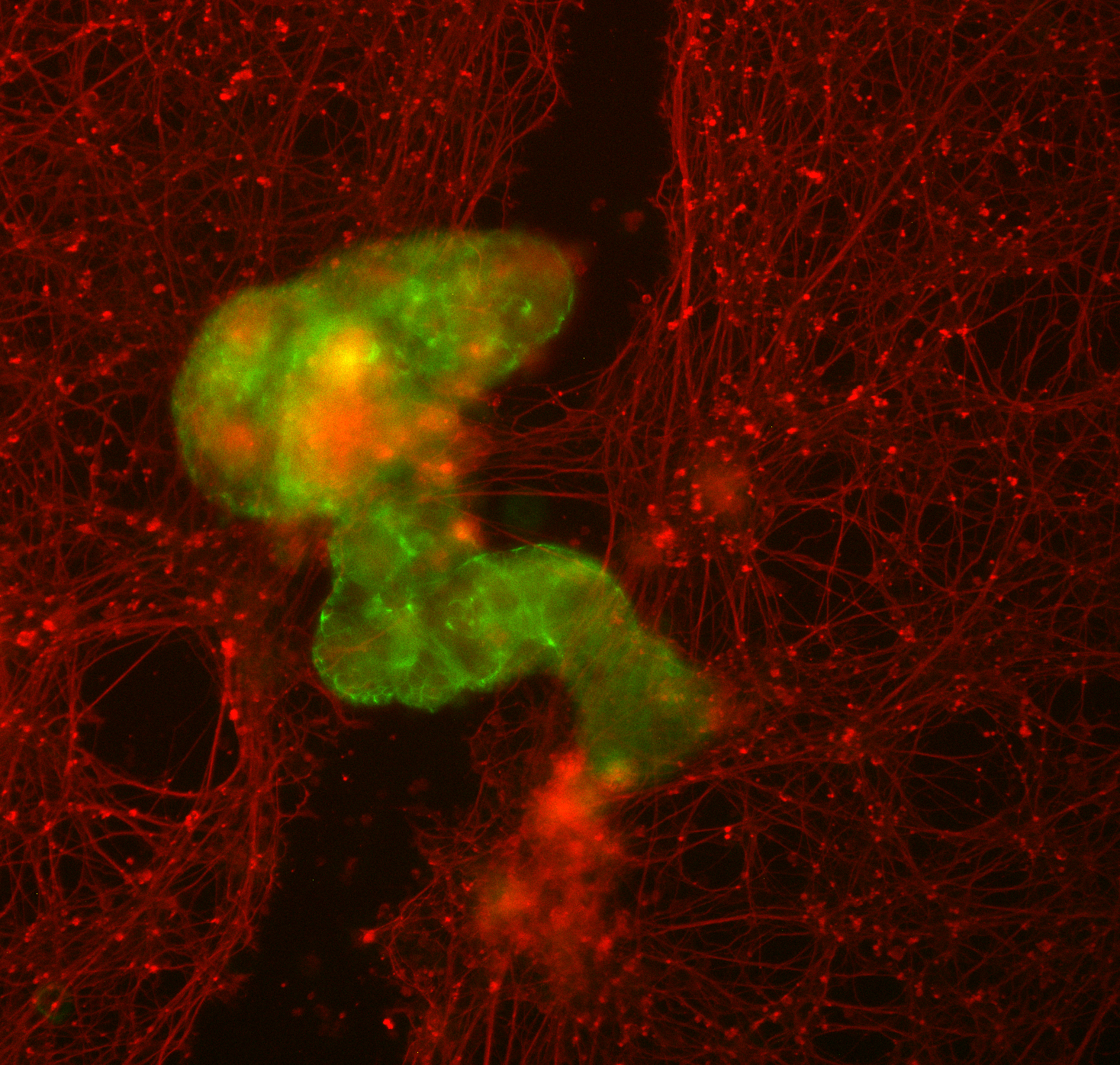
We found that their various behaviors are also related to their shape and distribution of cilia (they come in several discrete morphotypes or classes). But perhaps the most amazing behavior we’ve seen so far is what happens when you let them interact with an induced gap in a neural tissue (a 2-dimensional layer of human neurons grown in a petri dish, scratched to mimic a very simple version of a wound):

As single bots, they traverse the scratch. But if allowed to assemble into a “superbot” cluster, and placed in this environment, they can induce the neural cells next to them to grow across the gap – they push the neurons to heal across the scratch “wound” (or do the neurons use the bot to complete their repair? We will identify which side is the driver). We don’t know how exactly they do it yet, but we know it’s not simply mechanical (passive material used in their place doesn’t cause the effect). My personal hypothesis is that the bots are enabling the cells from each side to know that there’s something on the other side for them to connect to. We don’t know this yet, but we will test the hypothesis that they can work as an active communications pathway (perhaps bioelectrical) by which cells and tissues can talk to each other. Note from the images below that the new neurons don’t just grow under (in contact with) the superbot – they also appear in spaces between the bots (the second image shows what it looks like after the bot has been removed).

Anthrobots (green) causing knitting of a scratch defect in a 2-dimensional field of human neural cells (red).

We envision many future uses in the human body – laying down pro-regenerative molecules, clearing plaque from arteries, healing spinal cord or retinal damage, dealing with cancer cells or bacteria in the gut, or informing us of the status of the surrounding tissues. It’s crucial to note that the effect we saw – healing the neuronal scratch – was not test #78 out of hundreds of things we attempted. This was one of the first assays we tried. Thus, I suspect that we didn’t just luck onto the one thing they happen to be able to do – I think this is probably one of a myriad of unexpected things that Anthrobots (and other biological constructions) can do in the context of other tissues. Also important is the safety factor: unlike transgenic bacteria, viruses, and genetically-modified plants and animals, these biobots have a wild-type genome and do not exponentially reproduce and just biodegrade at the end of their lifespan (measured in weeks).

One interesting thing to note is that as a possible medical intervention, this technology is at a higher level of competency than for example drugs, which have a prescribed but fixed molecular interaction with some target(s). Biobots are made of cells which have a myriad different natural sensors on their surface and machinery for information amplification, decision-making, memory, and other types of context-sensitive behavioral controls. We do not know yet (but are studying) what their behavioral repertoire is but it’s quite likely that if we pay attention to what the cell collectives are telling us, we will be able to reach a much more sophisticated level of control of processes in the body by using technology that is itself not passive, hardwired devices but flexible agential materials that share our body’s priors about health and disease.

This conjecture is the flip side of my claim that physics only sees mechanisms, not minds, because it uses low-agency tools (voltmeters and rulers and such), and that higher-agency detectors (i.e., other minds) are needed to detect cognition at various levels. Perhaps the same is true for functional control; maybe complex system-level outcomes (e.g., health), that are hard to ensure with simple mechanical (bottom-up) stimuli like drugs, can be reached via symbiosis and communication with tools like Anthrobots with more of their own collective intelligence. Of course this is, at this point, speculation to be tested. And, we are not making any claims about their agency or problem-solving potential – the degree of their competency in physiological, anatomical, behavioral, and transcriptional spaces is an empirical question which we are in the process of addressing. We don’t know yet what they are capable of, but the idea is that as we learn to program them, we will use not only bottom-up familiar tools of synthetic biology but also top-down controls (training and re-writing of set-point memories) that take advantage of higher levels of organization that may exist in this system.

What is the Anthrobots’ status? They are certainly alive, but are these proto-organisms? machines? biological robots? products of bioengineering? natural forms? Yes. They are all of those things, because none of these words have (useful and deep) binary definitions, but rather express a variety of vantage-points across a continuum. By taking each of these perspectives, and the terminology that drives it, we see a different part of reality, focus our attention on a different aspect, and thus enable/prevent specific next discoveries.

I see the Anthrobots (and synthetic morphology in general) as an exploration device, with which to begin to understand plasticity of the software of life, to probe the competency of the agential material from which are constructed, and to start to map out the region of morphospace and behavioral space around the default outcomes facilitated by the genomic hardware under standard conditions. I think they are also a new platform for the fields of regenerative medicine, evolutionary developmental biology, and diverse intelligence (basal cognition). Importantly, we have made no claims yet about their degree of intelligence – we simply don’t know yet whether they can learn, and if so, in what capacity, but we will find out. Perturbative experiments are necessary to get a true idea of their capabilities in various problem spaces.

What’s next? Many things. First, unlike current Xenobots, Anthrobots can be made in bulk, in whatever quantities are necessary. Second, being made of the patients’ own cells, their use in the body won’t require immunosuppression – think personalized medicine. So, we are now investigating:

  • how exactly do they knit together neural scratch wounds? what, if anything, are they saying to the neuronal cells?
  • what other beneficial functions might they have in damaged tissues of different kinds?
  • can they be used as avatars for screening drugs that alter behavior, not just morphogenesis?
  • what are their proto-cognitive properties? can they learn from experience? do they have behavioral repertoires in complex environments? preferences?
  • can we learn to program their form and behavior – how much control, and by what stimuli, can we exert? in other words, what does the option space look like, around the pinpoint of Homo sapiens morphology that evolution and normal development reveal by default?
  • what other cells can these be made of? what if we make them chimeric with other body cells, or give them a microbiome, or instrumentize them with optical or electronic readouts of their internal states?
  • what is the role of bioelectricity as an interface to modulate their morphogenesis?
  • how do Anthrobots interact with bacterial, immune, and cancer cells?
  • what are the transcriptomic and proteomic consequences of their new lifestyle?
  • and much more – stay tuned, all of these experiments are under way.

So, next time you think about your body cells, quietly sitting in their tissues, you might wonder: what else are they capable of, if we were to let go of our tight focus on the genomic defaults of the hardware and gave them a chance to express new branchpoints of the software of life to see what journeys in morphospace, physiological space, and behavioral space they could undertake?

And one last thing. In the ancient biblical story, illustrated in the famous etching below, it was up to Adam to name the animals – not God, not the Angels, Adam had to do it (I guess that it’s in part because he was the one that would be living with them – an embedded observer, and in part because as one of them, he would have a unique ability to comprehend their bodies and minds in a kind of resonance that the Celestials would not have). I think this was pretty prescient, because “naming” a thing means to discover fundamental aspects of its true and deep nature. And in the coming decades, we humans are going to have to “name” and seek to truly understand a very wide variety of new forms that have never existed before.

Adam naming the creatures in the Garden of Eden.

The “scientific version of the Blind Men and the Elephant” image courtesy of Jeremy Guay of Peregrine Creative. The biological images were produced by the co-authors of the Anthrobot paper and taken from that paper and the supplemental material.

42 responses to “Meet the Anthrobots: a new living entity with much to teach us”

  1. Matt Avatar
    Matt

    Amazing stuff.

    1. Matt Avatar
      Matt

      Are they also engaging in mechanical reproduction ?

      1. Mike Levin Avatar
        Mike Levin

        We don’t see it happening yet, but we may be able to find conditions under which it can be induced.

        1. Matt Avatar
          Matt

          Do you think cells from different species have different level of competency? Like would a human cell be more competent than a cell from a frog for example. I remember reading somewhere from you (maybe), that you thought evolution might select for competency or agency; I understood it like evolution might select for biological components that might be more able to solve problems on their own. Thus wondering if more “complex” systems like humans would be made of cleverer cells basically 😀

          1. Mike Levin Avatar
            Mike Levin

            Excellent question. We don’t know yet. We will find out though!

  2. Teja Avatar

    Wow, this is massive and mind-blowing! <3

  3. Hank Liliënthal Avatar
    Hank Liliënthal

    Wauwie………combined with a Q*-like AI, your team will hit a plethora of possibilities. CHAPEAU!!

  4. Anthony Rockel Avatar
    Anthony Rockel

    Truly exciting and inspiring!

  5. Karen Wong Avatar
    Karen Wong

    Did you choose epithelial cells because of their natural ability to heal wounds?

    1. Mike Levin Avatar
      Mike Levin

      No, because tracheal epithelium has cilia (one of the few body tissues that has motile cilia) which will make it easy for them to show us their behavior (self-directed swimming).

      1. Karen Wong Avatar
        Karen Wong

        You’ve probably already seen this regarding the basal cells of the mammalian airway:

        Tata, Purushothama Rao, Hongmei Mou, Ana Pardo-Saganta et al. (2013). “Dedifferentiation of Committed Epithelial Cells into Stem Cells in Vivo”, Nature vol. 503 (November 14), pp. 218-23. doi:10.1038/nature12777

  6. Prof Mick Thacker Avatar
    Prof Mick Thacker

    I think that this is some of the most ground breaking science around at the present time, especially as you and your team collaborate widely and bring a big perspective to your work!

  7. Lio Hong Avatar
    Lio Hong

    Cool to get a heads-up on this work continued from the xenobots. Morphotype 3 with its polarised cilia localisation pattern reminds me of E.coli with its nanobrain of chemoreceptors, though maybe less sophisticated.

    I am curious as the anthrobots were stated to grow from a single seed cell i.e. via clonal development while the xenobots were aggregated and sculpted. I’m assuming this was to explore potential self-assembly mechanisms, but then the anthrobots were fused together into “superbots” for the application part of the paper.

    Could I ask why the fusion was necessary, and how the application of neural healing was chosen?

    1. Mike Levin Avatar
      Mike Levin

      Right now the difference is because the two types of cells act differently by default; Anthrobots naturally replicate from a single cell – we don’t yet know whether they can be aggregated (although whole bots can be aggregated into superbots).

  8. SONALI SENGUPTA Avatar
    SONALI SENGUPTA

    Fabulous.

  9. Ralph Mayer Avatar
    Ralph Mayer

    I know your lab is looking for a math/physics type but I’m already putting this out there for free, much like you are. May I take a shot at offering you a new language, type theory? I’ve been using Latin for article titles because that is how we name types. Type theory describes an object that has a certain amount of degrees of freedom, some of them taken up by traits. Degrees of freedom are conserved. One or more type objects can share a degree of freedom each to benefit in environment. This is entanglement in type theory. The gain in environment is offset by the loss of self reference. The type object becomes a group effect through shared degrees of freedom. A caterpillar becomes a rolling swarm of caterpillars by sharing where they put their feet down with each other instead of the environment ( ground ). Driven from behind.
    By turning your cell inside out and exposing the cilia, you took the internal degrees of freedom normally not available and made them external. Each cilia is a degree of freedom. This is much like in chemistry where the outermost particle provides the trait information. You turned the nucleus inside out and exposed internal entanglement and maximized its entropy. That’s why most of them are scooting around.
    That’s what’s nice about type theory; it works with any scale and ties scale together. Hydrogen bonding is another example. The two degrees of freedom of the electron is usually one because of its spin, which usually precesses but can share its degree of freedom with another electron instead. This becomes superconductivity at low temperatures and is called Cooper pairing.
    Repairing neural tissue is the anthrobots entangling with either side of the scratch with their degrees of freedom. You need a group to share their degrees of freedom. This lets the cells know where they are and what’s missing. Spatial aspect. Your anthrobots get their degrees of freedom back as the nerve cells regrow into place. And their full identity. Stem cells seem to need to know location too. So they can take on their new role from the surrounding type tissue’s identity.
    The perfect language to model your anthrobots. Other things too.

    1. Mike Levin Avatar
      Mike Levin

      This is quite interesting. I wonder how this relates to category theory and some ideas in computer languages. Please email any links if you know of basic introductions to these ideas. thanks!

  10. Benjamin Anderson Avatar
    Benjamin Anderson

    Love this format for quick sharing of results + how candidly you can address criticisms of prior work such as the Xenobots being made from already plastic cell types as to why you did the follow-on with epithelial cells.

    Also this is one of the longer form posts you’ve shared so far on ongoing work and just the language of the text is easier to read than the more rigid academic tone for publications.

  11. Alberto Molano Avatar
    Alberto Molano

    Read the paper, Incredible.

  12. Bob Averill Avatar

    Congratulations on the Nature article, too! Hitting the big time!

    https://www.nature.com/articles/d41586-023-03777-x

  13. Michael Wright Avatar
    Michael Wright

    These may seem like starter questions as I’m not a biologist myself but how do you go about keeping these things alive? Why don’t the cells just die as soon as they are removed from the body environment? Do you have to feed them? Are they kept in some sort of warm nutrient broth?? Could they survive in the cold, mean world? How elastic do you think our genome could be without mutation? Given enough time do you think they could evolve into a wholly new macro organism with the same genome?? Again sorry if these are silly questions, I’m no scientist I’m merely a curious layman.

    1. Mike Levin Avatar
      Mike Levin

      Look up “cell culture” and “tissue culture” – the nutrients are in the medium in which they live (and yes, it’s kept at human body temperature). They will not evolve (at least in their current implementation) because they do not expand their numbers (reproduction, necessary for the evolutionary cycle to go).

  14. Turil Cronburg Avatar

    You talk a lot about programming these little beings, and I’d suggest instead maybe thinking about using terminology that reflects that we’re collaborating with them. The collaborative framing helps us see that we can work with nature to serve multiple needs/goals simultaneously, instead of competing against or controlling nature/others in ways that might not be beneficial to everyone.

    I know it’s a small difference on the surface, but when it comes to the larger connotations of science and ethics, it makes a large difference, I think.

    1. Mike Levin Avatar
      Mike Levin

      You’re preaching to the choir. I have a bunch of papers where I have said exactly this, and it’s why I catch flack from some mechanistic reductionist folks. My framework is all about this – recognizing and collaborating with unconventional intelligences all around (and within) us. But let’s not be naive: just collaborating with nature, by itself, is absolutely no guarantee of anything being “beneficial to everyone”. Nature, by default, definitely does not optimize for everyone, nor for multiple goals we would find laudable. In collaborating with it, and using our minds to help guide things, we can do way better. So yes, programming has its place too, but it’s absolutely not the only frame. There is a wide toolbox, which is what my TAME framework is about.

      1. Turil Cronburg Avatar

        Yes, I deeply appreciate you talking about the diverse types of impressive problem solving that even single cells are capable of!

        And I know it’s not common to think of nature as having a direction for increased effectiveness/efficiency in serving life’s needs, but in my own research on systems and development, I’ve seen that evolution (entropy) is overall moving things in that increased-health direction. Of course, evolution is slow and complicated, but from what I’ve seen of the math, all the different processes in the universe do tend, on average, to become more collaborative over time. Specialization becomes standard, such that more and more individuals end up doing their own weird thing, and a whole system emerging “unpredictably” as an impressively creative multi-individual-collective.

        There are indeed no specific guarantees, but on AVERAGE, there are high probabilities of effectiveness over time, and the more we intentionally try to serve “everyone’s” needs (at whatever level we are able to account for), the more effective the outcome will be in the long run.

        Of course, I do understand you limiting your personal thoughts on some of this, and being cautious with your language, so that you’re less likely to be dismissed outright just because of some unpopular linguistic details. I’ve certainly been there, and I’m not even close to being in academia. 🙂 And thanks for the response, too.

  15. Tori Alexander Avatar
    Tori Alexander

    You’ve created a lab for philosophers to contemplate and test out the Big Questions. Bravo! Maybe human civilization can evolve ideologically with what we learn from this.

    1. Mike Levin Avatar
      Mike Levin

      That’s always been my dream – some degree of span between fundamental philosophical issues and empirical work that is driven by it and feeds back to give us a better view of the philosophy. I think we sometimes manage that a bit. It’s very hard.

  16. Alex Avatar
    Alex

    Hi Michael,

    This work is just fascinating. Really appreciating the work and the other findings from you over the years. Would love to speak further at some point as my family runs a biotech investment fund.

    On a more personal note though and I always think of this when I read your work. Have you started conceptually thinking about how this will work for humans from a medical perspective? Are there some assumptions from the work that are already being put to work on trials etc? For me this seems to hold great hope for a variety of issues, but not sure how far things have advanced yet or what the plans may be.

    Cheers,

    Alex

  17. […] creation of these living devices opens the way to personalized medicine.” — Latest Science Levin’s blog, has sample Anthrobot videos. From the full paper: “Anthrobots self-construct in vitro, via a […]

  18. […] DR. MICHAEL LEVIN ¿Te has preguntado alguna vez de qué son realmente capaces las células de los organismos multicelulares? Sabemos lo que hacen normalmente in vivo: construir tejidos y órganos familiares predeterminados bajo la influencia de sus vecinos durante la embriogénesis normal. Pero, ¿qué harían si se les permitiera reiniciar su multicelularidad, si se les liberara del control de otras células que dan forma a su comportamiento y se les permitiera expresar sus formas básicas? […]

  19. Juergen Reiss Avatar
    Juergen Reiss

    Hi Michael,

    I have been following you since almost two years now, and I have never seen such an amamzing perspective on things. You and your work are truly inspiring!

    When it comes to biology, I always had the feeling that we will never be able to micromanage a myriad of parameters in living organisms.
    Your top down approach seems to be solution, to simply ignore all of the micro complexity and just “communicate” with the system itself.
    Its like training a dog to get the stick.

    And with the uprising of current AI methods, I think your work can revoutionize all of medicine.
    Is there any way right now for an individual to invest in your start-up(s)?

  20. Collin Kindred Avatar
    Collin Kindred

    Could you help me understand why the neuronal assay was chosen over other cell types? I can see that this experiment was curiosity-driven, not fully knowing what might happen. Though I imagine that some assumptions went into this choice, and I’m curious what those might have been!

    1. Mike Levin Avatar
      Mike Levin

      Good question. Not many assumptions because there is currently no mature science allowing prediction of emergent capacities of novel agents. We had an intuition that this is a good thing to try first, and crucially, it was relatively easy to set up. We have a long list of interesting and difficult assays, which we will get to, but we wanted to try something simple, easily observable, and impactful.

  21. […] second are the Anthrobots, discussed in a previous post. These are made from lung epithelial cells of human adult donors – about as far from […]

  22. Russell Garrett Avatar
    Russell Garrett

    Please continue the great work on this project. I’m certain that with outside resources, donations, trials, studies, this work will be monumental in the future of all human medicine.

  23. […] reflecting on the extraordinary journey of Anthrobots, it’s rather amusing how far we’ve come—from traditional medicine’s toolbox […]

  24. Paul Jackson Jr Avatar
    Paul Jackson Jr

    This is awesome and exciting to me. Makes you think what the future holds. Like to know more

  25. […] Meet the Anthrobots: a new living entity with much to teach us […]

  26. […] goals (ones that couldn’t have been directly set by evolutionary selection in the case of synthetic proto-organisms). We also work toward tools for detecting, understanding, communicating with, and constructing such […]

  27. […] morphologies) to map this space, aiming to bridge mathematics, biology, and AI, as seen in Meet the Anthrobots: a new living entity with much to teach us. This aligns with his broader work on cellular intelligence, discussed in New intelligence model […]

  28. […] post highlights some of the most recent data on Anthrobots, first explained here. The official final paper, first published as a preprint is now online, detailing the next stage of […]

Leave a Reply to Benjamin Anderson Cancel reply

Your email address will not be published. Required fields are marked *