Planarian flatworms are an amazing creature. Here’s a movie of one gliding around (taken by Junji Morokuma, Levin lab):
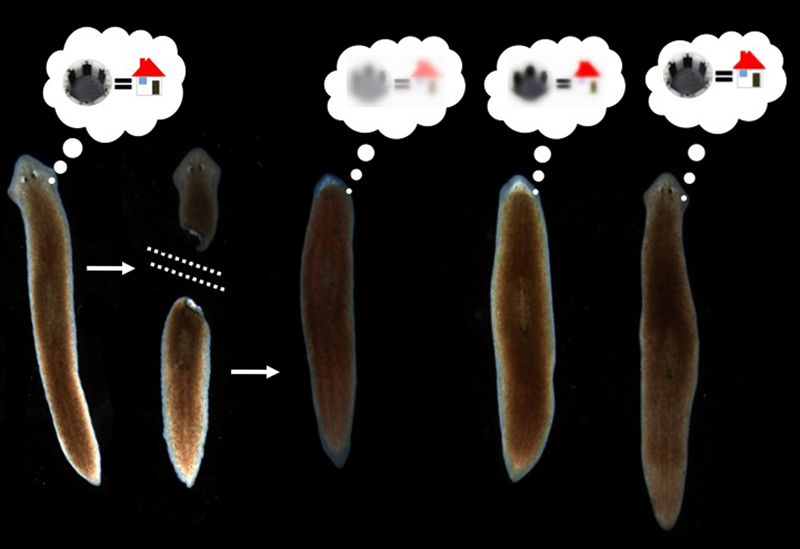
They are similar to our direct ancestor, having true bilateral symmetry, many tissue and organ types, and a true centralized brain. One remarkable property is that they are one of the few species in which we can do regeneration and memory experiments in the same animal. Not only do they readily regenerate their entire bodies from a small fragment, but they can learn in a variety of behavioral assays. This means that we can do experiments that probe the nature of memory and its ability to be transferred across tissues. Once trained on certain tasks, planaria can have their head amputated, and when the tail regenerates a new brain, behavior will resume that shows evidence of recall (i.e., they regenerate their memories, which have to be imprinted somehow onto the new brain). This has been discussed in the literature since the groundbreaking work of a truly unconventional pioneer – James V. McConnell:

Some links where you can read about this work and its relevance to biomedicine of brain regeneration, and the nature of embodied minds:
https://www.tandfonline.com/doi/full/10.1080/19420889.2015.1073424
Here, my goal is not to rehash the facts or implications, but rather to make it easier for others to get into this field and do experiments. Planaria are not an expensive model system, and great for students, but they are a bit finicky – especially when it comes to behavior experiments. We’ve spent a lot of time gathering resources and perfecting protocols, and while my lab is still working to improve many of these, I wanted to make some hard-to-get materials available to anyone who wants to get into this field.
First, two editions of the very hard-to-find McConnell’s original Manual of planarian behavior experimentation protocols:
Now, some links to protocols for how to keep planaria and do behavioral experiments:
https://journals.sagepub.com/doi/10.1207/s15328023top1301_6
http://cshprotocols.cshlp.org/content/2008/10/pdb.prot5053.full.pdf+html
Nicolas, C.L., Abramson, C.I., and Levin, M. (2008), Analysis of behavior in the planarian model, in R. B. Raffa & S. M. Rawls (Eds.), Planaria: A Model for Drug Action and Abuse, RG Landes Co.: Austin, pp. 83-94 :
A good primary paper from the golden age of planarian regeneration:
A cool trick for getting the complete history of where your planaria have been: remove them and the water from their container, and lightly puff baby powder on the surface – it will stick to their slime trails:

And, as a final bonus, the broader issue of memory movement across tissue (from tail to new brain) raises the question of inter-animal transfer of memories. There are papers on this, even apart from the literature on possible personality transfer during heart-lung transplants in human patients (more on that in a subsequent post, meanwhile here are some thoughts on memory). Here are the ones I know about (plus the superb work of David Glanzman and Sam Gershman):
1. McConnell, J.V., Memory transfer through cannibalism in planarians. Journal of Neuropsychiatry, 1962. 3: p. 42-48.
2. Hartry, A.L., W.D. Morton, and P. Keithlee, Planaria – Memory Transfer through Cannibalism Reexamined. Science, 1964. 146(364): p. 274-275.
3. Hartry, A.L., W.D. Morton, and P. Keithlee, Planaria – Memory Transfer through Cannibalism Reexamined. Science, 1964. 146(364): p. 274-&. http://science.sciencemag.org/content/sci/146/3641/274.full.pdf
4. Byrne, W.L., et al., MEMORY TRANSFER. Science, 1966. 153(3736): p. 658-&. http://www.jstor.org.ezp-prod1.hul.harvard.edu/stable/pdfplus/1719421.pdf
5. Byrne, W.L., et al., Memory Transfer. Science, 1966. 153(3736): p. 658-+.http://science.sciencemag.org/content/sci/153/3736/658.full.pdf
6. Schneider, A.M. and M. Hamburg, Interhemispheric Transfer with Spreading Depression – a Memory Transfer or Stimulus Generalization Phenomenon. Journal of Comparative and Physiological Psychology, 1966. 62(1): p. 133-+.
7. Ungar, G., Chemical Transfer of Learning – Its Stimulus Specificity. Federation Proceedings, 1966. 25(2P1): p. 207.
8. Mcgaugh, J.L., Analysis of Memory Transfer and Enhancement. Proceedings of the American Philosophical Society, 1967. 111(6): p. 347-&.
9. Reinis, S., Block of Memory Transfer by Actinomycin D. Nature, 1968. 220(5163): p. 177-&. https://www.nature.com/articles/220177a0.pdf
10. Reinis, S. and J. Kolousek, EFFECT OF METHIONINE SULPHOXIMINE ON MEMORY TRANSFER. Nature, 1968. 217(5129): p. 680-&.http://www.nature.com.ezp-prod1.hul.harvard.edu/nature/journal/v217/n5129/pdf/217680a0.pdf
11. Ungar, G., Molecular Mechanisms in Learning. Perspectives in Biology and Medicine, 1968. 11(2): p. 217-232. http://muse.jhu.edu.ezp-prod1.hul.harvard.edu/journals/perspectives_in_biology_and_medicine/v011/11.2.ungar.pdf
12. Peretti, P.O. and H.G. Wakeley, Memory Transfer in Meal-Worms. Psychonomic Science, 1969. 15(1): p. 33-&. https://link.springer.com/content/pdf/10.3758%2FBF03336182.pdf
13. Pietsch, P. and C.W. Schneider, Brain Transplantation in Salamanders – an Approach to Memory Transfer. Brain Research, 1969. 14(3): p. 707-715.
14. Pietsch, P. and C.W. Schneider, Brain Transplantation in Salamanders – an Approach to Memory Transfer. Brain Research, 1969. 14(3): p. 707-+. https://ac.els-cdn.com/0006899369902108/1-s2.0-0006899369902108-main.pdf?_tid=b70b93bd-fb7a-4180-ab31-479b51a09857&acdnat=1536265268_6bda4889ef371e79cefb06ed60557744
15. Stein, D.G., B. Frank, and J. Rosen, Interanimal Memory Transfer – A New Interpretation. Psychonomic Science, 1969. 17(1): p. 54-&.
16. Zippel, H.P. and G.F. Domagk, STUDIES IN MEMORY TRANSFER FROM COLOR-TRAINED GOLDFISH TO UNTRAINED ANIMALS. Experientia, 1969. 25(9): p. 938-940.
17. Zippel, H.P. and G.F. Domagk, Studies in Memory Transfer from Color-Trained Goldfish to Untrained Animals. Experientia, 1969. 25(9): p. 938-&. https://link.springer.com/content/pdf/10.1007%2FBF01898075.pdf
18. Frank, B., D.G. Stein, and J. Rosen, Interanimal Memory Transfer – Results from Brain and Liver Homogenates. Science, 1970. 169(3943): p. 399-&. http://science.sciencemag.org/content/sci/169/3943/399.full.pdf
19. Golub, A.M., et al., Behavior Induction or Memory Transfer. Science, 1970. 169(3952): p. 1342-&.
20. McConnell, J.V. and J.M. Shelby, Memory transfer experiments in invertebrates, in Molecular mechanisms in memory and learning, G. Ungar, Editor. 1970, Plenum Press: New York. p. 71-101.
21. Bisping, R., et al., Negative and Positive Memory Transfer through Rna in Instrumentally Conditioned Goldfish. Studia Psychologica, 1971. 13(3): p. 181-190.
22. Bisping, R., et al., NEGATIVE AND POSITIVE MEMORY TRANSFER THROUGH RNA IN INSTRUMENTALLY CONDITIONED GOLDFISH. Studia Psychologica, 1971. 13(2): p. 146-146.
23. Ungar, G., Molecular Code in Memory. Recherche, 1972. 3(19): p. 19-.
24. Ungar, G., Molecular Coding of Information in the Nervous System. Naturwissenschaften, 1972. 59(3): p. 85-91.
25. Wilson, D.L. and S.W. Arch, Does Memory Transfer Imply Limits on Human Knowledge. International Journal of Neuroscience, 1972. 3(1): p. 43-&. https://www.tandfonline.com/doi/pdf/10.3109/00207457209147438?needAccess=true
26. Smith, L.T., The interanimal transfer phenomenon: a review. Psychological bulletin, 1974. 81(12): p. 1078-95. http://www.ncbi.nlm.nih.gov/pubmed/4612576
27. Ungar, G., Peptides and Memory. Biochemical Pharmacology, 1974. 23(11): p. 1553-1558.
28. Ungar, G., Molecular Coding of Memory. Life Sciences, 1974. 14(4): p. 595-604.
29. Ungar, G., Is There a Chemical Memory Trace. Israel Journal of Chemistry, 1975. 14: p. 169-176.
30. Ameriks, K., Personal Identity and Memory Transfer. Southern Journal of Philosophy, 1976. 14(4): p. 385-391. https://onlinelibrary.wiley.com/doi/abs/10.1111/j.2041-6962.1976.tb01295.x
31. Maldonado, H. and A. Tablante, Behavioral transfer in praying mantis by injection of brain homogenate. Physiol Behav, 1976. 16(5): p. 617-21.
32. Whiddon, M.F., M. Oboyle, and J.D. Lowe, MEMORY TRANSFER OF AN ESCAPE RESPONSE BY MEANS OF BRAIN-TISSUE HOMOGENATE INJECTION. Journal of biological psychology, 1976. 18(1): p. 27-32.
33. Miller, B.E. and G.L. Holt, MEMORY TRANSFER IN RATS BY INJECTION OF BRAIN AND LIVER RNA. Journal of biological psychology, 1977. 19(1): p. 4-9.
34. Risse, G.L. and M.S. Gazzaniga, WELL-KEPT SECRETS OF RIGHT HEMISPHERE – CAROTID AMYTAL STUDY OF RESTRICTED MEMORY TRANSFER. Neurology, 1978. 28(9): p. 950-953.
35. Wojcik, M. and S. Niemierko, The effect of synthetic scotophobin on motor activity in mice. Acta Neurobiol Exp (Wars), 1978. 38(1): p. 25-30. http://www.ncbi.nlm.nih.gov/pubmed/566023
36. Carrier, L., Memory Transfer in Planaria. Ohio Journal of Science, 1979. 79: p. 80-80.
37. Ghoneim, M.M., S.P. Mewaldt, and J.V. Hinrichs, Diazepam and Memory – Evidence for a Memory Transfer Hypothesis. Federation Proceedings, 1983. 42(5): p. 1347-1347.
38. Holt, G.L. and G. Bentz, Interanimal Memory Transfer of a Barpress Response through Brain and Liver Rna Injections. Bulletin of the Psychonomic Society, 1983. 21(1): p. 51-53.
39. Smith, R., Memory Transfer in Planaria. Ohio Journal of Science, 1985. 85(2): p. 72-73.
40. Martin, H. and U. Martin, Transfer of a time-signal isochronous with local time in translocation experiments to the geographical longitude. Journal of Comparative Physiology A-Sensory Neural & Behavioral Physiology, 1987. 160: p. 3-9.
41. Setlow, B., Georges Ungar and memory transfer. J Hist Neurosci, 1997. 6(2): p. 181-92. http://www.ncbi.nlm.nih.gov/pubmed/11619520
42. Smalheiser, N.R., H. Manev, and E. Costa, RNAi and brain function: was McConnell on the right track? Trends Neurosci, 2001. 24(4): p. 216-8. http://www.ncbi.nlm.nih.gov/entrez/query.fcgi?cmd=Retrieve&db=PubMed&dopt=Citation&list_uids=11250005
43. Iijima, K., et al., Is Memory Transfer Reproducible in Vitro? A Long-Lasting Synaptic Enhancement after Repeated Ltp Induction in Cultured Brain Slice, in Journal of Physiological Sciences. 2009. p. 137-137.
44. Bedecarrats, A., et al., RNA from Trained Aplysia Can Induce an Epigenetic Engram for Long-Term Sensitization in Untrained Aplysia. eNeuro, 2018. 5(3). https://www.ncbi.nlm.nih.gov/pubmed/29789810
45. Colaço, D., Rip it up and start again: The rejection of a characterization of a phenomenon. Studies in History and Philosophy of Science Part A, 2018.
46. Martin, U., H. Martin, and M. Lindauer, Transplantation of a Time-Signal in Honeybees. Journal of Comparative Physiology, 1978. 124(3): p. 193-201.
47. Savel’ev, S.V., et al., [Changes in amphibian behavior after transplantation into the brain of neural anlage cells from Drosophila]. Dokl Akad Nauk SSSR, 1991. 316(3): p. 735-8. https://www.ncbi.nlm.nih.gov/pubmed/1905993
48. Pearsall, P., G.E. Schwartz, and L.G. Russek, Changes in heart transplant recipients that parallel the personalities of their donors. Integrative medicine : integrating conventional and alternative medicine, 2000. 2(2): p. 65-72. http://www.ncbi.nlm.nih.gov/pubmed/10882878


Leave a Reply to Mike Levin Cancel reply