Resources for planarian memory experiments

Published by

on

Planarian flatworms are an amazing creature. Here’s a movie of one gliding around (taken by Junji Morokuma, Levin lab):

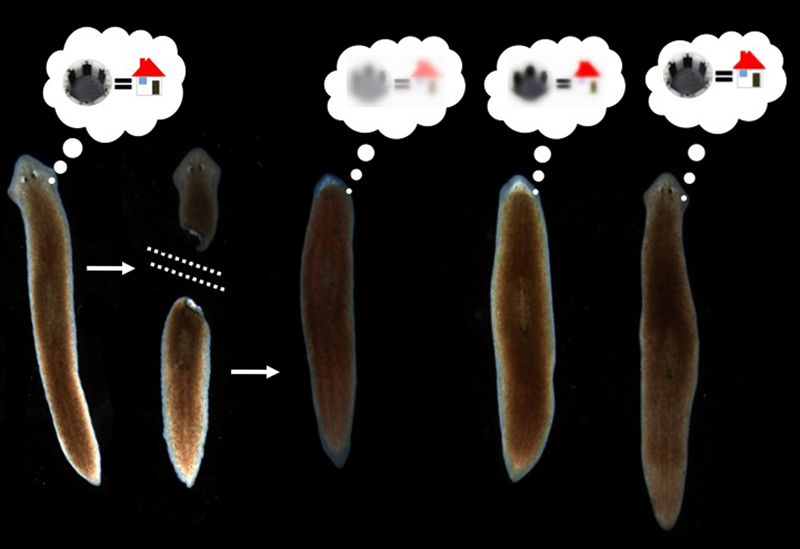
They are similar to our direct ancestor, having true bilateral symmetry, many tissue and organ types, and a true centralized brain. One remarkable property is that they are one of the few species in which we can do regeneration and memory experiments in the same animal. Not only do they readily regenerate their entire bodies from a small fragment, but they can learn in a variety of behavioral assays. This means that we can do experiments that probe the nature of memory and its ability to be transferred across tissues. Once trained on certain tasks, planaria can have their head amputated, and when the tail regenerates a new brain, behavior will resume that shows evidence of recall (i.e., they regenerate their memories, which have to be imprinted somehow onto the new brain). This has been discussed in the literature since the groundbreaking work of a truly unconventional pioneer – James V. McConnell:

Some links where you can read about this work and its relevance to biomedicine of brain regeneration, and the nature of embodied minds:

https://www.theverge.com/2015/3/18/8225321/memory-research-flatworm-cannibalism-james-mcconnell-michael-levin

https://www.tandfonline.com/doi/full/10.1080/19420889.2015.1073424

Here, my goal is not to rehash the facts or implications, but rather to make it easier for others to get into this field and do experiments. Planaria are not an expensive model system, and great for students, but they are a bit finicky – especially when it comes to behavior experiments. We’ve spent a lot of time gathering resources and perfecting protocols, and while my lab is still working to improve many of these, I wanted to make some hard-to-get materials available to anyone who wants to get into this field.

First, two editions of the very hard-to-find McConnell’s original Manual of planarian behavior experimentation protocols:

Now, some links to protocols for how to keep planaria and do behavioral experiments:

https://journals.sagepub.com/doi/10.1207/s15328023top1301_6

http://cshprotocols.cshlp.org/content/2008/10/pdb.prot5053.full.pdf+html

Nicolas, C.L., Abramson, C.I., and Levin, M. (2008), Analysis of behavior in the planarian model, in R. B. Raffa & S. M. Rawls (Eds.), Planaria: A Model for Drug Action and Abuse, RG Landes Co.: Austin, pp. 83-94 :

A good primary paper from the golden age of planarian regeneration:

A cool trick for getting the complete history of where your planaria have been: remove them and the water from their container, and lightly puff baby powder on the surface – it will stick to their slime trails:

And, as a final bonus, the broader issue of memory movement across tissue (from tail to new brain) raises the question of inter-animal transfer of memories. There are papers on this, even apart from the literature on possible personality transfer during heart-lung transplants in human patients (more on that in a subsequent post, meanwhile here are some thoughts on memory). Here are the ones I know about (plus the superb work of David Glanzman and Sam Gershman):

1.         McConnell, J.V., Memory transfer through cannibalism in planarians. Journal of Neuropsychiatry, 1962. 3: p. 42-48.

2.         Hartry, A.L., W.D. Morton, and P. Keithlee, Planaria – Memory Transfer through Cannibalism Reexamined. Science, 1964. 146(364): p. 274-275.

3.         Hartry, A.L., W.D. Morton, and P. Keithlee, Planaria – Memory Transfer through Cannibalism Reexamined. Science, 1964. 146(364): p. 274-&. http://science.sciencemag.org/content/sci/146/3641/274.full.pdf

4.         Byrne, W.L., et al., MEMORY TRANSFER. Science, 1966. 153(3736): p. 658-&.  http://www.jstor.org.ezp-prod1.hul.harvard.edu/stable/pdfplus/1719421.pdf

5.         Byrne, W.L., et al., Memory Transfer. Science, 1966. 153(3736): p. 658-+.http://science.sciencemag.org/content/sci/153/3736/658.full.pdf

6.         Schneider, A.M. and M. Hamburg, Interhemispheric Transfer with Spreading Depression – a Memory Transfer or Stimulus Generalization Phenomenon. Journal of Comparative and Physiological Psychology, 1966. 62(1): p. 133-+.

7.         Ungar, G., Chemical Transfer of Learning – Its Stimulus Specificity. Federation Proceedings, 1966. 25(2P1): p. 207.

8.         Mcgaugh, J.L., Analysis of Memory Transfer and Enhancement. Proceedings of the American Philosophical Society, 1967. 111(6): p. 347-&.

9.         Reinis, S., Block of Memory Transfer by Actinomycin D. Nature, 1968. 220(5163): p. 177-&. https://www.nature.com/articles/220177a0.pdf

10.       Reinis, S. and J. Kolousek, EFFECT OF METHIONINE SULPHOXIMINE ON MEMORY TRANSFER. Nature, 1968. 217(5129): p. 680-&.http://www.nature.com.ezp-prod1.hul.harvard.edu/nature/journal/v217/n5129/pdf/217680a0.pdf

11.       Ungar, G., Molecular Mechanisms in Learning. Perspectives in Biology and Medicine, 1968. 11(2): p. 217-232. http://muse.jhu.edu.ezp-prod1.hul.harvard.edu/journals/perspectives_in_biology_and_medicine/v011/11.2.ungar.pdf

12.       Peretti, P.O. and H.G. Wakeley, Memory Transfer in Meal-Worms. Psychonomic Science, 1969. 15(1): p. 33-&. https://link.springer.com/content/pdf/10.3758%2FBF03336182.pdf

13.       Pietsch, P. and C.W. Schneider, Brain Transplantation in Salamanders – an Approach to Memory Transfer. Brain Research, 1969. 14(3): p. 707-715.

14.       Pietsch, P. and C.W. Schneider, Brain Transplantation in Salamanders – an Approach to Memory Transfer. Brain Research, 1969. 14(3): p. 707-+. https://ac.els-cdn.com/0006899369902108/1-s2.0-0006899369902108-main.pdf?_tid=b70b93bd-fb7a-4180-ab31-479b51a09857&acdnat=1536265268_6bda4889ef371e79cefb06ed60557744

15.       Stein, D.G., B. Frank, and J. Rosen, Interanimal Memory Transfer – A New Interpretation. Psychonomic Science, 1969. 17(1): p. 54-&.

16.       Zippel, H.P. and G.F. Domagk, STUDIES IN MEMORY TRANSFER FROM COLOR-TRAINED GOLDFISH TO UNTRAINED ANIMALS. Experientia, 1969. 25(9): p. 938-940.

17.       Zippel, H.P. and G.F. Domagk, Studies in Memory Transfer from Color-Trained Goldfish to Untrained Animals. Experientia, 1969. 25(9): p. 938-&. https://link.springer.com/content/pdf/10.1007%2FBF01898075.pdf

18.       Frank, B., D.G. Stein, and J. Rosen, Interanimal Memory Transfer – Results from Brain and Liver Homogenates. Science, 1970. 169(3943): p. 399-&. http://science.sciencemag.org/content/sci/169/3943/399.full.pdf

19.       Golub, A.M., et al., Behavior Induction or Memory Transfer. Science, 1970. 169(3952): p. 1342-&.

20.       McConnell, J.V. and J.M. Shelby, Memory transfer experiments in invertebrates, in Molecular mechanisms in memory and learning, G. Ungar, Editor. 1970, Plenum Press: New York. p. 71-101.

21.       Bisping, R., et al., Negative and Positive Memory Transfer through Rna in Instrumentally Conditioned Goldfish. Studia Psychologica, 1971. 13(3): p. 181-190.

22.       Bisping, R., et al., NEGATIVE AND POSITIVE MEMORY TRANSFER THROUGH RNA IN INSTRUMENTALLY CONDITIONED GOLDFISH. Studia Psychologica, 1971. 13(2): p. 146-146.

23.       Ungar, G., Molecular Code in Memory. Recherche, 1972. 3(19): p. 19-.

24.       Ungar, G., Molecular Coding of Information in the Nervous System. Naturwissenschaften, 1972. 59(3): p. 85-91.

25.       Wilson, D.L. and S.W. Arch, Does Memory Transfer Imply Limits on Human Knowledge. International Journal of Neuroscience, 1972. 3(1): p. 43-&. https://www.tandfonline.com/doi/pdf/10.3109/00207457209147438?needAccess=true

26.       Smith, L.T., The interanimal transfer phenomenon: a review. Psychological bulletin, 1974. 81(12): p. 1078-95. http://www.ncbi.nlm.nih.gov/pubmed/4612576

27.       Ungar, G., Peptides and Memory. Biochemical Pharmacology, 1974. 23(11): p. 1553-1558.

28.       Ungar, G., Molecular Coding of Memory. Life Sciences, 1974. 14(4): p. 595-604.

29.       Ungar, G., Is There a Chemical Memory Trace. Israel Journal of Chemistry, 1975. 14: p. 169-176.

30.       Ameriks, K., Personal Identity and Memory Transfer. Southern Journal of Philosophy, 1976. 14(4): p. 385-391. https://onlinelibrary.wiley.com/doi/abs/10.1111/j.2041-6962.1976.tb01295.x

31.       Maldonado, H. and A. Tablante, Behavioral transfer in praying mantis by injection of brain homogenate. Physiol Behav, 1976. 16(5): p. 617-21.

32.       Whiddon, M.F., M. Oboyle, and J.D. Lowe, MEMORY TRANSFER OF AN ESCAPE RESPONSE BY MEANS OF BRAIN-TISSUE HOMOGENATE INJECTION. Journal of biological psychology, 1976. 18(1): p. 27-32.

33.       Miller, B.E. and G.L. Holt, MEMORY TRANSFER IN RATS BY INJECTION OF BRAIN AND LIVER RNA. Journal of biological psychology, 1977. 19(1): p. 4-9.

34.       Risse, G.L. and M.S. Gazzaniga, WELL-KEPT SECRETS OF RIGHT HEMISPHERE – CAROTID AMYTAL STUDY OF RESTRICTED MEMORY TRANSFER. Neurology, 1978. 28(9): p. 950-953.

35.       Wojcik, M. and S. Niemierko, The effect of synthetic scotophobin on motor activity in mice. Acta Neurobiol Exp (Wars), 1978. 38(1): p. 25-30. http://www.ncbi.nlm.nih.gov/pubmed/566023

36.       Carrier, L., Memory Transfer in Planaria. Ohio Journal of Science, 1979. 79: p. 80-80.

37.       Ghoneim, M.M., S.P. Mewaldt, and J.V. Hinrichs, Diazepam and Memory – Evidence for a Memory Transfer Hypothesis. Federation Proceedings, 1983. 42(5): p. 1347-1347.

38.       Holt, G.L. and G. Bentz, Interanimal Memory Transfer of a Barpress Response through Brain and Liver Rna Injections. Bulletin of the Psychonomic Society, 1983. 21(1): p. 51-53.

39.       Smith, R., Memory Transfer in Planaria. Ohio Journal of Science, 1985. 85(2): p. 72-73.

40.       Martin, H. and U. Martin, Transfer of a time-signal isochronous with local time in translocation experiments to the geographical longitude. Journal of Comparative Physiology A-Sensory Neural & Behavioral Physiology, 1987. 160: p. 3-9.

41.       Setlow, B., Georges Ungar and memory transfer. J Hist Neurosci, 1997. 6(2): p. 181-92. http://www.ncbi.nlm.nih.gov/pubmed/11619520

42.       Smalheiser, N.R., H. Manev, and E. Costa, RNAi and brain function: was McConnell on the right track? Trends Neurosci, 2001. 24(4): p. 216-8. http://www.ncbi.nlm.nih.gov/entrez/query.fcgi?cmd=Retrieve&db=PubMed&dopt=Citation&list_uids=11250005

43.       Iijima, K., et al., Is Memory Transfer Reproducible in Vitro? A Long-Lasting Synaptic Enhancement after Repeated Ltp Induction in Cultured Brain Slice, in Journal of Physiological Sciences. 2009. p. 137-137.

44.       Bedecarrats, A., et al., RNA from Trained Aplysia Can Induce an Epigenetic Engram for Long-Term Sensitization in Untrained Aplysia. eNeuro, 2018. 5(3). https://www.ncbi.nlm.nih.gov/pubmed/29789810

45.       Colaço, D., Rip it up and start again: The rejection of a characterization of a phenomenon. Studies in History and Philosophy of Science Part A, 2018.

46.       Martin, U., H. Martin, and M. Lindauer, Transplantation of a Time-Signal in Honeybees. Journal of Comparative Physiology, 1978. 124(3): p. 193-201.

47.       Savel’ev, S.V., et al., [Changes in amphibian behavior after transplantation into the brain of neural anlage cells from Drosophila]. Dokl Akad Nauk SSSR, 1991. 316(3): p. 735-8. https://www.ncbi.nlm.nih.gov/pubmed/1905993

48.       Pearsall, P., G.E. Schwartz, and L.G. Russek, Changes in heart transplant recipients that parallel the personalities of their donors. Integrative medicine : integrating conventional and alternative medicine, 2000. 2(2): p. 65-72. http://www.ncbi.nlm.nih.gov/pubmed/10882878

17 responses to “Resources for planarian memory experiments”

  1. Mathieu Hautefeuille Avatar

    Have you seen Oded Rechavi’s last work on planarian memory?

  2. Mike Levin Avatar
    Mike Levin

    which one? Oded and I have worked together on planarian memory before, is there something new since then?

  3. Francis Forde Avatar
    Francis Forde

    I came across a recent paper doing a conceptual replication of the RNA transfer experiments – it was published by a high school student in collaboration with a scientist (https://www.jsr.org/hs/index.php/path/article/view/1397).

    The authors suggested there was no effect of RNA or DNA transfer. However, the data to me look like something is going on. I re-ran the analysis and found a significant effect – perhaps I missed something, but interesting if this is in fact a successful modern replication of the RNA transfer effect.

    Related to RNA stuff – I heard Sam Gershman mention that you two are collaborating on investigating the RNA transfer effect. Would be interested if you have any updates on this work!

    p.s. Thanks for putting together this page. I am doing my Masters on learning and memory in Planaria over in New Zealand, and greatly appreciate you collating some useful sources here.

    1. Mike Levin Avatar
      Mike Levin

      Cool! I’ll take a look. Yes, Sam and I are collaborating on this, but it’s early days still, so nothing new to report yet. Please keep in touch (via email) – this kind of work is rare, I’m happy to be in contact with people doing it.

  4. Marilyn Strube Avatar
    Marilyn Strube

    Have the planaria that you altered with the bioelectric field ever reproduce sexually and if so, does the novel trait reappear in some or all of the offspring?

    1. Mike Levin Avatar
      Mike Levin

      Ha excellent question. We did try this, for quite some time, but we can’t get any of our worms (1H or 2H) to sexualize and mate, so we’ve never done the experiment. More broadly, with respect to this: 1) our current data and models do not imply that it should necessarily propagate through sperm/egg reproduction, so nothing changes if it doesn’t work, but, 2) if it *did* work, I have a model of how that can be explained (based on projecting patterns of bioelectric states on the surface of a single cell, which we have seen a lot).

  5. Marilyn Strube Avatar
    Marilyn Strube

    Thank you for your reply. What do you think of Dr. Sheldrake’s theory of morphic fields? The way I understand it, his fields are quantum in nature and act as the pattern for your bio-electric fields, which I think of as the “scissors”. What do you think of this or do you have a different theory?

    1. Mike Levin Avatar
      Mike Levin

      I like Rupert and his work, I think it’s valuable and probably onto something very important. But to my knowledge there’s not enough actionable information about his fields yet, for me to use the concept in our work. I keep a strict demarcation between ideas and conjectures (e.g., that Sheldrake fields are quantum, that they intersect with our bioelectric patterns somehow, etc.) and hypotheses that are specific enough that they can help in our work (have enough actionable knowns to be testable, usable in the lab, address some gap in our knowledge or capability). For example at the moment, our bioelectric fields don’t need an upstream pattern because the existing electrophysiological models show exactly how the patterns self-organize from a symmetric arrangements at the 1 cell (egg) stage (like Turing patterns). I don’t see any place where we could plug them in or anything that would practically benefit from doing so (how to use them in regenerative medicine work for example). But I’m open to the idea that someday that might happen.

      1. Marilyn Strube Avatar
        Marilyn Strube

        I completely understand that. It would be difficult indeed to prove the interaction of a quantum field with your bioelectric fields, but I am glad that you don’t dismiss Dr. Sheldrake’s theories. I looked at Rechavi’s work. He talks about heritability of small bits of mRNA which can interfere with gene expression. To me, it doesn’t seem as likely to be a major mechanism of inheritance of acquired characteristics as Dr. Sheldrake’s morphic fields. For example, how did the knee pads of a camel come to be inherited? That would require spatial information. Even if a bit of mRNA could induce the formation of a callus by stimulating the overproduction of skin cells, how could it instruct for the placement on the knees and how would it stop when the pad is fully formed, especially if that mRNA would be in every cell of subsequent generations? It’s all so fascinating and I hope that a way can be found to study the heritability of new traits created from altered bioelectric fields. Please keep up the tremendous work! Thanks again for taking the time to discuss these fascinating ideas.

        1. Mike Levin Avatar
          Mike Levin

          I understand, but Sheldrake’s model doesn’t really answer those questions either, if you hold it to the same standard (i.e., “how”) – there are way more unknowns there than in conventional models. Both need a lot of development to do justice to the richness of the biology. Thanks!

          1. Marilyn Strube Avatar
            Marilyn Strube

            Ok, yes, totally fair! Take care!

  6. Marilyn Strube Avatar
    Marilyn Strube

    An additional thought:
    Yes, the old paradigm would predict that the offspring would be wildtype. It would be groundbreaking if you could show that a new trait you created by altering the bioelectric field is heritable. I read that you created an extra eye in a tadpole. Did it survive and reproduce? Since two-headed planaria don’t reproduce sexually, perhaps an animal such as a frog or salamander would be better suited? One that produces lots of eggs with a high hatch rate would be ideal because, if heritable, the trait may prove to be recessive and, at least in the first generation, may show up in a minority of the offspring.

    1. Mike Levin Avatar
      Mike Levin

      The life cycle of a frog is about 2 years, and many of the (normal) tadpoles die and don’t make it through morphogenesis. It’s not a convenient model for transgenerational inheritance studies, but Oded Rechavi has done amazing work on this in the nematode.

  7. Marilyn Strube Avatar
    Marilyn Strube

    I humbly submit some food for thought recognizing that I may be wrong.

    The advantage of a morphic field is that it is inherently three-dimensional, or four-dimensional if you include time. I imagine it as a three-dimensional “mold,” with the mature adult form being the goal or endpoint. A quantum field that has a two way information flow allows the field (mold) to adjust with time. Additionally, a quantum field has the potential to store a limitless amount of information.

    I’m not a physicist, so I don’t fully understand HOW the morphic field interacts with the electric field. However, since we know that quantum fields interact with everything in the known universe, perhaps it’s not essential to understand this interaction in detail.

  8. Marilyn Strube Avatar
    Marilyn Strube

    Hi Dr. Levin,
    I had a new idea that I wanted to share with you. I believe it presents a testable hypothesis and if true would be important. Now, instead of considering your bio-electric fields as different and separate from Dr. Sheldrake’s morphogenic fields, I think that perhaps they act together as an integrated system. The combination with morphic fields might be what distinguishes generic electric fields from bio-electric fields. On their own, electric fields contain no inherent information, but their integration with morphic information fields—through what Sheldrake calls “morphic resonance”—could be the key to forming bio-electric fields in specific living systems and allowing them to receive patterns from previous generations. As in computers, electricity can be a crucial medium through which information can be potentiated and in nature, bio-electric fields are the physical medium of morphogenesis and morphic inheritance, i.e., the “scissors” and the “pattern”.
    I don’t know if you’ve had the chance to read Dr. Sheldrake’s books. He writes that the concept of morphic fields is not new. What’s unique about Sheldrake’s theory is his suggestion that most forms in living organisms are inherited not through DNA, but via morphic resonance and causative formation, a process that connects morphic fields of organisms based on their similarities and drives inheritance of phenotypes and behavior patterns. I don’t know if Sheldrake’s fields are quantum in nature, and to my knowledge, he hasn’t stated this explicitly. However, he believes that these fields record and transmit information across space and time and rather than DNA and are the principal mechanism by which most physical forms and instinctual behaviors are inherited. In his books, Sheldrake presents well-reasoned arguments that DNA does not contain the information necessary to create the complex forms of living things and that morphic resonance explains this and other mysteries of nature for which inheritance via DNA fails to account. Examples of these include the inheritance of complex behaviors, such as web spinning in spiders and complex nest building in weaver and tailor birds.
    If Sheldrake’s theory is correct, and if your bio-electric fields are integrated with his morphic fields, then new phenotypes created by altering the bio-electric field should be heritable. A test of this hypothesis would be to create a novel phenotype by altering the bio-electric field of developing organisms, then when adults, cross breed them to see if the new trait is inherited. According to Sheldrake, a novel trait will be recessive so cross breeding of the novel trait through several generations will see an increase in the appearance of the novel trait compared to wildtype. I have not discussed this idea with Dr. Sheldrake, but he may have additional ideas on ways to test this.
    What do you think? If you are interested, would you be open to discussing potential models that could be used to study this?
    I’m a retired molecular biologist, so I’m not seeking to conduct research in this area myself—I’m just genuinely fascinated by these concepts. If this idea could be proven, it would be a breakthrough in how we think about inheritance and development, potentially opening doors to a completely new field of inquiry.
    I am looking forward to your opinion of this idea.
    Best wishes,
    Marilyn Strube

  9. Marilyn Strube Avatar
    Marilyn Strube

    Cont.. There would be a way to test to see if heritability is non-local. If the trait is heritable and subsequent generations consist of a higher and higher percentage of the novel type, you could repeat the experiment with the same trait and see if the rate of frequency of the trait appears faster from generation to generation compared to the first trial. This would show a non-local influence from similar animals.

  10. Marilyn Strube Avatar
    Marilyn Strube

    Correction: I believe I misused the word crossbreed. I meant breeding individuals with the same novel trait. Novel x Novel not Novel x Wildtype.

    Wildtypes could be used in control groups if desired.

Leave a Reply to Mathieu Hautefeuille Cancel reply

Your email address will not be published. Required fields are marked *