Some Downloadable Infographics

Published by

on

Multi-modal control of anatomy (drawn for me by Ben Oldroyd via support of the Templeton World Charity Foundation):

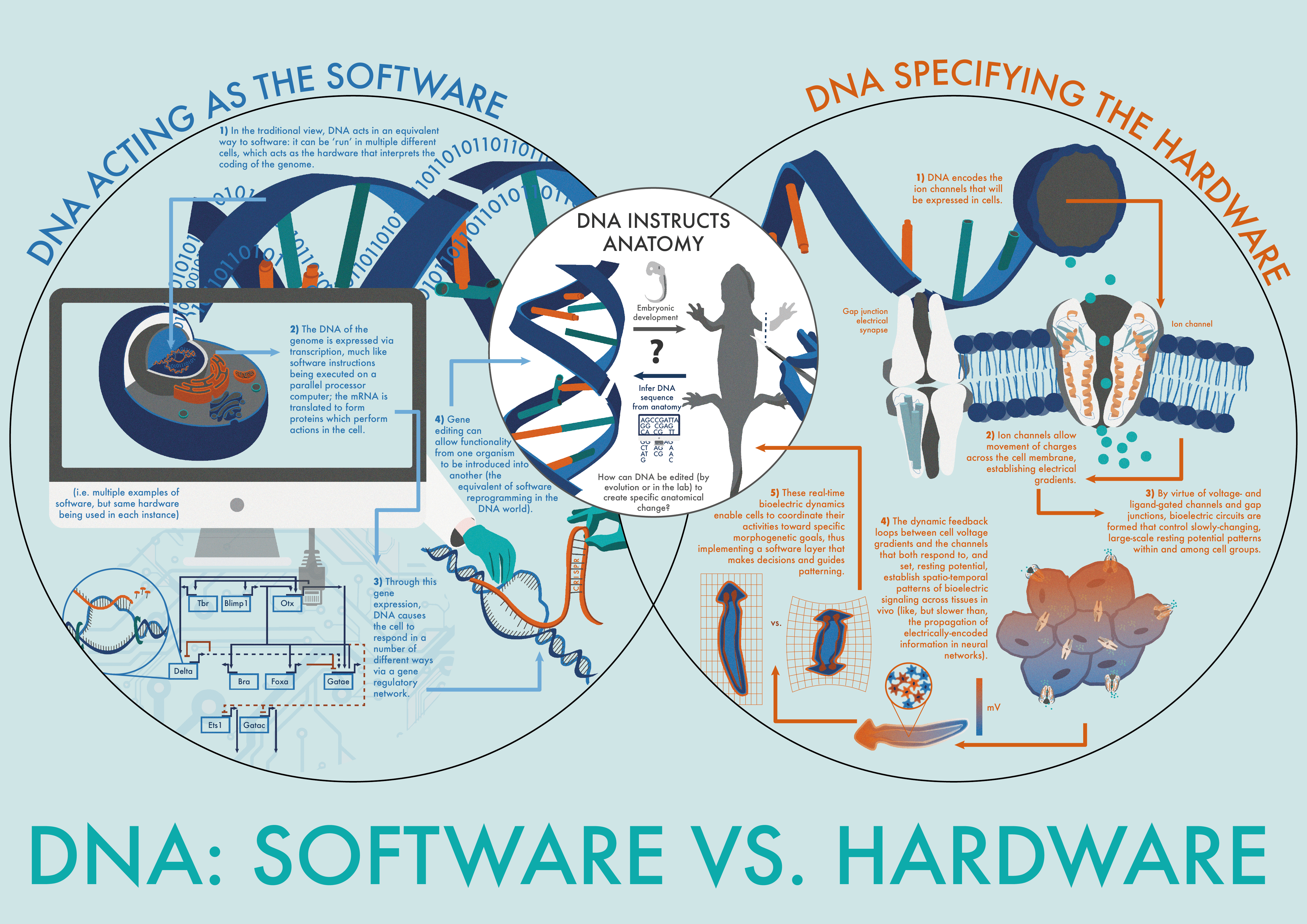
DNA, and the concept of software vs. hardware (drawn for me by Ben Oldroyd via support of the Templeton World Charity Foundation):
Flowchart diagrams of what I think the various findings in cognitive science and philosophy of mind mean for you in practical terms:

A flowchart diagram for ways to think about free will:

Two flowchart diagrams of how to think about cognition/consciousness/sentience:

22 responses to “Some Downloadable Infographics”

  1. frank a schmidt Avatar

    This is absolutely wonderful.

  2. Cem Engin Avatar
    Cem Engin

    Wow! What a great treat…

  3. Sheila Macrine Avatar

    Absolutely inspiring!

  4. Turil Cronburg Avatar

    As for the Free Will chart, my own version uses all the basic categories of how a universe could be generated to describe where the variation that “free will” normally refers to applies:

    00. Pre-Existing Single Timeline – “The Book” – Free will is the characters’ freedom to be unique and complex, and even unpredictable from a reader’s perspective

    01. Single-Function Generated Single Timeline – A Running Program – Free will is the characters’ freedom to be unique and complex, and to be unpredictable even from their own perspective

    10. Multiple-Function Generated Single Timeline – Outcome of Multiple Programs Running In Parallel – Free will is the whole system’s freedom to be unpredictable and emergent due to different programs interacting

    11. Pascal’s Triangle (Pure Randomness) Generated All-Possible-Timelines – Universal Sexual-Reproduction Evolutionary Family Tree – Free will is each timeline’s/reality’s/experience’s freedom to be independent and unpredictable at every moment where a split/random-mutation or merge/natural-selection with a neighboring timeline happens.

    All of these are deterministic, because there’s no way to generate something without the generator function, even randomness, in it’s mathematical sense of all outcomes being equally probable, is a deterministic process. So free will isn’t some magical supernatural ability to freely vary from the laws of nature, but instead it’s the freedom of the system to generate unique/complex stories, like how the digits of pi wander around creatively.

    1. Juan Zarama Avatar
      Juan Zarama

      Beautiful. I want a print of a couple of these.
      Thank you!

  5. Turil Cronburg Avatar

    And as for the cognition, intelligence, sentience, consciousness diagram, I say that those are all different things. There is no “it” to define with that list. And defining each one of those might involve multiple elements on your “x or y” decision tree.

    The general definition of intelligence is usually something like objective problem solving (3D perspective taking), so you would absolutely need a 4D being to do it, and it’s both behavioral and structural.

    Cognition might just be the processing of data into categories, which software on normal computers can do now.

    Sentience is about feelings, so anything that has its own goals and uses sensory inputs to compare its current state to its goal state would be sentient (currently what we call “life”).

    Consciousness is the whole range of possible information processing (energy flow) that represents everything from 0 to 4D+ modeling of reality internally (modeling the perspectives of self, another, the local system both are in, and the whole universe that all local systems are in) Anything that doesn’t have its own “independent” (unique) goals is just simple matter with 0 consciousness, while anything that has its own goals would have a positive level of consciousness, depending on both it’s architecture and behavior.

    1. Zach C Avatar
      Zach C

      > Anything that doesn’t have its own “independent” (unique) goals

      The quoted “independent” is doing a lot of heavy lifting. Can you name one thing you are independent from?

  6. Maria Fátima Pereira Avatar
    Maria Fátima Pereira

    I liked.
    Thank you.

    1. Juan Zarama Avatar
      Juan Zarama

      Beautiful. I want a print of a couple of these.
      Thank you!

  7. Joe Devon Avatar
    Joe Devon

    Well done

  8. Matea Avatar
    Matea

    Where’s the cool one that has all the possible life forms to form in the coming decades? (xenobots, cyborgs, etc)

  9. Norwegian_Lynx Avatar
    Norwegian_Lynx

    I have a question regarding what education / degree you would recommend pursuing if one wants to work as a scientist in regenerative medicine. I deeply admire your research and its practical applications, and you have inspired me to also want to work with regenerative medicine. I am not sure if this is the right place to ask this question, but I don’t know of any other place where I could ask.

    I have a bachelors degree in computer science, but I would like to work with regenerative medicine in the future, and I am therefore thinking I should pursue a new degree.
    However, I am not sure what degree would be most suited for working with regenerative medicine. Is it for instance physics, biology or would you recommend a medical school degree? What degree would you recommend choosing?

    (Sorry for my English)

    1. Mike Levin Avatar
      Mike Levin

      It kind of depends what you want to do: clinical work or basic research? Most probably you want a PhD in bioengineering or biology (if you want to lead the research someday), or a Masters or at least B.S. degree in biology or bioengineering to be part of a team.

      1. Norwegian_Lynx Avatar
        Norwegian_Lynx

        Thank you so much for your answer.
        Sorry for my late reply. I just came back from a trip.

        If I have understood correctly, clinical work relies on the results of basic research, it is the process of taking knowledge discovered in basic research and checking if this works for human patients. Basic research however, is what makes new treatments possible. If I had to choose between the two, I think it would then be basic research.

        Regarding choosing what to study, I don’t know if this is relevant, but in Norway, where I live, most medical schools give students the opportunity to apply for a scientist track, which I think is what results in an MD/PHD title after graduation. When one takes the scientist track, one can choose a project to work on and join a team. This gives the students the opportunity to work on a scientific project (for example study alzheimer’s disease on a low level (cellular level I think)) and be part of a team while at the same time studying medicine. Does this sound like something that would be beneficial to study if one wants to work in regenerative medicine later? Or do you think that medical school in general does not give the required knowledge to do impactful work on regenerative medicine, and that one would be better off studying biology?

        Another thing that came to my mind, I believe I’ve heard you say once in a podcast, if I remember correctly, that one should study as broadly as possible. With that, do you mean that one should study many different subjects in the university? If so, what subjects would you recommend? I would be very happy if I am able to help advance the field of regenerative medicine and contribute to making new treatments available to people. So much suffering in the world is related to problems that would be solved with advancements in regenerative medicine. If there are other subjects you think I should study that would make me more able to contribute to the field, I would gladly study them as well.

        1. Mike Levin Avatar
          Mike Levin

          It really depends on your preferences. There are a thousand ways to contribute to regenerative medicine. If you want to see patients, go to medical school. If you like basic science, then graduate school is what you want (biology or bioengineering). For breadth, it depends: for a more medical path, just study biology, bioengineering, materials science, biophysics. For the basic science path, you should take developmental biology, computer science (not bioinformatics alone, computer science), some neuroscience (behavioral, cognitive), and maybe some philosophy of science/philosophy of mind.

          1. Norwegian_Lynx Avatar
            Norwegian_Lynx

            Thank you so much for your advice! 🙂

  10. Alain Schaerer Avatar
    Alain Schaerer

    One thing to note about the biomechanical part of the first infographic might be that the forces can come from external events too. I.e physical exercises. But its seems to be all connected and cyclical anyways.

  11. Leah Avatar
    Leah

    Thank you! I am jumping jacks, dancing happy, over your work, especially the timing correlated to culture and myself; finally a serious component of hope, when I met you through video. Super cool!! to get this on my email! thank you! for every breath and step you took, will take. I for one, am really excited to see what the larger cognitive cone of Michael Levin’s goal will be. Again thank you thank you thank you!!!❣GEM❣

  12. Amir Avatar

    This is so brilliant!

  13. Teja Avatar

    Awesome, thank you, Mike. 🙂

Leave a Reply to Teja Cancel reply

Your email address will not be published. Required fields are marked *