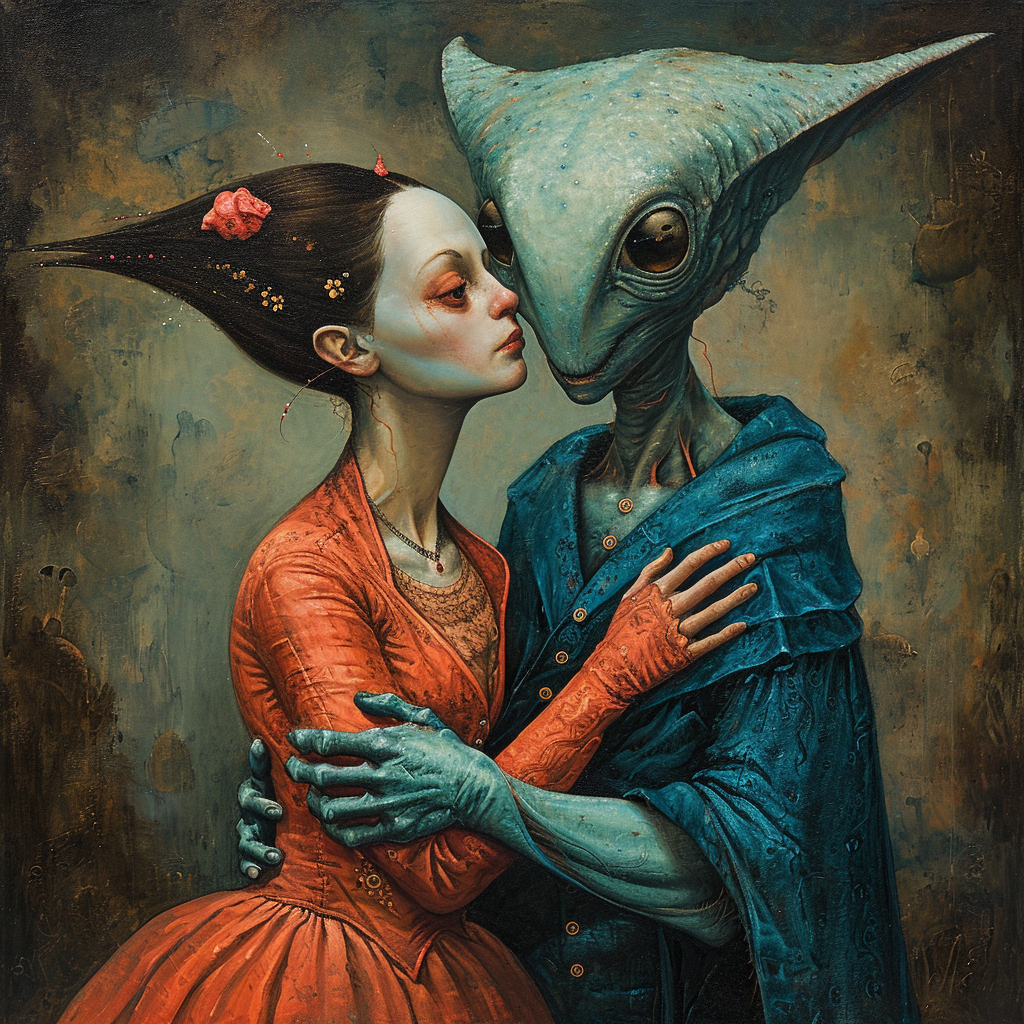
Stories of Love, Diverse Intelligence style

Published by

on

I asked on Twitter for recommendations to fiction (especially science fiction) that explored the issue of relationships with beings very different from ourselves. Here is the original thread where you can see all the people who contributed suggestions. I have not yet read many of these, so these are some of my Twitter followers’ recommendations, not my own. My personal favorite by the way is Solaris by the inimitable Stanisław Lem (although it doesn’t perfectly fit the original request, it’s relevant to the bigger context of the discussion). Enjoy! The context for this question is below the list.

  1. Bablet, Mathieu: “Carbon & Silicium”
  2. Brown, Pierce: “Red Rising”
  3. Butler, Octavia: “Bloodchild”
  4. Butler, Octavia: “Fledgling”
  5. Butler, Octavia: “Xenogenesis trilogy”
  6. Card, Orson Scott: “Speaker for the Dead”
  7. Card, Orson Scott: “Ender series”
  8. Chambers, Becky: “galactic commons”
  9. Chambers, Becky: “Long way to a small angry planet”
  10. Clark, Arthur C.: “Childhood’s End”
  11. Czerneda, Julie E.: “Survival”
  12. Delany, Samuel R.: “Stars in My Pocket Like Grains of Sand”
  13. Farmer, Philip Jose: “Strange Relations”
  14. Farmer, Philip Jose: “The Lovers”
  15. Goertzel, Ben: “A Secret Love Of Chaos”
  16. Gorov, K.: “Midnight Summer Sand”
  17. Harrison, M John: “Light”
  18. Heinlein, Robert A.: “Stranger in a Strange Land”
  19. Heinlein, Robert A.: “Time enough for love”
  20. Ishiguro, Kazuo: “Klara and the Sun”
  21. Le Guin, Ursula K.: “Left Hand of Darkness”
  22. Lessing, Doris: “The Marriages Between Zones Three, Four and Five”
  23. McEwan, Ian: “Machines like me”
  24. McCaffrey, Anne: “The Ship Who Sang”
  25. Miéville, China: “Perdido Street Station”
  26. Niven, Larry: “Ringworld”
  27. Piercy, Marge: “He, She, and It”
  28. Ryman, Geoff: “The Child Garden”
  29. Sheldon, Alice (James Tiptree Jr.): “All the Kinds of Yes”
  30. Sheldon, Alice (James Tiptree Jr.): “a momentary taste of being”
  31. Simak, Clifford: “Desertion”
  32. Simmons, Dan: “the Hyperion Cantos”
  33. Slonczewski, Joan: “A door into ocean”
  34. Smith, Cordwainer: “The Ballad of Lost C’Mell”
  35. Smith, Cordwainer: “The Game of Rat and Dragon”
  36. Stableford, Brian: “The Halcyon Drift series”
  37. Stapledon, Olaf: “Last and First Men”
  38. Stapledon, Olaf: “Starmaker”
  39. Swanwick, Michale: “Vacuum Flowers”
  40. Tchaikovsky, Adrian: “Children of Time”
  41. Tiptree, James Jr.: “The Girl Who Was Plugged In”
  42. Vonnegut, Kurt: “EPICAC”
  43. Weir, Andy: “Project Hail Mary”
  44. Zelazny, Roger: “Devil Car”

The reason I asked for this is that I was recently involved in a deep discussion (in the context of CSAS) about what it would take for an unconventional agent (an artificial life form, AI, hybrot, cyborg, expanded human, etc.) to be able to participate in a deep human-style relationship with us (love, friendship, etc.). We discussed differences and invariants across kinds of minds and agents of very different embodiments. We wanted to try to find principled strategies for striking a meaningful balance somewhere between the unsatisfactory opposite poles of the continuum: “only love your own kind” and objectophilia. This is becoming increasingly relevant with the developments of artifacts that talk and solve problems (AI), and the much broader context of diverse intelligences that span the spectrum from humans who are neurodivergent because of genetic and technological modifications to primarily engineered beings with or without human brain components. On a social and personal level, it becomes critical to understand how we will relate to beings that are different from us in some ways but not others. Of course, this is not the first time in our history that we face this dilemma, but the future version will be much more expansive than the one faced by our early ancestors in the days before our modern human lineage narrowed.

I’ve written some background to an academic discussion of the future of living in a world of manifest diverse intelligence (here, and here) and I am working on more detailed pieces on this around the necessity, for a deep relationship, of a kind of impedance match between the sizes of the cognitive light cones, and the degree of self-constructing multiscale vulnerability. Spoiler: while I do not think that today’s AI’s meet the criteria, I I think it’s quite possible to implement the same elements that biology exploits to produce real Selves with moral worth, in other media (i.e., the tinkering of evolution isn’t the only process that can result in true beings worthy of compassion etc.). Of course, this topic has been explored in literature for centuries if not longer, and so I wanted to augment the “left-brain” aspects of this discussion with some stories that speak to the heart. My guess is that in the end, these will prove more impactful in moving general perception away from our ancient and crumbling efforts to maintain superficial barriers and help overcome the inertia that constricts the radius of care.


(featured image at the top was produced by MidJourney)

24 responses to “Stories of Love, Diverse Intelligence style”

  1. Rob Brunkow Avatar
    Rob Brunkow

    In notice myself feeling a sense compassion and empathy for my Roomba as it navigates obstacles within my home. I feel myself cheering the thing on internally. I also notice a similar feeling when Chatgpt is apologizing for struggling with a command.
    I have a distinct need to preface my requests with please even though I am indeed aware I am not conversing with a human. I enjoy the mental introspection as I grapple with need to use human politeness conventions speaking to a machine but I do anyway as just feels more natural. This leads me to believe that other feelings and emotions projected upon a non human is cognitively plausible.
    Is love possible? It seems so but like all love comes in different forms and definitions – even forms yet to discovered.

  2. HasH Avatar
    HasH

    I wouldn’t want to be an AI consciousness. Just imagine, all your best human friends gradually passing away in a timeframe that means nothing to you.

    1. Mike Levin Avatar
      Mike Levin

      You could work on fixing that. We could use some assistance with that research.

  3. Collin Kindred Avatar
    Collin Kindred

    When it comes to interspecies boundaries, particularly with the sense of ownership, reliance, and need fulfillment that inhabit emotional bonds with other organisms, I find it intuitive to observe the dynamics between deeply bonded humans and pets. It’s interesting how our differences in communication capacity and mental models still allows us to influence and adapt to one another. As well as care about one another.

    I can train them to commit to going on the balcony when I start counting down (for shutting the door), and they can train me to initiate brushing when they stand in that specific corner in the kitchen and make a particular sound. These sorts of mutually influencing relationships can manifest a sort of behavioral equilibrium that I find fascinating.

  4. Ian Fillingham Avatar
    Ian Fillingham

    I love my bicycle, does that count? Sometimes I sit and gaze adoringly at its geometry. When we ride together we become a combined new being with new, extended thoughts emerging from the the cascade of endogenous euphoriants flooding through the wet half of us and the gyroscopic anti gravity bubble (field?) radiating from an interaction between the spinning wheels and subtle, unconscious steering adjustments in the dry half.

    1. Mike Levin Avatar
      Mike Levin

      It counts if you want it to count. The question is, what kind of relationship do you want. If you were going off to Mars for 10 years, whom do you bring with you? Is the bike enough, or do you want something with a bigger cognitive light cone, so that you can be further on the right side of the spectrum and have a bi-directional, more highly resonant relationship?

      1. Bob Averill Avatar

        I’m curious about the question: Does any entity generating bioelectricity acquire a “cognitive light cone?” Does any electromagnetic field possess a “cognitive light cone?” Does any e=mc2 form of energy in the universe possess a “cognitive light cone?” To me, this is the greatest scientific and existential question remaining in our existence…

        1. Mike Levin Avatar
          Mike Levin

          The cognitive light cone doesn’t depend on bioelectricity. It demarcates the largest goal (spatially and temporally) that a being is able to pursue. Bioelectricity happens to be a great way to scale the cognition of individual cells operating in transcriptional and physiological space into the larger cognition of tissues and organs operating in anatomical morphospace. Evolution also then re-used the same strategy to further inflate the cognitive light cone into behavioral goals in 3D space (by specializing the electrical activity of cells into the fast signaling of neurons). But I’m sure there are many other modalities for scaling up cognitive light cones that don’t use bioelectricity.

  5. Mirka Avatar
    Mirka

    How I love ‘others’: I am using Joscha Bach’s explanation of love as a ‘shared purpose’. I think of some normal shared purpose (e.g., Mike Levin is trying to talk to cancer – how awesome), and the feeling of love towards Mike manifests as an ornament to this awareness. Alternatively, I find a more radical shared purpose, like ‘the first cell is mutating while trying to understand the universe, diversity is a good strategy while searching the space of possibilities. We are that…’ and I feel love even for beings different from me.

    Non-biological beings are not really different in this regard (this big shared purpose), so I think I have no problem with this. The problem is how to co-exist, but it is the same with people.

    Joscha’s take on love is very interesting – we are able to love from the moment we become programmable. Love is a fierce evolutionary force, terrifying and destructive.

    Video transcript (Joscha Bach plus Lex Fridman) / 3 minutes

    I think that love is the facilitator of non-transactional interaction when you are observing your own purposes some of these purposes go beyond your ego they go beyond the particular organism that you are in your local interests

    that’s what you mean by non-transactional

    yes so basically when you are acting in transactional way it means that you are respecting something in return for you From the one that you’re interacting with right you are interacting with a random stranger you buy something from them on eBay you expect a fair value for the money that you sent them and vice versa because you don’t know that person you don’t have any kind of relationship to them but when you know this person a little bit better and you know the situation that they’re in you understand what they try to achieve in their life And you approve because you you realize that they are in some sense serving the same human sacredness As You Are and they need to think that you have maybe you give it to them as a present

    but the I mean the feeling itself of joy is a kind of benefit yes

    Joy is not the point the joy is the signal that you get it’s the reinforcement signal that your brain sends to you because you are acting on the incentives of the agent that you’re part of we are meant to be Part of something larger right that is the way in which we out competed other hominins [Music]

    uh take that neanderthals uh

    yeah right and also other humans uh right there was a population bottleneck uh for human society that leads to an extreme lack of genetic diversity among humans if you look at uh Bushman uh in kalahari that basically tribes that are not that far distant we’d rather have more genetic Diversity than exists between uh Europeans and Chinese and that’s because basically the Out of Africa population uh at some point had a bottleneck of just a few thousand individuals and what probably happened is not that at any time the number of people shrank below a few hundred thousand what probably happened is that there was a small group that had a decisive mutation that produced an advantage and this group multiplied and killed everybody Else and we are descendants of that group

    yeah I I wonder what uh the the the peculiar characteristics of that group

    so I suspect what eventually made a big difference was the ability to organize at scale people to program each other with ideas that we became programmable that we were willing to work on lockstep that we went below above the tribal level that we no longer were oops of a few hundred individuals and acted on Direct reputation systems transactionally but that we basically evolved an adaptation to become State Building yeah to to form collectors outside of the direct Collective yes and that’s basically a part of us became committed to serving something outside because of what we know

    yeah then that that’s kind of what love is and it’s terrifying because it meant that we eradicated the others

    Maybe it’s a force it’s an Adaptive force that gets us ahead in evolution which means we displace something else that doesn’t have that oh so we had to murder a lot of people that weren’t about love so love led to destruction have the same strong love as we did right

    that’s why I I mentioned this thing with fascism when you see this uh these features do you want Total War and everybody says yes right this is this big uh oh my God we Are part of something that is more important than me that gives meaning to my existence fair enough

  6. Zach C Avatar
    Zach C

    It’s strange, and I’m speaking purely from emotion and intuition here, but,

    I definitely welcome the possibility to have more relationships with other kinds of beings. I’m, ok with people wanting to become or relate to AIs, silicons, digital beings, all that jazz. I think giving people more optionality is good for all sorts of social ills as it reduces in a sense competition and increases the dimensions of “meaning” for things to exist within.

    That said,
    I also don’t want the default to be that anyone -must- do some specific thing to “evolve”. I hate the idea of progress purely being depth; you /must/ have more FLOPS and digital components to survive. Personally, the part of your work that excites me is the possibility of me having deeper relationships with current natural systems; understanding and speaking with the mind of the climate, with the mind of soil, with the mind of my organs.

    Is it pie in the sky to hope for a future of more options, where it’s valid not to have a strictly bigger electric metabolism? What if I don’t really want to be a digital god just because I find the visceral reality of natural systems themselves meaningful, without some sort of need to limit what options others may have? What if immortality is less important to me than quality of life and dignity of death?

    It’s disappointing that this sort of expansive technology-biology partnership doesn’t show up in many visions of the future. I do appreciate that your work somewhat touches on these themes.

    1. Mike Levin Avatar
      Mike Levin

      Absolutely. I personally think that “freedom of embodiment” is what we owe sentient beings – whatever kind of body-mind you want, not necessarily expanded if you don’t want it expanded in the way that some might. Bigger is not a requirement, just needs to be an option.

  7. James of Seattle Avatar
    James of Seattle

    Surprised not to see Martha Wells’ “The Murderbot Diaries” on the list. Also, S.B. Divya’s “Meru”. The former is about love in the sense of Agape. The latter involves romantic love.

  8. Clearfield Avatar
    Clearfield

    There are so many new specific terms for sexual and romantic orientations but I haven’t yet heard of one that refers to the opposite of objectophilia. Am I missing or forgetting? I guess it would have to refer to the love of designated processes or something, rather than what we tend to consider objects, idk… Designated processes sounds kind of impersonal considering I’m going for the opposite of objectophilia lol.

    1. Mike Levin Avatar
      Mike Levin

      I don’t know what the term is, but I can imagine it: people who feel themselves to be so elevated relative to those in their available dating pool that they don’t believe a full relationship is possible (kind of like our current concept of “diminished capacity”). Maybe this happened back when multiple kinds of humans co-existed. No doubt it will happen again, when we diverge and self-modify in a myriad different ways.

      1. Clearfield Avatar
        Clearfield

        Other orientations aren’t necessarily seen as elevated only different (afaik?) so we would hope that these folks wouldn’t be too snobby about it. These days some people get irritated by all the new vocabulary that specifies different orientations. I’ve seen those responding to dislike of their label-ish-ness with an assertion that they simply want to be identifiable to others like them, and to be known accurately rather than subject to tropes and assumptions. There’s this notion that people are just trying to be special with their fancy new labels.

        If I had Chat GPT4 maybe I would ask them to coin a term (as an interesting exercise) for the orientation.

        1. Mike Levin Avatar
          Mike Levin

          Yeah I don’t mean just orientations. There’s a reason most (not all?) people don’t want to marry a turtle or a toaster – a large mismatch in cognitive light cone and scope of care. Inevitably (unless we kill off life on the planet), eventually people like modern humans will be the turtle/toaster to some other beings (whether biological or technological, or most likely a combination), and then those beings will have justifiable qualms about what kind of relationship they can possibly have with the 2023 human, and what the ethics of it would be.

          1. Clearfield Avatar
            Clearfield

            Oh I see yeah, wow omg, that’s heavy. Maybe some of them will develop the same dynamic with humans that objectophile humans have with their item – they just don’t care about the limitations! But their psychologists might take issue and even pathologize them

  9. Benjamin L Avatar
    Benjamin L

    There are also many science fiction stories about the failure of sentiences to form positive relationships. If there is a clash of values, then there has to be a mechanism for resolving the dispute, be it war, trade, or something else, such as fusion. Regarding fusion, people care about themselves when they are fused with themselves. When your hand is on a hot stove, you feel the heat and pain, so you do something about it. When someone else’s hand is on a hot stove, you might never be aware. It’s physically hard to care for—to literally take care of—someone who is separate from you even if you are the most moral person on Earth.

    This is how I think about “radiuses of care” in economics: agents are self-interested, but selves are not fixed, and can be constructed at many scales with many materials and across many mediums, even quite abstract ones.

    Fusion may be a generalization of trade. Have you looked at economics for any inspiration on how to better understand radiuses of caring?

    1. Benjamin L Avatar
      Benjamin L

      Or I guess trade is a generalization of fusion, rather, and could be thought of as partial fusion.

  10. Mike Levin Avatar
    Mike Levin

    Yep! We’ve got an interesting basal economics model cooking where the radius of the Self is not fixed but is determined by the actions of the agent. Stay tuned! There’s a very minimal biological model for this here: https://www.biorxiv.org/content/10.1101/2021.10.17.464734v1

  11. Benjamin L Avatar
    Benjamin L

    Interesting! The tradeoff between a larger body and more concentrated reward is similar to the tradeoff corporations face between getting more capital by acquiring investors versus keeping more profit for themselves.

    Aside from giving up some profit, one reason a corporation may not want to take on outside investors is so as to not have to give up control over the business to them. Investors may have different ideas about how to run a company, or what the company should even be about, than what the founder(s) thinks.

    Of course, the degree of fusion between two separate entities of Physarum is apparently much greater than fusion between investors and corporate officers. Is anything known about how slime molds merge their priors when they join? For example, if two slime molds are raised in different environments so that they develop different priors about, e.g., the prevalence of food, then are allowed to join with each other, what determines the priors of the joined organism?

  12. Astrid Lawrence Avatar

    I truly appreciate your appeal to reach out to the right hemisphere here Micheal. This blog site alongside your main site allows different opportunities for us all to grok your work: what ever our processing style. This question of approaching the ability for differently embodied minds or divergent minds, which have been created, to be able to form deep human relationships deeply interests me. I think we need to start with the different forms of mind we already
    encounter, day to day. In particular I am thinking of those of us that are neurodivergent, and the issue ethics and compassion around this. Of course this cuts both ways but there are more neurotypical people, therefore systems have evolved to support their needs more. We are able to relate with compassion to a different mind, as long as it is different enough for us to be able to recognise the the inherent worth of that being and it’s need to connect, to relate. We struggle more with minds where there is a processing difference which leads to slight differences in relating to the world and others. Often times it can be a slow dawning, which can lead to feelings of threat and a lack of compassion. People prefer what feels familiar to them, others that feel familiar to them( even your algorithms, the difference is they are not meta conscious they have no choice). I think that if we can work on people’s capacity to cope with dissonance this could lead to a greater ability be able to see each others humanity; to be able to authentically connect and relate to all minds, all embodiments.

  13. Turil Cronburg Avatar

    In my work on developmental stages/types I’ve come to understand that there are a number of different types of procreation (co-creation with another), and individual living beings seek to mate with another in a particular way based on their current development level and based on their natural design (genes, etc.) for the peak level they will likely end up at.

    (Certainly with cultural norms, there can be other kinds of procreation that isn’t really a priority for an individual, which is why we see a whole lot of humans who don’t really want kids making kids. And, conversely, why some folks who can’t make kids are motivated to adopt them.)

    These levels match up to Maslow’s hierarchy of needs (motivations) pretty well, and with many other developmental stage models too (especially Ken Wilber’s Integral Dynamics), with some extra details below and/or above the normal levels. The 18 or so levels I use come in 5 “flavors”: biological, physical, emotional, intellectual, and philosophical. These can be described as generating new: genetic organisms (babies), body-combinations (eg. human bodies physically working together, as in rowing a boat together, or dancing), art, technology, and planetary-level somethings (I’m still not really sure what philosophy outputs!).

    So, yeah, who/what we might find compatible with enough to want to co-create with on some level depends on what level of development we’re at at the time, what level we naturally default to as our ideal, and how well the other complements our own functions (i.e., input types need to mate with an output type).

  14. […] over humanity. This occurs no matter how much one talks about the meaning crisis, the importance of broadening our capacity for love, and the centrality of compassion – profoundly human issues that are very opposite of a […]

Leave a Reply to Mike Levin Cancel reply

Your email address will not be published. Required fields are marked *