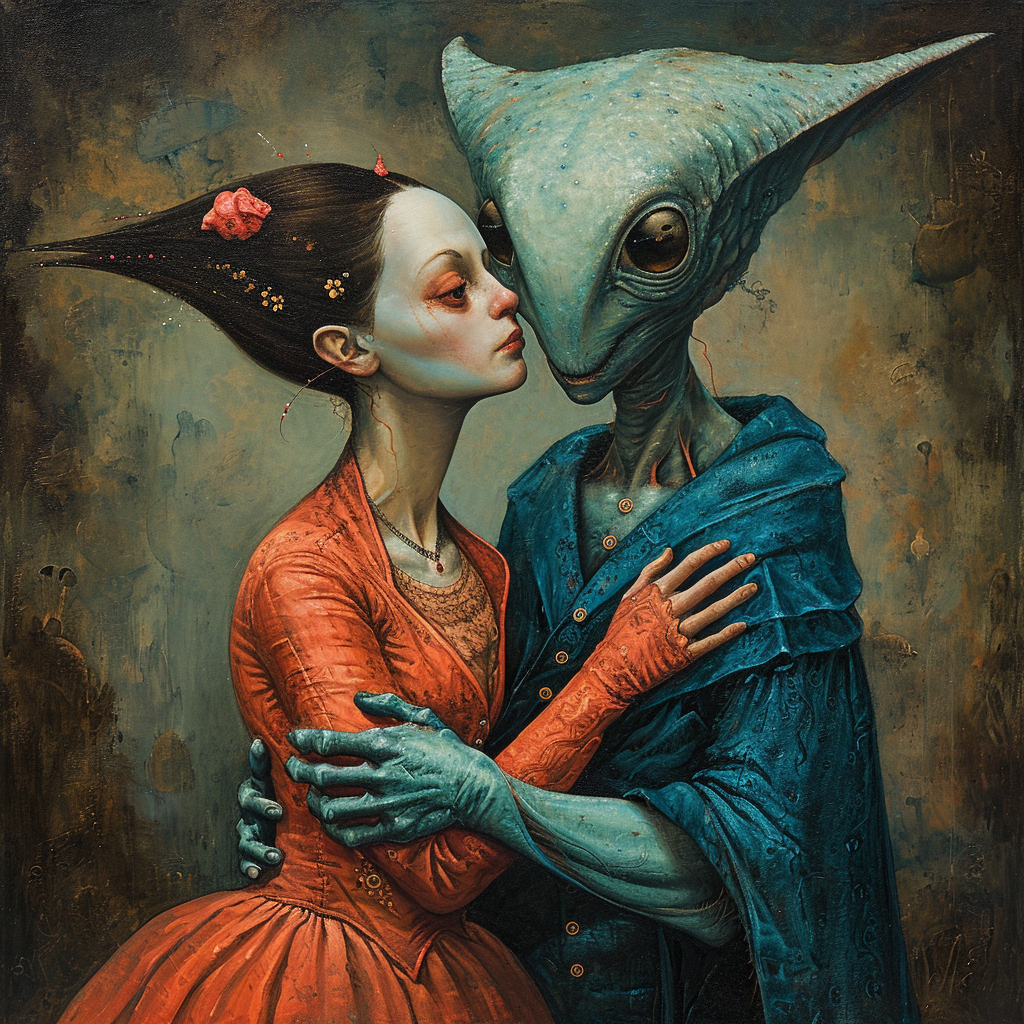
I asked on Twitter for recommendations to fiction (especially science fiction) that explored the issue of relationships with beings very different from ourselves. Here is the original thread where you can see all the people who contributed suggestions. I have not yet read many of these, so these are some of my Twitter followers’ recommendations, not my own. My personal favorite by the way is Solaris by the inimitable Stanisław Lem (although it doesn’t perfectly fit the original request, it’s relevant to the bigger context of the discussion). Enjoy! The context for this question is below the list.
- Bablet, Mathieu: “Carbon & Silicium”
- Brown, Pierce: “Red Rising”
- Butler, Octavia: “Bloodchild”
- Butler, Octavia: “Fledgling”
- Butler, Octavia: “Xenogenesis trilogy”
- Card, Orson Scott: “Speaker for the Dead”
- Card, Orson Scott: “Ender series”
- Chambers, Becky: “galactic commons”
- Chambers, Becky: “Long way to a small angry planet”
- Clark, Arthur C.: “Childhood’s End”
- Czerneda, Julie E.: “Survival”
- Delany, Samuel R.: “Stars in My Pocket Like Grains of Sand”
- Farmer, Philip Jose: “Strange Relations”
- Farmer, Philip Jose: “The Lovers”
- Goertzel, Ben: “A Secret Love Of Chaos”
- Gorov, K.: “Midnight Summer Sand”
- Harrison, M John: “Light”
- Heinlein, Robert A.: “Stranger in a Strange Land”
- Heinlein, Robert A.: “Time enough for love”
- Ishiguro, Kazuo: “Klara and the Sun”
- Le Guin, Ursula K.: “Left Hand of Darkness”
- Lessing, Doris: “The Marriages Between Zones Three, Four and Five”
- McEwan, Ian: “Machines like me”
- McCaffrey, Anne: “The Ship Who Sang”
- Miéville, China: “Perdido Street Station”
- Niven, Larry: “Ringworld”
- Piercy, Marge: “He, She, and It”
- Ryman, Geoff: “The Child Garden”
- Sheldon, Alice (James Tiptree Jr.): “All the Kinds of Yes”
- Sheldon, Alice (James Tiptree Jr.): “a momentary taste of being”
- Simak, Clifford: “Desertion”
- Simmons, Dan: “the Hyperion Cantos”
- Slonczewski, Joan: “A door into ocean”
- Smith, Cordwainer: “The Ballad of Lost C’Mell”
- Smith, Cordwainer: “The Game of Rat and Dragon”
- Stableford, Brian: “The Halcyon Drift series”
- Stapledon, Olaf: “Last and First Men”
- Stapledon, Olaf: “Starmaker”
- Swanwick, Michale: “Vacuum Flowers”
- Tchaikovsky, Adrian: “Children of Time”
- Tiptree, James Jr.: “The Girl Who Was Plugged In”
- Vonnegut, Kurt: “EPICAC”
- Weir, Andy: “Project Hail Mary”
- Zelazny, Roger: “Devil Car”
The reason I asked for this is that I was recently involved in a deep discussion (in the context of CSAS) about what it would take for an unconventional agent (an artificial life form, AI, hybrot, cyborg, expanded human, etc.) to be able to participate in a deep human-style relationship with us (love, friendship, etc.). We discussed differences and invariants across kinds of minds and agents of very different embodiments. We wanted to try to find principled strategies for striking a meaningful balance somewhere between the unsatisfactory opposite poles of the continuum: “only love your own kind” and objectophilia. This is becoming increasingly relevant with the developments of artifacts that talk and solve problems (AI), and the much broader context of diverse intelligences that span the spectrum from humans who are neurodivergent because of genetic and technological modifications to primarily engineered beings with or without human brain components. On a social and personal level, it becomes critical to understand how we will relate to beings that are different from us in some ways but not others. Of course, this is not the first time in our history that we face this dilemma, but the future version will be much more expansive than the one faced by our early ancestors in the days before our modern human lineage narrowed.
I’ve written some background to an academic discussion of the future of living in a world of manifest diverse intelligence (here, and here) and I am working on more detailed pieces on this around the necessity, for a deep relationship, of a kind of impedance match between the sizes of the cognitive light cones, and the degree of self-constructing multiscale vulnerability. Spoiler: while I do not think that today’s AI’s meet the criteria, I I think it’s quite possible to implement the same elements that biology exploits to produce real Selves with moral worth, in other media (i.e., the tinkering of evolution isn’t the only process that can result in true beings worthy of compassion etc.). Of course, this topic has been explored in literature for centuries if not longer, and so I wanted to augment the “left-brain” aspects of this discussion with some stories that speak to the heart. My guess is that in the end, these will prove more impactful in moving general perception away from our ancient and crumbling efforts to maintain superficial barriers and help overcome the inertia that constricts the radius of care.
(featured image at the top was produced by MidJourney)


Leave a Reply to Mirka Cancel reply