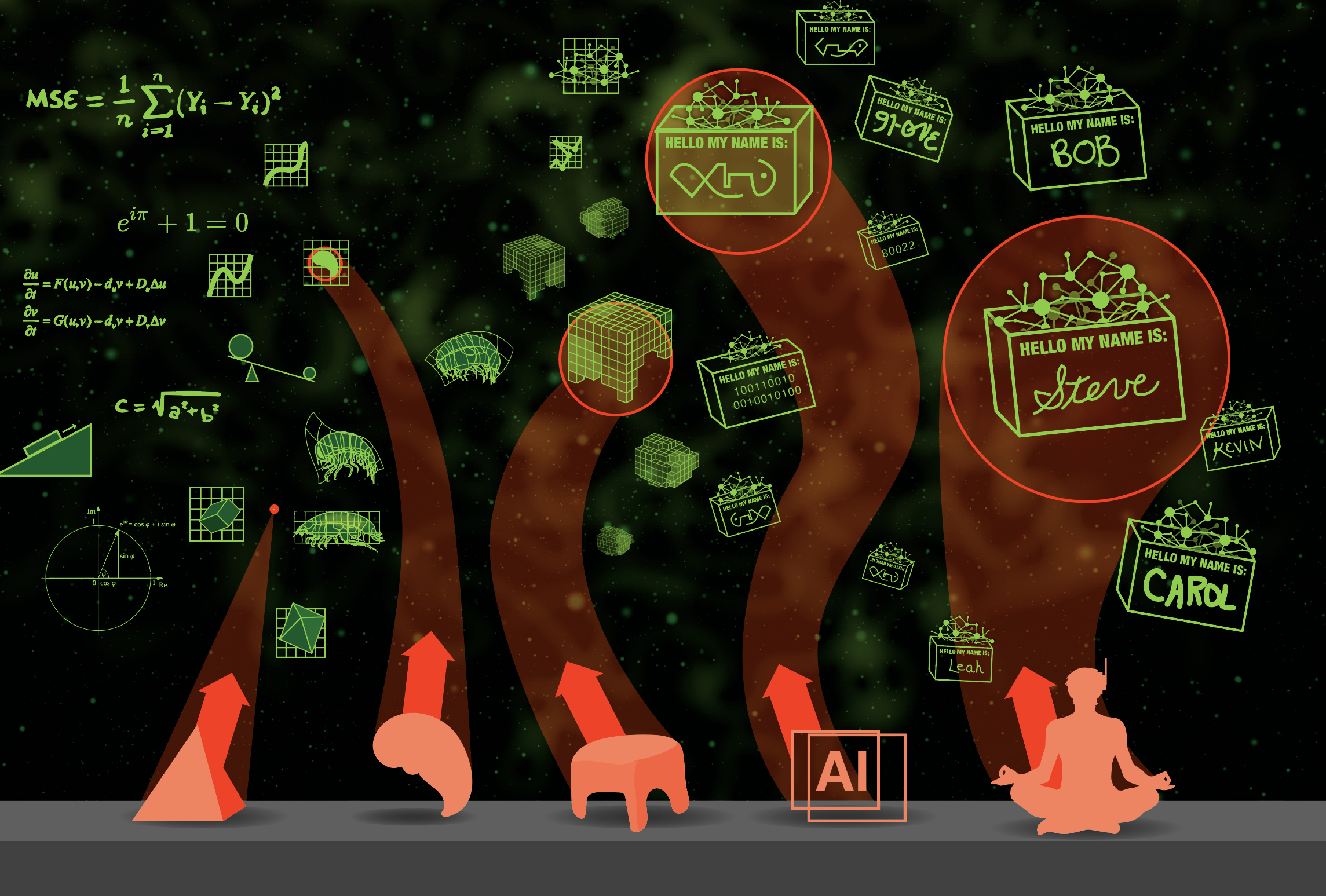

“Platonic Space” refers to a structured, non-physical space of patterns, such as the properties of mathematical objects, and perhaps other, higher-agency patterns that we detect as forms of anatomy, physiology, and behavior in the biosphere. Thus, the contents of this space may inform (in-form) events in our physical world, constraining physics and enabling biology. The concept of a space of specific information patterns that interacts with our world, but exists independently of it, is ancient.
Recent work in several disciplines has made exploration of this topic timely. I decided to hold what was, to my knowledge, the first interdisciplinary symposium on it. The intent was not to hew closely to the original conceptions of Plato and Pythagoras, but to use some of the deep ideas associated with these classical thinkers as a springboard for novel approaches to causal patterns across disciplines. We also hoped to go beyond “emergence” as an empirically fruitful framework for understanding where novel patterns come from and how the latent space of possibilities can be explored.
About the symposium
Hananel Hazan and I organized the symposium as an asynchronous event, with presentations taking place via telepresence, recorded or in real time, throughout fall 2025. The talks are collected on their individual pages below, with many also available in the public YouTube playlist. They are followed here by a series of recorded group discussions.
The symposium brought together philosophy, biology, physics, computer science, mathematics, and other fields that are not so easy to characterize. I hope it lowers interdisciplinary barriers, softens metaphysical priors that hold back some kinds of research, and leads to specific advances in several applied fields.
Questions and themes
The symposium set out to address:
- the nature of explanation in various fields, especially in mathematics, and what happens to an explanation when a phenomenon crosses multiple fields
- causation in various fields, especially in mathematics
- the philosophy of causation by non-physical causes
- examples of how the properties of mathematical objects determine outcomes in physics and biology
- where patterns of form and behavior come from in biology, physics, and other fields
- whether we can do better than “emergence” for the prediction and control of novel phenomena
- how these ideas can move empirical work forward in computer science, biology, and related fields, toward a research program
Introduction
What you’ll find here
There are 30 talks, in the order they were given, followed by 6 recorded discussion sessions. Each talk has its own page with a short introduction, the recording, and any slides or materials shared with it.
Talks
Presenter
Affiliation
Talk
Tufts University
MIT Connection Science
George Washington University
Cross Labs
University of Edinburgh
Institute of Discrete Mathematics and Geometry, TU Wien
Philosophy, Cosmology, and Consciousness Program, California Institute of Integral Studies
Embodied Cognitive Science Unit (ECSU) at the Okinawa Institute of Science and Technology (OIST)
Cornell University
University of San Diego
University of Melbourne
Brain Modeling Department, Neuroelectrics Barcelona
Department of Neurosurgery, McGovern Medical School, University of Texas Health Science Center
NIH
Yale School of Medicine
Indiana University Bloomington
Computational & Systems Biology, MIT
Discussion sessions
Perspectives
I think that modern physics has definitely decided in favor of Plato. The smallest units of matter are not physical objects in the ordinary sense; they are forms, ideas which can be expressed unambiguously only in mathematical language.
— Werner Heisenberg
Biology is the study of the larger organisms, whereas physics is the study of the smaller organisms.
— Alfred North Whitehead
Mathematics seems to endow one with something like a new sense.
— Charles Darwin
Further resources on Platonic space
Additional talks by Michael Levin:


Leave a Reply