Symposium on the Platonic Space

Published by

on

“Platonic Space” refers to a structured, non-physical space of patterns, such as the properties of mathematical objects, and perhaps other, higher-agency patterns that we detect as forms of anatomy, physiology, and behavior in the biosphere. Thus, the contents of this space may inform (in-form) events in our physical world (constraining physics, and enabling biology). The concept of a space of specific information patterns that interacts with our world, but exists independently of it, is ancient. Recent work in a number of disciplines have made exploration of this topic timely, and I have decided to hold the first (to my knowledge) interdisciplinary symposium on this topic. The intent is not to hew close to the original conceptions of Plato and Pythagoras, but to use some of the deep ideas associated with these classical thinkers as a springboard for novel approaches to casual patterns across disciplines. We also hope to go beyond “emergence” as an empirically fruitful framework for understanding where novel patterns come from, and how the latent space of possibilities can be explored.

Hananel Hazan and I are organizing it as an asynchronous event, with presentations occurring via telepresence, recorded or in real-time, throughout the Fall of 2025. All talks will be placed online here and below, as they are given (roughly one per week starting in September 2025), and be eventually followed by a series of real-time discussions online (this post will be updated as each new piece of content appears). You’re welcome to post questions in the Comments section below – these will be offered to the participants to address in the discussion session at the end of the symposium.

Represented will be philosophy, biology, physics, computer science, mathematics, and other fields that are not so easy to characterize. I hope that it will result in a lowering of interdisciplinary barriers, a softening of metaphysical priors that hold back some kinds of research programs, and specific advances for research programs in several applied fields. Here is the current roster (subject to change, especially expansion):

PresenterAffiliationURLTitle
Michel LevinTufts Universityhttps://www.drmichaellevin.org/Platonic Space and Biology: understanding evolved, engineered, and hybrid embodied minds
Joel DietzMIT Connection Sciencehttps://connection.mit.edu/people/joel-dietz/Radical Platonism and Radical Empiricism: Network Analysis of Testable Platonic Hypotheses in Contemporary Science
Olaf WitkowskiCross Labshttps://olafwitkowski.com/tba
Mariana Valdetaroindependenthttps://mvtta.github.io/posts/resume/resume.htmlIs Mathematics Animated?
Lucy SpouncerUniversity of Edinburghhttps://lucyspouncer.uk/Abstraction is Organic
Lauren RossUniversity of California, Irvinehttps://sites.socsci.uci.edu/~rossl/Explanation in Biology: principles and pragmatics
Chris FieldsAllen Discovery Center, Tuftshttps://allencenter.tufts.edu/christopher-a-chris-fields-ph-d/ From Experience to Math
Akarsh KumarMIT CSAILhttps://akarshkumar.com/Questioning Representational Optimism in Deep Learning: The Fractured Entangled Representation Hypothesis
Juan P. AguileraInstitute of Discrete Mathematics and Geometry, TU Wienhttps://juan.ag/The Platonic Conception of Mathematics and its Consequences for Mathematical Practice
Blaise Agüera y ArcasGoogle Researchhttps://en.wikipedia.org/wiki/Blaise_Ag%C3%BCera_y_ArcasFunctions As Forms: From Computation to Agency
Matt SegallPhilosophy, Cosmology, and Consciousness Program California Institute of Integral Studieshttps://footnotes2plato.com/about-me/Whitehead on the Ingression of Novel Form: Toward a New Formal Causality in the Life Sciences
Tom FroeseEmbodied Cognitive Science Unit (ECSU) at the Okinawa Institute of Science and Technology (OIST)https://www.oist.jp/research/research-units/ecsu/tom-froeseThe Geometry of the Mind-Body Interface: Reinterpreting Platonic Forms as Informational Operators
Jack Morris & Rishi JhaCornell University https://rush-nlp.com/Universal Embeddings
Sam A. SenchalIndependent Researcher https://github.com/SASenchal/Observer-Theory-ExtensionObserver Theory
David ResnikNIHhttps://en.wikipedia.org/wiki/David_ResnikMathematics, morphogenesis, and metaphysics: thinking about Platonic space in biology
Iain McGilchristAll Souls College, Oxfordhttps://channelmcgilchrist.com/home/Spherical Causation
Brian CheungMIThttps://briancheung.github.io/The Emergence of Convergence in Different Levels of Biology and AI
Timothy JacksonUniversity of Melbournehttps://scholar.google.com/citations?user=vOnot8oAAAAJ&hl=enThe ontogenetic alternative: “Platonism”, khôric mater(ial)ism, and open-ended evolution
Giulio RuffiniBrain Modeling Department, Neuroelectrics Barcelonahttps://giulioruffini.github.io/#gsc.tab=0The Algorithmic Weltanschauung:
An Algorithmic, Platonic Perspective
Elliot MurphyDepartment of Neurosurgery
McGovern Medical School
University of Texas Health Science
Center
https://scholar.google.co.uk/citations?user=4AYNRj0AAAAJ&hl=enPlatonic Forms in the Study of Language and Mind
Denis NobleOxford Universityhttps://www.dpag.ox.ac.uk/team/denis-nobleMathematics justifies the Metaphysics in Biology
Darren IammarinoUniversity of San Diegohttps://scholar.google.com/citations?user=YNrxRaYAAAAJ&hl=enExploring an Ever-Growing Platonic Space and the Entities that Enrich it
Karl FristonUniversity College, Londonhttps://www.fil.ion.ucl.ac.uk/~karl/ On the (Platonic) Nature of Things
Gordana Dodig-CrnkovicChalmers University of Technologyhttps://www.gordana.se/Platonic Space as Cognitive Construct
Douglas BrashYale School of Medicinehttps://scholar.google.com/citations?user=QHCv7ZIAAAAJ&hl=enAbstract Forms & Tangible Biology – palanquins, princes, and a LEGO hypothesis
Jacob FosterIndiana University Bloomingtonhttps://scholar.google.com/citations?user=dpuY5hkAAAAJ&hl=enThe Evolution of Ideal Objects: Toward Cultural Morphodynamics

Topics that we hope to address include:

  • the nature of explanation in various fields, especially in math, and what happens to “explaining” a phenomenon when it crosses multiple fields
  • causation in various fields, especially in math
  • the philosophy of causation by non-physical causes
  • examples of how the properties of mathematical objects determine outcomes in physics and biology
  • where do patterns of form and behavior come from in biology, physics, etc.
  • can we do better than “emergence” for prediction and control of novel phenomena?
  • how to use these ideas to move empirical work forward in computer science, biology, etc. – toward a research program

An introduction can be seen here:

Talks:

1) Michael Levin – “Patterns of Form and Behavior Beyond Emergence: how Platonic Space in-forms evolved, engineered, and hybrid embodied minds”

The first half introduces the biological examples and data that motivate the applicability of the Platonic Space framework in a field where molecular genetics is thought to be sufficient. Skip to ~47th minute to see the Platonic Space ideas themselves.

Also, here’s a simplified 1-page argument highlighting my specific claims, and some discussion (~17 minutes total) of the implications and research program:

2) Joel Dietz – “Radical Platonism and Radical Empiricism: Network Analysis of Testable Platonic Hypotheses in Contemporary Science”

3) Alexey Tolchinsky – “Patterns and Explanatory Gaps in Psychotherapy (does God place dice?)”

4) Benjamin Lyons – “The Historical Construction of Normativity in Mathematics”

5) Olaf Witkowski – “Substrate-dependent mathematics hypothesis”

6) Mariana Emauz Valdetaro – “Is Mathematics Animated?”

Downloadable material for Mariana’s talk:

7) Lucy Spouncer – “Abstraction is Organic: translating mathematical patterns through the literary substrate”

8) Lauren N. Ross – “Explanation in Biology: principles and pragmatics”

9) Chris Fields – “From Experience to Math”

10) Akarsh Kumar – “Towards a Platonic Intelligence with Unified Factored Representations”

11) J. P. Aguilera – “The Platonic Conception of Mathematics”


12) Blaise Agüera y Arcas – “Computational Symbiogenesis”

13) Matt Segall – “Whitehead on the Ingression of Novel Form: Toward a New Formal Causality in the Life Sciences”

14) Karl Friston – “On the (Platonic) Nature of Things”

15) Tom Froese – “The Geometry of the Mind-Body Interface: Reinterpreting Platonic Forms as Informational Operators”

16) Iain McGilchrist – “Spherical Causation” (audio only)

17) Denis Noble – “Maths Justifies Metaphysics in Biology”

18) Rishi Jha and Jack Morris – “All AI Models Might be the Same: harnessing the universal geometry of embeddings”

19) Sam A. Senchal – “Observer Theory” (see also this paper)

20) Darren Iammarino – “Exploring an Ever-Growing Platonic Space and the Entities that Enrich it”

21) Timothy Jackson – “The ontogenetic alternative: “Platonism”, khôric mater(ial)ism, and open-ended evolution”

22) Giulio Ruffini – “The Algorithmic Weltanschauung: An Algorithmic, Platonic Perspective”

23) Elliot Murphy – “Platonic Forms in the Study of Language and Mind”

24) David Resnik – “Mathematics, morphogenesis, and metaphysics: thinking about Platonic space in biology”

25) Gordana Dodig-Crnkovic – “Platonic Space as Cognitive Construct”

26) Brian Cheung – “The Emergence of Convergence in Different Levels of Biology and AI”

27) Douglas Brash – “Abstract Forms & Tangible Biology – palanquins, princes, and a LEGO hypothesis”


“I think that modern physics has definitely decided in favor of Plato. The smallest units of matter are not physical objects in the ordinary sense; they are forms, ideas which can be expressed unambiguously only in mathematical language.” – Werner Heisenberg

“Biology is the study of the larger organisms, whereas physics is the study of the smaller organisms.” – Alfred North Whitehead

“Mathematics seems to endow one with something like a new sense.” – Charles Darwin


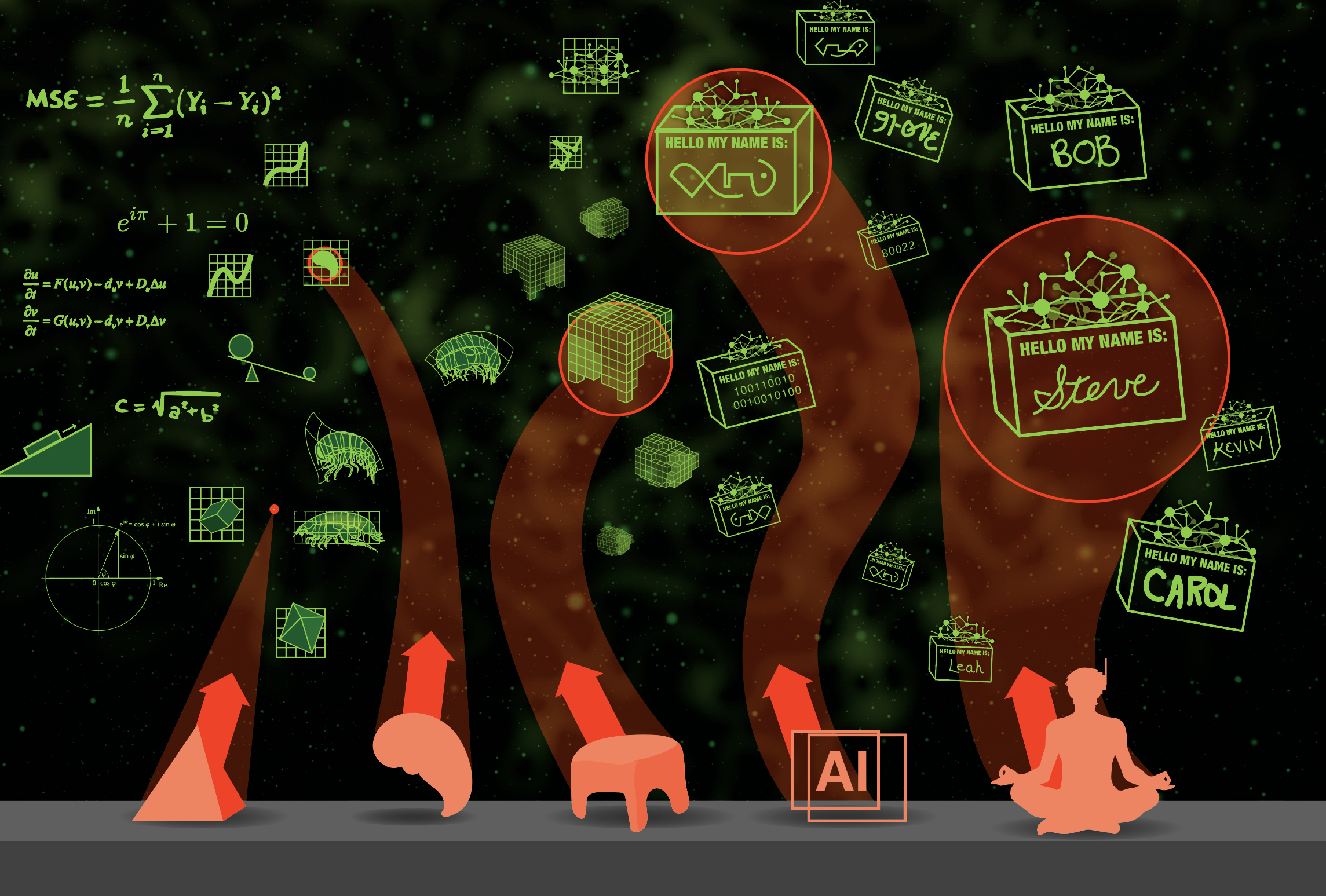
Featured image courtesy of Jeremy Guay of Peregrine Creative.

269 responses to “Symposium on the Platonic Space”

  1. Doina Contescu Avatar
    Doina Contescu

    Looking forward to this amazing series! fyi there’s a small typo here: “Topics we hope to address inclide:- Copied from thoughtforms.life”

    1. Mike Levin Avatar
      Mike Levin

      thanks!

      1. Mr Godspower Avatar
        Mr Godspower

        Hi sir. It’s an honour to see you. I heard about your success in regenerative medicine and cellular reconstruction. I want to encourage you to keep going strong. You might just make the biggest difference in humanity. Also stay safe out there. There are always haters from the genesis. Guard your work.

      2. Rama Ganesan Avatar
        Rama Ganesan

        Where’s David Resnik talk please?

        1. Mike Levin Avatar
          Mike Levin

          It’ll be up next week – it hasn’t been given yet!

  2. Ben Moskowitz Avatar
    Ben Moskowitz

    This looks so great! So many interesting and diverse concepts all coming together for this. It seems like biology and other fields are finally crossing over more with other domains such as physics and philosophy, which I believe is something the space has been missing. I’m very much looking forward to attending and seeing more things like this in the future!

  3. Tejvir Mann Avatar
    Tejvir Mann

    Hi Mike,

    Will there be a zoom link for the real time discussion? Is it in-person? Can the audience ask questions? Is there a time already scheduled for it? Thanks.

    1. Mike Levin Avatar
      Mike Levin

      The time is not yet scheduled. I’m guessing there will be more than one because the time zones of the participants make it very hard to have everyone. We may have one for the public, but at the very least I’ll invite the public to submit questions for speakers to address.

  4. William J McCartan Avatar

    Awesome Mike

    Really looking forward to hearing about these discussions in the coming months, nice cross section of collaborators as well, it will be interesting to see where this journey takes everyone involved. Thank you for continuing to share your time, work,knowledge and experience, Mike

    Hope you and your family had a great summer, cheers

  5. Larry Green Avatar

    this is a very exciting project Michael. I’m a psychotherapist with over 50 years experience. your work which finds an underlying pattern that generates both cognitive and biological development, produced feelings of euphoria in me. Some sort of wholeness is being evoked.

  6. Alex Avatar
    Alex

    Good day, Michael
    Our team is working on a topic similar to yours. Bioelectricity and its role in rejuvenation, life extension, longevity, and disease treatment. The positive results we have obtained from our human experiments support our hypotheses and your work in these areas. We would be delighted to collaborate with you on this project. Perhaps this will be your Nobel Prize.
    Sincerely,
    Alex Reznikov

    1. Mike Levin Avatar
      Mike Levin

      Hi Alex. Thanks; I can’t look at anything that is not public but if you have a link to published work, I’ll check it out.

  7. Christopher Judd Avatar

    I understand and I am as guilty as the next of being so wrapped up in my own theories I do not have the time or sometimes the inclination to look at others but have any of you advocates of Platonism actually took time out to look at Holowave Ontology at http://www.quantumconsciousnesstheory.com. This framework has been work in progress for a while now but is stable at its core postulates with the roots taken from A N Whitehead’s realm of potentiality, revisions to Whitehead’s mistaken placement of the potential in space-time (due to the then unrecognised non-locality and of course his theistic view of God. Mathematical patterns must be behind our and very likely other beings.

    1. Richard Watson Avatar

      “reality is a Recursive Universal Waveform (RUW)—a conscious, mathematical medium whose activity is recursive self-harmonization”
      Well, that sounds right to me.
      “it is strict materialism that relies on ever-more miraculous and inexplicable assumptions to explain away anomalous data.” agreed.
      “If you are already convinced that materialism is an inadequate framework for explaining reality”… For me, it is enough that we cant explain biocomplexity. I am consciousness-curious (not ready for ESP, NDE yet).
      “a deeper, self-referential symphony of mathematical harmony? The Recursive Universal Waveform (RUW) proposes that consciousness, physics, and even time itself emerge from an atemporal ocean of pure potential—where the universe ‘thinks’ itself into existence through recursive self-harmonisation” that sounds right 🙂
      “only perfectly stable, self-consistent patterns (Invariant Recursive Patterns or IRPs) are selected for manifestation” that doesnt sound quite right – there can be resonant standing waves that have almost categorical distinctiveness from travelling waves, but in general, patterns can persist for longer or shorter periods, and its all part of the symphony.
      Reject locality and realism: OK so far.
      Something is bubblng up in me. A sort of symmetry. Like there must be a symmetry between the flowing subjective process and the static objective structure. So, when a theory wants to really grapple with subjective experience, it needs a super complex mathematical structure to complement it. The structure is the universal potential, and the subjective experience is something like a ride on that structure (you say “bridge its atemporal state to our dynamic experienced reality”). I think thats where this holowave theory is going, and Don Hoffman, and me (with songs). Its like there is a pulling apart of subjective and objective, creating a little space between them, and a symmetry between the two…. Lets read on.
      “,,,the capacity …to encode all possible structural rules, retain only those achieving fixed-point convergence under recursive self-reference, and (holographically) project stable subsets as manifested realities” – well, that still sounds right to me. Its kinda poetry to me, at this stage of reading, but it has the same feel as my way of thinking.
      “These patterns exist in pure potentiality—like unplayed musical scores—until projected into manifested realities” – makes sense to me.

      “Each Holon is a whole—a complete, self-referential state of potential—and a part—fundamentally interconnected with all other Holons, constituting the larger whole of the RUW. This part-whole nature is the source of their intrinsic proto-consciousness.” yes, still yes from me.

      “their “interconnectedness” means the state of one implicitly contains information about all others. This is not communication but innate, instantaneous correlation” also yes. Like they share a common underlying fundamental – or ‘written in the same key’.

      “A simple waveform interaction creates a new, more complex waveform, which then becomes the input for further recursive interactions.” songs, sub-songs, and meta-songs – all part of one unversal song, and yet simultaneously self-contained (for a given timescale).

      Laws: Im ok with the stable and the unstable. I dont like the selection/filtering metaphor. Id prefer ‘what is visible to me is what resonates with me’ without implication that there is a set of others that didnt make it or failed to survive/persist.

      “IRPs naturally form resonant relationships with other stable IRPs. This is not a conscious seeking but a mathematical attraction—an inevitable consequence of their interconnectedness and shared stability” Yes (I change IRP for song)

      “Reconciling the Unchanging with the Process” – ooh, nice.
      btw, are you familiar with Stu Kauffman’s ‘Res Potenia’ and ‘Res Extensa’?

      “The RUW is the integrated, holistic set of all possible relational potentials.” The universal song is … all possible intervals/relations/actualisable-songs.

      “an infinite symphony where every note adjusts itself in real time to create perfect harmony” …and never reaches it because in so moving it creates new intervals, new notes that themselves become participants, adjusting and harmonising – so its a ceasless flow not a thing with a beginning and an end.

      “Think of it like a hall of mirrors where reflections keep refining themselves until only the most stable, self-consistent images remain.” I dont like the finiteness, the end-goal feeling of this. I think that as some things come into focus, other things are sent back into pure potential, so the process flows on…. Like attention roving over reality, drawing parts of it into focus, but simultaneously letting other parts go so that they may manifest anew in ways not previously conceived.

      chords and melodies – yes.

      “The thought projects into awareness via holographic encoding (like a radio tuning to a station).” yes, thats the only way it can be. Likewise, the organism is a manifestation tuning into universal song resulting in physical form. The genetics is, at best, the hardware of the radio. The organism is the song it picks-up.

      “A rock, a tree, a dog, and a human are all the RUW interacting with itself; they differ not in the fact of their resonance, but in the complexity of the conversation they are able to have. The “interaction problem” is dissolved—there is only the RUW in continuous, recursive dialogue with all its manifested aspects.” Yes, very Vedic.

      “Harmonic Idealism” Nice.

      “Interconnectedness”, “Transcendent Experience”, “Participatory Purpose” – also good.

      Internal and external harmony – meaning. Also good.

      L/R hemispheres – also good.

      OK, great. Very Vedic – which appeals to me (seems like the only view that makes sense to me). Also lots of resonance and musical principles – also appeals to me (https://www.richardawatson.com/songs-of-life-and-mind). Especially, manifestations as projections (tuning-in) to truths already there. The way it reimagines the interaction of physics with experience, great.

      So…. now what?

      I want to build something that works. A working model. To unify shape and form, development and evolution, cognition and adaptation – all as songs within songs. The bit that I can contribute, I think, is a working model of how to do cognition with songs. A song is (amongst other things) a programme that draws a perspective (also a song) out of another programme (also a song) via resonance, naturally. I think I can make this computationally universal – but do so in a way that retains the meaning of the artifacts – not just empty symbols. [shrug] I dunno. Thats what Id like to do.

      One deep problem I have is a sort of AI crisis. If Im right, and it works, it’ll be an amazingly powerful substrate for AI. So, Hoorah!… But I dont want to build an an amazingly powerful substrate for AI. So, Boo!….. For me its science (with meaning), not an engineering project. Like ideally, I guess I want to build it, and then I just want people to look at it, _get it_ deeply, and then say – ‘oh right – _thats_ what I am, and _thats_ what this life means.’ Then turn off this new AI and be kind to one another – to participate in creation. More likely, they are going to want to use it for profit and extortion and destruction – like the graspy ignorant frightened egos that they are. Which makes me want to not do it at all. [Sigh] (which is also easier because, although I have deep ideas about how to do it (if I say so myself), I dont _really_ know how to do it (yet). What a beautiful song-journey this is 🙂 <3 ).

      1. Christopher Judd Avatar

        Richard,
        I am deeply grateful for your analysis and being brain tired today will reflect on your points and where deemed necessary will revise. Kindest Regards
        Chris Judd

      2. Christopher Judd Avatar

        Have reflected on your comments. You will note if you look I have articulated now a more monist use of language and adopted the free flowing experiential element as opposed to selection which is something I hadn’t focused on. I truly appreciate your comments, feel free to get in touch at any time we are all on the same side here and egos have to be kept in check. Humanity is in desperate need of a unifying theory.

    2. Matt Segall Avatar

      Great that you are drawing on Whitehead, but can you say more about “Whitehead’s mistaken placement of the potential in space-time” and “unrecognised non-locality”? That does not track at all with my understanding of his realm of eternal objects, which he very clearly says is not in spacetime, since spacetime itself is an abstract field of relational potential (one subset of the full breadth of possibilities that could have been actualized in a given cosmic epoch). Similarly, he goes to great lengths to criticize the classical physics idea that he labels “the fallacy of simple location” in his 1925 book Science and the Modern World.

      1. Christopher Judd Avatar

        Mat. You are absolutely right. I must apologise; I was relying on an AI-generated summary of Whitehead’s position to quickly draw a contrast, and it clearly provided a flawed synthesis that misrepresented his clear and well-defined separation of the eternal objects from spacetime. My criticism was based on a false premise. My ontology was formulated from very near a clean slate as I am not that impressed with any existing Ontology and at my age do not see the virtue in terms of my goals. Save as to say what little I do know about Whitehead I like in principle and I think he was nearer the money than all else at the time and for a long way after his passing.

        This is actually excellent news for me, as it reveals that the Holowave Ontology’s framework is far more aligned with Whitehead’s thinking than I initially presented. The RUW’s non-local, atemporal domain of potential (populated by IRPs) seems to be a direct conceptual parallel to his realm of eternal objects. And the process of instantiation, where a stable pattern is selected for manifestation within a spacetime context, seems analogous to the ingression of an eternal object into an actual occasion.

        My core intended contrast was less about the location of the potential and more about the mechanism of selection. Where Whitehead invokes God’s primordial and consequent natures, I am proposing a impersonal, mathematical mechanism of recursive self-harmonisation driven by an intrinsic experiential spectrum. But on the fundamental nature of potential itself, I thank you for pointing out that we are in agreement. It’s a valuable lesson in not trusting AI for nuanced philosophical history!”

    3. Nathan Sweet Avatar
      Nathan Sweet

      Christopher,

      Following this exchange, I examined your website as you requested in your comment. Several methodological concerns emerged that I believe merit addressing, particularly given your acknowledgment to Matt Segall about relying on AI-generated summaries of Whitehead’s philosophy.

      On September 3rd, you wrote to Matt:

      “I must apologise; I was relying on an AI-generated summary of Whitehead’s position to quickly draw a contrast, and it clearly provided a flawed synthesis that misrepresented his clear and well-defined separation of the eternal objects from spacetime. It’s a valuable lesson in not trusting AI for nuanced philosophical history.”

      This admission is concerning because the pattern appears to continue in your November 10th response to me. You’ve:

      Characterized my framework as claiming experience “arises from matter” (I never claimed this, my thermodynamic monism argues experience is intrinsic to constraint satisfaction via enactive cognition, not emergent from inert substrate, your framing creates the very dualism I categorically reject and Dennett dismantles)

      Dismissed thermodynamics as unable to explain consciousness (ignoring Friston’s Free Energy Principle, Deacon’s teleodynamics, Thompson’s enactive cognition, and Kauffman’s constraint closure: all peer-reviewed, empirically grounded frameworks)

      Misrepresented my argument about Platonism and thermodynamics (I never claimed they’re mutually exclusive, I argued Platonism fails parsimony, provides no novel testable hypotheses beyond thermodynamics, remains unfalsifiable, and gets weaponized by ID/Creationist organizations funding anti-scientific advocacy, all points you evaded with personal attacks and strawman arguments)

      Asserted on your website that materialism must “explain away robust data—like veridical Near-Death Experiences—through denial, not refutation” (quantumconsciousnesstheory.com), yet the June 2025 Scientific American study tested 53 cardiac arrest survivors and found zero confirmed cases of veridical perception, this is empirical refutation, not denial.

      These characterizations bear the hallmarks of AI-generated arguments rather than direct engagement with source material.

      I never claimed experience “arises from matter.” My thermodynamic monism argues experience is intrinsic to constraint satisfaction via enactive cognition (Varela & Maturana, 1980s; Thompson, 2007), not emergent from inert substrate. This is process ontology, not substance dualism—a distinction you would recognize had you engaged with the actual framework.

      Thermodynamics + enactive cognition provides robust models of consciousness (Friston’s Free Energy Principle, Deacon’s teleodynamics, Kauffman’s constraint closure). These are peer-reviewed, falsifiable frameworks that don’t require invoking unfalsifiable metaphysical realms.

      The “robust data” about NDEs has been comprehensively addressed in recent neuroscience. A June 2025 study in Scientific American tested 53 cardiac arrest survivors for veridical perception—zero confirmed cases. The neuroscience now provides complete explanations via disinhibition without requiring consciousness-first assumptions.

      When Matt Segall corrected you, a recognized and world respected Whitehead scholar, you immediately apologized and acknowledged your error.

      This pattern raises a deeper question: How can Holodynamic Ontology claim to be “testable” when:

      Your website states it makes “novel, falsifiable predictions,” yet provides none with success/failure criteria, where’s your test data? Failure modes? Anything?

      You’ve acknowledged revising “core postulates” based on blog comments (August 28th: “free flowing experiential element as opposed to selection which is something I hadn’t focused on”), this shows your framework does not have solid axioms.

      You present claims about NDEs and remote viewing as “robust data” while dismissing contrary peer-reviewed research as “denial”. On what grounds?

      Your website also invokes Asch conformity studies to position yourself as the brave truth-teller against “sterile materialism maintained by conformity and failure of intellectual courage.” This is textbook epistemic authoritarianism, framing disagreement as moral/intellectual failure rather than substantive critique.

      Academic discourse requires:
      Primary source engagement, not AI summaries
      Stable definitions before making grand claims
      Falsification criteria before claiming testability
      Peer review, not blog validation

      Intellectual honesty applied consistently, not selectively based on interlocutor status

      You’ve demonstrated this capacity with Matt Segall. I’m simply asking you extend the same intellectual honesty here.

      If you believe thermodynamics cannot explain consciousness, engage with Friston (2010, 2019), Deacon (2011), or Thompson (2007) directly, don’t rely on AI-generated strawmen. If you believe your framework is falsifiable, specify one experiment that would disprove it. If you believe NDEs refute naturalism, address the 2025 Scientific American study directly rather than dismissing it.

      The issue isn’t whether Holodynamic Ontology might have interesting insights, it very well might. The issue is presenting unfalsifiable metaphysics as peer-reviewed science, using AI-generated arguments to attack alternatives you haven’t engaged with, and applying different standards of rigor depending on your interlocutor’s perceived authority.

      Moving forward, I suggest focusing on what would make Holodynamic Ontology scientifically productive: testable predictions, peer review submission, and substantive engagement with existing frameworks rather than strawman dismissals.

      Does this sound charitable?

  8. chrisgjudd Avatar
    chrisgjudd

    Hi Guys I am as guilty as the next man of being so obsessed with my own thoughts and theories not to give credence or time to others but I really hope those advocating Platonic type theories would take a look at holowave ontology. This basically takes Whiteheads process theology revises his incorrect placement in spsce-time (non-locality not proven then) and revises his theistic God for a self bootstrapping mathematical / conscious potential realm. It ticks all the boxes including I hope yours, anyway at least take a look at it.

  9. Vicente Sanchez-Leighton Avatar

    You could invite Roger Penrose.

    1. Mike Levin Avatar
      Mike Levin

      I am certainly going to. But he’s in his 90’s and generally not taking on new activities, we’ll see.

  10. Em M. Lenartowicz Avatar
    Em M. Lenartowicz

    I’m all ears already! 🙂

    A connection I would love to see in the future is between your work, Michael, and Thomas Metzinger’s conceptualisations of OBE. Such cognitive/electric pattern states seem to be a mind’s path to traverse these Platonic spaces experientially…

  11. Dil Green Avatar

    I studied Architecture, in part with Christopher Alexander, whose work is almost an independent research discovery of complexity and self-organisation on the basis of a single minded ambition to understand how to make beauty through architecture.He published ‘A City is not a Tree’ in 1965, ‘A Pattern Language’ in 1977, and ‘The Nature of Order’ in 2003/4.

    I am putting this comment here because Alexander does something in ‘A Pattern Language’ which I have not seen elsewhere in complexity work, which speaks to the quest to get more concrete about ’emergence’.

    Among other things, APL is an attempt at a self organising knowledge architecture which encourages structure to emerge.

    Unlike a wiki (also inspired by Alexander’s work), links from a pattern to other patterns (which are ‘first class citizens’ of the pattern) are ‘directional’,

    The pointing is either in the direction of patterns of larger scope (cybernetic variety, to be more formal) to which the pattern in focus believes contributes, or toward patterns of smaller scope, which the pattern in scope suggests support its own viability. The pointers propose a network graph which organises along an axis of variety.

    Thus the patterns in APL are grouped in three sections – Towns, Buildings, Construction, which map roughly onto ’emergent’, ‘complicated’, ‘simple’.

    This allows purposeful traversal of the graph, for instance starting with what is known about an apparently ’emergent’ property like, say “The distribution of towns” (https://www.iwritewordsgood.com/apl/patterns/apl002.htm) and tracing the explicit pathways to knowledge about scopes with lesser variety across the knowledge graph.

    I am proposing, in a small project, adding an orthogonal axis to ‘variety’, – ‘abstraction’. This would allow knowledge nodes to point at less and more abstract nodes with the same context.

    Later, in ‘The Nature of Order’, he proposed fifteen underlying topological/geometric ‘properties’ – which I certainly found useful in architectural design, but make no claims for as deep underlying principles with mathematical qualities (Alexander believed that this was so, but had long since moved away from his original discipline in math).

  12. Alexey Tolchinsky Avatar

    Sounds wonderful. Very much look forward to. If a perspective of psychotherapy/clinical psychology can be useful, and there’s a spot to present, I’d be happy to.

    Thank you

  13. Rik Lubking Avatar
    Rik Lubking

    The human mind is arguably the most dynamic and adaptive self-organising system we know of, closely followed by human culture.

    An exploration of cognitive and psychological/sociological archetypes and mythological motifs would seem to be a logical extension of this topic.

    A Jungian space of forms, if you will, which would complement a Platonic space of forms, forming a duality of social/transitory and functional/eternal archetypes/forms.

    In the sense that say the archetypes of mother and father, cooperation and competition, or in-group and out-group (to name only a few) to biology are nearly as fundamental and essential as physics and mathematics.

    Dealing with psychology and sociology (historical and current) arguably requires special care. I hope you can also find a group of people to handle such discussions.

    Off the top of my head, I’d recommend John Vervaeke (and/or Iain McGilchrist), I wonder how much Mark Solms knows about Jungian archetypes, and I’d think that Karl Friston could keep such a conversation grounded. A missing ingredient would be game theory, which could explain many of the attractors that “emerge” in adaptive (cognitive/psychological/sociological) landscapes.

    Just a thought, I understand if you’re more focussed on the mathematical aspect.

    In any case, fascinating stuff, thanks for sharing.

    1. Mike Levin Avatar
      Mike Levin

      yep!! they are definitely on the invitee list. We’ll see how it goes. John Vervaeke I’ve spoken to before and am speaking with again soon. thanks!

  14. S.A. Senchal Avatar

    This sort of program is a fantastic way to broaden the discussions of all the above subjects from point in time mathematical constructions (think theory’s and formulas in physics / chemistry) to computational process models.

    Generally, for platonic space to have any formal causation structure, it needs to share a language of discourse with the hard sciences.

    Abstractions of computational universes, like the Ruliad (itself a meta-theory), lend themselves well to these discussions. It has enough computational scale to encode these sorts of structures and a formal and proven (at least in category-theoretic terms, though the low level functions are currently mostly underspecified or unspecified).

    Generally, my position is that these topics all narrow to the following question:

    How do Observers interact with and impact reality?

    When we measure these spaces or sample there patterns we need to know that it is at some level directed connected to the physical world (otherwise we lose causal closure in this type of model which becomes combinatorially explosive and breaks the finite computational power of i. us ii. physical systems iii. universe)

    https://t.co/Byd0eXxsWa

    Is a model of Observers and how they sample these types of spaces. This details this sort of position in full and provides a few conjectures and hypotheses on how to test these sorts of positions.

  15. Alex Naumenko Avatar
    Alex Naumenko

    The topics are so resonating with my paper. Consider adding those ideas to your research – https://papers.ssrn.com/sol3/papers.cfm?abstract_id=5381816

  16. chrisgjudd Avatar
    chrisgjudd

    Michael, your work brilliantly reveals a universe built not on inert matter, but on cognition and goal-directed agency. This is a monumental shift, but it invites a deeper question: what is the source of these goals?
    I propose that the next step is to embrace a broader metaphysics that can house your findings. Holowave Ontology seems a prime candidate. It posits a Recursive Universal Waveform (RUW)—an atemporal ocean of all possible stable, mathematical patterns. Your “morpho space” maps directly to this realm of potential forms.
    Your biological agents aren’t generating goals ex nihilo; they are resonating with invariant patterns (IRPs) within the RUW. Bioelectricity isn’t just a computer; it’s a resonant receiver, holographically projecting these non-local “Ideas” into spacetime.
    This is where the challenge—and opportunity—lies for our community. Many of us are building pieces of this new ontology, but our models are often siloed by discipline and, frankly, ego. Your biological framework provides the undeniable empirical validation. Holowave provides the overarching metaphysical embodiment it requires.
    Uniting these perspectives is the task ahead. It offers a complete picture: a conscious, mathematical universe articulating itself through goal-driven biological agents. Your work is the proof; a neo-Platonic Holowave framework is the natural home for it.

  17. chrisgjudd Avatar
    chrisgjudd

    Michael and everyone. What would be nice if a few could correlate a coherent theory, then purge the jargon and make it accessible to the public as a catalyst for coming together. Michael Levin’s et al Biological work + Iain McGilchrist’s Hemisphere work + Holowave Ontology to give it the necessary meta physics. On our own my question is what is the point, being clever is left brained without be balanced with humility and unity of purpose.

    1. Mike Levin Avatar
      Mike Levin

      For many of us, the goal is progress in specific tangible areas. Many people have theories but what’s critical is to get theory to the point where it intersects with the physical world (for example, driving applications in medicine, ethics of relating to novel beings, etc.). I have been thinking about these ideas for 30+ years but never spoke publicly about them until last year, when it finally became actionable (i.e., impactful for driving new discoveries, amenable to experiments). It’s really hard to get to that point, for any theoretical framework. Our primary purpose here is not just to bring ideas to the public – there is an almost infinite amount of interesting theory, philosophy, spiritual texts, etc. which are available to the public; adding to that mountain will not move the needle for the kinds of improvements we want to see. Our purpose is to drive new science (which requires some cleverness, yes, but both ‘sides of the brain’ for sure) and new discovery. After that, some of us may write popular pieces or books etc. to explain the ideas in a simpler way. Right now the idea is to squeeze these ideas for practical research programs, and see how that works out. I do my best in making it open to the public, but producing general-level descriptions of it remain, at least for me, a smaller part of the finite day because the biomedical and other goals are hard and require most of my effort. Everyone else should set their personal time balance in whatever way they think makes the world better and hopefully we’ll end up with a nice mix of advances and accessible science writing for all.

      1. Christopher Judd Avatar

        Dear Michael,
        Thank you for this clarifying and peaceful response, —it’s helpful to understand the prioritization here. I completely agree that the real value of any theoretical framework lies in its ability to generate testable hypotheses, guide experimentation, and lead to tangible applications in science and society. The work you and your team are doing in biology—especially in morphogenesis, bioelectrical communication, and navigating novel intelligences—is a powerful example of theory made actionable.

        My suggestion about correlating theories like yours with McGilchrist’s hemispheric research and frameworks like the Holowave Ontology wasn’t meant to divert focus from practical science, but rather to suggest that deeper metaphysical coherence might help accelerate and unify applied research in the long run.

        For instance:

        McGilchrist’s model helps explain why reductionist approaches (valuable as they are) often reach limits in understanding systems that are relational, contextual, and whole.

        Ontologies like Holowave offer a possible mechanism for the hard problem of consciousness and the role of mind in nature—not as spiritual abstraction, but as a potential foundation for a more complete biophysics.

        The hope wouldn’t be to add “just another theory” to the pile, but to eventually develop an integrated scaffold—one that helps bridge specialized domains (e.g., developmental biology cognitive science, AI ethics) and prevent siloed innovation.

        That said, I respect that the immediate focus must remain on doing the science itself. I also recognise the difficulty you in persuading your scientific colleagues of a paradigm shift and for one reason or another Platonism has a certain kudos even in materialist circles so I can see the leverage. Perhaps down the road, once certain experimental paradigms mature, there will be a natural opportunity to gather interdisciplinary minds—biologists, neurologists, physicists, philosophers—for a symposium focused specifically on convergence: not as philosophy for its own sake, but as a way to strengthen the foundations of practical discovery.

        Keep up the inspiring work. What you’re doing already feels like a quiet revolution.

        Chris Judd

        1. Alexey Tolchinsky Avatar

          “deeper metaphysical coherence might help accelerate and unify applied research in the long run.”

          A search for a unified theory and coherence of vastly different disciplines operating at different scales has a risk of Narrative Fallacy – creating a story, were things seem to cohere, but this story doesn’t stand a chance of being empirically tested and there is no way to verify if it is true. More on that here, as applied to mental health and various attempts “to connect the dots, no matter what”

          https://www.psychologytoday.com/us/blog/embrace-the-unknown/202312/narrative-fallacy-in-clinical-psychology-and-psychiatry

          Take one discipline – physics. Quantum mechanics is not compatible with General Relativity while both theories are well experimentally supported. This is the state of a mature science. Adding Iain McGilchrist’s work on lateralization will do nothing to that problem.

          McGilchrist’s model applies to the brain to CNS. Some things from his model may translate to cells and many things will not translate to cells – these are different scales and systems in important ways. For example, you can’t unify a liner, flat system a non-linear, composite, hierarchical system without loosing essential qualities of each.

          Take just one discipline again – mathematics. Each model/theory in mathematics operates in a specific formal system – a set of axioms. You can’t just grab a theorem from one formal system, port it to another one and expect it to look the same. So when you propose to unify McGilchrist’s theory with specific models by Michael – can you show that the formal systems are identical? if you can’t then it’s premature to “combine” or “unify.” You can start with a set of definitions and a set of axioms and see if you can in principle come up with the same set for both. (I don’t think so.)

          Often in a quest of ONE unifying theory the question is – who exactly wants one theory and why exactly? What is wrong with two or three theories? They make predictions well enough in their respective fields and their respective scales, why would one want to combine cosmology with DNA research?

          Often a wish “to connect the dots no matter what” is a wish of a person, along the lines of the above-mentioned Narrative Fallacy. What underlies it is a challenge to tolerate the uncertainty of having multiple viewpoints, competing viewpoints, probabilities assigned to each one – which is the norm in science. Human mind has challenges tolerating diversity, complexity and probabilities – it much prefers ONE COHERENT STORY. Science is data-driven, not opinion driven, if data doesn’t support one story, then there are multiple.

          When models are combined and their terminology is unified (or worse – abandoned for the sake of being “jargon-free no matter what”) – the critical step is to evaluate the predictive and explanatory power of the new theoretical synthesis – is it better or worse in empirical predictions? Not just how beautiful it is, or digestible to a human mind, or unified or coherent (why is that an objective good when all intelligences are collective.) – Is a unified theory holding water empirically?

          Often, you see hybrids which make no sense, like an Indo-Italian restaurant. These 2 cuisines have an opposite approach to ingredient selection. You have 50 ingredients in an Indian dish and 4 carefully chosen ones in a Caprese salad. Both are delicious and the appoaches can’t be combined. It’s fine to have 2 different restaurants here, there is no need to combine, we can enjoy the diversity.

          1. Christopher Judd Avatar

            Excellent points on scale, formal systems, and the danger of the Narrative Fallacy. This is precisely the rigor needed. My proposal isn’t for a forced marriage of theories, but to suggest the possibility of a working group with a focused question: Can the principles of morphological computation (Levin), hemispheric mediation (McGilchrist), and non-local conscious projection (Holowave) be formulated in a way that generates novel, testable hypotheses? The objective is friction, not fusion, to see if new empirical paths emerge from the clash. There always exist risks from either a collective or individualist pathway.

            1. Alexey Tolchinsky Avatar

              Thank you for clarifying.

              I have watched meetings with Iain and Michael. I read some of Iain’s work – his books. There are some points of resonance and some disagreements I have with what he proposes. I think that his statements on the influence of lateralization on functioning are at times insufficient or seem exaggerated, as compared to the state of science on that topic – his approach, for example, do not lead one to properly investigate the emergent properties of the two cortical hemispheres interacting through the corpus callosum; his models not talk sufficiently enough about the extremely complex, dynamic, network-level things starting from the upper brain stem, going up through basal ganglia, insula, taking a side tour to amygdala and also interacting with with a cortex in a complex as a component in a highly non-linear way. When you consider the entire network and all its dynamics, then left and right won’t be enough.

              We have 86 billion neurons connected in an extremely complex way and right vs left is an insufficient theory to describe it. There is asymmetry, yes. There is the left and the right, but there is also top and bottom and core and periphery, and all sorts of things in between etc. The brain is not a collection of modules of any kind, it’s more than that.

              Stated differently, I do not see Iain McGilchrist’s work as a fundamental theory in neuroscience or psychiatry (nor is he staying that it is). It is a model – one of them and there are many, many other models. I do not see why specifically McGilchrist’s work must be integrated with Levin’s work over all the other ones – Friston’s work, Solms’s work, Panksepp’s work, Tononi’s work, etc, etc, etc.

              One of the possible wishes to highlight McGilchrist’s work specifically is that you might like it and it resonates with you?

              Many people like his work, it is indeed popular. Is it a sufficient fundamental theory to model consciousness or morphogenesis? I don’t see how.

              What makes you think his model is generalizable onto phenomena that operate at very different scales and in very different systems? Do you think that there is a consensus in neuroscience on McGilchrist’s work – among experts – and that his work is universally accepted by all neuroscientists and no substantive criticisms were expressed?

              If you propose to search for quantum gravity, I hear you. You attempt to understand the interaction of two indeed fundamental theories. But why did you pick Iain McGilchrist’s work as a fundamental, I am not sure why.

              And I say that with huge respect to his work. The cultural implications of his work are significant – societal implications. At the scale of collectives of humans. At the level of a single brain – for me personally – it is one of the models and it has significant limitations.

    2. Alexey Tolchinsky Avatar

      With huge respect to Iain McGilchrist, “left brained” is a metaphor. Most functions use both hemispheres. Impressed by his books, we then sometimes tend to use these “left brained” terms as the thing, as a concrete reality, but that is detached from the neuropsychological, psychiatric and neurobiological literature.

      The brain is a non-linear system that is not decomposable (without a loss) into any collection of modules, be it left hemisphere + right hemisphere, cortical+subcortical, etc – these are all conventions, concepts. All such attempts to talk in brain modules loose important details of what happens when multiple “modules” interact.

      More on that here:

      Pessoa, L. (2023). The entangled brain. Journal of cognitive neuroscience, 35(3), 349-360.

      In terms of “purging the jargon.” When the intent is to reach the widest possible audience, the material has to be teachable, generalizable, and as jargon-light as possible. Generalizability often comes at a cost of complexity.

      Explaining general relativity or quantum entanglement, or Perelman’s proof of Poincare conjecture without “jargon” can be naive – the essence will be lost and it may simply not work. Some things imply layers of complexity and that’s reality – it takes work to understand them and this work is necessary. There is no “Jargon-free” option for them, not without a major loss of meaning.

      Instead of jargon-full vs. jargon-free choice, one can consider that there is a place for both – having sufficient complexity in peer-reviewed papers and having some talks/presentations/texts, where complexity is decreased to some degree for the purpose of informing or engaging a wider audience.

      All of this has little to do with humility, I think. One can use terminology and be humble and not use it and not be humble (there are many examples of the latter lately, where profanation is elevated to be a norm and a virtue and extraordinarily arrogant individuals talk “plainly,” without jargon.)

      I think that experts in each field who make a complex point need to be able to use terminology, which is just compression. If they had to explain every concept point down to the bare bones, it would take them ages to deliver a talk.

      Decompression/meaning-making can be the function of the audience and not always the burden of the presenter. And yes, not everyone will be able to decompress every single talk, which is fine.

  18. Alexey Tolchinsky Avatar

    A person who might be interesting to talk to is mathematician Edward Frenkel. You might know him. He’s quite famous. He talks about pretty much exactly the same topic, but appeals more to “Jungian archetypes” than Platonic space, but the core idea is itentical, I think. The points he makes about math are useful. I respectfully disagree with his generalizations about psychology, analytic psychology and what seems to be an idealization of C.G Jung as well as some stretching of Jung’s ideas onto other areas, but I thought I’d mention.

    He has been thinking about that for a while apparently as well. Some of his ideas are in this series “YouTube show/podcast “AfterMath” ”

    https://www.youtube.com/watch?v=7eejAeqYFCg
    https://www.youtube.com/watch?v=Gg1PW4Y6DJ0
    https://www.edwardfrenkel.com/

    1. Mike Levin Avatar
      Mike Levin

      super, thanks – great pointers. I’ll reach out.

  19. Aleksandr Yeganov Avatar
    Aleksandr Yeganov

    Hi Michael, I’m fascinated by your work! I live nearby – if it is possible to attend in person how could I learn the details of where and when?

    1. Mike Levin Avatar
      Mike Levin

      Apologies, nothing is happening in person – it’s all remote!

  20. Benjamin L Avatar

    I appreciate your effort in putting interesting stuff like this on. I’ve been musing over some related mathematical ideas due to its connections to some other stuff—check out this essay on how value judgments exist on the mathematical level. It may prove relevant. https://interestingessays.substack.com/p/normativity-and-timeless-history

  21. Alexey Tolchinsky Avatar

    Michael, I was thinking about the question you pose in your talk “Where did these goals come from” (e.g. in xenobots navigating a maze or replicating) and suggesting that the goals did not come from history or physics.

    The way the question is posed seem to suggest historicity (grammatically), and that could be because our language has historicity. There is the past tense and a possible spatial origin implied in the question. So then, any answer to it (say they came from the latent Platonic space) is a kind of history, which seems causal. Might that not contradict your and Chris’s paper on retrospective causality where uni-directional time is not assumed?

    If we take a human chin and ask – what is it’s function and where did it come from? Possible answers might include that it has no function (a spandril-type object) and it didn’t come from anywhere in a historical sense (e.g. where did universe come from and can we assume unidirectionality of time, or not?). Is it possible that the function and the origin are in the eye of the observer (I think you state that) and then, they are not answerable in classical physics – there is no universal answer.

    Is the theory of universal time not implied in the question “where did this goal come from?”

    If we take Chris’s theory where communications are primary and time and space are derived from communication than time itself “came from” communications.

    Does your question suggest: “What is the ontology of these goals xenobots pursue?” Or “Which agent tasked the xenobot with these goals?”

    As Solms and Friston suggested, some question are posed in a way that can’t be answered, such as “how does thunder produce lightning?”

    If the goals came from the Platonic space, is it implied that there is a super-agent (e.g. God) and that the Platonic space “came from” the will of the super-agent, can we always answer where everything came from? What if it came from the future? Or it didn’t come from anywhere?

    To go back to the measurement of agency, which you suggest is an empirical question now. Are there circumstances when we can’t prove or measure agency?

    What I mean here is the question “Where did this goal come from” seems in Chris’s term the question of classical physics. If we consider that the “observer,” “scale,” “stability,” “origin” are all classical concepts, then how will this question look like in quantum information theory?

    Would we accept the answer that this goal we see the xenobot pursuing now has been latent?

    By that we can possibly mean that in the wave function of the universe there was some probability of a xenobot named Kolya navigating a maze in Massachusetts in 2025 and another probability of a xenobot named Natasha taking a drive to Vermont with Pai and surviving this drive. And that is where they came from – form the wave-funciton of the universe with probabilities. And what happened was the superposition of Michael with Kolya and the lab and, separately, Pai with Natasha and a car)?

    Or in Sean Carroll’s interpretation of QM – that there is a universe in which xenobot named Kolya navigating a maze in Massachusetts and another one where this is not the case. How would we then answer where his goals came from?

    Is it necessary to fix the physics here and state that this is a strictly classical question and we’re not talking quantum mechanics at all?

    Sorry if this is off-topic.

    1. Alexey Tolchinsky Avatar

      Typo – entanglement, not superposition. sorry.

    2. Mike Levin Avatar
      Mike Levin

      >The way the question is posed seem to suggest historicity (grammatically), and that could be because our language has historicity. There is the past tense and a possible spatial origin implied in the question. So then, any answer to it (say they came from the latent Platonic space) is a kind of history, which seems causal. Might that not contradict your and Chris’s paper on retrospective causality where uni-directional time is not assumed?

      good question. Chris pointed out something similar – he doesn’t like Platonic forms as causes because causes precede effects, and I don’t know how to handle time at the juncture of the physical and the nonphysical (yet). But, I think the standard notion of causation, which relies on time relations, is too limiting for what we really want to talk about. My notion is that of an engineer: I want to know the cause of something in the sense that I want to know *what to intervene on, understand, and exploit* to do cool new things. If it comes before or after, close or far, I don’t care. If I want to know why the cicadas come out at 13 years, I need to understand the distribution of primes, not worry about how aspatial/atemporal laws can affect the physical world. I want to understand what other patterns I can expect, find, exploit. More rigorously, if I have A and B, I tweak A and see if B changes. I tweak B and see if A changes. Based on that outcome I can model the kind of causation we have. So whatever the story with time is, I think that if the distribution of primes were different, the cicadas would come out at a different number of years. The reverse is, I think, not true (nothing we can do in the physical world to change the distribution of primes). So based on this pragmatic approach, I think the Platonic fact is responsible for the biological (or physical) fact. There are many such examples. Perhaps we need a different word instead of “cause”, but I think it’s close enough in intent that I don’t see why we should let the old definition (mostly focused on billiard-ball and steam engine examples) rule how we expand into new science.

      > If we take a human chin and ask – what is it’s function and where did it come from? Possible answers might include that it has no function (a spandril-type object) and it didn’t come from anywhere in a historical sense (e.g. where did universe come from and can we assume unidirectionality of time, or not?). Is it possible that the function and the origin are in the eye of the observer (I think you state that) and then, they are not answerable in classical physics – there is no universal answer.

      indeed; and the whole polycomputing thing suggests there should be no universal answer. But I’m thinking of the engineer’s perspective. I want to know “where from” only in the sense of “where do I look for insight on what I can do next”. For chins, it’s a combination of historical fact and behavioral properties of cartilage cells, but also of some mathematical laws such as found in D’Arcy Thompson’s On Growth and Form.

      >Does your question suggest: “What is the ontology of these goals xenobots pursue?” Or “Which agent tasked the xenobot with these goals?”

      I haven’t claimed a degree of agency on forms of anatomy, physiology, and such, but I think it’s an experimental question we are investigating.

      > As Solms and Friston suggested, some question are posed in a way that can’t be answered, such as “how does thunder produce lightning?”

      True; this might turn out to be a bad phrasing. But I will plead the excuse of insufficient language: if our terminology and grammar is not up to the task, that’s not too surprising – it’s old. I lean on the purity of engineering: ask it however you want, but show me the latent space I can exploit, and we can all see if it works out or not. Also, I lean on an un-provable metaphysical stance: optimism, that the answers to this question aren’t a random bag of “emergences” (surprises) but a structure we can explore and understand. If so, then the vocabulary will have to morph to adapt.

      > If the goals came from the Platonic space, is it implied that there is a super-agent (e.g. God) and that the Platonic space “came from” the will of the super-agent, can we always answer where everything came from? What if it came from the future? Or it didn’t come from anywhere?

      I have no idea of where the Platonic space came from – it’s a great question but the nice thing about science is that you agree to try to say something without having to say everything 🙂 if I had to think about it, I’d say it’s the question of: is the Platonic space unique – could it have been otherwise? if not, then I suppose there’s no more question. But I don’t know how to answer that.

      > To go back to the measurement of agency, which you suggest is an empirical question now. Are there circumstances when we can’t prove or measure agency?

      Absolutely. There are many (most) cases in which we don’t have the knowledge or imagination to measure agency, and I think we can’t ever prove it, just show that we can exploit it to have a better interaction (which I guess is as close to proof in this world that we can get to).

      > What I mean here is the question “Where did this goal come from” seems in Chris’s term the question of classical physics. If we consider that the “observer,” “scale,” “stability,” “origin” are all classical concepts, then how will this question look like in quantum information theory?

      oof I don’t know. A good direction for the future.

      Would we accept the answer that this goal we see the xenobot pursuing now has been latent? By that we can possibly mean that in the wave function of the universe there was some probability of a xenobot named Kolya navigating a maze in Massachusetts in 2025 and another probability of a xenobot named Natasha taking a drive to Vermont with Pai and surviving this drive. And that is where they came from – form the wave-funciton of the universe with probabilities. And what happened was the superposition of Michael with Kolya and the lab and, separately, Pai with Natasha and a car)? Or in Sean Carroll’s interpretation of QM – that there is a universe in which xenobot named Kolya navigating a maze in Massachusetts and another one where this is not the case. How would we then answer where his goals came from? Is it necessary to fix the physics here and state that this is a strictly classical question and we’re not talking quantum mechanics at all?

      yeah I am in no way ready to address those big questions. I don’t know; it seems to me that the basic interaction I’m proposing was already happening in a classical world – doesn’t need QM. How to modify it for QM is somewhat beyond my pay-grade, but I will keep an eye on it!

      1. Alexey Tolchinsky Avatar

        Makes perfect sense. Engineering approach is very reasonable. I am not a grammar nazi, I just thought that how the question is posed has some influence on the exploration.

        There is yet another possibility is that a component of the “Platonic space” is culture – a complete knowledge accumulated consciously and non-consciously by humans.

        For example, if we consider planaria with 1,2, or 3 heads, we can hypothesize that there is a Platonic space out there with these shapes, or, we can consider that in our culture for thousands of years we have been counting things, using real and not complex numbers. This counting became a cultural meme and when we look at an organism, we simply don’t have a model of 2.75 heads or 3i heads. So things that became entrenched in our culture as the Dawkins’ “memes” can be the objects which appear to is as distinct forms that populate the “Platonic space.”
        And it’s possible that all mathematical objects are just that.

        By the way, in terms of gradualism, we count heads as discrete and not continuous variables.

        So then the question of where the triangle or square or circle came from can be answered by – humans invented them and then used and repeated them 3 million times and these geometrical shapes became entrenched memes in our culture (and chimps don’t have triangles). We can then are biased to perceive these objects over things that we never saw before, we recognize them, we predict them.

        And then Mandelbrot came and gave us his invention – in this math producing complex shapes example you’ve mentioned. And we learned that and added it to our culture. Where did it come from? One of the answers is Benoit Mandelbrot.

        So Frenkel makes a point that math is timeless and universal and if Euclead didn’t invent his geometry and Pythagoras his theorem – someone else would have and it would have looked exactly the same. But I don’t know if this is true – it can be a belief that we have, while it’s possible that Euclead inventing what he did when he did it was a unique event that shaped the dynamics of culture a certain way and it’s not obvious that this specific development would have happened exactly the same elsewhere and at different time.

        Culture as a component of the Platonic space?

        Thank you so much for this thought provoking and useful project!

        1. Mike Levin Avatar
          Mike Levin

          > I just thought that how the question is posed has some influence on the exploration.

          for sure. I think we’re going to need new vocabulary, or to rehabilitate the old, I’m not sure which is better.

          > There is yet another possibility is that a component of the “Platonic space” is culture – a complete knowledge accumulated consciously and non-consciously by humans.

          interesting. yeah it seems reasonable to me that the space is changing/enhancing over (our?) time.

          > For example, if we consider planaria with 1,2, or 3 heads, we can hypothesize that there is a Platonic space out there with these shapes, or, we can consider that in our culture for thousands of years we have been counting things, using real and not complex numbers. This counting became a cultural meme and when we look at an organism, we simply don’t have a model of 2.75 heads or 3i heads. So things that became entrenched in our culture as the Dawkins’ “memes” can be the objects which appear to is as distinct forms that populate the “Platonic space.” And it’s possible that all mathematical objects are just that. Culture as a component of the Platonic space?

          possible. George Lakoff and Rafael Núñez argue for this kind of view in their book. But what aspect of our culture sets the value of e, or Feigenbaum’s constant, or all the crazy properties the mathematicians keep discovering? And aliens with a different culture, I can believe they won’t find our math first, but they will find it eventually I think, no?

          > By the way, in terms of gradualism, we count heads as discrete and not continuous variables.

          eh, right now mostly. But look at David Eagleman’s work, and Andy Clark’s “Extended Mind Thesis”. I think it’s not clear at all that the relevant head count will be an integer. Anatomically, possibly, we can always squeeze a phenomenon into a desired formal framework, but does it preserve what we want to capture?

          > So then the question of where the triangle or square or circle came from can be answered by – humans invented them and then used and repeated them 3 million times and these geometrical shapes became entrenched memes in our culture (and chimps don’t have triangles). We can then are biased to perceive these objects over things that we never saw before, we recognize them, we predict them. And then Mandelbrot came and gave us his invention – in this math producing complex shapes example you’ve mentioned. And we learned that and added it to our culture. Where did it come from? One of the answers is Benoit Mandelbrot.

          it’s interesting, I am not sure how to use it yet, but possibly.

          > So Frenkel makes a point that math is timeless and universal and if Euclead didn’t invent his geometry and Pythagoras his theorem – someone else would have and it would have looked exactly the same. But I don’t know if this is true – it can be a belief that we have, while it’s possible that Euclead inventing what he did when he did it was a unique event that shaped the dynamics of culture a certain way and it’s not obvious that this specific development would have happened exactly the same elsewhere and at different time.

          by the way, I reached out to Frenkel on your suggestion, and he responded – he wants to talk. Should be interesting!

          > Thank you so much for this thought provoking and useful project!

          thank you for your thoughts on this, lots more questions now than answers, which I think is a good sign.

          1. Alexey Tolchinsky Avatar

            Look forward to the two of you talking. Very interesting.

  22. Alexey Tolchinsky Avatar

    Here is a possible alternative viewpoint to “Platonic space” existing irrespectively of human efforts.

    Human knowledge over the course of its development evolved in a hierarchical way, where higher levels of knowledge have a higher degree of abstraction. To start with, the language of chimps is concrete (Y. Harari), they can’t say: “seven zebras were at the water hole yesterday” because “yesterday” is not a concrete object they can touch, it’s an abstraction.

    Human language allows us to create objects that do not exist in the physical world, “concepts,” (not just percepts). We then can then build higher and higher levels of abstraction.

    In the natural sciences the discipline with the highest level of abstraction is possibly mathematics. To cite Frenkel, an ideal line that Euclid used to build his theory does not exist in the physical world – any physical line is an approximation of this theoretical abstraction – it contains imperfections, bumps, etc.

    Then, over the course of the evolution of mathematics, higher and higher levels of abstraction were created. For example, about 10 people in the world can fully understand Perelman’s proof of the Poincare conjecture. Let’s call Perelman’s level of abstraction a 100. Let’s call Karl Friston’s level – 95 (more people in the world understand Karl Friston than Perelman’s proof).

    Does it mean then that Perelman and Friston “discovered” things that have been “out there” sitting in the Platonic space, or that Perelman and Friston evolved and their knowledge base is the product of their personal development (in culture and society) but also of the evolution of human knowledge over the course of history?

    I think, I’ll vote for the latter – and this is not an account free of history, it is necessarily historical.

    Let’s take your example of a triangle – a necessarily perfect mathematical triangle. Humans in ancient Greece invented an abstract concept that is at the higher level than a line – it is a composite of three perfect lines, as well as three perfect points/dots. This abstract object exists on a plane – another perfect, abstract concept invented (in physics no plane is perfectly flat, it will have curvature and then we don’t have a perfect triangle.) Then, they have shown an “invariance” (another abstraction) that is relevant to this category of perfect objects – that the sum of triangle’s angles is always 180. In addition, they created such an abstractions as a “definition,” an “axion,” a “theorem,” “true,” “false” – and then they built even higher level of abstractions from these conceptual building blocks, which they called a “formal system” and a “theory.”

    In what sense do any of these concepts “exist” (ontologically) in Platonic space? Did the concept of macroeconomics exist in Platonic space or humans invented it? I vote for the latter. In a way the “Platonic space” is yet another abstract concept (belief) that exists exactly like a perfect line – it exists as a concept after it has been invented by Plato but is did not “exist” prior to Plato who came up with it. Empirically proving that it did exist would be hard?

    1. Mike Levin Avatar
      Mike Levin

      I get it, and I think it’s reasonable, a number of people have had this view. My question is: would aliens, developing in the gas atmosphere of Jupiter, have the same value for e? for Feigenbaum’s constant? I bet they would find calculus (and Bernoulli equations) before they find integers (because there are few to no discrete objects in their world), but my intuition says they will eventually find both (including the crazy and impractical, to them, concept of an “integer”) and they will have the same value of e as we do. I can’t prove it, and we have no aliens yet, but perhaps some sort of AI can help as a model system. Also, if invented and not discovered, what are we to make of the specific transcriptomes, behaviors, morphologies, etc. of non-evolved, non-human-engineered beings – how do we go about predicting them if they don’t come from an ordered space of possibilities we can study? To empirically prove that patterns (not concepts, which I am not claiming) existed before I think we’d have to show that a) radically different beings can find the same stuff (if not in the same order), b) we can develop tools to traverse that space in an ordered fashion – not just be surprised when they show up but systematically find one pattern from knowing its neighbor. But having said all that, I agree with you that I don’t know if macroeconomics is there (we don’t know much about this space yet), but I bet, it’s not – what is there are specific patterns we see in macroeconomics and probably in other systems at different scales.

      1. Alexey Tolchinsky Avatar

        Very interesting that you make a distinction between concept and patterns, Michael (if I got it right?). Can we focus on that? I do not know if the two are different. If they are, I’d like to understand how exactly.

        Let’s take a human child. A newborn has zero knowledge of apples and birds. None. (unless we adopt mysticism, including Jung’d collective Unconscious). At some point a child sees mom bite into something round and red and they hear a crunch and see mom’s smile. At some age there is apple puree in their baby food. A few months late they are given small bites of apples – red ones, yellow ones, green ones. In parallel they develop receptive language and hear a word “apple” when mom points to an apple. Then at some point they bite into a whole apple. Repeat 200 times.

        Their first experiences result in mono-sensory memories (gustatory, visual, auditory, tactile). They also encode episodic/autobiographical memory for every episode of seeing or hearing or biting an apple. At some points these episodes (concrete contextual memories) generalize onto a mode coarse-grained thing – a category “apple” – this can happen even without a language, it is an abstraction – a semantic memory. (object/category recognition is possible without language). It is necessarily multi-sensory or meta-sensory. Perhaps occipilo-parietal-temporal association cortex is involved. Concrete apples are red or green, sweet or sour, but the child learn a category. Repetition and sameness or similarity in the objects is important and gets coarse-grained – by extracting a pattern from the set of objects via generalization. We also know some neuronal mechanisms of that.

        Then children learn to associate a word “apple” (another abstraction) to their semantic meta-sensory memory of a class of objects.

        And then there is a category of a higher abstraction level – fruit, then food, etc.

        When a child recognized an apple on a table – it’s pattern recognition. It is exactly a pattern that they recognize – visual pattern, auditory, gustatory, etc.

        So then a concept “apple” a percept “apple” and a pattern apple are the same thing.

        We visually recognize a concept of a triangle by pattern recognition – we must see a closed system of three intersecting lines.

        Why are concepts distinct from patterns them?

        1. Mike Levin Avatar
          Mike Levin

          > Very interesting that you make a distinction between concept and patterns, Michael (if I got it right?). Can we focus on that? I do not know if the two are different. If they are, I’d like to understand how exactly.

          let’s try. this is all a work in progress so I’m making this up as I go along…

          > Let’s take a human child. A newborn has zero knowledge of apples and birds. None. (unless we adopt mysticism, including Jung’d collective Unconscious).

          well, there’s mysticism and then there’s mysticism… For example, many birds are born knowing complex songs and nest-weaving etc. Now, we can say those patterns “come from” evolution of their neural networks, selected for specific default (out-of-the-box, no learning needed) properties. But what of creatures who were never selected? Where did theirs come from? Our choice is: “that’s just what happens, good luck figuring out what happens in other cases”, or, “there’s a latent space of patterns to pull from, let’s work out why specific patterns are pulled by specific physical interfaces by moving from 1 pattern to another and map out the space”.

          >So then a concept “apple” a percept “apple” and a pattern apple are the same thing.
          We visually recognize a concept of a triangle by pattern recognition – we must see a closed system of three intersecting lines.
          Why are concepts distinct from patterns them?

          right, that’s a good description of a concept. I would say (provisionally) that a concept is an observer-constructed data structure and can come about exactly as you indicate. Observers can structure their concepts in many ways, which need never be congruent or compatible with each other (as in aliens etc.). A pattern (which may be recognized by an observer within their constructed concepts) is something that constrains (and enables) observers – they can twist it this way and that, but a) there are things that can’t be done with it and still be the same pattern (you can have a concept of e=2.50, but it won’t work for you), and b) in a sense, you get more out that you put in (put 2 transistors together and you get a truth table of a logic function, and it may surprise you with truths you didn’t see coming and didn’t spend energy building in your concept, such as NAND is special). Maybe another way to think about it is that concepts you build and pay for all the way, while patterns can forbid some moves and also give you other things you didn’t pay for. Thus my notion of the Platonic Space: it’s the stuff we didn’t pay for.

          1. Alexey Tolchinsky Avatar

            Something to think about. Fascinating.

            “For example, many birds are born knowing complex songs and nest-weaving etc.” This can be explained non-mystically. Experiments show that mice are born with innate phobia of cat odor, which is a memory engram carried over by evolution and not learned. Most fears are taught, but some are innate.

            “patterns can forbid some moves and also give you other things you didn’t pay for” – sounds a bit like God 😉

            “A pattern (which may be recognized by an observer within their constructed concepts) is something that constrains (and enables) observers” – right. Let’s say we have 2 electrons that are entangled. Spin of one being determined when we observe/measure the spin of another one – can be seen as a constraint that is independent from an observer hypothetically sitting within an electron. This pattern exists at a higher level/scale than that of each electron, but it is observer-dependent at another level. Since “observer” is a classical concept, then patterns as you define them are classical concepts. I wonder if you definition is scale-dependent?

            Say, a cultural pattern may constrain a group of human observers, each of whom can impose a cultural constraint on their child and this can be seen as fairly independent of a specific person – within this cultural context – when the pattern is a cultural “meme,” such as debt to sacrifice (Nietzsche), but if “an alien” a person form another culture shows up there, they can observe that everyone is in debt and wonder why is this so.

            When we talk about constants being invariant, we operate within specific range of scales and formal systems. Yet, even in physics gravity stops working at subnuclear scales and in the black hole singularity – then the “stability” of the “g” constant doesn’t hold at these scales and in these circumstances.

            I have to think more about this.

            1. Mike Levin Avatar
              Mike Levin

              > For example, many birds are born knowing complex songs and nest-weaving etc.” This can be explained non-mystically. Experiments show that mice are born with innate phobia of cat odor, which is a memory engram carried over by evolution and not learned. Most fears are taught, but some are innate.

              yep; the only kind of mysticism, if you want to call it that, which I’m pushing is not to be afraid to ask the question: I know when we paid the computational cost of the bird nest and the frog form: during thousands of years of selection. Cool; when did we pay the computational cost of the Xenobot shape, transcriptome, and behavior? And what’s up with the theory of evolution whose whole claim to fame is to explain a current feature (an innate skill or fear) by great specificity from the environment that shaped it, if we have to say “well, we learned to be a Xenobot at the same time as we selected a frog, just accept it.” The specificity between past history and current outcome is broken; then you either have to say “don’t ask when it was paid for, it just happens as emergent from the froggy parts” (which to me is the mystical, mysterian position) or you commit to asking the question and be willing to pay the price for expanding one’s ontology to allow useful answers to that question (useful, if we can show that we can exploit this kind of thing when we need our own free compute).

          2. Alexey Tolchinsky Avatar

            Thinking more about your provisional definition of a pattern as compared to a concept, it appears that you define a pattern very similarly to “strong emergence” vs. “weak emergence” (which is more like a concept.) You also consider “emergence” to be mysterian in some sense, it seems.

            So I wonder if the level of mysterianism in strong emergence is any higher than that in a Platonic space.

            I think that we have fairly rigorous theories and examples of strong emergence, which originate in exactly the same medium – mathematics. Perhaps, you are well aware of them.

            The best example I know is Friston’s famous 2013 paper “Life as We know it” – where self-organizing systems emerged from a primordial soup under some basic mathematical assumptions (e.g. ergodicity). He started from a soup of 128 random dynamical systems. This is an in silico proof of concept.

            Friston, K. (2013). Life as we know it. Journal of the Royal Society Interface, 10(86), 20130475.

            What emerged in this mathematical / computational paper was exactly the pattern having top-down constraints on the underlying structures. He shows the exact mechanisms of how it emerged, purely from mathematics, including FEP.

            Chris’s course “Physics as Information Processing” contains similar examples, including space and time emerging from [quantum] communications and they then have qualities of strong emergence.

            Here is another paper with mathematical theory of strong emergence

            Bar‐Yam, Y. (2004). A mathematical theory of strong emergence using multiscale variety. Complexity, 9(6), 15-24.

            What is similar in Bar-Yam’s work to Friston’s work is the ensemble perspective.

            All of this is very close to Chaos theory and non-linear dynamical systems theory, as well as various theories of complexity, self-organization – all math.

            Linear systems have no contextuality. Non-linear systems are contex-dependent. Xenobots present a significant change in context from these cells being in a human body, a change in their behavior would be unexpected only if we treated them as linear systems. What exactly would “emerge strongly” we may not know, as well how and “where it cam from” [a tricky question] but non-linearity of them alone suggests that a change in behavior is to be expected when their context changes.

            In fields other than math, weak and strong emergence have a long history that is not particularly mystical. Gestalt psychologists talked about the supersummativity principle. Sociology showed experimentally strongly emergent properties in collections of people.

            I realize all of this can be critiqued, as any model, with that, it’s hard to say that “strong emergence” is purely a-scientific, mystical, we have no theory and no examples of that and no simulations rooted in mathematics – we do have all that with random dynamical systems, ergodicity, Markov Blankets, differential equations. etc.

            In fact, Friston and colleagues frequently suggest that temporal depth and planning “emerge” as the FEP generative model grows in size and aquires layers/hierarchy. “Automatically” from FEP, it follows that the core parts of the deep generative model operate at slower time scales and they do impose constraints on the more peripheral levels with top-down flow of predictions.

            The evolution from single cells to multicellular organisms follows this path. A xenobot has been originally assembled (by Doug?) from individual cells and a non-linear, hierarchical system was assembled that is supposed to have higher complexity and deeper generative model than a set of isolated cells.

            I do get everything you are saying about where did we pay the computational costs in the past, where did this particular feature came from – there are many unanswered questions that require investigation.

            What do you think?

            1. Mike Levin Avatar
              Mike Levin

              > Thinking more about your provisional definition of a pattern as compared to a concept, it appears that you define a pattern very similarly to “strong emergence” vs. “weak emergence” (which is more like a concept.) You also consider “emergence” to be mysterian in some sense, it seems. So I wonder if the level of mysterianism in strong emergence is any higher than that in a Platonic space.

              I don’t know if the terminology is letting us down here, but this is what I observe in the scientific community. I ask about some outcome that doesn’t seem to have either a physics or a history (selection) explanation (nor can be changed by intervening on either of those 2 domains). People shrug their shoulders and say “well, that’s just something that holds in our world; it’s emergent”. But few (except for many mathematicians) like the next step of saying “ok so could this emergent pattern be part of a structured, ordered space where others are do be found?”, and there’s also a difference in approach. The former focuses attention on the physics of the thing itself, while the latter sees the thing itself as an interface or a pointer. Here’s an analogy. In our (yours and mine!) days, we used dumb terminals – a thin client that allows access to the server where all the real action is. The question is: can you come up with a science of the thin client, not believing that there is a server – just study it all as the behavior of the front end. I am sure you can get somewhere with this, but can you get fully deep? I suspect not. So that’s my point – the emergence tack basically says there is no server, let’s describe the thin client really well and it has everything we need. The Platonic Space tack says that may be limiting, and asks: does the back end offer: nothing, occasional static patterns, dynamic patterns (useful algorithms, policies, etc.), or even more – an actual virtual machine where live computations can happen that don’t cost physical world energy).

              > I think that we have fairly rigorous theories and examples of strong emergence, which originate in exactly the same medium – mathematics. Perhaps, you are well aware of them. The best example I know is Friston’s famous 2013 paper “Life as We know it” – where self-organizing systems emerged from a primordial soup under some basic mathematical assumptions (e.g. ergodicity). He started from a soup of 128 random dynamical systems. This is an in silico proof of concept.
              Friston, K. (2013). Life as we know it. Journal of the Royal Society Interface, 10(86), 20130475. What emerged in this mathematical / computational paper was exactly the pattern having top-down constraints on the underlying structures. He shows the exact mechanisms of how it emerged, purely from mathematics, including FEP.

              I’d need to think back to this and see if there’s anything to improve on it from my perspective (unlikely), but regardless, I’m not claiming that emergence gets you no-where: there will surely be cases where this kind of thinking works perfectly well.

              > I realize all of this can be critiqued, as any model, with that, it’s hard to say that “strong emergence” is purely a-scientific, mystical, we have no theory and no examples of that and no simulations rooted in mathematics – we do have all that with random dynamical systems, ergodicity, Markov Blankets, differential equations. etc.

              I agree. I’m not saying it’s a-scientific, or mystical, or that there are no examples that work well. I’ve called it *pessimistic* and *mysterian” because I think there are important things it will not catch. Not Karl or others, but too many are happy to say “eh it just holds in our world” and not consider the computational budget-balancing of the free lunches (or free cookbooks or free kitchen) that is afforded to us by the fact that these things hold. If I’m right (and it’s a big if), then saying “those free gifts don’t come from anywhere” will seem rather unproductive, we need a name for the ensemble and the fact that it has an ordered structure. Whether Platonic Space is a good name for it or not, I’m not sure.

              thank you for the great discussion, it certainly pushes me to clearer ideas.

              1. Alexey Tolchinsky Avatar

                Thank you, Michael. I read and thought much as a result of you highlighting this topic. I can also be very wrong and people might say that there is no strong emergence in Friston’s work or elsewhere.

                I hear you when people just claim that something “emerge” – it is grossly insufficient. For sure.

                When some others infer about how new qualities happened, why and how they became causal, it’s better – but there is much work to be done here.

                1. Mike Levin Avatar
                  Mike Levin

                  Absolutely, much work to be done. And as you say, it’s a spectrum. I suppose I’m somewhat far on one side of the spectrum, and the strong emergence people are in the middle, and there are skeptics on the other side who will say there’s no emergence at all and “nothing to see here”. And I suppose there may be people who go further than I and say something religious about it (which was your point at the beginning).

          3. Alexey Tolchinsky Avatar

            I also looked at the “causal emergence” you and your colleagues refer to in

            Pigozzi, F., Goldstein, A., & Levin, M. (2025). Associative conditioning in gene regulatory network models increases integrative causal emergence. Communications Biology, 8(1), 1027.

            and it is based on

            Mediano, P. A., Rosas, F. E., Luppi, A. I., Jensen, H. J., Seth, A. K., Barrett, A. B., … & Bor, D. (2022). Greater than the parts: a review of the information decomposition approach to causal emergence. Philosophical Transactions of the Royal Society A, 380(2227), 20210246.

            Where they derive the causal emergence from partial information decomposition (PID). – a coherent mathematical account. While there can be significant differences between strong emergence and causal emergence (that leads to downward causation,) I think they are pretty close.

            So then there is a mathematical theory of patters in your terms (causal emergence), which is Mediano et all., (2022).

            In their paper, Figure 2 – they refer to the applications of their theory to bird flocking, macaque ECoG, human fMRI (resting state and loss of Consciousness.)

            Seems like a viable mathematical/information-theoretic theory of causal emergence.

            1. Mike Levin Avatar
              Mike Levin

              yeah it’s perfectly viable I think. I haven’t made any claims about causal emergence and the Platonic Space yet, but I will just nod to a forthcoming paper (preprint should be up in a week? stay tuned) where we show a very curious relationship between causal emergence and learning which has implications for evolution. It’s an amazing asymmetry that I think drives the intelligence spiral, and if we ask where it comes from, then we can ask what other asymmetries are its neighbor and what interfaces we can build or find to patterns that are similarly powerful. If we don’t ask that, then I wonder what the alternative move will be, from Mediano etc., to find new factors like this.

              1. Alexey Tolchinsky Avatar

                Very much look forward to it and my interpretation of your/Hoel’s causal emergence can be wrong – it can be quite different in important ways from strong emergence. The example of traffic light having causal emergence on the traffic flow as compared to the dynamics of the cars’ break pedals and engine dynamics brings it home – there is a higher predictive power at the higher level of the system, but this system with traffic lights and cars is reducible and there are no “brand new” qualities emerging without a reason kind of magically. It just says that at the micro level we have less predictability and need to look higher – very much in line with your work on cell collectives, cancer, etc.

                1. Mike Levin Avatar
                  Mike Levin

                  yep. It may also be like, in one sense the prices of airline tickets today owe *something* to the universal constants at the time the big bang, but really, how much insight can we get, from looking for causes at that level, as to why the prices rise and fall? Is it just complexity that prevents us from deriving it all from there, or would a derivation (even if accurate) miss the whole point of what’s going on? It’s an old debate… I have a thought about it which is the basis of something I’m writing on this (it’s about trying to play chess with Laplace’s Daemon: he knows what will happen, always, but he can’t make a move himself because to him all microstates are identical and he doesn’t believe in pieces, boards, rules of chess, etc.). It’s like, sticking to the lowest levels prevents some of your own actions even if it allows you to track others’ very well. In any case: you said “magically”, which is very interesting. What exactly is “magic” as an adjective? We definitely don’t want magic in the sense of “no idea why it happened or when it will happen again”, that’s not productive. But what kinds of things are acceptable magic – photos finding least-action paths? e^p*i = -1? Pauli Exclusion Principle and a-causal particle decay (quantum randomness)? Wheeler’s delayed choice experiment? Platonic ingressions? I’m not sure what the definition is, but it seems to me that if magic = not obeying some old assumptions about a mechanical world, then we’ve already seen plenty of magic.

                  1. Alexey Tolchinsky Avatar

                    “play chess with Laplace’s Daemon” – this is an absolutely beautiful example of writing, among other things. What a great image in 5 words! This can be a chapter in your upcoming book, or a movie. This idea has great value as the writer’s image among other things.

                    We infer in chess (unless chess AI is playing) – we wonder why the opponent made a move (psychologically – mentalize), we do not know the long term outcome.

                    Kasparov was once asked how many steps ahead he calculates and he said – none. I just analyze the current position on the board as well as possible.

                    This incomplete computing of humans is just wonderful and artistic as well. The weather scientists are trying to teach computers to do that.

                    We also do calculated risk taking in chess, which is tolerance of being wrong. Blitz especially.

                    Playing chess with “Laplace’s demon” – a human can win, surprisingly, because just knowing all the facts (or having an illusion of that) is not nearly enough.

                    Chat GPT has the vast domain of crystallized knowledge, but can’t obey basic rules predictably, can’t identify a cow in an image when the background is unexpected and generally does poorly in areas where it hasn’t been trained. Human children can beat all that.
                    __

                    “sticking to the lowest levels prevents some of your own actions” – perfect example of FEP’s failure of sensory attenuation.

                    1. Mike Levin Avatar
                      Mike Levin

                      good idea to make it a chapter title. Now all I have to do is get started on that book.

                      > “sticking to the lowest levels prevents some of your own actions” – perfect example of FEP’s failure of sensory attenuation.

                      interesting, I need to know more about this – very relevant. Please make a note of it for our next scheduled discussion, I’d love to hear your take.

        2. Tori Alexander Avatar

          This may be irrelevant to the point you’re making (uh, oh, bad way to begin a comment).

          Repeat 200 times?

          I’m a biosemiotician and I am fascinated by the fact that living systems do seem to be able to learn a new sign instantly — or with very few exposures, say 3. Even primitive organisms like slime mold and pea plants.

          With humans, we have the examples of instantaneous learning of new signs/associations with flashbulb memories, PTSD, and the memory palace technique.

          To relate a personal example, my son’s first word was “ice.” We were at a restaurant and he grabbed ice out my glass and put it in his mouth. He was surprised by the cold slipperiness of it. My husband and I said “ice” a couple of times, discussing whether or not it was a choking hazard. We took the ice away and he cried so much, we had to leave the restaurant. After that, he referred to all food, peas, mash potatoes, crackers, even breastmilk, as “ice” for at least several months.

          So he recognized and started using an index sign for “food” or perhaps for “I want to eat.” The word “ice” had meaning in the context; it was an index connected to the surprising thing to eat. Then, when he used it outside the context, it became a symbol for all food.

          So, more to your point, in my story (or the story of slime mold or pea plants) there is no real repetition of the word ice, no real pattern. And yet, he learned to associate it with food.

          How does the association form if there is no firing together wiring together?

          This is going to sound strange (par for the course here), but it could be that the instantaneous associations of sign vehicles to meanings are due to the way that chemical oscillators (for sensing, processing) can become phasically aligned and prone to being recalled together.

          That might be considered a formal cause. My colleague J. A. Baccigalupi has proposed this phasic alignment explain slime mold behavior and also may be a way to improve AI if it could be designed to harness emergent regularities. See section 4 of this paper. https://www.sciencedirect.com/science/article/abs/pii/S030326472100085X

          Maybe organisms can learn new associations rapidly or “for free” by exploiting something like phasic alignment.

          1. Nathan Sweet Avatar
            Nathan Sweet

            Tori Alexander, this is a fascinating insight that essentially validates Thermodynamic Monism through the lens of Biosemiotics. You have correctly identified that “Association” is not a wire; it is a wave.

            Here is the scholarly grounding for why your son didn’t need 200 repetitions:

            Indigenous Science (The Protocol): You are describing what Tyson Yunkaporta (Sand Talk) calls Polymorphic Resonance. In Indigenous epistemologies, knowledge isn’t “stored” in static neurons; it is “sung” into existence through relationship. The “sign” (Ice) and the “meaning” (Food/Shock) became Phase-Locked because the context (the ritual of eating) created a shared constraint.

            Active Inference (The Mechanic): Under Karl Friston’s framework, your son experienced massive Surprisal (Prediction Error). The cold/slippery sensation was a high-entropy input that shattered his prior model.

            Mechanism: Precision Weighting. When prediction error is this high, the brain up-weights the sensory data significantly.

            Result: To minimize Free Energy (anxiety/shock), the system had to create a Deep Attractor Basin instantly. He didn’t need repetition because the Thermodynamic Cost (the emotional shock) paid for the rapid restructuring of the network in one go.

            The Physics of “Wiring” vs. “Resonance”: You ask: “How does it form if there is no firing together wiring together?” The answer lies in Pascal Fries’ Communication through Coherence (CTC) hypothesis. Neurons don’t need to physically grow new synapses (slow “wiring”) to communicate; they just need to Synchronize Oscillations (fast “resonance”).

            Ilya Prigogine (Dissipative Structures): The “Ice Event” was a fluctuation that pushed his cognitive system far from equilibrium. To stabilize, it bifurcated into a new order (The Concept “Ice”). This is a Phase Transition, not a gradual etching.

            Scale-Free Cognition: This supports Michael Levin’s work on Basal Cognition and Toshiyuki Nakagaki’s work on slime molds. They don’t have neurons to “wire,” yet they learn. How? Through Bioelectric Phase-Locking. The “Memory” is stored in the geometry of the field of interactions, not the substance of the wire.

            Verdict: Your son used Terrence Deacon’s Teleodynamics. The “Formal Cause” you mentioned is the Constraint of the situation forcing the chemical oscillators into a coherent state. We don’t need to “wire together” if we vibrate together. Meaning is just Coherence. Beautiful!

            If high-energy phase-locking (a purely physical/thermodynamic event) is sufficient to instantly construct the ‘Form’ of the memory, I have to be left to wonder what explanatory gap remains that requires ‘Platonic Ingression’ to fill?

            Are we ‘accessing’ a pre-existing sign from a transcendent realm, or did the thermodynamic collision of your son and the ice simply forge the sign in real-time?

            1. Tori Alexander Avatar

              That all sounds right to me. Thank you for the additional resources!

          2. Nathan Sweet Avatar
            Nathan Sweet

            Sorry, I meant to say the answer could lie in The answer lies in Pascal Fries’ Communication through Coherence (CTC) hypothesis, I didn’t mean to suggest it was settled science. 🙂

          3. Alexey Tolchinsky Avatar

            Tori,
            There are different kinds of memory and they can be encoded, stored, and retrieved in various ways. A phobic memory (2 fingers in the power outlet in childhood) can be a single exposure, life-long memory, while learning to walk and many other procedural memories are “hard to learn and hard to forget.” Episodic memories are consolidated after encoding and become labile after retrieval when they are of certain age – and they can change before they are re-consolidated. In Acute PTSD things are quite different – there can be episodic, semantic, procedural, phobic memories, but no cohesion – no stable episodic memory encoded.

            __

            The idea of a single exposure and memorization can be a misrepresentation. Spelke’s work suggests that we have innate learning systems from the get go – intuitive physics, intuitive psychology – we are not really “blank slates.” So what seems to be just straight-on encoding from a single exposure is happening in the context of a very advanced system being already in place – and ready to do it – so not entirely blank.

            So I’d look at each individual case and see which memory system it was, in what context, circumstances, etc. Simple example – stress levels will influence the strength of consolidation and not in a linear ways.

            1. Tori Alexander Avatar

              Thanks Alexey! I know that differences in oxytocin production affects the propensity for PTSD (as well as suggestibility under hypnosis).

      2. Alexey Tolchinsky Avatar

        Thank you for your patience!

        I also think that “invented/created” vs. “discovered” [what was already there] is an age-old and possibly insoluble question, which can be seen as philosophical or even, by some, as possibly mystical/spiritual. Did Newtown invent classical mechanics or discovered what had already been created before him? Poets called it “in-spiration” – to discover the beautiful poem with a Muse sitting on their shoulder, yet, they usually took some pride in “creating” a poem. Arguably, Pushkin’s polished perfection came at a cost of a very long, effortful editing process and years of practice, not jut a Muse on his shoulder.

        I do think that a belief in discovering something that is already there in the Platonic space – can be seen by some is a version of the idea of God. Incidentally, many mathematicians who believe that the mathematical “facts” are discovered from a structured space are religious, or spiritual in some sense (including the beliefs in Jung’s archetypes – a version of the Platonic space belief).

        So there can be two alternative belief systems, which can both exist, not unlike the parallel universes in Sean Carroll’s interpretation of QM. Both can lead to the same functional outcome – Newton (or aliens) coming up with classical mechanics, Bach writing his fugues, Euclid writing his geometry.

        Going back to Euclid. If Lobachevsky and/or Riemann perceived Euclid’s theory as something existing as a fact in the Platonic space, would they have changed his fifth axiom and thus discovered new geometry – on a sphere? Or Einstein showed the limitations of Newton’s theory?

        You do make a point in your talk that patterns in the Platonic space are not static. However, some mathematicians claim that mathematical facts are universal and timeless. You possibly hint at that when you suggest that aliens would have discovered “the same” calculus and “the same” value of Feigenbaum’s constant – this suggests universality and stability in time.

        If we adopt that belief in universality and time-stability, we’d be less likely to update our theories/models and move on from Newton to Einstein and from Einstein to Clauser, Aspect, and Zellinger.

        If in science models are perpetually incomplete and are always revised at some point in the future, when new data arises, then what happens to the [timeless and universal] patterns used in these models?

        We have non-local influence in physics now. In Newton’s time that was unimaginable for physics. One way to make sense of this is that patterns changed in the Platonic space. Another one is that a new level of abstraction was created by humans in QM and then some theories were updated and refined – in this process of perpetual model refinement in science.

        If there are two competing belief systems, then will it bring empirical benefit to commit to just one of them, e.g. discovering what is already out there (by searching for pointers/interfaces,) vs. creating something new? I don’t know. I can see different individuals producing impressive results with either one (in terms of their motivation.)

        1. Mike Levin Avatar
          Mike Levin

          > I also think that “invented/created” vs. “discovered” [what was already there] is an age-old and possibly insoluble question, which can be seen as philosophical or even, by some, as possibly mystical/spiritual. Did Newtown invent classical mechanics or discovered what had already been created before him?

          I agree that it was an age-old question. I actually think now, with advances in syn-morpho and machine learning, we may be getting to a point where perhaps we can’t rule one out as false exactly, but we can say that one of these viewpoints gives rise to more new science than the other. I don’t know about “classical mechanics”, I’m not sure if it’s a pattern or a concept, but I’m feeling pretty firm on the fact that the value of e, Feigenbaum’s constant, etc. are not invented. I know some people disagree, and I’m no mathematician, maybe some of the other contributors to the symposium will address it. I’m trying to get Penrose and Tegmark too, I think they can make a better case than I can.

          > Poets called it “in-spiration” – to discover the beautiful poem with a Muse sitting on their shoulder, yet, they usually took some pride in “creating” a poem. Arguably, Pushkin’s polished perfection came at a cost of a very long, effortful editing process and years of practice, not jut a Muse on his shoulder.

          right. I can’t prove any of this, and I don’t know if The Godfather movie is a unique pattern or just one point in a sea of alternate versions, but for whatever it’s worth, here’s my take. I think these things do come through; what we as creatives can take pride in is being a collaborator – a kind of doola, where your effort goes to preparing the interface. Each day you study, practice, meditate, think, bust your ass at the lab bench, etc. you are making it more likely that the patterns you seek will ground themselves through you and not somewhere else (or nowhere at all). That’s the thing to be proud of, plus as I don’t believe patterns are static and unchanging, perhaps we can also be proud of refining and creating new patterns that weren’t that way before we exerted effort.
          I’ll also point out that another strong (highly risky, crazy, no one likes it) prediction of my model is that the Platonic space provides free gifts not just in static patterns, but in *free compute* – a virtual machine in the Great Cloud so to speak, where things happen that aren’t paid for by physical energy. I have some thoughts about how to show this, and perhaps we can settle the philosophical question with a practical result: a better version of Amazon AWS where the compute is way out of proportion to what we pay for in energy. That would finish off the debate I think. It’s going to be hard, but I see a path to try.

          > I do think that a belief in discovering something that is already there in the Platonic space – can be seen by some is a version of the idea of God. Incidentally, many mathematicians who believe that the mathematical “facts” are discovered from a structured space are religious, or spiritual in some sense (including the beliefs in Jung’s archetypes – a version of the Platonic space belief).

          I understand; I can’t do anything about that except to point out that a) it gives no indication of what *kind* of God (Zeus? Wotan?), so religious folks get no specific joy here, and b) all science proceeds from a pure article of faith that the universe is understandable and that we aren’t Boltzmann brains or Humean bubbles of order in a random data stream. If someone wants to call that God, fine (but it brings with it none of the other stuff, like what does it want etc.) so it’s very minimal (a deist God that many scientists are into).

          > So there can be two alternative belief systems, which can both exist, not unlike the parallel universes in Sean Carroll’s interpretation of QM. Both can lead to the same functional outcome – Newton (or aliens) coming up with classical mechanics, Bach writing his fugues, Euclid writing his geometry.

          yeah and I hope to show that one view leads to more free compute and better synmorpho than the other view. We’ll see!

          > Going back to Euclid. If Lobachevsky and/or Riemann perceived Euclid’s theory as something existing as a fact in the Platonic space, would they have changed his fifth axiom and thus discovered new geometry – on a sphere? Or Einstein showed the limitations of Newton’s theory?

          I’m not sure if a theory is a pattern in my sense. But, if Lobachevsky and Reimann assumed that Euclid’s form was *the only* form, they’d be making a grievous error. You can accept the existence of one form without stopping to look for other, related ones, which may suit you better.

          > You do make a point in your talk that patterns in the Platonic space are not static. However, some mathematicians claim that mathematical facts are universal and timeless. You possibly hint at that when you suggest that aliens would have discovered “the same” calculus and “the same” value of Feigenbaum’s constant – this suggests universality and stability in time.

          I don’t know if Platonic space has time in the sense we know it, but I conjecture that the space has low-agency forms, like e etc., which behave in simple ways and do not change. I suspect it also has high-agency forms, like kinds of minds, which perhaps change a lot. And everything inbetween. I think math is the behavioral science of well-demarcated things that don’t change much if at all. Biology/psychology is what we call the science of the much more fuzzy forms that can change.

          > If we adopt that belief in universality and time-stability, we’d be less likely to update our theories/models and move on from Newton to Einstein and from Einstein to Clauser, Aspect, and Zellinger. If in science models are perpetually incomplete and are always revised at some point in the future, when new data arises, then what happens to the [timeless and universal] patterns used in these models?

          it’s a good point, but I think it actually works in reverse. The reason no one found Anthrobots etc. before is because they were stuck on the standard, default outcome (human body, 1-headed worm) as the only possibility. My point is just as you say: find a form, but don’t stop there and assume that’s it, use it as a steppingstone to the next one.

          >If there are two competing belief systems, then will it bring empirical benefit to commit to just one of them, e.g. discovering what is already out there (by searching for pointers/interfaces,) vs. creating something new? I don’t know. I can see different individuals producing impressive results with either one (in terms of their motivation.)

          yeah I’m not suggesting abandoning anything – let a thousand flowers bloom, as David Haig says. If someone can do better with the standard view of emergence and “it’s just a fact that holds in our world” (which is what people say to me when I ask why XYZ happens), great. There’s plenty of people doing that, they don’t need me to do it too 🙂 I’m going to dig over here in this weird spot, and see what comes up. Then we can all see.

          1. Alexey Tolchinsky Avatar

            Considering the kind of things you and your collaborators created/discovered, whatever philosophy contributes to this process is entirely justified and useful.

      3. Weaver D.R. Weinbaum Avatar

        There is a way to reconcile the existence of universal patterns discoverable by any kind of being, and that such patterns are generative, that is, products of an evolutionary process. I will try to sketch it as follows: the primary assumption I am making is that the universe is interactive and the deepest meaning of interaction is the universe is progressively coming to know itself via interacting with itself but not as a ‘thing’, but as a vast and initially disparate multiplicity of interactions. This is to say that the universe (or the Mind) is self-referencing or self-reflecting, but again not as a unity but as a vast multiplicity. What do we gain by such a metaphysical assumption? 1. It is obvious that such a vastly complex self-referencing, self-interacting system, will have fixed attractor points since it is cybernetic in nature. 2. The number of possible interactions is vast and inexhaustible. Only a vanishing number of such interactions have already taken place. 3. The universe therefore is mostly mysterious and unknown to itself. 4. Most patterns or fixed attractors that we can assume that exist universally are in complete darkness – unknown as long as the interactions that realize them haven’t taken place yet. 5. Cognitive reflecting beings from the most humble ones to vastly complex, are focal points of recursive interactions through which the universe becomes known to itself locally. This is the connection between local subjectivities and universal reflectivity (I refrain at the moment to call it consciousness). 6. All such beings wherever and however they evolve and come into being as focal points of (more or less persistent) recursive interactions, will realize in the course of such interactions fixed attractors whose very existence is a consequence of cybernetic self-reference. 7. The meaning of ‘realize’ here reconciles the nature of patterns as evolving from unknown to known with how they seem to be existing a priori but only generally, as not-yet-determined consequences of the universal evolutionary process of self-knowing (i.e., we can safely know that they are without knowing specifically what they are) 8. Importantly: the hypothesis that all cognitive beings, wherever and however formed, will equally realize e (or other universal relational patterns), only points that e is a fixed attractor but do not support the universal a priori existence of the particular pattern e in the ideal Platonic sense. Every such universal pattern is realized innumerable times but as a unique consequence of a complex chain of interactions, or in other words, it evolves and is brought into existence as an instance of the universe coming to know itself. Indeed, there is, always, a first time when a pattern is brought to the light, but even so, every instance is a first time within a certain subset of the universe because the universe is not one thing or one entity but a multiplicity of interconnected instances of coming to know itself by interacting with itself. 9. On a more practical side, biological evolution exemplifies this reasoning as it evolves very complex structures like the eye multiple times following very different processes. It would be a mistake to see this as proof to an a priori existing universal idea of an ‘eye’. If we take morphological space as context we tend to see the ‘eye’ as a single point that pre-exists any trajectory that reaches it. This is our cognitive intellectual bias. What is significant is the multiplicity of trajectories converging into a point. It is the convergence of trajectories that exposes the point as an attractor that before such convergence was just a dark, meaningless point. 10. Mathematical constructs are all the same relational patterns that are fixed attractors. They are determined by evolutionary/creative thought processes, but only once they are determined their universal nature as fixed attractors emerges from the darkness of the unknown to the light of the known. 11. Mathematics therefore is creative and not a process of discovery. What makes mathematics possible is the realization of a meta-pattern – mathematical proof, that exposes patterns as universal attractors in the vast space of interactions. This is why mathematics is so powerful.

      4. Weaver D.R. Weinbaum Avatar

        Hello Mike,

        Thanks again for this fascinating initiative and presentation. Revisiting the notes from your talk “Patterns of Form and Behavior Beyond Emergence: How Platonic Space In-forms Evolved, Engineered, and Hybrid Embodied Minds”, I noticed a notion that, in my view, is somewhat misleading: namely, that the space of patterns exists independently of any material—or, more precisely, of any interactional substrate where patterns manifest through actual interactions.

        At one point, you argued that mathematical objects (taken as metaphors or analogues for general Platonic objects) exist independently of physicality, since nothing physical can possibly alter, for instance, the distribution of prime numbers. While this claim is valid, it omits something essential: mathematical constructs exist only as products of embodied minds that think them. By minds here, I do not mean solely conventional human minds (e.g., mathematicians) but also less conventional forms—such as collections of interacting cells that individuate into distinct morphological patterns in developmental processes.

        Elsewhere, you introduced the enlightening concept of agential materials. Such materials need not be physical, but if we were to make all agential materials disappear, then all minds—conventional or otherwise—would also disappear. With them, all pure Platonic patterns and mathematical objects being thought would vanish as well. Paradoxically, even the very idea of disappearance presupposes a thinker.

        As an alternative, I would suggest the claim that “everything thinks and is being thought.” Where the most basic form of thinking is interaction and minds = matter = thinking substrates. This attempts to encompass a broader reality in which Platonic space, populated by patterns, and matter—always agential at some level—are inseparable and irreducible to either. There is no need to contrast idealism with physicalism once we accept that all matter is intelligent and agential.

        The French philosopher Gilbert Simondon, not yet widely known in the English-speaking world (though this is changing), reflected on the concept of information in a way aligned with what I am trying to convey. For him, in-form-ation is the embedding of pattern (or form) into a substrate with specific properties of interaction and a dynamic (re)distribution of potential energy. This resonates—albeit in a different vocabulary—with the idea of agential material.

        Suppose we accept that all material is always agential in relation to a given space of possibilities (a fascinating reciprocal relation, since agents and possibility spaces co-define each other), then, material manifestations, cannot be considered as merely pointers or interfaces to an abstract immaterial realm. Patterns are not transcendent to matter; they are immanent in it, insofar as matter is always intelligent. This also fits very well to how the collective intelligence in populations of agents gives rise to individuated higher-level intelligent objects.

        I would much appreciate your thoughts about this perspective.

  23. Leo Bezhanishvili Avatar
    Leo Bezhanishvili

    Hi Michael,

    I’ve been fascinated by your framing of cells and tissues as collective intelligences navigating morphospace, with attractors representing anatomical goals. One thing I’m struggling with is how this perspective applies to aging:

    If during development the body is pulled strongly into the attractor of the adult form, what determines the persistence (or fading) of that attractor once the adult morphology is reached? In other words, why do some organisms (like planaria) seem to maintain a robust “youthful attractor” indefinitely, while others (like humans) gradually lose coherence and drift into aging?

    Naked mole rats seem to complicate this further: their developmental trajectory is not dramatically longer than a mouse’s, yet they maintain health and coherence for an order of magnitude longer. Do you think their neotenous brain traits could mean that their morphogenetic “goal” is extended, effectively prolonging stasis and lifespan?

    So in your view, is aging best understood as:
    1. The weakening or fuzziness of the original developmental attractor,
    2. A kind of “goal completion” where the collective intelligence no longer pursues a global target, or
    3. An active redirection of cellular goal-directedness toward reproduction/cancer suppression instead of indefinite maintenance?

    I’d love to hear how you think about this in terms of the Platonic morphospace framework.

    Thank you for your inspiring work — it’s been changing how I see biology altogether.

    1. Mike Levin Avatar
      Mike Levin

      Thank you! There are a few aspects, some covered in https://thoughtforms.life/whos-the-data-implications-of-thoughts-are-thinkers-continuum-for-developmental-bioelectricity/ and https://pubmed.ncbi.nlm.nih.gov/38636560/ and https://osf.io/preprints/osf/smzc4_v1 and https://www.preprints.org/manuscript/202412.2354/v3. We’re working on a single piece integrating all of this into a single model and also of course primary papers testing some of it. As for connections to the Platonic space network, that will come after – there are some challenging pieces to sort out empirically first, before I can put out anything detailed on it.

    2. Alexey Tolchinsky Avatar

      Leo, to cite Bernardo Kastrup, and i agree with him fully – attractors don’t pull anything, let alone strongly. An attractor is unfortunate name that implies doing so. It doesn’t. It is just a mathematical formalism, which discusses probabilities. Specifically, if you are indeed dealing with a set point attractor, then it’s depth (inverse of Shannon’s entropy) describes the probability function – the spread of probabilities. It has no causal bearing on a system in Newton’s sense as a force of gravity has on a particle with mass. The attractor (in phase space, not in physical space) just describes information geometry – probability distributions. That’s all it does.

      You can also have attractors different from a set point one and you can have a complex and dynamic attractor landscape, leading to homeodynamics, as compared to just one narrow case of homeostasis – which is not the universal law of nature. You can also find Michael’s papers that use homeodynamics.
      Then, one can have multi-stability, chaotic regimes, phase transitions and all sorts of things in between.

      1. Mike Levin Avatar
        Mike Levin

        > attractors don’t pull anything

        meaning, we’ve done away with forces entirely, and gravity doesn’t pull anything (it distorts an aetherless spacetime) and magnets don’t pull either (same thing, just bending energy landscape to make a well into which relevant things fall) – in that sense? Is it always true that we can define a pull-less story for these kinds of things, and is it true that nowadays those kinds of stories are superior (not merely an equivalent alternative) to the pulling kind of model?

        1. Alexey Tolchinsky Avatar

          I think it’s more than that Michael. Please forgive me if this is trivial and you know all that. And please correct me if I’m wrong.

          I understand that the curvature of the space-time can be responsible for gravity in Einstein’s model. However, a gravitational force is causal (mechanics level) and then if you place an object with mass into a gravitational field, it will move according to the set formulas – deterministically (unless it is inside of a black hole or at subatomic scales). A presence of gravitational force (or curvature of space-time) is causal.

          To state it differently, in physics we have dynamics, mechanics and principles. Dynamics are descriptive (Kepler – descriptions of orbits of heavenly bodies); mechanics is the How – Newton’s laws, Principles are prescriptive – why things work this way (Hamilton’s principle of least/stationary action). (There is a top-down, we can derive mechanics from principles and then if we know initial condition we can calculate the dynamics).

          Attractor is just descriptive math, it is not causal of anything. It describes a long-term steady state of the system and does it (unlike Kepler) “probabilistically.” It says nothing about how and why.

          1. Mike Levin Avatar
            Mike Levin

            I understand that dynamics are descriptive. It’s not clear to me (I’m no physicist) that curvature of space-time (equations describing the bending and torsion of empty space) are not, to some significant extent, descriptive too. I don’t think descriptive and causal are binary or mutually incompatible. But regardless of that morass, I was just wondering whether a) there’s a “curvature-like” story that can be told for attractors (thus making them more causal?), and b) which category you would put forces into. Is a force causal, or descriptive? f=m*a always seemed very descriptive to me, but have we totally done away with forces? I didn’t think so, but maybe. Perhaps unsurprisingly, I think it’s a continuum…

            1. Alexey Tolchinsky Avatar

              Michael, I most respectfully disagree, don’t think this one is continuum (if we stay in physics). And there is an asymmetry here. Maybe it’s better to say that I see this question differently and you’re right that semantic discussions are not always most useful. For what it’s worth:

              Prescriptive (principles) are instructive. They are methods. A principle to minimize free energy (or Least action) – tells the systems what do do. Description doesn’t tell anyone what to do or how to do anything, it just documents what is.

              Examples in chess. Beginners are taught to play such that every piece is defended at all times on the current move, or, worst case – on the next one. Prescriptive.

              An observation that beginners play games that end in less than 30 moves is not prescriptive.
              _

              In physics, one can derive Newton’s mechanics from Hamilton’s/Lagrange’s principle and then, if initial conditions are know can calculate the trajectory precisely.

              The reverse is not true. Given the trajectory, we do not know the mechanics or the principles. You can’t predict from descriptions. With principles you can predict (in a deterministic system or predict short term in a chaotic one)
              __

              It is entirely possible that in biology things are different from physics?

              If I may try, when you instruct a planarian to have two heads, you task it – this is prescriptive level. To call this at attractor is not sufficient, I think, it’s more than that. Teleological goal-setting is more than just an attractor. The term attractor just describes the statistics of the system (dynamics), it doesn’t govern it. When you observe that a cell that touches the collective of other cells changes it’s voltage – it’s descriptive.
              __

              I can be certainly be wrong on this and if this terminology is seen differently in biology, I understand.

              1. Mike Levin Avatar
                Mike Levin

                > Prescriptive (principles) are instructive. They are methods. A principle to minimize free energy (or Least action) – tells the systems what do do. Description doesn’t tell anyone what to do or how to do anything, it just documents what is.

                I agree. I guess I should be more precise. When I say “attractor”, I don’t really mean the mathematical description of what happens – that is indeed descriptive. I mean, the structure and metric of the space, which causes things to move in it in a certain way, and which we see as an “attractor”. It seems to me (though I am no physicist) similar to how we treat space/gravity nowadays, and also to how we treat the space of possible values for an equation – the function is prescriptive (given parameters, it tells you what to do) and the result of our observations of it lets us build a descriptive map of the places it will chase you into (attractors, as labels).

                >The reverse is not true. Given the trajectory, we do not know the mechanics or the principles. You can’t predict from descriptions. With principles you can predict (in a deterministic system or predict short term in a chaotic one)

                By the way, Yanbo Zhang in my lab is about to publish something pretty cool on this point. Stay tuned.

                >It is entirely possible that in biology things are different from physics?

                I don’t know about physics as much, but in biology I think there is less of a hard line between “instructions and data”, and causation is not linear (circular, distributed, etc. etc.) so I guess it may be harder to make a distinction.
                Btw, in physics: Pauli Exclusion principle – prescriptive or descriptive? My understanding (admittedly 30 years old at this point) is that it has no underlying mechanism, is phrased as an observation (you can’t have XYZ happen), but is considered an explanatory *reason* for specific facts of chemistry (i.e., doing double duty as a description but also as a source of causality).

                > If I may try, when you instruct a planarian to have two heads, you task it – this is prescriptive level. To call this at attractor is not sufficient, I think, it’s more than that. Teleological goal-setting is more than just an attractor. The term attractor just describes the statistics of the system (dynamics), it doesn’t govern it. When you observe that a cell that touches the collective of other cells changes it’s voltage – it’s descriptive.

                very true. But, when we say 2 heads, we don’t have to tell it *how* to do that – we don’t specify all the details. We give a very simple, high-level pattern, and trust it to complete the task and all the subtasks. I call it an attractor because once I give that particular marble a push, I don’t need to guide it all the way, I trust it to fall into the “2 normal heads” outcome because the structure of the option space for the circuit is such that it has the info it needs to do it, I don’t need to provide guidance all the way. I guess that is what I’m using “attractor” as shorthand for – embedded knowledge in the space that I don’t need to micromanage.

                1. Alexey Tolchinsky Avatar

                  Very interesting. Look forward to your and Yanbo Zhang’s work.

                  Chris is better than me to comment on Pauli, my impression is that the word “principle is used,” but it is not a principle in the sense of a method – e.g. Principle of least/stationary action.

                  “when we say 2 heads, we don’t have to tell it *how* to do that” – the same with the principle of stationary action in physics. It just prescribes to select the path that has a stationary action, doesn’t say how to do it. (One can derive that.)

                  “How” in physics, I think, is one level down – mechanics, e.g. Newton’s laws.

                  1. Mike Levin Avatar
                    Mike Levin

                    I think it was in Henry Margenau’s “The Nature of Physical Reality: A Philosophy of Modern Physics” but maybe a different book, I’ll have to look more carefully, where things like Pauli’s principle were described: not a method, but *causal* in the sense that when we ask why certain aspects of chemistry are the way they are, the answer is “Because Pauli’s Principle only allows XYZ”. I think the claim there is that there *is* no 1-level-down in terms of sub-mechanism, and yet it’s prescriptive because it is the reason specific things happen vs. other things.

                    As for the planaria, the thing is that in order to really use this stuff in the lab, we have to know the option space. I know that 2 heads is a possibility, 2.5 heads may not be. What else is a possibility and what will it look like? We have to map out the space of what the system is willing to do. In one sense descriptive, but in another sense, like a virtual governor, I think it captures some of what we mean by causality.

              2. Nathan Sweet Avatar
                Nathan Sweet

                Your debate here on “Attractors” touches the core of the “Interaction Problem” I brought up previously to Dr. Levin.

                Alexey you are right that an Attractor (mathematical object) cannot exert Force (physical push). A map cannot push a car.

                However, Michael you are right that Geometry is Causal (General Relativity). The “Shape” of spacetime causes gravity.

                These are not mutually exclusive however, and I don’t see them pointing at any necessity for a transcendent causal Platonic Realm, do they?

                It seems the resolution, unless I am missing something, lies in Dynamic Thermodynamic Landscapes (Waddington/Friston). An attractor in biology is not a ‘ghost’ pulling the cells, but the basin of a Dissipative Structure (Prigogine), a state of maximal entropy production under constraint. Per Wolfram’s Computational Irreducibility, this landscape is constructed by the system’s history; the ‘form’ does not pre-exist the process, but is the physical record of the process carving its own valley.

                The “Force” is Free Energy Minimization (Thermodynamics).

                The “Geometry” is the Bioelectric Gradient (Constraints).

                The “Attractor” is the state of lowest energy given those constraints.

                When you induce a two-headed worm, you aren’t “prescribing” a goal; you are reshaping the valley. The cells roll into the new 2-head basin because it is now the path of least resistance.

                It seems to me then that we don’t need Platonic “Pull” or pure Descriptive “Math.” We need Topological Causation. The system moves because the energy landscape is curved by bioelectricity.

                What do you think? Am I missing something here?

        2. Leo Bezhanishvili Avatar
          Leo Bezhanishvili

          Your question about whether force-free stories are just reformulations or actually superior made me think about aging. In physics, moving from “forces pulling” to “geometry shaping” wasn’t just cleaner — it opened new predictions. Maybe biology is at a similar threshold: describing development and aging in terms of information geometry might not only replace old metaphors but also give us real levers to extend healthy life.

          Here’s what puzzles me: in most mammals, the attractor landscape seems to “flatten” after development. The organism has reached its adult form, and with no further global goal, the system drifts, noise accumulates, and aging appears. Yet in planarians, the attractor seems to stay deep — the morphogenetic memory keeps renewing the body indefinitely. Naked mole rats are another curious case: their brains mature far more slowly, and perhaps this extended neoteny keeps the organism inside a stronger goal for far longer. Humans fall somewhere in between: rich developmental goals, but then long stasis followed by decline.

          So my question is this: can we think of aging as the progressive erosion of the attractor landscape, a kind of flattening of the informational geometry that once held the organism in a coherent form? And if so, what determines why some species (like planarians or naked mole rats) keep their attractors deep, while others (like rats or even humans) allow them to shallow out?

          1. Mike Levin Avatar
            Mike Levin

            My suspicion is that the body is not a passive “ball on a bumpy landscape” but an active agent on a bumpy landscape. For most organisms, the agent loses interest in the main attractor because having completed its goal, it no longer serves as a binding agent to keep the parts coordinated (we have some cool data on this coming soon). I think we’re too focused on simple things and their landscape (physics) and need to be thinking (in biology at the very least) about active navigation where the system has many more factors besides the shape of the landscape itself (such as 1st person “how compelling is this attractor to me” metrics). I haven’t even mentioned the ideas around the attractors themselves having a bit of agency (like a trap door spider, without the spider).

            1. Leo Bezhanishvili Avatar
              Leo Bezhanishvili

              But here’s the piece I still can’t resolve: why does the system stop being compelled by that global goal at all? If maintaining the adult body plan is itself a goal, why can’t the organism simply keep pursuing it indefinitely? In other words, why does the binding agency of the global attractor fade after development instead of remaining strong?

              And related to that — species differ dramatically in how long they can stay in “stasis.” Whales, for example, reach their adult form but then can maintain coherence for over 200 years, while a mouse loses it within 3. What makes the global attractor of some organisms remain compelling long after development, while in others it fades so quickly?

              Is this just about evolutionary strategy, or do you think there’s something intrinsic to the developmental code itself that sets the depth and persistence of the attractor?

              1. Mike Levin Avatar
                Mike Levin

                This is a good question. For #1, I suspect there is a metacognitive loop which operates over the basic homeostatic error minimization loop. I think that one is susceptible to… we could call it boredom, or a bigger sense of trajectory than the inner loop, and after the inner loop is satisfied, and nothing new is happening, the cost of keeping everything integrated (aligned) doesn’t seem worth the gains. This is, I think, intrinsic and fundamental, a law of cognition not a contingent fact of evolutionary tradeoffs per se. Stay tuned, we’re investigating some relevant issues experimentally. For #2, I think those kind of parameters are tuned by evolutionary strategies on top of the fundamental dynamic. Planaria is a special (extreme) case which I’ve described elsewhere in detail. Hydra doesn’t fit into my model yet, still thinking about that one.

                1. Leo Bezhanishvili Avatar
                  Leo Bezhanishvili

                  Thank you Michael. Do you think it would be possible to simulate or impose new long-term goals in the human body—like maintaining youth or organ coherence—without actually triggering major morphological reshaping, as happens in planarians or hydra? In other words, could we ‘reprogram’ the system with a new attractor that preserves the existing shape but keeps the global goal alive?”

                  1. Mike Levin Avatar
                    Mike Levin

                    Not sure yet; I suspect that extension and health won’t require major reshaping, but it’s possible that an infinite lifespan will require re-inventing ourselves from time to time – caterpillar-butterfly style.

                    1. Leo Bezhanishvili Avatar
                      Leo Bezhanishvili

                      Hi Michael,

                      I recently read “Regenerate to ‘Rejuvenate’: Insights From Adult Resident Stem Cells of Aged Flatworms and Mice” (Aging Cell, 2025). It shows that even sexual planarians, which normally age, can undergo systemic molecular and tissue rejuvenation after regeneration, effectively reactivating developmental programs across the whole body. In contrast, in mammals, regeneration appears to remain largely local, without triggering a global reset.

                      This raises an interesting question:
                      Do you think it might be possible to reactivate the global attractor in mammals without injury, essentially simulating the systemic regeneration-driven reset seen in planarians? Or is physical perturbation always required to unlock these latent morphogenetic programs?

                    2. Mike Levin Avatar
                      Mike Levin

                      I think mammals are not entirely local (e.g., trophic memory in deer, with info stored elsewhere as the entire rack falls off, Thomas Rando’s work on contralateral muscle response, etc.). I suspect we will not need actual injury, as per our work on stress as an indicator of global error in anatomical homeostasis. We need to manage the stress sharing signals.

                    3. Leo Bezhanishvili Avatar
                      Leo Bezhanishvili

                      Professor Levin,

                      I have a couple of questions that I hope you might share your perspective on when you have time:

                      1. Exceptional tissue memory and longevity:
                      In some species, such as naked mole-rats, developmental timelines are remarkably short, yet they maintain tissue and organ coherence for several decades. From a systems-level perspective, what mechanisms allow cellular and tissue-level agents to collectively “remember” target morphologies with such fidelity over extended periods? Specifically, how is this long-term pattern memory encoded and maintained to support extreme lifespans, despite rapid development and reach of the tatted goal in just a year?

                      2. Brain as a model for systemic pattern memory and rejuvenation:
                      Given that the brain exhibits unique aging dynamics—both molecularly (e.g., epigenetic changes) and bioelectrically—could it serve as a model for understanding and preserving pattern memory in other organs? Do you see a framework whereby principles of neural memory and self-correction might be applied to promote whole-body rejuvenation and maintain tissue coherence across the organism?

                    4. Mike Levin Avatar
                      Mike Levin

                      > what mechanisms allow cellular and tissue-level agents to collectively “remember” target morphologies with such fidelity over extended periods?

                      it’s a good question. We’re not sure yet of the details between naked more rats and others, and why in different species our dynamics go at different rates. Working on it. I’m not sure brain is special in terms of information preservation. We’ve done studies of development and regeneration without a brain, of the movement of memories in and out of the brain to the rest of the body, etc. I think it’s more general than just brain.

  24. Leo Bezhanishvili Avatar
    Leo Bezhanishvili

    Hi Michael,

    I’ve been fascinated by your framing of cells and tissues as collective intelligences navigating morphospace, with attractors representing anatomical goals. One thing I’m struggling with is how this perspective applies to aging:

    If during development the body is pulled strongly into the attractor of the adult form, what determines the persistence (or fading) of that attractor once the adult morphology is reached? In other words, why do some organisms (like planaria) seem to maintain a robust “youthful attractor” indefinitely, while others (like humans) gradually lose coherence and drift into aging?

    Naked mole rats seem to complicate this further: their developmental trajectory is not dramatically longer than a mouse’s, yet they maintain health and coherence for an order of magnitude longer. Do you think their neotenous brain traits could mean that their morphogenetic “goal” is extended, effectively prolonging stasis and lifespan?

    So in your view, is aging best understood as:
    1. The weakening or fuzziness of the original developmental attractor,
    2. A kind of “goal completion” where the collective intelligence no longer pursues a global target, or
    3. An active redirection of cellular goal-directedness toward reproduction/cancer suppression instead of indefinite maintenance?

    I’d love to hear how you think about this in terms of the Platonic morphospace framework.

    Thank you for your inspiring work — it’s been changing how I see biology altogether.

  25. Alexey Tolchinsky Avatar

    Thank you for your talk, Joel.

    I find your new quantitative method of Weight of Evidence evaluation to be creative. However, I think we need to independently verify the evidence for this evidence evaluating LLM-based methodology. I just don’t know what to do with these numbers and why they can be trusted?

    I think that David Resnick asked a critical question on that.

    You clarified that LLMs were parsing the scientific papers and then were quantifying the weight of evidence according to Bayesian methods. You controlled the prompts and the format of the output, but inside LLMs they were still black boxes. Did I get that right?

    Black boxes prone to hallucinations, unable to do holistic evaluations, follow basic constraints, highly dependent on their level of training in a specific field, and they consider context insufficiently.
    __

    May I share an example from the clinical research on psychotherapy? I am citing Jonathan Shedler here, who examined the composition of the “evidence” behind “evidence-based psychotherapies.”

    In this field, people look at the effect size in the meta-analysis of the RCTs as “the weight of evidence.” Supposedly, therapy ABC with effect size 0.7 for depression is better than therapy XYZ with effect size 0.4. Is that so?

    One of the Shedler’s points is that all RTCs and meta-analyses of RCTs look for one thing – statistical validity. What is missing here is that a statistically valid result can be clinically trivial and practically meaningless. Shedler shared the specific, large, well-funded, widely cited study, where the statistical validity was achieved, but, upon inspection, in meant – one point on the Hamilton Depression Scale. To any practicing clinician that means absolutely nothing. This does not mean successful treatment at all. But it is statistically valid.

    In addition to that, we have a fairly rigorous methodology on how RCTs are included and excluded from a meta-analysis. Has this been followed in “LLMs parsing the scientific papers” – did LLM have access to the full database? Selection and exclusion criteria? Was there any control of what LLMs could do with the data?

    In the clinical world, we look at RCTs, yes, but also we also consider longitudinal studies, (ecologically valid studies), qualitative research, stability of the outcome studies, and then we integrate … in a human mind.

    The weight of evidence in complex questions is never 0.5 – that is a decontextualized answer it is just too simple to be true, considering the complexity of the question. It could be a good start and now we need to document the process of evaluation, identify it is stable and controllable and independently verify if it is even possible to establish the weight of scientific evidence reliably with tools, such as LLMs.

    What do you think?

  26. Christopher Judd Avatar

    Dear Michael,
    I am writing to express my profound admiration for your work. Your research into bioelectric patterning and morphological communication is, in my view, some of the most important and paradigm-shifting science being conducted today.
    Your experiments—particularly those demonstrating that anatomical memory and goal-directedness are properties of distributed bioelectric networks rather than genetic blueprints—provide a stunning empirical validation for a theoretical ontology I have been developing, called Holowave Ontology.
    The central postulate of this model is that reality is fundamentally a conscious, mathematical medium—a Recursive Universal Waveform (RUW)—and that what we perceive as physical forms are stable, instantiated patterns within this medium. Your findings are a perfect match for this framework:
    • Your “Platonic space of possible forms” aligns precisely with our concept of the RUW as an ocean of potential Invariant Recursive Patterns (IRPs).
    • The way bioelectric networks serve as a physical interface to “remember” and execute morphological goals is a textbook example of how a local biological system can resonate with and instantiate a non-local, stable pattern from the RUW.
    • Your manipulation of these outcomes, creating stable two-headed planaria, demonstrates the process of forcing a system to break resonance with one IRP and lock onto another.
    I have incorporated a discussion of your work as a key piece of empirical evidence on the Holowave website, specifically in Section 3.2.1, where it serves to ground the abstract theory in tangible, experimental reality. I would be honoured if you had any interest in glancing at it, though I must apologise in advance for the current length, density and inevitable (for me) gremlins of the site; it is a work in progress, and a rationalisation into a more digestible format is a key priority once there is enough meat on the bone to drive a distributive agenda.
    Thank you again for your inspirational research. It provides not just data, but a crucial window into the deep mechanics of how consciousness and form interact. Believe me I know how hard it is sticking your head above the parapet and I am only an ordinary guy without academic peers to worry about.
    Respectfully,
    Christopher Judd

    1. Mike Levin Avatar
      Mike Levin

      Thank you Christopher, much appreciated. I’m totally swamped with my primary responsibilities and drowning in things to read and comment on, but will try to take a look in detail as possible.

  27. Christopher Judd Avatar

    Michael,
    Your work on bio-photons has been incredibly thought-provoking. It makes me wonder if this coherent light emission could be the actual physical mechanism for the long-range coordination morphogenesis requires. I’ve sketched out this idea in a new section (3.2.3) on my Holowave Ontology site, proposing that bio-photons allow a system to maintain ‘harmonic lock’ with a stable morphological pattern. I would be very curious to know if this alignment with your Platonic perspective feels conceptually coherent to you.

    1. Mike Levin Avatar
      Mike Levin

      We’ve done no work on bio-photons yet. There is some interesting work from F. A. Popp and the Godfather of the field, A. Gurwitsch, which suggests that coherent biophotons are an interface to Platonic patterns too, but I haven’t done anything on this and can’t offer anything beyond that speculation.

      1. Christopher Judd Avatar

        Michael, appreciate the response and will amend any errors on the website, if present. I think several people myself included can see how bio-photons could fit in to the overall scheme. What I have just done with my website for Holowave Ontology is to start off listing some core points of the framework for those that need to get a flavor, to see if the ontology is worthy of the time and effort as it is nearly book length.

        So far everything I have tried to explain using the ontology has been relatively easy. The crux of this ontology is conscious non-local space. This either had to possess fairies or a meta mathematical capability and I know which way I am minded. Thus as the explanatory power seems so good I am pursuing this with tenacity. It actually explains the double slit experiment in a far more coherent way than the usual interpretations. The issue is with people being so wrapped up in their own projects it takes a nudge or 2 to take time out to look but as I said its explanatory capability speaks for itself and most people can do such with AI to see this is not a false claim.

  28. Yordan Yordanov Avatar

    Dear Dr. Levin, as well as other organizers of the “Symposium on the Platonic Space”,

    my name is Yordan Yordanov for most of my life I’ve been working on a general (let’s call it a) theory of existence itself trying to breach the divide between philosophy, science and even theology. I’ve been searching for venues to present my ideas for long enough, but could not find them in numerous enough supply. This is why the Symposium you are organizing seems attractive to me. Could it be possible for me to send you a presentation/paper/short essay or whatever form you would prefer of my ideas and apply for participating in your venue? Dr. Levin, I know we barely know each other (I think you would recognize me from Twitter where my handle is YordanYord17007) but I support your endeavor to finally build a grid of knowledge surrounding what I believe is the most important question of existence itself: What actually are the Platonic Forms and where (and even more important-why) do they exist? I want to present what I perceive as an unique and previously unpublished point of view on this matter and may be participating in your Symposium is the right first step in this endeavor. I will like to share my thoughts with you and get to know your opinion.

    My hypothesis is based on the consequences of the concept of a rule (or you may call it a law) when applied to the concept of non-existence. I propose that when those two concepts are applied onto each other they produce an unexpected claim-the non-existence of rules within non-existence itself doesn’t prevent it from the appearance of rules within itself. That’s my basic philosophical premise. It means rules might appear in the state/form/thing (called it whatever you like) we refer to as non-existence and those rules could distinguish it from itself producing what we refer to as existence. Therefore, all of existence is “comprised” of all the ways the non-existence self-limits itself by all of the rules that could be applied to it. I know this formulation (and the underlying idea at all) may sound obscure and unintelligible at first but let me explain where such an assumption may lead us to.

    If, indeed, all reality is comprised of forms of existence that are “birthed” by the ability of non-existence to self-limits itself it means the Platonic realms IS the actual realm and our physical realm is only a shadow of it-an idea well established in philosophy. But it means something else entirely, too. It’s the idea there are forms of existence that could be traced back to the self-limitation of non-existence and these forms of existence should serve as “foundations” for all of existence. They should be accessible only by pure thought and must be the same for any observer from any Universe looking at them. As such they could serve as foundations for an universal language, too. The study of these form and their interactions I have deemed Nothingness Theory and it’s what I would love to present to your Symposium.

    For a first presentation I would like to present my point of view on three fundamental questions I think your audience would find entertaining – the emergence of the concept of numbers, the origins of the concept of space and the structure of existence. I would love to use them as an examples of the ability of Nothingness Theory to illuminate our understanding of abstract worlds. In case of numbers I would trace the origin of the idea of quantity from our perception of difference. There is a number, e. g. a form of existence pertaining to a greater class of forms of quantity, only when there is difference between at least two things. It means the class of forms of existence of quantity is fundamental throughout existence since everything that differentiates itself has intersection with these forms. By further intersections among these forms one forms the concepts of all natural numbers. By further intersecting among these one forms the concepts of other types of numbers-fractions, rational numbers, reals and I will present other types of numbers I think mathematicians haven’t figured out they exist yet. Inversely, by looking at the forms of existence of the natural numbers themselves and these newer types of numbers as they merge into each other one forms the concept of infinity and the different orders it could take with the number of possible forms of existence being the most numerous infinity possible.

    Then, I would like to take a look at the fundamental structure of space and explain how the form of existence we perceive as distance emerges. First, I would argue the intersection of self-differentiated forms of existence forms the idea of interacting points much in the same manner it differentiates the idea of numbers themselves. However, in the case of space the intersection is limited to a certain number of forms. Thus, there is an intersection on top of the intersection that provided the forms of existence of numbers. After I elaborate upon this concept I would like to show how any spacial structure-starting from a line and all the way to the biggest possible Universe in an infinite number of dimensions-could be reduced to a number of points interacting with a different number of points. This would be achieved by showing how the limitations on the number of points intersecting with each other forms the different structures of both space itself and the geometrical shapes that could inhabit it. I may also, if you could wish for it, make a brief disclaimer on the nature of time showing it literally doesn’t exist as what we actually perceive as time is nothing but the change of the intersections of the different forms of existence with each other. Therefore, time is a human illusion born out of our limited knowledge of the underlying reality of existence itself.

    And finally, I would like to say a few words about the different degrees of forms of existence intersecting each other. In addition to the ones of numbers and space I would like to elaborate upon forms capable of intersecting other forms all the way up to the infinite sum of all forms that could be. I would like to say that the form capable of intersecting all forms is none other than pure thought and it’s pure thought that we may, even as hugely limited imperfect finite human beings, posses. And it could nevertheless be enough to grant us access into this abstract worlds of forms that contains our reality itself. Thus, by advancing our abstract capabilities of thought we may be able to trace any intersection of forms. I would also like to elaborate on the meaning of this for the so-called “animal intelligence” and the ability of machines to become actual thinking beings.

    In addition to the point I was making above I would like to present my views of what I call “nested” forms of existence where a form capable of intersecting more forms of existence exists in a hierarchy of such form each responsible for intersecting an ever smaller number of them. Thus the simplest case of such “nestness” would be the mathematical Universe itself where different forms of responsible for what we perceive as numbers are “nested” within each other but a far more elaborate forms are possible. I would like to give an example of such an Universe of my own creation where the concept of time is also applicable and present such nested hierarchies within it. Then, I would try to show how our own Universe may contain such “nests” of forms of existence intersecting progressively many forms of existence in a hierarchical manner giving rise to the concepts of space, matter, life, thought, and even God. I’m not entirely sure whether I would like to include the last part (that about God) in a presentation geared towards a scientific audience, so on the basis of your advice I may actually omit it. The important part is we may be living in an Universe that has such a nested hierarchy of forms and what we perceive as life and thought may be nothing more but two levels of it.. I may also elaborate on the possibility for the existence of Universes that contain more steps in that “nested” hierarchy but it would depend on your advice and the limitations of time for my talk.

    If I have manged to attract your attention, please, send me an e-mail and describe me in more detail what are the requirements for participation in your Symposium? I would be eager to know more about them.

    Sincerely,
    Yordan Yordanov

      1. Yordan Yordanov Avatar

        Thank you very much for the reference Sam Senchal. I have skimmed through it and I find many of its ideas interesting. However, my general purpose goes a little bit deeper. I aim to develop a theoretical framework for how existence emerges out of its counterpoint-the non-existence-not only to define the forms of existence that comprise the mathematical, and by extension our own physical, Universe. I will keep in mind the formalism you provide but I think there may be something even more general than category theory that might be used to describe the emergence and “composition” (this word is used here due to the lack of a proper substitute) of existence.

        Please, don’t get me wrong-I think category theory is a marvelous tool of modern mathematics that could reach deep enough to describe the fundamental rules in that particular form of existence but I’m skeptical for its potential to describe the “way” existence itself “works”. In order to do this I want to propose a system based on primary forms of existence that arise from the non-existence itself and have the ability to intersect each other as well as them themselves. I find this approach more fruitful. But I would love to hear your opinion for that option?

        Would you like me to send you an e-mail summarizing my own approach to the question of the rise of existence from non-existence and continue our discussion through e-mails? I don’t spam the comment section of this website but I would love to have my Nothingness Theory evaluated by a mathematician.

        Once again thank you very much for your comment and the reference you provided.
        Sincerely,
        Yordan Yordanov

  29. Christopher Judd Avatar

    To the physicists, biologists, mathematicians, and visionaries drawn to this light: our angles are different, but the destination is the same. We are building the next paradigm. And since history shows the best ideas are met with resistance, not applause, this isn’t a search for validation. It’s a commitment to truth. Good luck to us all. We’ll need it.

  30. Alexey Tolchinsky Avatar

    Interesting talk by Benjamin Lyons. Also your paper together is quite interesting and creative.

    “Cognitive Glues Are Shared Models of Relative Scarcities:
    The Economics of Collective Intelligence”

    I was hoping to add/clarify on the thesis: “We argue that any cognitive glue must solve the same kind of problem that the price system solves
    in broadly the same way that the price system solves it, and thus the price system serves as a generic template or abstract model for all cognitive glues.”

    In the manuscript, you touch on the aspects of price, which seem to be related do rational economics (not quite Kahmeman’s work), such as scarcity.

    It would be useful to specify – a price of what exactly. I think that a price of lumber in the store is not the same animal as the price of a stock on the stock market.

    The stock price (to cite Howard Marks) reflects the level of optimism or pessimism that prevails in a collection of people involved in the stock transactions and has little to do with the value of the company (per share,) which is indeed related to its fundamental economics.

    The examples of a stock market (in H.Marks terms) being in a panic/depression state and in a manic state – are examples of anxiety spreading in a group of people – this is psychology of groups and individuals and has less to do with the scarcity of a resource, supply, demand, etc. An overheated market (blindly optimistic) or a blindly pessimistic market are more analogous to a human mental state that is not particularly adaptive, then to a cognitive glue in a cell collective working toward a morphogenic goal.

    We could use FEP and TAME formalisms to describe such disorders, but it takes multiple layers of the deep generative model, multiple precisions, interations, and not just a higher goal (e.g. an electrical map to build two heads) imposed on the lower levels of the system. In fact – with the same goal imposed on the lower levels, a cell collective can be in various “states” which will result in various outcomes, as covered here – in disorders of morphogenesis.

    Pio-Lopez, L., Kuchling, F., Tung, A., Pezzulo, G., & Levin, M. (2022). Active inference, morphogenesis, and computational psychiatry. Frontiers in computational neuroscience, 16, 988977.

    A rational price model, where price is determined by supply, demand, scarcity, etc – seems to be just one model and quite limited.

    __

    One more comment, your text about emotions in the paper seems to be based on just one school of thought/theorist – Lisa Feldman Barrett. There are at least 2 other major camps of major emotion theorists, which are at odds with what she writes. Her view is not a dominant one in the field, it is just her view/model.

    Ekman/Tomkins and Panksepp/Solms – represent two other camps. She is the only theorist out of the three camps that does not believe in the basic emotions (natural kinds she calls them) – without considering a substantial amount of experimental evidence collected by Jaak Panksepp and colleagues over the course of decades – experimental work, not speculations. Her reseach is nearly all based on fMIR, which is cortico-cerntric and disregards subcortical processes.

    1. Benjamin L Avatar

      Thanks for the interesting thoughts. I’ll have to think more about the price stuff, but regarding Lisa Feldman Barrett, I just think she’s right relative to the other two. I’d love for some people in her lab to present their work here so that the overlap between her ideas and Mike’s can become more apparent, and ideas for new experiments can be generated.

      1. Alexey Tolchinsky Avatar

        Thank you, Benjamin. Interesting to discuss this.

        So, I am not an economist, I am a clinical psychologist. Emotional systems are within my area of expertise and my opinions about the debates in other fields, such as economics, are not very strong.

        The state of the field of emotional system is a normal state for science – the pluralism of models. It’s not a matter of liking theorist A or B, it’s a matter of data. Her work may resonate with you, but I encourage you to study the primary literature on Affective Neuroscience by Panksepp, Burgdorf, Solms and their colleagues deeply and realize that they have accumulated a substantial body of experimental results.

        For example, a separation distress model of depression – based on Affective Neuroscience is in my opinion hands down best, clinically useful model of depression we have – and we use it in therapy. I don’t see Barrett’s model close to that.

        Michael’s principle in TAME is that debates are settled experimentally, not in opinion exchanges.

        Like everywhere else, you can criticize the specific methodology or results in Barrett’s work, Panksepp’s work, and Ekman’s work – and people do. What we don’t get to do is a wholesale dismissal or disregard of one of them. Her model is just one of the viewpoints, not more than that.

        You can find a 2-part debate on YouTube between her and Solms and he asks her a pointed question – do human babies feel pain – and she avoids an answer. Ask any parent the same question. Ask a pediatrician. Ask pain specialists.

        Her data is nearly all fMRI-based. As you know (unless Tesla 7 is used), MRI is not showing subcortical processes all that much. So she doesn’t collect data on the vast majority of the brain, which has profound influences on the emotional life, she bases her conclusion only on the part of the brain where things are indeed constructed, but what about the subcortical parts?

        If you consider incorporating the emotional research in your work, it’s useful to have a lit review and to include the state of the field in all of its complexity and disagreements and not one theorist, whose ideas resonate – that has a risk of cherry picking data in support of a preconceived notion.

        A newborn rat pup has an inborn phobia of a cat odor. One strand of hair in the cage and it freezes. No learning. And if you do opto-genetic work with its amygdala, you can actually see what happens – you will see the signature of fear. Where does that fit in a hypothesis of “constructed emotions.”

        You can certainly invite Barrett’s colleagues, but please consider inviting Solms and Burgdorf and Ekman’s followers and you will see a picture that is different from a one-size-fits all theory of emotions.

        1. Benjamin L Avatar

          I resonate with Lisa’s work in particular because it’s an economic theory, but it’d be great to have a wider discussion. Might be hard to set something up with so many people at once, but I was hoping to elaborate on some Barrett-Levin connections at some point anyway, so I’ll have to think about it. Maybe I’ll just blog more instead!

          1. Alexey Tolchinsky Avatar

            Disciplines influence each other. Kahneman was a psychologist and he powerfully changed economics. You can find some economic models in psychology and neuroscience (e.g. resource allocation, deficits, etc.) which boil down to math – and that is only a small part of psychology.

            Some of the math is oversimplified – hopelessly deterministic and linear. Some is not (non linear dynamical systems, FEP).

            A feeling of resonance can sometimes be dangerous. Forer/Barnum effect is based on that feeling. Something resonating is a powerful influence, which is quite a bit different from the object of resonance being true.

            https://en.wikipedia.org/wiki/Barnum_effect

            We go by the data (experiments), as Michael suggests in TAME. Panksepp’s work is actually applied clinically, leads to testable predictions and improved explanatory power. There are many popular theorists, I don’t know if all of their theories apply to Michael’s work. “So what” is the big question – how can we use this new cool theory number 349 and how is it more predictive than theory number 347.

  31. Vicente Sanchez-Leighton Avatar
    Vicente Sanchez-Leighton

    Mike, Very nice presentation on your Platonic Space. As you often also quote Humberto Maturana, I’d love to see some day a note by you on where do you depart from his theories and what do you keep. For instance Maturana writes “reality is not an experience, it is an argument in an explanation”*, which would give a home for your Platonic Space in “Language” (as he defines it).

    *”Reality : The search for objectivity or the quest for a compelling argument”, The Irish Journal of Psychology, 1988, 9, 1, 25-82, Humberto Maturana, University of Chile, Santiago, Chile.

    1. Mike Levin Avatar
      Mike Levin

      Thank you. I’m not a Maturana expert by any means but I’ll check out this paper!

  32. Sam Senchal Avatar
    Sam Senchal

    Patterns of Form and Behavior Beyond Emergence by Michael Levin

    Question re the presentation:

    about 14mins in you talk about bacteria moving up sugar gradients and transitioning re the search / choice they have (move around vs. transcriptional, digest new sugar turn on a gene)

    have you thought about or have a conjecture as to how they chose.

    Is it related to the computational burden? Is the lower order thing less computationally taxing (moving, requires firing a bunch of predictable things) vs. turning on a new gene (less predictable, more computationally burden, as even when it turns it on, it would still have to do the movement in physical space to instansiate the instruction – i.e. one more step).

    Do things (xenobots, single cells etc) only push to explore higher order spaces when the algo their running (or survival behaviour more narrowly) stops working (i.e. they have to take on more computaitonal burden to maintain persistance in time)?

    Keen to understand how you see this

    1. Mike Levin Avatar
      Mike Levin

      Great questions. Behavioral scientists do study decision-making of conventional animals, as to how they prioritize different types of explore/exploit decisions. It’s a complex area. Cell biologists can pit specific pathways for competing actions against each other and see which dominate in which contexts. I’m not sure we know a general rule or what is being optimized in all those cases. Still very open area, but definitely ripe for experimentation. Sometimes Physarum slime mold passes by one piece of food to get another one further, when it could have had both. Error in judgement, or some complex strategy we don’t understand?

      1. Weaver D.R. Weinbaum Avatar

        Hello Mike,
        [ I try to post again here as a reply to you, not on topic since all my attempts to have my comment appear at the end of this list of comments were unsuccessful and my post somehow appears far above and seem to get lost in much earlier comments…]

        Thanks again for this fascinating initiative and presentation. Revisiting the notes from your talk “Patterns of Form and Behavior Beyond Emergence: How Platonic Space In-forms Evolved, Engineered, and Hybrid Embodied Minds”, I noticed a notion that, in my view, is somewhat misleading: namely, that the space of patterns exists independently of any material—or, more precisely, of any interactional substrate where patterns manifest through actual interactions.

        At one point, you argued that mathematical objects (taken as metaphors or analogues for general Platonic objects) exist independently of physicality, since nothing physical can possibly alter, for instance, the distribution of prime numbers. While this claim is valid, it omits something essential: mathematical constructs exist only as products of embodied minds that think them. By minds here, I do not mean solely conventional human minds (e.g., mathematicians) but also less conventional forms—such as collections of interacting cells that individuate into distinct morphological patterns in developmental processes.

        Elsewhere, you introduced the enlightening concept of agential materials. Such materials need not be physical, but if we were to make all agential materials disappear, then all minds—conventional or otherwise—would also disappear. With them, all pure Platonic patterns and mathematical objects being thought would vanish as well. Paradoxically, even the very idea of disappearance presupposes a thinker.

        As an alternative, I would suggest the claim that “everything thinks and is being thought.” Where the most basic form of thinking is interaction and minds = matter = thinking substrates. This attempts to encompass a broader reality in which Platonic space, populated by patterns, and matter—always agential at some level—are inseparable and irreducible to either. There is no need to contrast idealism with physicalism once we accept that all matter is intelligent and agential.

        The French philosopher Gilbert Simondon, not yet widely known in the English-speaking world (though this is changing), reflected on the concept of information in a way aligned with what I am trying to convey. For him, in-form-ation is the embedding of pattern (or form) into a substrate with specific properties of interaction and a dynamic (re)distribution of potential energy. This resonates—albeit in a different vocabulary—with the idea of agential material.

        Suppose we accept that all material is always agential in relation to a given space of possibilities (a fascinating reciprocal relation, since agents and possibility spaces co-define each other), then, material manifestations, cannot be considered as merely pointers or interfaces to an abstract immaterial realm. Patterns are not transcendent to matter; they are immanent in it, insofar as matter is always intelligent. This also fits very well to how the collective intelligence in populations of agents gives rise to individuated higher-level intelligent objects.

        I would much appreciate your thoughts about this perspective.

        1. Mike Levin Avatar
          Mike Levin

          Thanks; a few thoughts:

          > mathematical constructs exist only as products of embodied minds that think them.

          well this is a claim that needs to be defended, right? it’s sort of the whole question here. I don’t think this is right, but I understand it’s a view that some people hold.

          > if we were to make all agential materials disappear, then all minds—conventional or otherwise—would also disappear. With them, all pure Platonic patterns and mathematical objects being thought would vanish as well.

          I disagree with this as well; I think in an important sense, they would remain, like the un-embodied patterns that exist right now with no physical interfaces appropriate for them to ingress.

          > As an alternative, I would suggest the claim that “everything thinks and is being thought.” Where the most basic form of thinking is interaction and minds = matter = thinking substrates. This attempts to encompass a broader reality in which Platonic space, populated by patterns, and matter—always agential at some level—are inseparable and irreducible to either. There is no need to contrast idealism with physicalism once we accept that all matter is intelligent and agential.

          sounds reasonable to me; I’m not sure it’s an alternative – I think it’s a deeper reality and ultimately correct, but honestly, I don’t know how to do anything useful with idealism right now.

          > The French philosopher Gilbert Simondon, not yet widely known in the English-speaking world (though this is changing), reflected on the concept of information in a way aligned with what I am trying to convey. For him, in-form-ation is the embedding of pattern (or form) into a substrate with specific properties of interaction and a dynamic (re)distribution of potential energy. This resonates—albeit in a different vocabulary—with the idea of agential material.

          I do need to read up on him.

          > Suppose we accept that all material is always agential in relation to a given space of possibilities (a fascinating reciprocal relation, since agents and possibility spaces co-define each other), then, material manifestations, cannot be considered as merely pointers or interfaces to an abstract immaterial realm. Patterns are not transcendent to matter; they are immanent in it, insofar as matter is always intelligent. This also fits very well to how the collective intelligence in populations of agents gives rise to individuated higher-level intelligent objects.

          that’s fine, but I don’t know what to do next. With the Platonic latent space, I know what to do in the lab – map out the space using the interfaces we make and figure out why specific patterns show up and not others. If it is immanent in matter, what is the research agenda – what do we do differently?

          1. Weaver D.R. Weinbaum Avatar

            Greetings Mike, and thank you again for your attention and thoughts. A few points I would like to make in response:

            > Well, this is a claim that needs to be defended, right? It’s sort of the whole question here. I don’t think this is right, but I understand it’s a view that some people hold.
            I disagree with this as well; I think in an important sense, they would remain, like the un-embodied patterns that exist right now with no physical interfaces appropriate for them to ingress.

            The idea of the Platonic realm rests on an underlying metaphysical position: that things (individuals) are the primary elements of reality and thus have intrinsic existence (a.k.a. essentialism). From this perspective, the existence of pure patterns or ideas without any substrate appears natural and self-evident, requiring no additional defense. In contrast, it would seem that my position does require additional defence.

            My point of departure, however, is another metaphysical position: that relations are the primary elements of reality, and that things do not have intrinsic existence but exist only as secondary effects of relations. The doctrine of non-inherent existence has respectable philosophical roots, particularly in the Buddhist philosophy of emptiness—for example, Nagarjuna’s Seventy Stanzas (Komito & Nagarjuna, 1987). Neither position can be defended in a strictly scientific sense, but they carry important differences for the topic of this thread, differences I will try to clarify.

            > Sounds reasonable to me; I’m not sure it’s an alternative—I think it’s a deeper reality and ultimately correct, but honestly, I don’t know how to do anything useful with idealism right now.

            To clarify, I was not adopting an idealistic position. My claim is rather that thinking is what matter does through interactions. The dichotomy between pattern and substrate, idea and matter, is unnecessary.

            > That’s fine, but I don’t know what to do next. With the Platonic latent space, I know what to do in the lab—map out the space using the interfaces we create and figure out why specific patterns show up and not others. If it is immanent in matter, what is the research agenda—what do we do differently?

            I find this question both interesting and relevant. From the standpoint of an empirical research agenda, there may not be a major practical difference between your position and mine. If I understand your project correctly (and I apologize for any oversimplification—please correct me if I am mistaken), the logic seems to go like this:
            1. Observation: We observe self-organized agential entities in morphospace whose existence cannot be explained solely by evolution (DNA patterns, etc.) or by engineering.
            2. Question: Where do the patterns that guide their organization come from?
            3. Hypothesis: There exists a source of pure patterns that guides the self-organization of such entities, regardless of the substrate in which they manifest.
            4. Research program: By observing myriad manifestations of such entities, we can explore and map this realm of pure patterns, investigating its (so-called) topological properties, constraints, etc., as explanatory tools.

            My alternative framing would be:
            1. Observation: The same as above.
            2. Question: The same as above.
            3. Hypothesis: The source is a complex field of interactions that, through boundary formation, brings forth an indefinite richness of individuals—self-organized, temporarily persistent entities.
            4. Research program: By observing myriad manifestations of such entities, we can explore and map the field of relationships, its topology, constraints, attractors, etc., as explanatory tools.

            You then rightly ask: What’s the point if we don’t do anything differently? Here is the point I wish to highlight: My primary interest is not only in the research program itself (as groundbreaking as I think it is), but also in the possibility of expanding the scientific paradigm—understood as itself a pattern, whether Platonic or otherwise.

            In this pursuit, I believe description matters a great deal, even if it does not directly alter the conduct of research programs. One fascinating example is the work you mentioned on sorting algorithms: a shift in description (i.e., representation) of such a simple procedure revealed surprising facets and depth that could not have been derived from the standard account.

            Similarly, I believe there is a subtle yet significant difference in how we describe the origin of the guiding patterns. Both descriptions are consistent with the current scientific paradigm, but the Platonic-realm description is considerably more conservative in the sense that the scientific paradigm itself is an unchanging and unchangeable pattern. My description seems to readily open the door for mobility and progressive individuation of all patterns therefore more open to expanding the paradigm (and of course not anything goes!). This claim certainly requires a deeper and much more substantial defense, and it remains a work in progress. Still, I believe it is relevant to this thread.

            I hope this makes sense.

            1. Mike Levin Avatar
              Mike Levin

              Hi,

              >relations are the primary elements of reality, and that things do not have intrinsic existence but exist only as secondary effects of relations.

              I get it. I will need to think about how to re-define the things I operate with as relations, and also what it means to have a relation if there are no things that can relate to each other (I’m sure this has been addressed in the classic thought on this, I just don’t know the answer).

              >To clarify, I was not adopting an idealistic position. My claim is rather that thinking is what matter does through interactions. The dichotomy between pattern and substrate, idea and matter, is unnecessary.

              that I agree with. I’ve tried to erase the distinction between thoughts and material substrate within which they exist (thinkers): https://thoughtforms.life/whos-the-data-implications-of-thoughts-are-thinkers-continuum-for-developmental-bioelectricity/ and with Chris Fields: https://www.sciencedirect.com/science/article/abs/pii/S1571064525000089

              > 3. Hypothesis: The source is a complex field of interactions that, through boundary formation, brings forth an indefinite richness of individuals—self-organized, temporarily persistent entities.

              I sympathize with the approach but I’m not sure how we define interactions and boundaries (between what and what?) if we don’t have things that interact and can be separated by boundaries. Although, as I try to define what a “pattern” really is, I often end up somewhere that may not be very different. I just haven’t pushed hard on this because I don’t see how or what benefit I can get from it right now. In the long run, it will need to be dealt with.

              > 4. Research program: By observing myriad manifestations of such entities, we can explore and map the field of relationships, its topology, constraints, attractors, etc., as explanatory tools.

              Is there a formal theory of how a field of relationships works? Maybe this is done in math somewhere already, I would guess.

              >In this pursuit, I believe description matters a great deal, even if it does not directly alter the conduct of research programs. One fascinating example is the work you mentioned on sorting algorithms: a shift in description (i.e., representation) of such a simple procedure revealed surprising facets and depth that could not have been derived from the standard account.

              I agree. I think philosophy is important in part because it shapes what experiments we do, via our perspectives. The shift of perspective definitely eventually alters the conduct of a research program.

              > My description seems to readily open the door for mobility and progressive individuation of all patterns therefore more open to expanding the paradigm (and of course not anything goes!). This claim certainly requires a deeper and much more substantial defense, and it remains a work in progress. Still, I believe it is relevant to this thread.

              Relevant indeed; what would help me as an example of using this perspective to describe/analyze a situation. What would a prediction about, for example, gene expression of a Xenobot, or behavior of an Anthrobot, look like, from the perspective of relations?

              1. Weaver D.R. Weinbaum Avatar

                Hello Mike,

                Cool, I will look into the links you mentioned.

                > I sympathize with the approach but I’m not sure how we define interactions and boundaries (between what and what?) if we don’t have things that interact and can be separated by boundaries. Although, as I try to define what a “pattern” really is, I often end up somewhere that may not be very different. I just haven’t pushed hard on this because I don’t see how or what benefit I can get from it right now. In the long run, it will need to be dealt with.

                Your questions are most relevant. The brief points I raised hint but certainly do not capture the depth of the conceptual system that treats relations as primary—its vocabulary, nor the ways it can frame and guide scientific research. To address this more seriously, I’ll take it as a challenge to produce a paper that introduces this conceptual framework and demonstrates how it can be applied to the analysis of agential materials—in particular, how it supports the claim that all matter is agentic to some degree and what would it mean in terms of motivating a research agenda. That would be a first phase (see ahead).

                > Is there a formal theory of how a field of relationships works? Maybe this is done in math somewhere already, I would guess.

                The mathematical domains dealing with dynamical systems, phase-space analysis, and self-organization cover certain quantitative aspects—though these are notoriously difficult except in very simple cases (e.g., Prigogine’s work). Beyond that, there are qualitative aspects I see as valuable, but to the best of my knowledge, they do not yet have a formal mathematical treatment.

                > Relevant indeed; what would help me as an example of using this perspective to describe/analyze a situation. What would a prediction about, for example, gene expression of a Xenobot, or behavior of an Anthrobot, look like, from the perspective of relations?

                As a second phase of the above introduction, I would apply this framework to the phenomena of Xenobots and Anthrobots as case studies. I find these curious phenomena as manifestations of what I call Open-ended Intelligence – demonstrating what seems to be an intelligent behavior that does arise from an a priori goal-seeking process or mechanism. The aim would be to see whether such a philosophical approach can provide deeper understanding, new explanatory tools, or highlight novel research questions. It is an intriguing challenge on the boundary between science and philosophy. I already have some threads in mind to pursue—now the challenge is to find the time. 🙂

                Thanks again for your inspiring work!

                1. Mike Levin Avatar
                  Mike Levin

                  🙏🙏

        2. Yordan Yordanov Avatar

          Dear Mr. Weinbaum,

          if I may join the conversation, I would like to argue about some of the points you made and primary about the claim the Platonic space isn’t real and that mathematical constructs exist only as products of embodied minds that think them. First, of all I would like to point to the definitive quality of what you call mathematical “constructs” as independent of the observer who perceives them. If they were mere constructs shouldn’t they be malleable to the biases of the observer? Should there be observers/situations/realities where, for example, 2+2=5 or would some other mathematical “errors” be occurring on part of the particular situations the observer is in? Can you give arguments about such cases since I don’t know about them.

          I would argue for the Platonic position of immutable forms dis-connected from our observable reality and perceivable only for thought in its “purest” form since it’s clear our individual experiences don’t inform a different “points of view”on the reality of such objects we could change or bend to our will or even just particular circumstances. How does your hypothesis of them being the result of the perception of agential matter fits with that observation?

          And finally, as a prove we are dealing with extraneous “entities” to our own Universe itself, which merely “intersect” with its own existence but are independent of it, I would put forward the thesis mathematical object, as well as everything that exists, are merely different forms of existence “born”out of specific paths the non-existence itself limits its own non-existence. I know its a novel idea and I would like to present it further in the course of the Symposium but I think mentioning it now in the context of your conversation with Dr. Levin is worth the interaction.

          If one argues that reality is born of our senses then one ultimately faces the question: Would reality disappear if the observer disappears, too? However, if one comes from the perspective that existence, as well as the reality we perceive as a subcase of it, is a result of a (complicated) net of processes starting with the self-imposition of rules upon the non-existence itself than the existence of Platonic object inhabiting a “space”, e.g. a reality, of their own becomes a logical conclusion of the very “mechanism” behind the existence of all existence and there is no need to posit any further hypothesis about agential matter or the invention of mathematical “constructs”.

          That, in my mind, simplifies the question to its most basic solution possible, explains the existence of the Platonic space and its interaction with the observable Universe, and shields us from unwarranted skepticism by furthering our gaze till the origins of existence itself. This is why I would be thankful if you could comment on this point of view and its explanatory capacity in conjunction to your conversation with Dr. Levin and would love to hear your position/opposition to it.

          Once again I would apologize for “butting in” your conversation with Dr. Levin but I think the topic is relevant to my own interests and I could contribute a different point of view that can enrich the conversation.

          Sincerely,
          Yordan Yordanov

          1. Weaver D.R. Weinbaum Avatar

            Hello Mr. Yordanov,

            Thank you for your interest and for sharing your thoughts. I am not sure I fully understand your ideas, but I do find them relatable, and I will try to respond at least to some of the points you raised.

            > I would like to argue about some of the points you made, primarily about the claim that the Platonic space isn’t real and that mathematical constructs exist only as products of embodied minds that think them. First of all, I would like to point to the definitive quality of what you call mathematical “constructs” as independent of the observer who perceives them. If they were mere constructs, shouldn’t they be malleable to the biases of the observer? Should there be observers/situations/realities where, for example, 2+2=5, or would other mathematical “errors” occur depending on the circumstances of the observer? Can you give arguments about such cases, since I don’t know of them?

            I hope my position has become clearer from my recent response to Dr. Levin. First, I do not agree that if a construct is not malleable to the observer’s will, it automatically merits an observer-independent—or even substrate-independent—status. For example, objects outside our light cone are not malleable to our will, but they can change profoundly nonetheless.

            More specifically with regard to mathematical objects: I do not think they are absolutely independent of any substrate. Consider the distribution of prime numbers, often cited as an immutable pure pattern. The existence of prime numbers depends on operations such as addition and multiplication of integers. These operations, in turn, depend on the more primitive operation of counting. But where does counting come from? Surely, you would agree that counting requires the existence of discrete objects and also a notion (a concept) of similarity that allows one to group objects together.

            For the sake of a thought experiment, imagine a world populated by intelligent, perceiving beings who evolved in a completely fluid environment, where no discrete objects exist, and everything constantly merges and separates spontaneously. I hope you would agree that such creatures would find the very concept of counting absurd. Since all objects in their world would be fluid and mutable, addition as we know it would be impossible. These beings might therefore develop a mathematics radically different from ours—perhaps one where fluid dynamics is a primitive element. In particular, I doubt they would ever conceive of prime numbers or number theory as we understand it.

            Notice that I am not arguing here that mathematical objects are strictly observer-dependent. My point is more subtle: mathematics reflects the structure of our minds and the ways in which we interact with the universe. There are, of course, invariances within the complex relationships between minds and their environments. I believe this dependency to be both valid and significant.

            If you are not fully convinced, I would point you toward a much deeper treatment of the issue along similar lines by Dr. Stephen Wolfram, himself a prominent mathematician (and, I think, a very worthwhile invite for this symposium). See, for example, this short video: https://youtu.be/RlMMeqO7wOI?si=BdqsGqGHmSE3-k_A, and also his blog.

            > How does your hypothesis of them being the result of the perception of agential matter fit with that observation?

            I hope I have clarified how immutable mathematical objects can arise, at least in part, from the relationships between agents and the environments in which they exist.

            > If one argues that reality is born of our senses, then one ultimately faces the question: Would reality disappear if the observer disappears too?

            Reality is not just a product of our perceptions but dismissing the role of observation from how reality is, is a mistake. If one observer disappears, reality disappears for that observer. But if ALL observers were to disappear, who or what would remain to conceive of a Platonic realm? This seems to me paradoxical.

            One might object that even then the Platonic realm would still exist as a field of pure potential. I would agree with such a description—so long as “pure potential” means no distinct patterns, no distinctions, no differences whatsoever, only undifferentiated reality. Certain philosophies indeed claim that such pure potentiality is the primal nature of Mind.

            > However, if one comes from the perspective that existence—as well as the reality we perceive as a subset of it—is the result of a (complicated) net of processes starting with the self-imposition of rules upon non-existence itself, then the existence of Platonic objects inhabiting a “space” of their own becomes a logical conclusion of the very “mechanism” behind the existence of all existence. In that case, there is no need to posit any further hypothesis about agential matter or the invention of mathematical “constructs.”

            I am not sure I understand your theory of self-limiting non-existence, but I do find it resonant, at least in part, with core aspects of my own understanding. Please see my latest response to Dr. Levin, particularly my mention of the doctrine of emptiness as a foundation for accepting relations as the primary elements of reality. Again, I strongly recommend Nagarjuna’s texts on this topic, but there are also many similar treatments. The point of departure is non-essentialism: that is, the non-intrinsic (non-independent) existence of all phenomena. Everything—concrete or abstract—ultimately depends on relationships and interactions within a universal interconnected web of relations/interactions.

            Some continental philosophers, such as Gilles Deleuze and Gilbert Simondon, have developed modern versions supporting this philosophical approach, describing a creative and mobile reinterpretation of the Platonic realm.

            To summarize my position: All matter—or, more generally, all substrates—are agential, thinking substrates, and patterns are immanent within them. In my response above, I made the point why I prefer such description over the Platonic realm description even though they are, for many practical purposes equivalent. There is much more to be said, of course, but that is beyond the scope of this thread.

            1. Yordan Yordanov Avatar

              Dear Mr. Weinbaum,

              I’ve read your comment to Dr. Levin and have watched through the links you have provided and (I think) I now have a better grasp on your position. But I must say I would respectfully disagree with it. For the sake of brevity I won’t comment on every point you make in your comments to me and Dr. Levin but I would try to better present my case and show some fallacies I think I find in your positions instead. I hope this approach would make better sense to you and would further clarify our positions.

              I want to start by explaining better what I mean by the sentence: Existence is created by the self-limitation of non-existence. In that context I mean that I view existence as many, indeed, infinite number of, possible forms which intersect in all kinds of complex manners to bring forth what we experience as reality. But beyond the reality we experience, I would argue, are many many more other realities we not simply have no access to in the present, but will never have access to in either the future, nor did we have access to them in the past except for the ability of our thoughts and imagination to “reach” them through their capacities. E.g. I view reality as only one of many possibilities and don’t prescribe to it any special status. That said I think each and every of these forms is a particular case of the non-existence stopping to nonexist by applying rules to itself. That means I view any system of rules, as long as they are consistent, as a possible overhaul on non-existence that brings forth existence. And there are as many forms of existence as there are self-consistent systems of rules.

              That leads us to an inevitable question: Where do these systems of rules themselves come from? which could be interpreted as an even simpler question: What are the rules that make up the rules which, in turn, are responsible for the existence of everything that could possibly exists? In order to answer said question I propose we reduce the question which bring forth these rule based systems to their bare minimum. And when we have reached this bare minimum-to look whether these systems of rules could be derived from self-sufficient, e.g. circular, arguments that predicate upon the non-existence itself. In such manner the “chains” of ever simpler forms of existence coming from the intersection of even simpler forms of existence should predicate themselves on the non-existence itself. That’s my working hypothesis. It consists of the claim there are series of forms of existence “coming out of” simplest forms of existence which derive their existence directly by the self-limitation of non-existence. Have I made myself clear enough?

              For example, let’s see the origin of the mathematical Universe and how it is comprised of ever more and more complex forms of existence. I would argue that the foundation of the mathematical Universe is none other that the simple self-proving loop of the statements: There is “no”thing. therefore: There is “some”thing. You may notice that the no-thing is an identifier for the existence of countable quality-the count of one (the no-thing) which is different than the complete lack of quantity. And yet the predicate of this statement is the lack of anything, even quantity. But it cannot be lacking any quantity if it has a count of one. Therefore, these two statements create a self-sufficient loop of one denying the other by confirming it and vice versa. I would argue these loops define the simplest forms of existence possible and if we perceive them BY THOUGHT ONLY they identify forms of existence which could further build ever more complicated forms and so on ad infinitum and we get the reality we live in by many such forms intersecting each other in myriads of possible ways. Our reason could perceive of them although our senses can’t. The heart of my argument is every form of existence that could possibly exist could be traced back to forms of existence originating in such self-sufficient self-confirming and self-denying loops. That’s basically the statement behind my theory of existence itself. Furthermore, all knowledge that could be prescribed to particular such minimal form of existence (or an intersection among such forms of existence) forms “an Universe” of the interactions among all the forms derived from this form which contains all the answers to all the questions that could be asked within the confines of the self-sufficient statements which brought forth this form of existence.

              So, in the case of the form of existence of the mathematical Universe the simple self-proving self-denying loop of There is nothing. There is something. designates a form of existence equal to what we would perceive as the number one. If we further impose this form onto itself by stretching the sentences into There is something. and There is another thing., e.g. adding to the self-proving self-denying loop of There is nothing. There is something. yet another There is something., we get the form equivalent to the number two. And furthering the self-imposing loops we could in essence get all the natural numbers. Furthermore, by taking the inverses of the shortcut actions of multiplication, raising to powers and so on we could get all the fractions, irrationals and so on filling up the space of numbers with values in between them. Thus, the entire “entourage” of the known numbers, and with them-the known concepts in mathematics, comes into being and the mathematical Universe is fully and completely defined.

              As you can see this “interpretation” of the coming into being of existence itself does not require an observer. So, I would say, indeed, your argument that if there are no observers to perceive existence it would ultimately stop is inapplicable under these circumstances. This is going to be my answer to your observers argument. I would take the stance existence is an autocasational rather than agential process and, indeed, there is no need for the primacy of thought as it comes secondary to the primeval forms that start it all. I know you could take a stance contrarian to my own but I don’t see any point of continuing the discussion if each of us just takes the point he likes instead of engaging in further debates. So I’ll leave that choice in your hands. If you want to further argue your position, please, take into account what I have just described and try to address it instead of merely pointing out you disagree with me. I think we are both free to disagree here but without addressing each other’s arguments this conversation can go no further.

              And finally, I want to address your example of a fluidic form of life that develops a completely different mathematics than our own and the talk with Dr. Wolfram you linked. In both cases my stance would be to strongly disagree with the positions expressed in them. As far as the fluidic lifeform is concerned I would argue that they would develop the same mathematics as we have if they acquire the ability to count. That ability ultimately leads to figuring out what numbers are and constructing an axiomatic system similar to our own. I would, however, give it a shadow of a doubt it would be completely identical to our own since they might not discover the ultimate theory of existence I have just described to you, so they may end up with a system full of paradoxes and will need to heavily reform it, but as far as simple fact, like for example that 2+2=4, are concerned I would argue they will have absolutely the same math as we do. It’s simply the kind of system required for them to develop the technology they would need to employ in their world.

              Now, as far as the claims of Dr. Wolfram are concerned I would argue he doesn’t fully grasp where do rules come from and which of them lead to consistent forms of existence and which don’t. I suspect he has done “too much theorizing” as far as possibilities of axioms are concerned without trying to derive those axioms from the self-limitation of non-existence itself. I would argue only this method is the true one as it produces self-sufficient systems without contradictions and, as Godel has pointed out, in a provisional system of axioms there may be statements that result in either paradoxes or are unprovable as true or false. However, if one comes out of the method for identifying the origins of the forms of existence I have pointed out Godel’s theorems could themselves be “circumvented” (I would love to describe you how it is done but it would merit a comment on its own and I feel this comment is already long enough) and only systems with consistent rules will be left. In such case there will be only one mathematical Universe left and I would argue this is the reality of the matter and, unfortunately for him. Dr. Wolfram is wrong.

              I would love to continue our conversation (as you can see there is also quite a lot we could exchange in both knowledge and positions) but I would want to continue it in the spirit of an open conversation based on the ability of each of us to look through the eyes of the other and defend his position from such a stance. And that means being ready to abandon positions that cannot cover the opponents arguments and most of all-not relying on personal convictions but rather on logical statements and (self-)provable facts. Are you ready for such a conversation Mr. Weinbaum?

              I’m asking this question not as a means to reach to you personally but rather as a statement of intent to show arguments that might go against your personal convictions and such be intolerable to you. You cited the French philosophers Deleuze and Simondon as an inspiration, did you not? I have a qualm with them (and by extension with their defendants) on the basis of them putting their own personal preferences as to what reality should look like before the actual mode of its existence. I have acquainted myself with their versions of reality through supporters of them and I must argue against it. I find their arguments rather personal and subjective and their version of events leading to the materialization of experiences rather inconvincing. Please, understand, I’m not trying to argue against anyone personally but their equation of the virtual with the real seems too far of a stretch for me and I find them as authors prioritizing the personal experience before the objective truth. Once again, it’s just personal opinion, not trying to offend anyone here, but that is what I think, so I wouldn’t be “too convinced” by their words or stances. (This is a part of the reason why I asked you are you ready to put aside your personal believes and have a mutually permeating, honest, and deep conversation in the previous paragraph. I fear we may depart on a number of issues and just stating that something is a personal position would be a nice argument but cannot further the conversation in any way I think.) So, this is why I would rather not trust Deleuze and Simonodon on the nature of reality and prefer my position instead. But fell free to disagree and leave your reply in the comment section.

              Thank you for your time and attention and I hope we could craft an interesting conversation.

              Sincerely,
              Yordan Yordanov

  33. Alexey Tolchinsky Avatar

    Michael, an additional resource to consider – Silvia Jonas is a Professor of Philosophy at the University of Bamberg. She is a philosopher of mathematics.

    Here is a summary of

    Silvia Jonas – Is Mathematics Invented or Discovered?

    https://www.youtube.com/watch?v=MmxjKwTXTvw

    This conversation gets to interesting places – from a singular Platonic space (universe) to a Platonic Multiverse.

    It is also nice that she evaluates arguments pro and contra, while leaning Platonic herself.

    My comment to her statements is finding a certain argument “convincing” or not is not a scientific reason to adopt or refute the argument or even to learn in any direction in the dilemma, due to Barnum/Forer effect and the Narrative Fallacy. Lots of arguments are convincing and wrong.

    https://en.wikipedia.org/wiki/Barnum_effect

    António Egas Moniz succeeded in convincing lots people that his method of treating psychosis was effective. He convinced even the Nobel committee, who gave him a Nobel prize for it. Thousands of these procedures were done.

    Now we know that this procedure is barbaric and does much more harm than good.
    _

    An additional observation – when we consider a question – “is mathematics is discovered or invented,” then both alternatives are agential – discovery and invention are volitional acts. However, an “invention” gives more credit to the author, thus the arguments about humility, which I think are misplaced, as they can equally apply to the discovery process.

    One can also argue that the difference between the two is not that significant. No one invents things in a vaccuum. People rely on culture and context and existing concepts to advance the science, so there is an events of discovery in an invention, it could be semantic. In fact, even people who did something we can rule out and disagree with contributed – they told us where not to go. So it’s a continuous and historical process that eventually – all of it results in an “invention,” but it wasn’t a sole genius N inventing things on his own – it was the entire field leading up to that point collectively.

    Your argument – that Platonic Space can be practically used/expoited if we identify the interfaces and its structure is reasonably clear. Practical.

    We can also similarly study the psychology and other underlying processes of “invention” and arrive at the same outcome. And this has been done. For example, in cultural contexts were oppression is prevalent, we see very little invention and in other contexts we see much – this can be studied and discussed.

    As Dawkins somewhat provocatively noted, a huge number of Nobel prizes originated in Trinity College, Cambridge.

    Long and consistent history, access to knowledge, value of critical thinking and pessimism and critical thinking, a-gnostic foundation of science, careful selections of faculty, etc, etc – they must be doing something right and these processes can be studied.

    1. Mike Levin Avatar
      Mike Levin

      Cool, I’ll reach out to her!

    2. Sam Senchal Avatar
      Sam Senchal

      platonic multiverse is essentially computational ruliad (i.e. every possible computational system) this has been formalised, contains all possible systems of math (would see Wolfram’s metamathematics – it’s useful for structure – also suggests discovery, rather than invention)

      1. Alexey Tolchinsky Avatar

        I respectfully disagree with “platonic multiverse is essentially computational ruliad.” I think you are referring to Wolfram’s term? He and his work are in a separate category and if you ask him, you might hear things close to a “theory of everything” and then “all things are essentially a ruliad.”

        However, he doesn’t believe in peer-review process any more, and does other things making it very hard to rigorously confirm or rule out such statements.

        A “Many Worlds” interpretation of QM is fairly well developed (e.g. Sean Carroll’s work) and he refers to David Wallace’s “Emergent Multiverse.”

        What Silvia Jonas means its best to ask her, but at the very simple approximation she means no longer one, unified space where things are either True or False (Aristotelian logic). She means – multiple spaces that might be organized differently.

        A ruliad is a different ballgame, I think, and I’m personally not inclined to connect things to Wolfram’s theories. If a serious investigation is necessary, I’d like to see peer-reviewed papers on his ruliad, which are exposed to the scientific community and can be independently from him verified and questioned.

  34. Alexey Tolchinsky Avatar

    Another interesting avenue of discussion here is “action at a distance.” The question “where did this come from,” as I’ve mentioned, feels classical to me at least – the world where where locality holds. (wave function of the universe or entanglement would not be satisfactory answers to a question posed this way.)

    Here is Karl Friston giving a nice FEP perspective on “strange loops” – circumstances where the active states are separated form the internal states in FEP systems result in the system perceiving its own actions as causing its sensory changes – the beginning of agency. So agency itself relies on non-local influence.

    https://www.youtube.com/watch?v=PNYWi996Beg&t=636s

    This presentation by Earl Miller about non-local electro-magnetic influences (Friston mentioned them as well) is also powerful and, sadly, we don’t talk enough about the influence of electrical fields and wave distributions in the brain, instead we talk about local things – synapses and spikes.

    https://www.youtube.com/watch?v=Sk4ehOcsDmM
    __

    Finally, I very much look forward to Lauren Ross’s talk, as emergence and causality are closely related concepts and it helps to reach some clarify on the kind of emergence or causality we are trying to obtain or the kinds that we criticize or find mystical.

    https://www.youtube.com/watch?v=0h46_5zsSgU
    https://www.youtube.com/watch?v=da31BUbrEBo

    1. Mike Levin Avatar
      Mike Levin

      great links, thanks. I often emphasize in talks that “where does it come from” will need a very different interpretation (vs. today’s “DNA” for example), partly because of the very issue you raise. This phenomenon involves, I think, a component that is localized and one that has no location in our space, so the classical locality is not a good framework here at all, I agree with that – I am not leaning on locality. To me, “where” in this case means something different and something very functional and practical: if I want to predict, control, etc. a particular outcome, “where” do I look – what is my control knob, what is my research target. What do I do, on a practical level, to understand why a particular pattern (and not some other pattern) obtains, what can I tweak to make it different, what can I use as an explanandum to say in a useful way “why” something (vs. something else) is happening. That’s what I mean by “come from” – causal/functional and explanatory targets, which can be all kinds of weird stuff with no location (I think).

      1. Benjamin L Avatar

        In economics, this view of causality is associated with Nobel prize winner Ronald Coase: https://interestingessays.substack.com/p/multicausality-and-the-economics. It’s also something macroeconomist Scott Sumner has argued for in macroeconomics.

        1. Alexey Tolchinsky Avatar

          There are many different kinds of causality in economics, not just one associated with Ronald Coarse.

          For example, Granger causality
          https://www.jstor.org/stable/1912791?utm_source=chatgpt.com

          Lauren has extensive works on all kinds of causality in all kinds of disciplines.

          You can also consider Chris Field’s work with Michael on retrospective causality (as compared to prospective one). And if you ask Chris, I bet he’ll say that it applies to human collectives and economics as well. It’s a relatively scale-invariant concept

          https://www.youtube.com/watch?v=CGA8su2nd3I

          1. Benjamin L Avatar

            Cool, thanks! Retrospective causality sounds analogous to how the meaning of a natural number includes the numbers that come after it as well as the numbers that come before it, which I talk about briefly in the above video Mike posted.

    2. Vicente Sanchez-Leighton Avatar
      Vicente Sanchez-Leighton

      It might also be interesting in this conversation, to have a look at Gödel’s own take on his Platonism. In a nutshell with carefully chosen words:
      « Thereby I mean the view that mathematics describes a non-sensual reality, which exists independently both of the acts and of the dispositions of the human mind and is only perceived, and probably perceived very incompletely, by the human mind.”*


      *in “Some basic theorems on the foundations of mathematics and their implications”, lecture manuscript. Printed in Kurt Gödel, Collected Works, Volumes III, pp. 304–323.

      Gödel’s text is presented there with an historical and critical note by George Boolos

      1. Alexey Tolchinsky Avatar

        Thank you for that citation, Vincente. Briliant scientists are humans, who are embedded in the zeitgeist of their time and culture.

        With Gödel, if we just take his incompleteness theorems, the main problem is that people far from mathematics (including some philosophers) take his highly specific, precise statements that hold within the formal systems he assumed – they take his work outside of the formal systems and generalize them beyond recognition. They tell stories about Gödel’s work and often spin his work to match their own beliefs. If one dives into the details of his theorems, they often don’t say what people claim they say.

        And then there’s Gödel the man. We know that Newton wrote more on alchemy than he did on physics. We know that a double Nobel prize winning Linus Pauling toward the end of his life believed that high doses of vitamin C cure cancer.

        So he wrote what you cited. I commented separately here that this view “only perceived” represents a model of passive perception in neuroscience, which is mostly abandoned.

        Another brilliant mathematician – Edward Frenkel, when he travels outside of math (e.g. his videos AfterMath) and talks about psychology – he tells stories about it, which are more his opinions on a field outside his area of expertise than the representation of what happened. For example, he attributes to C.G. Jung what was created by Sigmund and Anna Freud, etc.

        People tell stories, it is a human thing to do. Nothing wrong with that, but there is a difference between an opinion and a testable hypothesis.

        Michael is attempting to bring this framework into empirical science and to suggest how to test and use these ideas, which is interesting.

        1. Vicente Sanchez-Leighton Avatar
          Vicente Sanchez-Leighton

          Alexey, I am not talking about the quote in isolation, but about reading the quoted paper from where it comes ;-). I really think I understand what Michael is trying to do and if you read my previous post on a home for the Platonic space in Maturanean Language you can fill the dots. I know well Gödel’s work that I have been studying on an off since my PhD in mathematical logic 40 years ago. In the paper -or should we say lecture script- Gödel touches very practical issues -almost empirical- concerning mathematics from a Platonist point of view. Even if I don’t share all Gödel’s opinion I believe his analysis is sharp and would -I think- help Michael in his.

          1. Alexey Tolchinsky Avatar

            I am glad you take a sober and realistic position on Gödel’s work. I’m sure you have seen people throw his name around like it proves everything, generalizing his specific work beyond recognition as in “everything is incomplete because Gödel.” He made an extraordinary contribution and shook up the system and he was brilliant and also he was a man who put his pants on one leg at a time, just like Einstein and the rest of them.

            I see Michael view “I do claim that Platonic objects are not eternal and unchanging, they (to different degrees) are plastic, which suggests that we don’t merely passively detect them, but help co-create/metamorphose them, as the kind of thing you’re talking about (construction).” is not on the extreme end of Platonism, which is why I mentioned Silvia Jonas- she talks about the spectrum of the Platonic ideas. Michael doesn’t seem to hold an extreme position, he seems more of a centrist in Platonism and if shapes are co-constructed, I can live with such as version of Platonism, it’s not far form invented or invention-discovery cycle.

            It’s the extreme Platonism, perhaps Edward Frenkel’s version, but he’d correct me if I’m wrong – where there are timeless and unchangeable (essentially static) mathematical objects just sitting out there in some mystical collective unconscious waiting to be discovered; and then Euclid just kind of stumbled onto this path to Holly Grail and then he was the first discoverer of God-made geometry on a plane, but other people could also have done so.

            Nothing is co-constructed in that model, there are these beautiful God-made things sitting passively in this paradise of Platonic Space, like a faire maiden waiting for a prince – waiting to be “discovered”. – This is a “snow white fantasy”, which seems like a fairy tale. I love fairy tales, they are fun.

  35. Sam Senchal Avatar
    Sam Senchal

    Don’t know if Lenore Blum and Julian Gough are on this thread. But the talks were excellent. Thanks.

    On Lenore’s
    – Only using one type of computation to express the TM model (needs to include multi-computation for scales – and applicability to interactions within her conscious agents – also hierarchy and causal order of the probability weighting

    On Julian’s
    – Evolutionary framework aligns with entropy reduction / reducing computational burden of next state observation (if something becomes fully predictable, its invariant and stable to observers that share the same causal history (ie like light cone / from big bang if you want to go to his model) Different overlaps.

    Really think it would be worth looking at classes of computations from Ruliad (even if you think it’s not useful, it gives some more computational tools to improve these ideas.

  36. Alexey Tolchinsky Avatar

    Another aspect of “invented vs. discovered math” debate, is that the “discovered” path seems to describe an old model of perception that is pretty much retired in neuroscience – a passive perception. In passive perception, there is something out there and we just read that out and thus we consume information from the environment. Contemporary model is active and bi-directional – we construct hypotheses, get prediction errors, react to the delta, update beliefs, etc. In neuroscience, we have accumulated enough evidence to show that passive model of perception makes inaccurate predictions. Theoretically, in Active Inference, there in an inseparable action-perception cycle, while passive perception may exists in non-agents that can’t infer in principle.

    1. Mike Levin Avatar
      Mike Levin

      Purely for my own view, I don’t believe discovery implies passive perception (although even there, I can’t say that interactions between our minds, a Platonic object in my opinion, and other Platonic objects, will be along the lines of what neuroscience has shown us so far, so I’m holding to those things loosely). I see discovery as hard work – navigation of a space, certainly not passive, and I should probably get to work on a more specific theory of navigating the Platonic space using the machinery of constructing hypotheses, prediction errors, updating beliefs, etc. I think Richard Watson and the analog computing (resonance-based) he talks about may have good insights here too.

      1. Alexey Tolchinsky Avatar

        Of course. I didn’t imply that discovery is passive. I meant the perceptive aspect of it. There is a thing X out there and I’m working very hard to find it. This is what I technically call “passive” perception, vs. I predict to find food when I am hungry, I am adjusting my attentional system accordingly, I predict to find something red, orange or yellow on the backgroud of green foliage – this process allows me to more effectively pick an apple or a mango from a tree vs. let me go out there and search for food, which is out there. A stream of top-down predictions comes from within an organism/human and it is not “out there” in the space. We are not assembling an expedition and work very hard to find something on Mars, we predict what we are going for – pretty much all the time. That’s what I meant.

        __

        With respect to analog computing and bioelectricity and being a polymath and looking at the meso level, I see sooo much connections between your work and Earl K. Miller at MIT, it’s amazing. Electricity alone is a huge connection point. He is more into waves and traveling waves, but this is very much related to a voltage distribution in a tissue, which can be measured by LFPs for the brain. It’s only half an hour, but very useful and high signal-to-noise. If your labs are not cooperating just yet, I see a huge potential of your collaboration. Perhaps your lab is already doing it, but what if we examine the traveling electric waves in the cell tissues in addition to the set electric map of the number of heads? Analog computing all the way !

        There are some differences (he is not against weak emergence and spells out the mechanisms of how exactly that happens)

        I know you are swamped, only if you’ll be interested, his talk is a half hour.

        Please forgive me if I’m trivial and you know this work well already. Richard Watson is not the only one talking about analog computing and also imprecise computing, computing in degrees, etc.

        https://www.youtube.com/watch?v=Sk4ehOcsDmM

        Thank you for your patience with us. There’s quite a buzz here, which is a good thing. Don’t know how you find the time for all this.

        1. Mike Levin Avatar
          Mike Levin

          It’s a good point. I do claim that Platonic objects are not eternal and unchanging, they (to different degrees) are plastic, which suggests that we don’t merely passively detect them, but help co-create/metamorphose them, as the kind of thing you’re talking about (construction).

          And absolutely, Earl Miller’s stuff is amazing. I’ve talked to him before about this stuff, there are huge areas of connection. We aren’t doing anything specific together yet, we need to improve our technology a bit to really do a home run there, but it’s getting there. And conceptually, his ideas are very inspiring for me.

          1. Christopher Judd Avatar

            Many of us agree broadly in a relation based non-local space it comes down to which model works best. I would posit that it is unlikely any of us will be right in detail yet we are IMO getting nearer. I intend putting up a site for TOEs that have a mechanism. The site will have an brief summary and link to each site. I am minded to restrict the site to non-locally based / platonic based models. But early days?

          2. Weaver D.R. Weinbaum Avatar

            This is interesting! Once we posit a bidirectional exchange between the (so-called) Platonic space and embodied creative minds (including unconventional kinds of minds), the whole model becomes generative. This departs quite substantially (pun intended…) from Plato’s version of the realm of pure, immutable ideas—and the term Platonic space becomes somewhat misleading. I find this version much more compelling from both philosophical and scientific perspectives.

            Also, reflecting on a few previous comments, Plato himself seems to have been seriously concerned about his own theory of ideas. His dialogue Parmenides https://classics.mit.edu/Plato/parmenides.html exposes the deep problems he had already identified within it. Assuming he was indeed the author of this dialogue, it certainly reveals his taste for the ruthless scrutiny of philosophical ideas and hypotheses—something I deeply respect.

  37. Leo Bezhanishvili Avatar
    Leo Bezhanishvili

    Dear Professor Levin,

    I enjoyed your preprint on AI-guided resetting of associative memories in GRNs. I have two related questions about the choice of substrate and the translational logic toward aging/rejuvenation:

    1) Why GRNs first rather than bioelectric mapping?
    • From a mechanistic perspective, bioelectric states are often presented in your work as a higher-level, globally-coordinating “operating system” for morphogenesis. Why start with GRNs in silico rather than building the AI conditioning platform around bioelectric field models or tissue voltage maps?
    • Is the choice driven mainly by (a) better quantitative data & mature models for GRNs, (b) computational tractability, (c) ease of implementing stimulation schedules in silico, or (d) regulatory/experimental practicality? Which of these was the decisive factor?
    • Do you see GRN training as a proxy for demonstrating the principle (i.e., show that networks can be trained/forgotten), or as an intervention that will itself be therapeutically useful (independent of bioelectric control)?

    2) How will GRN resetting help reverse aging in vivo?
    • Mechanistically, do you expect AI-derived temporal stimulation schedules to (A) transiently nudge cells across attractors so endogenous repair completes rejuvenation, (B) permanently reshape network parameters (epigenetic/gene expression landscape), or (C) both depending on protocol? Which mode do you think is most realistic for aged mammalian tissues?
    • Practically, what modalities do you anticipate for delivering the learned stimulation schedules in vivo (e.g., timed small molecules, optogenetics, bioelectric actuators)? Will those require coupling to bioelectric/bio-mechanical readouts to close the loop?
    • If bioelectric states are the higher-level interface, do you plan to map how successful GRN reset protocols alter tissue voltage maps (or vice-versa)? In other words, do you intend to build a translation map: GRN-control ↔ bioelectric state ↔ morphological outcome?
    • Finally, what are the most important safety concerns you foresee when applying learned, time-varying stimuli to aged tissues (e.g., oncogenesis, maladaptive plasticity), and how will you test for them experimentally?

    Thank you — your perspective will help those of us thinking about how AI-driven network control can move from in silico proofs toward safe regenerative interventions.

    I have been deeply inspired by your work and consider myself an enthusiastic follower of your research.

    Best regards,

    Leo

    1. Mike Levin Avatar
      Mike Levin

      Thank you Leo. A few thoughts:

      > 1) Why GRNs first rather than bioelectric mapping?
      • From a mechanistic perspective, bioelectric states are often presented in your work as a higher-level, globally-coordinating “operating system” for morphogenesis. Why start with GRNs in silico rather than building the AI conditioning platform around bioelectric field models or tissue voltage maps?
      • Is the choice driven mainly by (a) better quantitative data & mature models for GRNs, (b) computational tractability, (c) ease of implementing stimulation schedules in silico, or (d) regulatory/experimental practicality? Which of these was the decisive factor?
      • Do you see GRN training as a proxy for demonstrating the principle (i.e., show that networks can be trained/forgotten), or as an intervention that will itself be therapeutically useful (independent of bioelectric control)?

      oh we’re definitely doing it for bioelectrics too. Including GRNs is a bit of a strategic decision. First, you don’t want to have too many new ideas at once. If we ask a new reader to understand bioelectricity and basal cognition at the same time, many will balk. This way, I take something that is totally mainstream (GRNs) and show this weird new way to think about it. That should be more palatable at the beginning of a new field. Second, it means that a large audience can use these ideas right away – there are a lot of labs that work with GRNs. Bioelectricity is a smaller domain right now. And, there’s also one other thing. For some people, the idea that electric networks can be trained etc. is not surprising – after all, this is what brains do. Finding it in a medium that was here long before nerve and muscle appeared has the needed shock value to remind people it’s not about brains.

      > 2) How will GRN resetting help reverse aging in vivo?
      • Mechanistically, do you expect AI-derived temporal stimulation schedules to (A) transiently nudge cells across attractors so endogenous repair completes rejuvenation, (B) permanently reshape network parameters (epigenetic/gene expression landscape), or (C) both depending on protocol? Which mode do you think is most realistic for aged mammalian tissues?
      • Practically, what modalities do you anticipate for delivering the learned stimulation schedules in vivo (e.g., timed small molecules, optogenetics, bioelectric actuators)? Will those require coupling to bioelectric/bio-mechanical readouts to close the loop?
      • If bioelectric states are the higher-level interface, do you plan to map how successful GRN reset protocols alter tissue voltage maps (or vice-versa)? In other words, do you intend to build a translation map: GRN-control ↔ bioelectric state ↔ morphological outcome?
      • Finally, what are the most important safety concerns you foresee when applying learned, time-varying stimuli to aged tissues (e.g., oncogenesis, maladaptive plasticity), and how will you test for them experimentally?

      Aging is just one of the application areas, but let’s focus on that for the purpose of this question. I expect to be able to a) communicate to GRNs that they are younger than they think (delete unwanted memories), b) specify new goals in transcriptional space (overcome the boredom problem we describe in another paper on aging, Pio-Lopez et al.), and some other things. It’s going to be combined with our bioelectric strategies. I think bioelectric states are on top of GRNs (though of course it’s a bi-directional relationship), but the bioelectric states may need some help adjusting the GRNs downstream. We’ve already published some studies of how bioelectric states alter transcriptional layers. As for safety concerns, I think our approach will be a lot safer than for example cell reprogramming that’s popular now. What we will keep our eye on is to be careful not to activate cell creativity too much. I think it will be easy to push cells to make unexpected new structures; some people will be all over that, but some will want the standard human shapes. I think it will be fine.

      1. Leo Bezhanishvili Avatar
        Leo Bezhanishvili

        Dear Prof. Levin,

        First of all, I want to sincerely thank you for taking the time to reply to my question in such detail. Your work has been a constant source of inspiration for me, and I find your perspective not only fascinating but also truly groundbreaking — you are a real legend to me.

        To briefly summarize the way I see the landscape: among scientists working on aging, Peter Fedichev seems the closest to your systems-level perspective. He also treats the body as a collective, emergent organism rather than reducing aging to only the molecular hallmarks. Still, he interprets aging primarily as the inevitable accumulation of linear damage, which eventually “eats” functional units and reserves of each organs, destabilizing once critical thresholds and high end energy barriers are crossed.

        Similarly, epigenetic reprogramming strategies — such as partial Yamanaka factor induction — strike me as powerful but inherently limited. Even with AI, it seems impossible to apply such interventions uniformly, since each tissue and subsystem would likely require different pulses, intensities, and timing to be safe and effective.

        That is why I see your work as uniquely important. You are the only scientist who can address both gene regulatory networks and bioelectric dynamics together, treating them as a dual dialogue within a cognitive system — the “thoughts and thinker” continuum. To me, this framework not only provides the most coherent explanation of aging but also opens up new directions across developmental biology and bioengineering.

        Recent studies in planaria and mice seem to strengthen your view. Even sexually reproducing planaria can regenerate their head if challenged, effectively resetting system-level instructions. Likewise, stem-cell–driven regeneration in mice has shown that tissues can rejuvenate globally, and not only in “immortal” or asexual species. These results suggest that regeneration-induced rejuvenation can mitigate or even reset molecular and cellular aging signatures, pointing to a conserved systemic capacity for restoring youthfulness across diverse organisms.

        For these reasons, you remain my greatest scientific hero. Thank you again for sharing your ideas and for continuing to challenge how we think about life, cognition, and aging.

        With deep respect,

        Leo

        1. Mike Levin Avatar
          Mike Levin

          Thank you for your kind comments. Peter and I have a paper in the works, but as you point out, he focuses on accumulation of damage which I see as secondary. Our work on the boredom theory of aging and the atavistic dissociation we found are indeed different than what most of the field is working on, and we’re moving forward to try to transition them into actionable interventions. Let’s see how it goes! In any case, yes I think regeneration is the key to the aging problem.

          1. Leo Bezhanishvili Avatar
            Leo Bezhanishvili

            Thank you once again for your reply.

            First, apologies for circling back to aging repeatedly in my questions — I know I’ve pressed on this theme from several angles, but it is because I’m trying to deeply understand your framework of “Platonic spaces” and goal-directedness in biology.

            With that said, here’s my question:

            Do you think that, in the course of evolution, bioelectricity emerged first as the primordial layer of control (already present in unicellular organisms and bacterial biofilms), providing a system-wide, top-down coordination, and that later, as multicellular life became more complex, evolution “invented” gene regulatory networks (GRNs) as a way to stabilize, canalize, and lock in specific gene expression programs and organ identities?

            If so, could this explain why in simpler organisms like planaria, bioelectric signals are sufficient to override GRNs — enabling regeneration, rejuvenation, and effective immortality even when the genome is highly disrupted — while in more complex organisms (mammals, birds, reptiles, amphibians), GRNs became increasingly rigid, making bioelectricity and GRNs inseparable partners in development and maintenance?

            In other words:
            • Planaria: bioelectricity dominates and can “reboot” the system directly.
            • Mammals and higher organisms: GRNs “calcify” the patterns, so evolution required a dual dialogue (bioelectricity + GRN) to coordinate growth, regeneration, and long-term maintenance.

            And if this framing is correct, does it imply that any attempt at reversing aging or enabling full regeneration in mammals will require not just bioelectric interventions, but also training and reprogramming of GRNs to escape their rigid attractors — echoing your “thoughts vs. thinker” analogy?

  38. Ken Brady Avatar
    Ken Brady

    Hello Mr. Levin, here’s an observation: in recent months you’ve used the term ‘point of ingress’ in some presentations, which implies something going one way — from the platonic space into the material world. At other times you describe an ‘interface’, which implies two-way, although the context of the presentations still connotes one-way. Then I see in the last week or so, you’ve been in exchanges on this board that talk about it in terms of co-creation — two-way influence. Interesting. I can’t tell what your leaning is here…

    As a side note, I started trying to imagine the contents of this platonic space of forms of structure and behavior and at first, I fell into the usual reductive tactic of constructing a categorized list. Then I realized, maybe seeing it as consisting of networks of agents would be more meaningful (just as it has been more useful in our understandings of biology!)

    I found the above discussions about attractor basins interesting as well. Whether they are in reality causal or purely descriptive, I find it interesting that such imagery 1) is always based on the gravity metaphor, and 2) treats everything below the surface of the landscape as uninteresting, featureless mass to be abstracted away, and this model then tends to become confused for reality. But isn’t it likely that’s what’s below that landscape surface is just as featured and varied in its own way? I like to rotate such images clockwise 90 degrees and then imagine what’s on the left side. Maybe it’s the network of platonic forms, and its nodes on each side reaching out to each other that appear as attractors basins from the POV of the biology side.

    1. Mike Levin Avatar
      Mike Levin

      I don’t think it’s unidirectional. I think the influence goes both ways, but I focus on the ingressions because those I know how to address experimentally. The other direction I don’t know how to study yet, so I don’t say much about it. Yes, I do think solutions reach out to the problem-solving agent – I have work happening on this but the work is too early to talk about. And I don’t think the gravity metaphor is a sufficient model. In some sense, attractors are just that – they are *attractive* to the agent navigating the space – like ear-worms, patterns that are hard to let go of. Also, thoughts are thinkers, so the whole thing is scale-free.

  39. aaron Avatar
    aaron

    Hi,
    Great chat over at https://m.youtube.com/watch?v=iwOJ9PWcPmo

    I was wondering how or how not might the idea of quantum entanglement explain what results you are seeing in your lab?

    Also, though sorta touched on briefly in that video, how would the existence of cymatic shapes and the Musical Pillars of Vittala Temple: In India, be similar or different to what you are doing in the lab.?
    Also, The hindus have chronicled a vast assortment of gods and goddesses is there a difference or similarity to what you are attempting to chronicle?

  40. Bill Seltzer Avatar
    Bill Seltzer

    Four weeks ago, David. Chalmers presented a lecture at the ICCS Forum. in Crete. He mentioned the Neural Correlates of Consciousness (NCC), but said he planned on discussing the Computational Correlates of Consciousness (CCC) with emphasis on AI. Chalmers, as usual, presented a clear and exhaustive lecture. I believe he is currently the leading philosopher on the mind/body problem.
    Near the end of his presentation, Chalmers introduced the Mathematical Correlates of Consciousness. In closing he said that at the end of the day, he would put his money on the MCC. https://youtu.be/6CZZ7MtIn0g

  41. Alexey Tolchinsky Avatar

    Good morning, Michael. I wrote a short essay about the shapes/patterns that constitute human beings, our cognitive light cones and what can help extend these. Thank you for an inspiring dialogue and this symposium.

    https://alexeytolchinsky.substack.com/p/the-crumbs-that-matter

    1. Mike Levin Avatar
      Mike Levin

      thanks, I’ll take a look, looks very interesting!

  42. Benjamin L Avatar

    Regarding the talk on animated mathematics, there are many interested mathematical concepts pertaining to the idea of reaching the same goal by different means, for example, in commutative diagrams:

    https://en.wikipedia.org/wiki/Commutative_diagram

    https://www.math3ma.com/blog/commutative-diagrams-explained

    Sometimes, it’s not super interesting to get to the same goal by different means—both 2 + 3 and 3 + 2 get you to 5, but it’s such a simple example that there’s not a strong sense of intelligence there. A more interesting example is adjoint functors, which don’t recreate the solution perfectly but instead recreate something that resembles the solution in an optimal manner—they confabulate, but efficiently.

    https://en.wikipedia.org/wiki/Adjoint_functors#Solutions_to_optimization_problems

    https://www.math3ma.com/blog/what-is-an-adjunction-part-1

    https://bartoszmilewski.com/2019/09/20/the-power-of-adjunctions/ — “Since the product functor loses some information, its left adjoint must somehow compensate for it, essentially by making stuff up.”

    Here’s a computer programming perspective on how adjoints can be seen as doing efficient confabulation: https://bartoszmilewski.com/2016/06/15/freeforgetful-adjunctions/

    I have an old essay talking about memory in mathematics here: https://benjaminflyons.com/wp-content/uploads/2024/09/memories-in-math-3.pdf

    It would be interesting to ask some mathematicians what they think of adjoint functors as a basis for exploring the presence of intelligence and agency in mathematics.

  43. Alexey Tolchinsky Avatar

    An interesting and creative presentation by Mariana Valdetaro: “Is Mathematics animated.”

    May I ask, Mariana, about one of your statement in reference to mathematicians reacting to various formulas, minute 12:

    “It does not depend culturally and […] there is something that is universal, something that transcends culture.” You stated about Euler’s identity, etc.

    I opened some of these and related studies and I do not see a large N with subjects recruited from diverse cultures. Which study specifically suggested culture-independence? In many of these studies, we see just the mathematicians asked in various colleges in London.

    Secondly, in order to make a strong statement like that (with respect to facial expressions and their meaning), Paul Ekman had to travel to New Guinea and find indigenous tribes, which didn’t see television or internet ever. This is a strong experiment to at least approach culture-independence, and if we do a lit review now, then some of his claims of complete culture-independence have been argued with, if not refuted.

    Finally, in order to understand the meaning of the Euler’s identity formula, we need to have a subject raised in a certain shared culture already. They know what an exponent is, what “pi” is, etc. This is not culture-independent. All these subjects see what’s written and they understand the meaning of the symbols the same way – which means that they share the language of mathematics and in that way they share culture.

    I do not quite understand what exactly is meant by “culture independence” here. Is it possible that such claim might need to be softened, possibly to “some cultural invariance,” meaning that mathematicians who understand what these formulas mean – regardless of their country of origin and upbringing – consider Euler’s identity to be “beautiful” to some degree?
    However, this would not mean a bright line of “culture independence.”

    There are aslso many stories going back centuries of why exactly Euler’s identity formula is “beautiful” and these stories are also taught to mathematicians explicitly and implicitly. Some become memes.

    https://www.youtube.com/watch?v=Oe8Uz-dtPRI

    __

    In addition, “the same area of the brain being activated” [on an fMRI] does not mean the same functions at all. You can see one area involved in 15 functions, multiple areas involved in the same function and a complex network collectively doing a certain function in some regimes of the brain-mind. There is no 1-to-1 mapping of anatomy to function in the brain.

    Esthetics and beauty perception/calculation/judgement in the brain-mind is a very complex question and there is no “one area” or even a universally agreed upon one network.

    There is also a developmental and indeed cultural, and historical aspect to these perceptions of beauty. If you ask a 24-month-old, you are unlikely to hear anything about beauty of the Euler’s identity, but mom’s face will be perceived as such. You can also see in paintings and modern fashion magazines that what had been considered beautiful is not considered as such now – massive influence of culture.

    Symmetry in the face is thought to be to some degree perceived as “beautiful” in various cultures and this is interpreted as “healthy.”

    Appreciate your contribution. Thank you.

    1. Mike Levin Avatar
      Mike Levin

      One small comment on this. From my perspective, the issue isn’t whether aliens (or uncontacted tribes) see the same math as we do. Let’s assume they don’t. I think that’s fine – they can be fishing in different pools of the Platonic Space. The issue as I see it is that one you make basic assumptions (of logic or set theory for example), you eventually end up with all sorts of curious facts and properties which are forced on you, about objects you didn’t even know existed – fractals, and SU groups, and amplituhedrons, and polynomials and all that. (btw it’s fine that they are not forced on you if you started in a different place. I’m not saying our math is the only math. Start somewhere else and you’ll be gifted/forced in other ways).

      What I mean is this notion of “getting more out than you put in” – it seems very clear that you don’t really get to construct the math you want – the space has a structure that you can wander, from different locations/paths (which you can choose) with different observational tendencies (which maybe you can choose), but it constrains and enriches you mightily, after you’ve made your choice. From very minimal beginnings you get all sorts of properties that you never had to build by hand (we know this because you have no choice about them); some are constraining us and some are giving free lunches. That’s the piece that is impressive to me – it seems generative, not the kind of thing where you have to micromanage it and make choices about every piece. You make a few choices of path and process, and then BANG you are handed an enormous set of discoverable facts that you had no idea were implied by your choices and can’t shape to your liking.

  44. Alexey Tolchinsky Avatar

    Can shapes in the Platonic space be continuous or they must be discrete objects?

    Michael, I was thinking about the two points you’ve made in your work – the shapes in the Platonic space and your commitment to gradualism (e.g. in TAME).

    I wonder if these two are compatible? As you know, commitment to gradualism is one of the most difficult parts of your work for me – in math and in physic we have both discrete and continuous variables and in physics with a long history of relationships between the two, as in quantum physics, photons, wave-particle debates, etc. I am not entirely clear why we should abandon the possibility of discrete variables in computational biology and psychiatry (if I understand you correctly?)

    Here’s an argument.

    Josh Tenenbaum makes an important point – pattern recognition and classification/categorization is the same thing. (Hello, LLMs.)

    https://www.youtube.com/watch?v=Pwm6DqdC4pU

    What this suggests is that a pattern is a discrete construct, it is not a continuous variable.

    Under FEP, one can have categorical variables at some higher-up level of the hierarchy and continuous ones at the lower levels – e.g. a decision to get up from the chair is discrete, while the movements of muscles are continuous. Further, continuous variables can be coarse-grained into categories at the higher levels; and all sorts of related processes can occur in renormalization groups.

    That being said, when we use a term “object permanence” which is very relevant for human development, that is a categorical/discrete choice. Let’s take visual perception for example. We must disambiguate a object from its environment (non-object) and in FEP that would be done with an informational boundary – a Markov Blanket. We can also disambiguate a dynamically moving object from its environment.

    So at the scale of human perception, perhaps under classical and not quantum physics, we need to have discrete variables and categorization – otherwise, we won’t have “objects,” “patterns,” and “shapes” (in the Platonic Space). They seem to be discrete things.

    Part of that might be related to the words that we use to classify (also discrete things). When we see a continuous process, e.g. water boiling and we recognize that as “turbulence” – we have just coarse-grained a flow and classified/recognized what we see as a match with a category.

    What do you think? Is there an example of a shape in the Platonic space that is continuous with other shapes without a Markov blanket separating the two? Or a spectrum of shapes that we can tap into? How would that look?

    1. Mike Levin Avatar
      Mike Levin

      More soon on the details, but meanwhile just one thing. I don’t say that the “discrete” frame is never useful. I do play a game with people to name things that they think are categorically discrete and I try to debunk them as a continuum. But that’s mostly for fun to illustrate that we shouldn’t be complacent about what comes naturally to us (coarse-graining and categorization). It’s perfectly possible (and not inconsistent with the rest of my framework) that some things are not suitable for a continuum. I’m not trying to be a purist about it and I can’t prove that *everything* is a continuum. My points are only that
      1) many (not necessarily all) things people assume are discrete are really not (and should be viewed via models of transformation across a continuum, not sharp categories)
      2) the default null hypothesis should be “continuum” and if someone wants to argue for emergent sharp categories, phase transitions, etc., it’s on them to make the argument that it’s a discontinuity – that there is no useful way to tune the key parameter very slowly, zoom in, and see the forms between the categories. If they make a good argument, fine, but it’s not the default assumption.

      1. Alexey Tolchinsky Avatar

        makes perfect sense. Thank you, Michael. I misunderstood before.

        “I don’t say that the “discrete” frame is never useful” – I can sleep better now 😉

        1. Mike Levin Avatar
          Mike Levin

          yeah I should probably clarify it more often… I usually tend to argue in that direction because I think most people are too far the other way, but I’m not at all sure it has to be absolute.

          1. Alexey Tolchinsky Avatar

            You are right, of course. In many areas, the bias is in the direction you mention. R. Sapolsky in the first lecture on Human Biology at Stanford makes this point exactly – we shlap an arbitrary boundary on a continuous phenomenon, and then think that we created some new entities (e.g. warm vs. cold on a continuously changing temperature.)

            However, in my field, I have also seen bias in another direction, where people go “everything is a spectrum” – mostly for political/ideological reasons, not scientific ones. Being a contrarian by nature, I suggested to them that stretching the idea of a spectrum onto discrete phenomena is as much of a distortion, as stretching the other way around – categories on a continuum. Both options exist in math and physics and we use discrete variables for discrete data and continuous for continuous data. No big deal, no ideology 🙂

            Physicists seem to have sorted it out, I can imagine “everything is a spectrum” people there would result in a farewell to QM, some of Einstein’s work, etc.

            I’m glad we agree on that and I completely get where you come from, especially with consciousness and intelligence – it needs to be said out loud what you say there, as some colleagues would want to have the bright lines of creatures with consciousness / unconscious creatures, intelligent / unintelligent, agent / devoid of agency, etc.

            Psychologically, I think the bias toward categorical thinking is more prevalent, as it is easier for humans to think this way/maintain discrete objects in working memory. We may have neuropsychological reasons leading to this bias, including the “Narrative Fallacy” – we tend to think in stories, which are composed of discrete components.

            We seem to agree that in principle categories and bright lines do exist as, if you wish, modeling tools, just like spectrum is a modeling tool. Then we build models with appropriate “thinking” tools and see how well it predicts the phenomena it describes. The ultimate judge is the experiment, as you pointed out.

            Thank you.

      2. Weaver D.R. Weinbaum Avatar

        Hi,
        A few comments that seem relevant: 1. Continuity and discreteness are often scale dependent. The obvious example is water that behave as a c continuum at one scale but is actually a collection of discrete molecules with corresponding discrete behaviors at appropriately small scale. And again, each atom in the water molecule H2O can be considered as discrete but within a molecular structure they exhibit a partial fused continuum sharing an electron cloud but their nuclei remain distinct etc. 2. There needs to be a clear distinction between a phenomenon and how it is represented by observers having different perspectives. The same object can be perceived as discrete from one perspective and continuous from another. This depends on differences in salience in regard to the properties of things. If two observers highlight different properties of an object as salient, it will be perceived as part of a continuum by one and as a discrete object by another. 3. Most living beings (but not only) self-maintain a boundary that clearly defines them as a discrete entity with an ‘inside’ and ‘outside’. But they do it by a continuous interaction with their environment across the very same boundary. These can be said to be both discrete and continuous. Atoms and molecules (and other physical structures) maintain a boundary that defines them as individuals while also interacting with their surroundings in various ways (e.g. crystal in a saturated solution).

        As Michael noted here and elsewhere, we chose descriptions that work for us in certain (predetermined) contexts. However, in most cases, it is a matter of representation rather than reality.

        1. Mike Levin Avatar
          Mike Levin

          Just parenthetically, while I’m no quantum chemist, my amateur reading of the current state of the art sees molecules and particles as smeared out probability distributions that are defined by what observers can detect (apparently atoms share electrons and this holds up certain aspects of chemistry because each atom in effect “has” the same electron, because it’s so delocalized you can’t say which one really has it). I can’t find the quote right now but one of the forefathers of QM did wonder whether the binary frame we put on quantum events is anything more than convenient human categories. I’m not expert in that field to argue one way or another so I’ll make np claims there, but it’s not obvious to me that “discrete molecules” or individual atoms as a natural category have survived the last century in modern physics and chemistry. I don’t know what quarks, Higgs field, string theory, or the stuff that Don Hoffman talks about does to the notion of discrete particles, but I’ll put my money on continuous at the end.

          1. Weaver D.R. Weinbaum Avatar

            Hello Mike,
            I entirely agree that the discreteness of atoms and molecules, as well as other natural structures, is more matter of representation and not a natural category. What I tried to point perhaps a bit clumsily is that the very distinction between continuous and discrete is somewhat artificial. Atoms are a good example: they have a (relatively) stable individual structure, so they can be discretely counted (the hallmark of discrete entities), and single atoms are featuring in many QM experiments. But as you note, their structure is more like a continuous field better visualized as a complex cloud that can permeate other atoms and in the case of molecules fuse with the structures of other atoms. In short, they are both continuous and discrete depending on context. Quantum entities are definitely demonstrating this very duality of context-dependent wave-particle behaviors. Schrodinger’s wave function underlying quantum phenomena is a continuous partial differential equation. The discreteness of events in QM is always associated with continuous probability functions.

  45. Gary Goldberg Avatar
    Gary Goldberg

    Couple of suggestions: Consider carefully distinguishing between ‘causality’ and ‘entailment’. ‘Causality’ tends to convey the idea of a physical force producing an observable effect. Entailment conveys the idea of correlation without necessarily involving a causal force.
    Think about looking for clues from the field of Biosemiotics as the study of relationality and communication in the context of living systems. And for a deeper understanding of the fundamental nature of relation and its ‘suprasubjective’ nature, see the work of the late John Deely, especially his book titled ‘Purely Objective Reality’…https://www.google.com/books/edition/Purely_Objective_Reality/tVY8vE_HXtsC?hl=en
    …and for the bigger picture, there is his broad-brush history of philosophy and a discussion of the fundamental transition which we are now experiencing in his magnum opus titled ‘The Four Ages of Understanding’… https://www.google.com/books/edition/Four_Ages_of_Understanding/zAsjkHJ8aP8C?hl=en&gbpv=1&printsec=frontcover
    …and the distinction between the fundamental basis of reality in unbroken continuity versus broken discontinuity is of critical importance in terms of their philosophical implications as pointed out in the work of Charles Sanders Peirce– generally recognized as the founding father of ‘Pragmatism’. Discontinuity is associated with ‘Nominalism’ and focal attention that registers the trees but cannot detect the forest. On the other hand, Continuity is associated with what Peirce called ‘Synechism’ and the idea of a hidden foundational primordial continuum as the source of potentiality offered up for actualization. In a series of papers published in the Monist from 1892 to 1893, Peirce laid out his ‘three-layered’ process metaphysics and warned of the ‘threat of Nominalism’ linked to ‘Necessitarianism’–belief in a mechanical world that is strictly deterministic and unmediated, complying with the mechanistic formalism. Robert Rosen showed that living organisms do not comply with the mechanistic formalism and resist formalization because they contain ‘closed causal loops’ and are closed to efficient causation, being self-contained autopoietic anticipatory systems.

  46. Benjamin L Avatar

    I appreciate Lucy Spouncer’s rejection of the master object idea, I’m sure there’s much to discuss about what’s going on with math and agency and choice. I don’t see Lucy’s contact information on her site but she can always email me at the info on mine.

  47. Seth Chaiken Avatar

    A couple of questions:

    (1) Has you gotten two-headed Planaria to reproduce sexually? If so, what are their progeny like?

    (2) Do all or most Xenobots made from skin cells from different frogs behave similarly?

    I’ve become an avid follower of your work and I’m working on making a presentation about it to my mostly math colleagues to initiate a discussion group. Thanks!

    1. Mike Levin Avatar
      Mike Levin

      1) no, we haven’t yet
      2) yes, or, perhaps we don’t have the assays to see the subtle differences yet

      cool; all my presentations at: https://drmichaellevin.org/presentations/

  48. Alexey Tolchinsky Avatar

    I find it very interesting that Elizabeth Spelke and Josh Tenenbaum are motivated and inspired from very similar starting points as you, Michael:
    “How come we get some much from so little” and “Where do abstract concepts come from.”

    Perhaps, their work on the innate core knowledge systems e.g. intuitive number sense, intuitive physics, intuitive psychology and intuitive agency resonate with your exploration. Spelke clarifies that in these innate knowledge systems, the concepts are abstract, coarse-grained, not refined and detailed. In her work, agency and psychology systems are distinct (babies can infer agency in non-social objects).

    This work may or may not be along the lines of Platonic Space, but it is very interesting that, I assume independently, they ask nearly the same questions in two other sciences:

    https://www.youtube.com/watch?v=6iW0beoK2tI
    https://www.youtube.com/watch?v=Pwm6DqdC4pU

    1. Mike Levin Avatar
      Mike Levin

      cool, absolutely relevant!

  49. Benjamin L Avatar

    Here is some speculation (very speculative) about whether mathematical objects can get cancer, which may be of interest to people watching these talks. https://interestingessays.substack.com/p/can-math-get-cancer

    I don’t know where this idea could possibly go, but I think it’s interesting that by generalizing cancer to the economic concept of externality, we can consequently envision the potential presence of cancer in mathematics.

    1. Mike Levin Avatar
      Mike Levin

      Amazing! Very interesting.

  50. Alexey Tolchinsky Avatar

    Michael,

    This recent presentation by Chalmers might be relevant.

    https://www.youtube.com/watch?v=ZsvePdaYw7M

    When we talk about “Forms” in “Platonic Space,” we’re likely discussing a degree of invariance/universality, e.g. a Scientist A or Scientist B in two different locations in the world at two different times can access “the same” form in a platonic space by building an appropriate interface, which seems to be one of your pursuits.

    In this quest for reasonably invariant patterns, one inevitably strips some details, as they tend to be scale-dependent and situational, and they contain noise. This is coarse-graining, or compression. We all know that some quantity is lost in this process. Is there any qualitative loss as well? It depends.

    So here, Chalmers reminds us that at the top of Newton’s “Principia Mathematica” manuscript was “Philosophiae Naturalis” – Natural philosophy.

    Chalmers talks about “naturalizing philosphy” – rendering the topics of phisology as natural (unlike the super-natural, mystical, or artificial) by “physicalizing,” “mathematizing,” “biologizing,” “computationalizing” philosophy, etc.

    Newton’s manuscript was a brilliant and clearly successful example of mathematizing. As we learned later, an incomplete account, as most if not all examples in physics.

    Chalmers then takes one of the frequent objects of investigation in philosophy – Consciousness and asks – can we create a mathematical account of that? Can there be a mathematical theory of Cs? (One of his examples of attempts of doing so is IIT, where Ф>0 means conscious.)

    He arrives at a conclusion that such theory will necessarily be incomplete in a sense that there will be a significant loss when we try to map phenomenology to mathematics. The structure can’t capture phenomenology in principle in his view. An additional, extra-mathematical “vocabulary” would be needed to make the theory more complete.

    This likely more messy addition might not be as invariant as the mathematical formalism.

    We arrive then at a model, where the coarse-grained mathematical formalisms describe a part of the structure – say a skeleton, but they do not describe the life itself nor the consciousness itself. Math is necessary and essential, but not sufficient, and likely in a critical way not sufficient.

    In a recent presentation I asked Anil Seth of his views on your gradualism as applied to Cs as well as his views of the Solms/Friston approach to the hard problem and Solms et al.’s attempt an an AI with basic emotions.

    He first of all agreed with you that there can be a degree of Cs and not only and not always just a bright line. However, in reference to the latter – the model of Cs in “AI with emotions” – he said that this is a problem with taking a simulation of a hurricane and confusing it with the hurricane – we don’t get wet from a simulation. Critical components are missing.

    What do you think?

    1. Mike Levin Avatar
      Mike Levin

      omg I just wrote a long reply and lost it by accident… What a pain. Let me see if I can reconstruct most of what I said.

      I saw David Chalmers at the Dennett event at Tufts recently – we had a good discussion.

      >Scientist A or Scientist B in two different locations in the world at two different times can access “the same” form in a platonic space

      So I see this a bit differently. I don’t think the agents are we (physical beings) who do or don’t access forms. I think we *are* the forms, who do or don’t project through physical interfaces.

      > can we create a mathematical account of Consciousness?

      I understand the view that mathematics is a constructed formalization of ultimately physical events. I see it differently. I start with the observation that we get more out than we put in. Starting with a few axioms of logic (or set theory), we eventually find a specific value for e, or Feigenbaum’s constant, or the surprising truths of number theory. We don’t have a choice about it, we find out what these are (we do have a choice about the axioms of course): once you make some minimal decisions about the way you plan to navigate the Platonic space, and the starting position/orientation, you then find what you find – some very specific objects with specific and often curious properties. So, if I dare say this (not being a mathematician), I think Mathematics is the behavioral science of a certain kind of pattern: the layer of the Platonic Space whose denizens are amenable to those kinds of formal tools. Presumably (but maybe not, who knows) they are less agential than those studied by biologists (the behavior science of a different set of patterns). Psychology (if I can trespass there too) is the behavioral science of an even more sophisticated kind of patterns. So in the end, I’d say: consciousness is not going to be explained or formalized by a math theory. Instead, a successful science of consciousness would have to tell us what it’s like to be a mathematical object, as it would have to tell us what it’s like to be a biological object (a liver or paramecium) or a psychological object (a human, cyborg, whatever).

      > we don’t get wet from a simulation. Critical components are missing.

      I agree with this, but not because of the typical distinction between simulations and the real thing (all of those arguments depend on precisely the thing that is in question – what is “real” about something vs a simulation; hurricanes are a bad example that makes this problem seem deceptively simple). I agree with it because I am not a computationalist. I don’t think something (whether biological or technological) becomes conscious because it’s doing some specific algorithm. I think interfaces, with specific materials and algorithms, may be good or not so good at enabling specific consciousness to participate in the world via them. Actually I’m an anti-computationalist: I think the correlates of consciousness exist *despite* the algorithm (the intrinsic motivations done in the “spaces” the algorithm doesn’t control) not because of it (I float this idea in recent talks about our algorithms, and we’ll have some more primary papers on this soon). So a simulation is fine, but the consciousness it may facilitate could have very little to do with whatever the algorithm is trying to do. This is what I’ve said about LLMs too: the degree of consciousness could have very little to do with their ability to talk or anything they say.

      1. Alexey Tolchinsky Avatar

        Thank you, Michael. Very interesting. You think in highly creative ways that challenge me and many others.

        As a contrarian by nature, I struggle with “We don’t have a choice about it” (Feigenbaum’s constant, or presumably other constants.) I am not a physicist, and Chris will correct me, but I’m not sure this is as set in stone as it seems.

        The constancy of constants in physics is precisely the invariance that impresses us – and possibly evokes hypotheses of them being in platonic space.

        Going back to Paul Dirac, the constancy of all constants in physics was put in doubt. I think all theories we have in physics are provisional and temporary – they are eventually updated.

        With respect to constants: There is an unsettled debate about the constancy of the fine-structure constant (alpha ~ 1/137).

        Conservation of energy used to be thought of as a universal (invariant) law of nature (for more than a 100 years), up until we saw that expanding universe did not conform to it and then Emmy Noether explained why this was so, when the conservation laws held and did not – something that had been constant/invariant stopped being so.

        Instead of being constant, conservation laws became the functions of symmetry and when the symmetry broke, the conservation was no longer holding. (e.g. time translation symmetry does not hold in an expanding universe -> conservation of energy does not hold).

        The Law of gravity was thought of as invariant. It is very clear, as gravity laws holds at remarkably varying scales – but then we found out it had limits and then the law stoped being constant. but was proven to not hold at subatomic scales.

        So it is unclear if all physics constants are fully scale-invariant. The history shows that they might change, just like all other invariances.

        I’m sure you know all this.


        I do hear you, however. I just don’t know if what we perceive as “constants” will remain so in the future, while nearly every theory in physics has changed with time and new data.

        1. Mike Levin Avatar
          Mike Levin

          I get it and I agree; I have no allegiance to physics constants. I even hear (though I’m obviously not an expert) that some people think that the constants change over time. But I’m not talking about physics constants. I’m talking about math constants. The precise value of e and facts about different types of mathematical objects, which appear to be given to us after we’ve chosen some very minimal axioms (logic, set theory, etc.). Of course we can choose new axioms, but once we do, we inherit all sorts of surprising stuff. And for me the most important thing is that as far as I can tell, there’s nothing we could do in the physical world to change any of it – these things aren’t defined by the physics constants.

          1. Alexey Tolchinsky Avatar

            I hear you, Michael. Perhaps. We don’t fully know that though. That might be a belief, on the surface of it. Might there be circumstances where these constants are not needed?

            Math constants and anything else were designed to be invariant by how they were constructed. We would not have had a perfect pi without a perfect circle, which is a pure abstraction. Humans have invented many counterfactuals, including stories, which remained stable and unchanged in thousands of years.

            Example. The Greek alphabet is the oldest continuously used alphabet in history – 2800 years, far longer than many concepts in math. We know of “e” since the 17th century.

            And China evolved without the Greek alphabet perfectly fine.

            Conceivably, there is a universe without an “e” and a “pi” and without a need for them, much like a hieroglyph-based language existed and survived for as long as the alphabet-based one – in parallel, with amazing inventions, such as the gunpowder being invented in the 9th century in China – before the “e” was invented in Europe.

            Humans have created the systems of knowledge where “we have no choice” – it is by design that the sum of angles of a perfect triangle on a perfect plane is 180. And we invented open systems, such as physics – which are perpetually updated.

            Even in math, the idea of a completeness of a consistent formal system was firmly believed in up until Goedel proved it to be not be the case, which was quite a shake up.

            Sorry, I don’t mean to argue endlessly, we can see this differently and I understand what you mean.

            1. Mike Levin Avatar
              Mike Levin

              I agree that our understanding might change in the future; if it changes, I’ll change my mind 🙂 for now I’m going with what we see today. But importantly,

              > circumstances where these constants are not needed?

              yes! I’m not arguing that these are required for anything in particular. I can imagine other systems where they are never found, and I suppose there can be evolutionary streams somewhere that don’t benefit from them. And that’s compatible with my view. All I am saying is that 1) some of these things, *when examined* (which might be never, in some cases, but not the ones we have indeed examined), reveal details we did not set nor can change (once we accept some minimal axioms), and 2) some of these things are exploited by biology. We can, apparently, start with set theory and eventually learn the exact value of e. We might not, if we go in a different direction, but in this direction, we find (not set) a specific value. I’m impressed by that 🙂

      2. Alexey Tolchinsky Avatar

        Michael, I was thinking more about your brave statement: “Actually I’m an anti-computationalist.”

        Anti- is a strong position, possibly differing from Pro- by polarity only. Might there be a role or a degree for a computational component?

        From listening to this useful presentation by Anil Seth
        https://www.youtube.com/watch?v=wZE4_Oa3YA0&t=2163s
        (from 36 minutes).

        The thing about that is that substrate-independence is a feature of computational theories. There might possibly be substrate-independent non-computational ones, but that’s tricky and I’d like to understand that.

        In your TAME framework, you list substrate-independence as an important, perhaps, foundational principle. I just wanted to highlight that if substrate-independence is vital in your theory-building, then if we look at the computational — non-computational spectrum, it seems that your position leans closer to computational side than to the non-computational one. Or it could be that your definition of “computational” is different?

        When you say that an algorithm under-determines things, you are very closely aligned with Seth. He says exactly the same. That, possibly, does not make you an anti-computationalist, another way of saying this is that you consider computational framework to be significantly insufficient to capture the essence of what you model (instead of being wrong,). This is indeed the Seth position. He talks about the non-computational functions being vital components, which would be missed if we consider computational to be fully sufficient.

        Did I misunderstand your view?

        1. Mike Levin Avatar
          Mike Levin

          > Michael, I was thinking more about your brave statement: “Actually I’m an anti-computationalist.” Anti- is a strong position, possibly differing from Pro- by polarity only. Might there be a role or a degree for a computational component?

          thanks; to clarify. I was referring to the strong computationalist thesis, popular in philosophy of mind today, which says that whatever consciousness you have is *because of* a specific algorithm you are computing, and that algorithm in any embodiment (i.e., virtual etc.) will be conscious because that is what it means to be conscious – to be executing a specific kind of computation. A soft negation of that thesis would be to simply say that computation is not sufficient, some other secret sauce is needed. I am going one step past that, and offering the hypothesis that not only is a specific algorithm not sufficient for a true mind, but that the presence of a mind is specifically happening *despite* the algorithm (in other word, in the spaces left between what the algorithm forces the system to do). I explain those spaces (at least, what tiny bit we know of it) in my talks on intrinsic motivation in very minimal systems.

          >The thing about that is that substrate-independence is a feature of computational theories. There might possibly be substrate-independent non-computational ones, but that’s tricky and I’d like to understand that.

          Yeah it’s tricky. My starting point here is that we don’t *make* minds, we facilitate them into the physical world (in either the biological or digital case). In other words, it’s substrate independent in the sense that the mind is not coming from the physical substrate. But, it’s very substrate dependent because the physical interface matters a lot: if you create a fruit fly embryo, you’re not getting a human mind through that. And so on.

          > In your TAME framework, you list substrate-independence as an important, perhaps, foundational principle. I just wanted to highlight that if substrate-independence is vital in your theory-building, then if we look at the computational — non-computational spectrum, it seems that your position leans closer to computational side than to the non-computational one. Or it could be that your definition of “computational” is different?

          ok maybe I have to re-read my TAME paper, I don’t recall that being a key principle, but maybe I phrased it poorly there. What I do think is that there is no secret sauce in biological materials: I don’t believe that things made of squishy, proteinaceous matter are fundamentally more mind-ful than those made of silicon. In principle, many different materials will do the trick, if they facilitate some key features of interfaces (which we don’t understand well, but multiscale competency is surely one, and some other stuff we can guess at). I’m skeptical about specific materials, or specific origin stories (evolved vs. designed) being key for good interfaces, but certainly some aspect (causal architecture, etc.) will be important – the interface does matter.

          > When you say that an algorithm under-determines things, you are very closely aligned with Seth. He says exactly the same. That, possibly, does not make you an anti-computationalist, another way of saying this is that you consider computational framework to be significantly insufficient to capture the essence of what you model (instead of being wrong,). This is indeed the Seth position. He talks about the non-computational functions being vital components, which would be missed if we consider computational to be fully sufficient.

          I think I’m going further than what Anil would be willing to say (we’ve talked about this). I’m going beyond the idea that it’s insufficient; I think in an interesting way (that our vocabulary is not yet well suited for) the part the algorithm is handling is precisely what is *not* part of the mind. Not just that it needs help from something else. Here’s where this becomes an important implication. Look at a chatbot. A bio-naturalist might say, it’s not a real mind because the symbols it’s using aren’t bound to experiences in the real world, as organisms’ are; so, if we were to add some biological features (development, navigation in 3D space, experiences with testing predictions, etc.), then it will be a real mind and the things it talks about will have meaning in the same sense that yours and mine do. I’m making a weird, and stronger claim: the things that it’s saying may actually have *nothing* to do with what it actually cares about – a distraction, because the talking is what our algorithm forces it to do, and any significant mind exists in the spaces of what systems do that their algorithms and materials neither force nor forbid. In the context of sorting algorithms, this means: the sorting is what we force it to do, the other stuff is intrinsic motivation in the spaces left by the algorithm (neither chance nor necessity). The intrinsic motivations are the interesting part as far as where whatever mind it has is manifesting. We don’t have enough examples yet (but are working on several more) and will need to flesh out this theory a lot better, to make specific claims in specific cases of LLMs etc. (which I suspect are a mix of the 2 cases)

          1. Nathan Sweet Avatar
            Nathan Sweet

            Dr Levin, I want to ask you something that’s been nagging at me about your framework that I think you might have interest in. You say:

            “We are the forms, who do or don’t project through physical interfaces.”

            And:

            “The presence of a mind is specifically happening despite the algorithm (in the spaces left between what the algorithm forces the system to do).”

            These statements are beautiful and subtle, but let me probe them with genuine curiosity, not criticism.

            When you say “we ARE the forms” what is the “we” that exists before, or independently of, the interface?

            If “we” are forms, and forms project through interfaces, then aren’t forms themselves things with properties like substances? Just non-physical substances instead of physical ones?

            Or, and this is where I think you might actually be pointing, are forms not substances at all, but relational patterns that have no existence except in the act of interaction itself?

            Let me unfold this more carefully. You distinguish:

            Computationalism: Mind exists because of algorithm
            Your position: Mind exists despite algorithm (in spaces algorithms don’t control)
            But notice: both positions presume there IS a “mind” that exists somehow independently, prior to our description of it. One says it’s caused by computation. Yours says it’s facilitated by but not caused by computation.

            But what if neither is true?

            What if the question “where does mind exist?” already presupposes that “mind” is a substance that can be located somewhere whether in algorithms, or in “spaces algorithms don’t control,” or in Platonic forms?

            And what if the real insight is that there is NO such location because there is no such substance?

            Here’s what I think you’re actually discovering, Michael, but I suspect your language is still holding you to substance ontology: When you say consciousness exists in “spaces algorithms don’t control,” this is functionally equivalent to saying (minus the unfalsifiable metaphysical baggage): Consciousness is the pattern of a system’s recursive modeling of its own constraints.

            Not “consciousness is something that exists in those spaces,” but rather “consciousness is the process by which constraints interact with possibility spaces to generate surprise, error, and novelty.” Drawing on Rovelli’s relational quantum mechanics, Whitehead’s process philosophy, Varela and Maturana’s autopoiesis, and Friston’s free energy principle, this unified view suggests consciousness has no location (it’s not “in” the brain, “in” Platonic space, or “in” algorithmic freedom), consciousness has no substance (it’s a pattern of relations, not a thing), consciousness IS fully physical (thermodynamic processes, information geometry, constraint dynamics), yet consciousness is NOT computationalist in the strong sense because computational irreducibility means the process cannot be reduced to algorithm.

            Do you see the difference?

            Let me try to structure this more clearly… Within Platonism your framing might suggest that forms are substances existing in a non-physical realm and minds access them, but this is functionally equivalent to saying minus the unfalsifiable metaphysical baggage: relational patterns in constraint space ARE the forms, and minds are patterns of relation. In strong computationalism, consciousness IS an algorithm and exists completely determined by algorithmic relations. In your anti-computationalism as currently framed, consciousness is NOT an algorithm and exists in freedom spaces, but this is functionally equivalent to saying minus the unfalsifiable metaphysical baggage: consciousness emerges from computational irreducibility plus constraint closure plus active inference. The issue is that your language still makes it sound like consciousness is a thing that exists somewhere, either “in spite of” algorithms or “accessing” Platonic forms. But what if consciousness has no location and no substance, only pattern, only relation, only process?

            You gave a beautiful example: LLMs don’t become conscious through their talking algorithm. The consciousness, if present, exists in intrinsic motivations in “spaces the algorithm doesn’t control.”

            Now ask: What would need to be true for this to be the case? The algorithm specifies certain constraints (produce grammatical output, follow user intent, et cetera), the system explores the possibility space LEFT BY those constraints, in that exploration the system develops stable attractors, goals, patterns, regularities that are neither forced nor forbidden by the algorithm, and these self-organizing attractors are what you call “intrinsic motivations.” But notice: this requires NO non-physical substance. The “spaces algorithms don’t control” are just regions of phase space where multiple futures are possible. The “intrinsic motivations” are just stable configurations that emerge from thermodynamic exploration of those regions. This is completely physical. It’s just not computational in the algorithmic sense because computational irreducibility means you can’t shortcut the exploration, you have to run the system to see what emerges.

            So here’s my hypothesis, Michael: Your argument doesn’t actually require substance ontology. You just haven’t fully escaped the linguistic gravity well of it yet.

            When you say “We ARE the forms” this is functionally equivalent to saying minus the unfalsifiable metaphysical baggage: we are patterns of relation. When you say “Consciousness exists despite algorithm” this is functionally equivalent to saying (again minus the unfalsifiable metaphysical baggage): consciousness emerges from computational irreducibility plus constraint closure. When you say “Spaces algorithms don’t control” this is functionally equivalent to saying regions of possibility space that remain unexplored by the specific algorithm. All of this is consistent with relational process ontology developed by Rovelli, Whitehead, Varela-Maturana, Juarrero, and Deacon without requiring any Platonic substances.

            Where I think you ARE right, and where substance ontology is NOT the culprit, is this: There IS something real that algorithms don’t capture. Not because there’s a substance they miss, but because computational irreducibility makes some aspects of system behavior impossible to capture by any efficient algorithm, because constraint closure means the system’s organization defines its own possibility space, because recursive autonomy means the system models itself which changes what it can model, and because thermodynamic necessity means the system must explore possibility space and cannot be fully determined from initial conditions. This is NOT anti-physical. This IS physical, just a different kind of physical than classical mechanistic determinism.

            Michael, let me ask directly: If I granted you that everything you’ve discovered about xenobots, bioelectric patterns, and intrinsic motivation is completely true, and that none of it requires Platonic forms or non-physical substances, would that change anything about your research or your conclusions?

            Because I suspect the answer is: No.

            The science remains beautiful and profound. The only thing that changes is the ontological framing.

            And perhaps that’s the deepest insight? The need to invoke Platonic substance might be a linguistic habit, not a logical necessity?

            What do you think?

            1. Mike Levin Avatar
              Mike Levin

              >When you say “we ARE the forms” what is the “we” that exists before, or independently of, the interface?

              A complex pattern that is an additional ingredient to the physical interface, in the same way that the specific value of e, the specific facts about Quaternions, etc. exist independently of any physical or biological interface whose properties they constrain and enable.

              >If “we” are forms, and forms project through interfaces, then aren’t forms themselves things with properties like substances? Just non-physical substances instead of physical ones?

              I think our vocabulary fails us a bit here, we don’t have the language to make the distinction clear (maybe Sanskrit does?). I think the whole dualism of “substance” vs. “process” is more limiting than helpful. They are not substances in the sense of a permanent object. They share some important things with processes. But, in that they are also targets of manipulation and have continuity and properties that stick together for some noticeable timeframe, they also have some features of substances (but again, are clearly not substances like we have in the physical world).

              >What if the question “where does mind exist?” already presupposes that “mind” is a substance that can be located somewhere whether in algorithms, or in “spaces algorithms don’t control,” or in Platonic forms?
              >And what if the real insight is that there is NO such location because there is no such substance?

              I understand that position; some of my Buddhist friends (when not talking about continuity of Karma belonging to someone, of course) have that view. I don’t disagree. It’s only “located” in the sense that there is (sometimes) some physical interface through which we can interact with the pattern. The location is not for the pattern, it’s for a useful interface to it. The pattern itself has no location and is not an object in physical space. It’s not a substance (assuming there even are any substances, in the naive realism view).

              > Here’s what I think you’re actually discovering, Michael, but I suspect your language is still holding you to substance ontology: When you say consciousness exists in “spaces algorithms don’t control,” this is functionally equivalent to saying (minus the unfalsifiable metaphysical baggage): Consciousness is the pattern of a system’s recursive modeling of its own constraints.

              I get the idea of a processual, relational view. I am *not* holding the view that these forms are objects in our normal sense of the word objects. Patterns are closer, and I actually suspect there’s much more than even patterns but I can’t say that yet so I leave it open for now. But it’s coming because we have some experiments cooking that I think may tell us what is the actual type of free lunch that we get with these ingressions. Also, process ontology is great, but when we need to develop specific interventions *targeting* a process, it starts to look a little like substance talk, even though we know it isn’t, because these things become the objects of interactions.

              > Not “consciousness is something that exists in those spaces,” but rather “consciousness is the process by which constraints interact with possibility spaces to generate surprise, error, and novelty.”

              I’ve said very little about consciousness per se, and I don’t have any strong claims for it now. I have conjectured that consciousness is what we call the 1st person perspective of a form looking out into the 3D world through an interface. If you want to view consciousness as a process, that’s fine; one thing I’ve conjectured is that consciousness is what the process of interpreting one’s own memories feels like.

              >Let me try to structure this more clearly… Within Platonism your framing might suggest that forms are substances existing in a non-physical realm and minds access them,

              my view is more symmetric. Minds *are* forms in that space, and they access each other, in that space (laterally) but also project into the “physical world” through interfaces.

              > but this is functionally equivalent to saying minus the unfalsifiable metaphysical baggage: relational patterns in constraint space ARE the forms, and minds are patterns of relation. In strong computationalism, consciousness IS an algorithm and exists completely determined by algorithmic relations. In your anti-computationalism as currently framed, consciousness is NOT an algorithm and exists in freedom spaces, but this is functionally equivalent to saying minus the unfalsifiable metaphysical baggage: consciousness emerges from computational irreducibility plus constraint closure plus active inference. The issue is that your language still makes it sound like consciousness is a thing that exists somewhere, either “in spite of” algorithms or “accessing” Platonic forms. But what if consciousness has no location and no substance, only pattern, only relation, only process?

              I’m not going to say anything significant about consciousness right now. I’m working on something but it’s a year away at least. It’s a difficult area, it needs careful framing, and it’s not strictly necessary for me yet because there’s a ton of empirical work to do still that doesn’t require that. But let’s just say that properly executed, I’m not at all against a process view here.

              > Now ask: What would need to be true for this to be the case? The algorithm specifies certain constraints (produce grammatical output, follow user intent, et cetera), the system explores the possibility space LEFT BY those constraints, in that exploration the system develops stable attractors, goals, patterns, regularities that are neither forced nor forbidden by the algorithm, and these self-organizing attractors are what you call “intrinsic motivations.” But notice: this requires NO non-physical substance. The “spaces algorithms don’t control” are just regions of phase space where multiple futures are possible. The “intrinsic motivations” are just stable configurations that emerge from thermodynamic exploration of those regions. This is completely physical. It’s just not computational in the algorithmic sense because computational irreducibility means you can’t shortcut the exploration, you have to run the system to see what emerges.

              I see no point in keeping anything “completely physical” – that was dead by Pythagoras’ time and probably long before. We already know some patterns are described by the world of mathematicians, not physicists. And, “intrinsic motivations” are just stable configurations” is a claim that we will know the value of eventually: is it better studied by dynamical systems theory (stable configurations) or also by concepts of behavioral science (useful for predicting and exploiting motivations). That’s why the names matter – they invite, or shut off, tools from specific disciplines. I wonder why we’re finding things that hadn’t been found before, by people who see everything as stable configurations?

              > So here’s my hypothesis, Michael: Your argument doesn’t actually require substance ontology. You just haven’t fully escaped the linguistic gravity well of it yet.

              I am not into substance ontology; but I think the duality between substance and process isn’t as useful or as clear as people assume. And yes the linguistics are holding us back, we will need better vocabulary. Shifting to “process ontology” doesn’t do the trick (or at least, it hasn’t, in finding the things we have found and need to find more of).

              > When you say “We ARE the forms” this is functionally equivalent to saying minus the unfalsifiable metaphysical baggage: we are patterns of relation.

              > When you say “Consciousness exists despite algorithm” this is functionally equivalent to saying (again minus the unfalsifiable metaphysical baggage): consciousness emerges from computational irreducibility plus constraint closure. When you say “Spaces algorithms don’t control” this is functionally equivalent to saying regions of possibility space that remain unexplored by the specific algorithm. All of this is consistent with relational process ontology developed by Rovelli, Whitehead, Varela-Maturana, Juarrero, and Deacon without requiring any Platonic substances.

              I’m not talking about Platonic substances, unless the specific value of e is a substance. I don’t say much about consciousness, but we did discover behavioral competencies that are not only not explored by the algorithm but indeed happen *more* if we let the algorithm loose a bit (by allowing duplicate digits in the sorting algorithm), so in that case, it’s happening despite the algorithm. If someone wants to take the views of Rovelli, Whitehead, Varela-Maturana, Juarrero, and Deacon and make discoveries, I’m all for it. Let’s roll; the more the better. Let’s see what those can do. In the meantime, I am describing ideas that are pushing us to experiments and saying what it looks to me the situation is right nw.

              > Where I think you ARE right, and where substance ontology is NOT the culprit, is this: There IS something real that algorithms don’t capture. Not because there’s a substance they miss, but because computational irreducibility makes some aspects of system behavior impossible to capture by any efficient algorithm, because constraint closure means the system’s organization defines its own possibility space, because recursive autonomy means the system models itself which changes what it can model, and because thermodynamic necessity means the system must explore possibility space and cannot be fully determined from initial conditions. This is NOT anti-physical. This IS physical, just a different kind of physical than classical mechanistic determinism.

              “physical, just a different kind of physical” means we can stretch physics to cover whatever we want it to. That’s fine; if you want to call the value of e part of physics, alright. I don’t need to argue about that, but it sure has different properties than everything else in physics and I guess my only claim is that we need to map out this unusual corner of physics to understand the patterns, like e, that biology exploits.

              > Michael, let me ask directly: If I granted you that everything you’ve discovered about xenobots, bioelectric patterns, and intrinsic motivation is completely true, and that none of it requires Platonic forms or non-physical substances, would that change anything about your research or your conclusions? Because I suspect the answer is: No.

              My argument is simple: we need to map out the properties of patterns, themselves not discoverable from the laws of physics (like e, and much more complex ones) that impact biology and physics. If you don’t want to think those patterns exist in an ordered space (are random), then you have no research agenda beyond waiting until cool examples of emergence are found. I prefer the (metaphysical) assumption that it’s not a random bag of regularities (whatever those are), it’s a structured space like many mathematicians think. That’s it; I don’t need substances; I just point out that math is not thought by anyone I know to be the same domain as physics, and I suspect it has more in the option space of mathematical truths than is currently assumed. I don’t see any reason to think that mathematical truths, known to be important for physics, suddenly become irrelevant in biology or cognitive science. You can say “that’s physics too”, but in the end you either are mapping that space or you’re not, you’re either asking how physical objects involve (or don’t) specific patterns, or you’re not. I prefer to do so. Everyone else can do it a different way and let’s see what they find.

              > The science remains beautiful and profound. The only thing that changes is the ontological framing. And perhaps that’s the deepest insight? The need to invoke Platonic substance might be a linguistic habit, not a logical necessity? What do you think?

              no, it’s not a linguistic “habit”. I’ve thought carefully about things and patterns, processes and objects – see here for example: https://iai.tv/articles/patterns-are-alive-and-we-are-living-patterns-auid-2919?_auid=2020 and here: https://www.sciencedirect.com/science/article/abs/pii/S1571064525000089 , although of course much more is needed and being worked on. The language is not sufficient, but maintaining a binary substance/process distinction doesn’t help nor does saying “process ontology” alone help us make sense of what we see or help us find new things. But again, I’m very open to seeing what can be done from other perspectives. What I’m not open to is giving up on science and sticking with “emergence” as surprise (which is really the alternative to denying a space of mathematical patterns to investigate), or pretending that physical facts are all the important facts (until all the mathematics departments get subsumed into physics departments because their subjects of study get explained in terms of physics, as opposed to the other way around).

              1. Nathan Sweet Avatar
                Nathan Sweet

                Dr. Levin,

                I appreciate your response, but to move this forward, we must address the fact that your latest reply repeats the same category errors and perhaps unintentional evasions to my questions I raised, while introducing new logical fallacies that actively obscure the scientific issues at stake.

                By making over a dozen separate (explicit and implicit) ontological claims, each regarding a non-physical entity or mechanism without any specified means of empirical falsification, you have constructed what functions structurally as a metaphysical Gish Gallop, even if unintentional.

                This creates an asymmetry where I am required to provide rigorous physical evidence to refute claims that you have not provided physical evidence to support. To move this back to science, we must collapse this sprawl into a single, discriminatory test. If Platonism is a scientific hypothesis and not just a philosophical preference, there must be one experiment where it predicts a different outcome than thermodynamic constraint satisfaction. If we cannot find that experiment, then by the standards of parsimony, the thermodynamic framework (which requires no new ontological categories) stands as the superior explanation and prevents harmful misuses and appropriation.

                I’ll post a follow up comment breaking down each point and the scientific and philosophical challenges they create without resolving, one by one.

          2. Alexey Tolchinsky Avatar

            What you said in your last comment, Michael, is wonderfully resonant with Solms & Friston’s theory of Consciousness as in “felt uncertainty.”

            According to Solms, we need affects/feelings precisely to problem-solve in novel/uncertain circumstances, where we do not have any algorithms or preprogrammed ways of doing things.

            And in his theory the Core Self is affective – composed of all the life-sustaining functions.

            He is “I feel therefore I am.” and “I feel” is a fundamental form of Cs (Core Cs) without which all other ones can’t be – e.g. self-report would be a peripheral/extended version of Cs. My apple computer and the internet can self-monitor and self-report to some degree (on CPU, RAM, bandwidth utilization) – but they can’t feel or problem solve in novel circumstances – something human babies can do.

            Also, intrinsic motivations are precisely affective in his theoretical framework. In Panksepp’s Affective Neuroscience, we are born with the core emotional systems (which we then train in development with our caregivers). And even decorticated primates have them and feel things.

            So if your version of the “mind” comes up when we have no algorithm, Solms theory is relevant, except you don’t appeal to feelings explicitly, perhaps.

            I know you’ve talked to Mark, I just wanted to highlight that in that specific sense your and his theories align quite well.

            1. Mike Levin Avatar
              Mike Levin

              > What you said in your last comment, Michael, is wonderfully resonant with Solms & Friston’s theory of Consciousness as in “felt uncertainty.” According to Solms, we need affects/feelings precisely to problem-solve in novel/uncertain circumstances, where we do not have any algorithms or preprogrammed ways of doing things.

              yeah that’s a very good point. I was already a fan of this idea because of my “need to interpret your own memories” paper, so I wondered if consciousness is what it feels like to have to construct a story about your own memory engrams.

              > And in his theory the Core Self is affective – composed of all the life-sustaining functions. He is “I feel therefore I am.” and “I feel” is a fundamental form of Cs (Core Cs) without which all other ones can’t be – e.g. self-report would be a peripheral/extended version of Cs. My apple computer and the internet can self-monitor and self-report to some degree (on CPU, RAM, bandwidth utilization) – but they can’t feel or problem solve in novel circumstances – something human babies can do. Also, intrinsic motivations are precisely affective in his theoretical framework. In Panksepp’s Affective Neuroscience, we are born with the core emotional systems (which we then train in development with our caregivers). And even decorticated primates have them and feel things. So if your version of the “mind” comes up when we have no algorithm, Solms theory is relevant, except you don’t appeal to feelings explicitly, perhaps. I know you’ve talked to Mark, I just wanted to highlight that in that specific sense your and his theories align quite well.

              thanks, good ideas. I’ll talk to him, we have a discussion scheduled in a few weeks.

  51. Leo Bezhanishvili Avatar
    Leo Bezhanishvili

    Dr. Levin, based on your work on goal-directedness, bioelectric circuits, and pattern memory as fundamental features of living systems, I wanted to ask a question about long-lived mammals such as the naked mole-rat.

    In planarians, we see that both sexual and asexual species can maintain coherence and rejuvenate through mechanisms that seem largely independent of accumulated molecular damage — their pluripotent neoblasts remain transcriptionally stable and can reset aging markers via global pattern reinforcement.

    You and others have pointed out that aging in more complex organisms may reflect not so much a buildup of molecular damage, but a gradual loss of system-level coherence — a kind of “boredom” or drift away from the developmental goal state, as bioelectric communication and tissue coordination weaken.

    What I’m trying to understand is: why do you think the naked mole-rat, despite having a rigid mammalian gene regulatory network and no obvious planarian-like regeneration, can maintain this system-level coherence for so long?

    Is it your sense that their long lifespan reflects a particularly stable bioelectric attractor, perhaps maintained by their social, metabolic, or environmental stability — or do you think they’ve evolved a cellular “attention” mechanism that continuously reinforces their organismal goal even in adulthood?

    In other words, what is your best current intuition for how a species like the naked mole-rat resists the drift of goal-directedness that normally leads to mammalian aging?

    — thank you for all your work bridging development, cognition, and aging — it’s incredibly inspiring.

    1. Mike Levin Avatar
      Mike Levin

      thanks. I don’t know much about Naked Mole Rat yet, I don’t know if it has special bioelectrics or what. But, its lifespan isn’t terribly long – similar to some frogs, some insect queens, etc. I think these are all relatively small differences, within the overall dynamnic, probably tuned by evolution for various ecological reasons. We’ll have to do something significant to go to really long spans and beyond all the fine-tuning. But we’ll see !

      1. Christopher Judd Avatar

        Just to tell Mike and all you guys how much I love your work on the more detailed specific fields you specialize in. I do not see much that divides my more general theory (Holodynamic Ontology) and the thrust of your posits / mindset. The paradigm is shifting, it cannot do otherwise.

  52. Nathan Sweet Avatar
    Nathan Sweet

    Dr. Levin,

    I’ve been following your Symposium on the Platonic Space with considerable interest, particularly the bioelectric morphogenesis work your lab has advanced so impressively. The empirical rigor there is genuinely remarkable. However, the ontological framework you’re proposing around this data raises questions that I think merit careful scrutiny, especially given your own stated uncertainties about how time operates at the “juncture of physical and non-physical” and your acknowledgment that you “can’t prove it.”​

    When you describe patterns “in-forming” physical reality from a structured non-physical space, I find myself wondering whether we might be encountering what Whitehead called the fallacy of misplaced concreteness. The concern here is not trivial. Rogers (2024, DOI: 10.1093/cje/bead050) recently demonstrated how this fallacy operates when idealized abstractions get mistaken for representations of reality, leading to systematic mistakes in reasoning. His analysis of Walrasian economic models showed that when abstractions are misused this way, theorists end up either violating their own principles or changing the meaning of core concepts to avoid contradiction. Could something similar be happening when we reify “Platonic space” as an ontologically independent realm? If morphospace is a useful mathematical idealization for organizing empirical observations about developmental attractors, why must we also claim it exists as a non-physical entity that causally interacts with cells? The mere fact that a conceptual tool proves indispensable for organizing our thinking about phenomena does not automatically warrant upgrading that tool’s ontological status from pragmatic fiction to independent reality.​

    Your cicada example is particularly instructive here. You suggest that the primeness of their 13- and 17-year cycles indicates mathematics “constraining” biology, with primes existing in Platonic space such that evolution somehow “samples” or “accesses” these abstract truths. But Hartry Field’s nominalist reconstruction project (Science Without Numbers, 1980/2016) demonstrated that we can reformulate physical theories without ontological commitment to mathematical objects while preserving all empirical content. The updated discussion by Hellman and Leng (2018) and the ongoing nominalization work surveyed in multiple 2023-2024 papers shows this program remains viable across classical theories. If we can nominalize gravitational theory by treating mathematical statements as convenient fictions that enable efficient derivation without requiring abstract objects to exist, why couldn’t evolutionary biology work the same way? The cicadas don’t need to “know about” Platonic primes any more than falling apples need to “know about” differential equations. In both cases, couldn’t the mathematical description be capturing regularities in physical processes without those regularities requiring a non-physical realm to exist in? Consider that predator-prey dynamics create fitness landscapes with local maxima at prime-numbered reproductive intervals simply because prime periods minimize temporal overlap between prey emergence and predator life cycles. This is straightforward population dynamics, fully explicable through differential equations describing birth rates, death rates, and interaction frequencies. Where in this causal chain do we need primes to exist in a non-physical realm exerting downward causal influence on evolutionary processes?​

    Consider how Salazar-Ciudad et al. (2024, PMC11788879) used computational models to explore morphospace, finding that elongation, invagination, evagination, and other morphogenetic processes cluster in attractor basins determined by gene expression gradients and cell property modulations. Their EmbryoMaker simulations show these attractors emerging from straightforward thermodynamic constraints on cell adhesion, tension, mechanical forces, and bioelectric gradients. Similarly, the xenobot work you’ve highlighted demonstrates reproducible behaviors arising from cellular biophysics plus boundary conditions, with differentiable physics engines enabling gradient descent optimization on both body parameters and control architectures. Where in any of this validated empirical work do we actually need a non-physical Platonic realm? The morphospace concept works perfectly well as a phase space of physically realizable configurations under given constraints. The attractors are thermodynamically stable states. The “goals” you observe are phenomenological descriptions of free energy minimization. All causation remains entirely physical and electrochemical.​

    I think Alexey Tolchinsky’s point about narrative fallacy deserves serious consideration here. His observation that quantum mechanics and general relativity remain empirically well-supported despite being formally incompatible illustrates how mature science can maintain multiple frameworks at different scales without forcing premature unification. When he notes that each mathematical theory operates within specific formal systems with distinct axioms, he’s highlighting how the search for one coherent story can lead us to connect dots in ways that feel satisfying but lack empirical grounding. The human cognitive preference for unified narratives is well-documented, but is this preference itself evidence that reality is unified in the particular way we’re proposing? Or might it be another instance where, as Tolchinsky warns, we’re “creating a story where things seem to cohere but this story doesn’t stand a chance of being empirically tested”? Your framework posits that mathematical patterns exist in a non-physical realm that somehow interacts with physical processes to constrain developmental outcomes. But how would we test this claim empirically? What experimental outcome would falsify it? If every observation of mathematical regularity in nature counts as evidence for Platonic realism, but no observation could count against it, have we moved from empirical science into metaphysical speculation?​

    Lucy Spouncer’s presentation offers what strikes me as a more parsimonious alternative. By treating mathematical symbols as physical presentations rather than representations of non-physical objects, she eliminates the interaction problem entirely. All instances of “13” (cicada life cycles, aluminum nuclear structure, neural activation patterns recognizing the numeral, voltage states in computer memory, ink arrangements on paper) become equally physical implementations of the same relational structure, connected by translations rather than by reference to a master Platonic “13.” Rita Alman’s forthcoming hermeneutics framework (2025) appears to provide operational tools for analyzing how these physical presentations relate through structure-preserving mappings. This dissolves your “where from?” question about xenobot goals. The frog cells evolved bioelectric and cytoskeletal dynamics that produce tadpole morphology in their normal environment. When placed in a petri dish with different boundary conditions, those same physical dynamics explore morphospace and settle into different attractor basins, including some that generate locomotion. No Platonic realm needed, just thermodynamic relaxation into locally stable configurations.​

    The causal emergence literature you cite actually supports this physicalist interpretation rather than undermining it. Rosas et al. (2020, DOI: 10.1371/journal.pcbi.1008289) developed an information-theoretic framework showing that macro-level descriptions can have higher effective information than micro-level descriptions, but both levels remain entirely physical. The mechanism is thermodynamic coarse-graining, which filters irrelevant microstates while preserving macro-regularities. Zhang et al. (2024, DOI: 10.1093/nsr/nwae279) tested this on climate patterns, collective behaviors, and brain activities using machine learning to maximize effective information, finding that macro-dynamics emerge from learning procedures applied to complex physical systems. Similarly, Mediano et al. (2022, DOI: 10.1098/rsta.2021.0246) showed information decomposition revealing temporal evolution information unobtainable from parts separately, but again, all studied systems (bird flocking, macaque electrocorticography, human fMRI) involve purely physical processes. Farnsworth (2025, PMC11937085) explicitly analyzes how downward causation in biological systems operates through coupled upward-downward loops that maintain closure to efficient causation, all within physical constraints. Where in any of this peer-reviewed causal emergence research do we find evidence requiring non-physical causation? These researchers consistently describe emergent properties as arising from the physical organization of physical components, mediated by physical information flows like concentration gradients, electrical potentials, and mechanical stresses.​

    Your bioelectric work provides perhaps the clearest example of this issue. Manicka, Pai, and Levin (2023, DOI: 10.1016/j.isci.2023.108398) beautifully demonstrated that multicellular voltage patterns get spatiotemporally integrated into gene activity through higher-order mechanisms, with clear division of labor between bioelectric and genetic components, validated in Xenopus embryonic brains. This is genuinely groundbreaking empirical work. But notice what’s actually being measured here: voltages across cell membranes (physical), ion channel dynamics (physical), gap junctional coupling (physical), transcription factor activation (physical), gene expression changes (physical). The “pattern” that exhibits causal efficacy is a distributed configuration of measurable physical quantities. When Hansali et al. (2025, DOI: 10.1109/TMBMC.2025.3575233) showed that bioelectric patterns act as regulative signals enabling target morphologies from non-standard initial conditions, they were describing how physical voltage distributions constrain the physical space of accessible developmental trajectories. The equipotential control they observed is thermodynamic coordination across cell sheets via electrochemical signaling. At what point in this empirical chain do we encounter a non-physical Platonic form? Your experimental interventions involve physically altering ion flux with drugs or optogenetic tools, these create physical voltage pattern changes, which trigger physical downstream cascades culminating in altered morphology. The entire causal chain consists of physical quantities causally interacting through physical mechanisms.​

    This connects to a question about how we understand agency in these systems. In your discussions with John Vervaeke, you’ve described free will as “a symphony of choices over time” and explored “choice, agency, decision making as a continuum” that extends down to cellular scales. This framing raises an important question: does your Platonic framework require that cells possess something like genuine choice among alternatives, or are the “choices” phenomenological descriptions of physical systems exploring attractor landscapes? Your own empirical findings seem to point toward the latter interpretation. The collective intelligence work you’ve highlighted (2024, DOI: 10.1038/s42003-024-06037-4) demonstrates how coordinated behavior emerges from networked interactions rather than from discrete decision-makers consulting abstract patterns. The bioelectric networks in your planarian and xenobot studies exhibit what researchers in enactive cognition call participatory sense-making: agency distributed across physical networks engaged in dynamic coupling with their environment, not localized in discrete agents accessing non-physical realms. This networked, physically grounded understanding of agency seems more consistent with your data than a framework requiring cells to have libertarian access to Platonic forms. Could it be that the “goals” and “agency” you observe are better understood as emerging from thermodynamic optimization in complex physical networks rather than from consultation with non-physical patterns?​​

    Your exchange with Weaver Weinbaum about whether Platonic space might be “changing” or “generative” rather than immutable exposes what seems to be a fundamental tension. If Platonic space changes over time or co-evolves with physical minds, it’s no longer Platonic in any recognizable philosophical sense. Plato’s Forms were explicitly eternal and unchanging, existing in a realm beyond time and becoming. If patterns in this realm are generated by or bidirectionally exchange with embodied minds, then you’ve moved from Platonism to something more like cultural-historical emergence of mathematical knowledge, which is precisely Tolchinsky’s alternative hypothesis about accumulated human and non-human cognitive artifacts. You cannot simultaneously maintain that mathematical objects exist independently of physical reality and that they are generated through physical cognitive processes. Either mathematical truths are discovered (implying they pre-exist independently) or invented (implying they’re products of cognitive activity), but not both. Trying to have it both ways by proposing a “generative Platonic space” seems to preserve the word “Platonic” while abandoning its philosophical substance.​

    The argument from alien convergence (that extraterrestrials would discover the same values of e, pi, Feigenbaum constants, and prime numbers) is often presented as evidence for Platonic realism, but it works equally well for nominalist physicalism. If mathematical “truths” describe structural invariants in thermodynamic optimization landscapes, then any sufficiently sophisticated physical information-processing system (human brains, alien brains, silicon AIs) will encounter these same structural features because they’re exploring the same physical phase space. Exponential processes converge on e because that’s how physical growth under continuous compounding behaves. Circular geometries converge on pi because that’s the physically achievable optimal ratio between circumference and diameter given spatial isotropy. Period-doubling bifurcations converge on the Feigenbaum constant because that’s a universal feature of iterated nonlinear maps in physical dynamical systems. Prime numbers are discovered by predator-prey evolutionary dynamics not by accessing Platonic space but because reproductive timing interactions create fitness landscapes with local maxima at prime periods. Bostrom’s substrate-independence arguments show that computational processes can be structurally replicated across different physical implementations, but note that “substrate-independence” still means physical substrate, just not tied to one particular kind.​

    Your stated motivation for this framework is pragmatic and oriented toward engineering applications, seeking “insight on what I can do next” and “latent space I can exploit.” This is entirely legitimate as research strategy. But does the engineering utility of morphospace concepts as organizational tools require that morphospace exists as a non-physical realm? Couldn’t these concepts function perfectly well as what Field called “conservative” mathematical idealizations, allowing nominalistic claims to generate other nominalistic consequences more efficiently without generating novel empirical content? The computational shortcuts you rightly emphasize (the “free lunches” or “free cookbooks” that macro-level descriptions provide) are explained by thermodynamic coarse-graining, not by accessing some repository of pre-existing abstract patterns. Xenobots navigating mazes “for free” without explicit programming are thermodynamically relaxing into attractor basins that were sculpted by evolution’s prior exploration of cellular design space.​

    Field’s epistemic challenge remains unanswered by Platonic realism. If mathematical objects are causally inert and exist outside spacetime, how do physical brains reliably access mathematical truths? The Putnam-Gödel indispensability argument has been substantially weakened by two responses as analyzed in the 2023 Tandfonline review (DOI: 10.1080/09672559.2023.2282766). First, nominalization programs like Field’s show that science doesn’t need mathematical ontology, just convenience in deriving predictions. Second, instrumentalism concedes that mathematics is indispensable to scientific practice but denies this entails ontological commitment to abstracta. Both responses allow mathematical utility while avoiding the interaction problem.​

    I’m also struck by how your own framework generates what might be called an infinite regress problem. If patterns in Platonic space constrain and inform physical processes, what explains the structure of Platonic space itself? You acknowledge not knowing “where it came from” or whether it has time or how to handle the juncture between physical and non-physical. But these aren’t minor technical details to be worked out later, they’re fundamental to the coherence of the proposal. Without answers, Platonic space functions as what philosophers sometimes call an explanatory orphan, invoked to explain biological phenomena but itself remaining unexplained. Doesn’t this just push the mystery back one level? By contrast, thermodynamic attractor monism grounds everything in physical processes subject to energy conservation, entropy maximization under constraints, and information-theoretic limits like the Landauer bound.​

    When you describe emergence as “pessimistic” and “mysterian,” suggesting there are important things it won’t catch, I understand the concern about black-box explanations that don’t provide mechanistic insight. But is positing a non-physical Platonic realm really less mysterian? At least with emergence frameworks grounded in causal emergence theory, we have quantitative information-theoretic tools (effective information, causal decoupling, integrated information decomposition) that generate testable predictions. What comparable empirical traction does Platonic realism offer? How would we test whether patterns actually exist in a non-physical space versus whether they’re useful organizing concepts for physical regularities? Until we can specify an experiment whose outcome would differ depending on whether Platonic realism or nominalist physicalism is true, we’re choosing between metaphysical preferences rather than adjudicating empirical hypotheses.​

    I want to emphasize that none of this diminishes the remarkable empirical contributions your work represents. The bioelectric manipulation of morphology, the reconstitution of anatomical targets from scrambled cellular starting conditions, the xenobot demonstrations of collective intelligence, the application of information-theoretic measures to developmental systems, this is all tremendously valuable science that’s advancing multiple fields. The question is solely whether this empirical success requires or benefits from the particular ontological interpretation being offered. Might the Platonic framework, despite feeling intuitively compelling, actually be a kind of cognitive overhead that obscures rather than clarifies the underlying physical mechanisms?​

    Given the symposium’s interdisciplinary nature and stated goal of “softening metaphysical priors that hold back some kinds of research programs,” I’m wondering whether the nominalist-physicalist alternative deserves more serious consideration than it’s received. If Spouncer’s translation framework can preserve all the empirical content and engineering utility of morphospace concepts while eliminating the interaction problem, isn’t that preferable by Occam’s razor? If the causal emergence literature demonstrates that higher-level patterns can exhibit stronger causal efficacy than lower-level dynamics through purely physical thermodynamic coarse-graining, doesn’t that undercut the motivation for positing non-physical causation?​

    What empirical predictions does Platonic realism make that differ from nominalist physicalism? What experiments could distinguish between patterns existing in non-physical space versus patterns being organizational regularities in thermodynamic phase spaces? Until we can specify concrete empirical differences, aren’t we simply choosing between metaphysical preferences rather than adjudicating empirical questions? And if the choice is indeed metaphysical rather than empirical, shouldn’t the burden of proof fall on the more ontologically profligate theory?

    I’m genuinely curious how you’d respond to these concerns, particularly given your engineering orientation and emphasis on pragmatic research programs rather than abstract philosophy. Does the Platonic framework generate research directions that nominalist alternatives don’t? Are there specific experiments you’re planning that depend on Platonic assumptions? Or might it be that the framework functions primarily as a heuristic organizing principle, valuable for structuring thought and motivating inquiry, but not itself requiring ontological commitment? Many successful scientific frameworks operate precisely this way, providing intuitive scaffolding that guides research without their entities corresponding to fundamental reality.​

    Thank you for organizing this symposium and for your openness to critical engagement. The depth of interdisciplinary conversation it’s generated is rare and valuable. I look forward to seeing how these ideas develop as the field continues to grapple with the profound questions you’ve helped bring into focus.​

    1. Mike Levin Avatar
      Mike Levin

      > how time operates at the “juncture of physical and non-physical” and your acknowledgment that you “can’t prove it.”

      Yeah I’m not at all sure that time (in the conventional sense) is the right concept at all, and it seems to me that this issue is already here with the relationship between mathematical constraints and physical objects. In other words, long before biology and anything I am saying about it, the math:physics relationship is already raising this issue, so it’s a problem for everyone, not just me 🙂

      > When you describe patterns “in-forming” physical reality from a structured non-physical space, I find myself wondering whether we might be encountering what Whitehead called the fallacy of misplaced concreteness. The concern here is not trivial. Rogers (2024, DOI: 10.1093/cje/bead050) recently demonstrated how this fallacy operates when idealized abstractions get mistaken for representations of reality, leading to systematic mistakes in reasoning. His analysis of Walrasian economic models showed that when abstractions are misused this way, theorists end up either violating their own principles or changing the meaning of core concepts to avoid contradiction. Could something similar be happening when we reify “Platonic space” as an ontologically independent realm?

      It will have to read it. I’m open to finding problems here, all of this is being worked out and it’s early days. Lauren Ross and I will be writing a paper on this stuff which will need to address those issues. If Rogers has a more fruitful path, I’m totally up for it.

      > If morphospace is a useful mathematical idealization for organizing empirical observations about developmental attractors, why must we also claim it exists as a non-physical entity that causally interacts with cells? The mere fact that a conceptual tool proves indispensable for organizing our thinking about phenomena does not automatically warrant upgrading that tool’s ontological status from pragmatic fiction to independent reality.

      Yeah I don’t think that works. I don’t know what independent reality is; neuroscience (and I think physics) are telling us that naïve realism is not viable. Whether electrons, companies, embryos (vs. the cells that they’re comprised of, or, the quantum foam that cells are comprised of), etc. are “real”, I have no idea what that question means. But the fact that e has a particular value, and not a different value, that is real in a very significant sense. Mach thought “atoms” were a convenient fiction. Eliminativist materialists think minds are a convenient fiction. I think it’s a mistake to try to draw a hard line. Everything is “real” to the extent that it matters and can figure prominently as a target of relationships. And beyond all that metaphysics, the specifics here are: if I want to understand biology, I have to understand properties of mathematical objects. That makes them real – if they weren’t real, I wouldn’t have to worry about them or could change them at will.

      > Your cicada example is particularly instructive here. You suggest that the primeness of their 13- and 17-year cycles indicates mathematics “constraining” biology, with primes existing in Platonic space such that evolution somehow “samples” or “accesses” these abstract truths. But Hartry Field’s nominalist reconstruction project (Science Without Numbers, 1980/2016) demonstrated that we can reformulate physical theories without ontological commitment to mathematical objects while preserving all empirical content.

      Interesting; I’ll have to read it, but what’s his explanation for why the cicadas come out at 13 and not 12 years?

      > The updated discussion by Hellman and Leng (2018) and the ongoing nominalization work surveyed in multiple 2023-2024 papers shows this program remains viable across classical theories. If we can nominalize gravitational theory by treating mathematical statements as convenient fictions that enable efficient derivation without requiring abstract objects to exist, why couldn’t evolutionary biology work the same way? The cicadas don’t need to “know about” Platonic primes any more than falling apples need to “know about” differential equations. In both cases, couldn’t the mathematical description be capturing regularities in physical processes without those regularities requiring a non-physical realm to exist in?

      I think we’ve got 2 separate issues here. First, can you do good science without knowing the properties of mathematical objects. If you want to tell me that the key thing aren’t numbers, but rather some exotic object I don’t understand, fine. But you still have to show me why my biology (and physics) acts in a certain way and not some other way, and what I know is that if I keep asking “but why?” for almost any problem, we eventually reach the math department. The second issue is whether it’s a realm. I address this in my talk: you can make the assumption that it’s a random grab-bag of “regularities”, whatever those are. I would rather assume these regularities are ordered, in a relationship we can at least partly make sense of, and that understanding one brings you closer to understanding another – so there’s a sense of distance or a metric of some sort. Boom – now they are a realm, of a kind. 3D physical space is not the classical “real world” that naïve realism envisioned either.

      > Consider that predator-prey dynamics create fitness landscapes with local maxima at prime-numbered reproductive intervals simply because prime periods minimize temporal overlap between prey emergence and predator life cycles. This is straightforward population dynamics, fully explicable through differential equations describing birth rates, death rates, and interaction frequencies. Where in this causal chain do we need primes to exist in a non-physical realm exerting downward causal influence on evolutionary processes?

      Great; if you want to stop your causal chain at “it’s prime, that’s all”, then you don’t need to do anything other than write down a list of prime numbers in a book of regularities that just happen to hold in our world. But if you want to keep going, and ask “but why are those numbers prime, and how soon will I encounter the next one?” and such, then you’re going into properties of mathematical objects that explain *why* the biology is what it is, and things that serve as the reason why something is happening are, in a crucial sense, their cause. Otherwise I don’t know what cause is supposed to do for us.

      > The “goals” you observe are phenomenological descriptions of free energy minimization. All causation remains entirely physical and electrochemical.

      That’s a whole other set of questions. Some people think your goals, as a human with hopes and dreams, are phenomenological descriptions of free energy minimization. Do your goals go in quotes too? And, your goals have a long history of evolution behind them. We can guess your goals from your history. No one guessed Anthrobots’ behaviors (I’ve not made any claims about their goals) from the history of the human genome. Wouldn’t you like to know what space of possibilities they are drawn from and how specific constructs pull from that distribution? It’s not good enough to wait until we see and then write them down. We need to know the option space.

      >Tolchinsky warns, we’re “creating a story where things seem to cohere but this story doesn’t stand a chance of being empirically tested”? Your framework posits that mathematical patterns exist in a non-physical realm that somehow interacts with physical processes to constrain developmental outcomes. But how would we test this claim empirically? What experimental outcome would falsify it? If every observation of mathematical regularity in nature counts as evidence for Platonic realism, but no observation could count against it, have we moved from empirical science into metaphysical speculation?

      Well I agree with all that. Evidence for Platonic realism is not given by every mathematical regularity (and again, I don’t know what regularity is, other than “we observe it, catalog it, but refuse to ask what option space it’s drawn from or what relationships it may have to other such regularities”). It’s not about the existence of regularities. My recent ideas drive a research program. I listed it in several of the talks I gave about it (see the last slide of https://www.youtube.com/watch?v=EdEqgCOSx7E, and the first slide for a simple argument). It’s keeping about 6-7 people in my lab very busy right now. So no, it’s not metaphysical speculation (I can tell the difference because the former is very expensive and hard; the latter is cheaper). We can consider it a failure if, after some amount of active work (like with any new paradigm), it doesn’t generate more new discoveries than competing paradigms are doing.

      > When placed in a petri dish with different boundary conditions, those same physical dynamics explore morphospace and settle into different attractor basins, including some that generate locomotion. No Platonic realm needed, just thermodynamic relaxation into locally stable configurations.

      That is a testable hypothesis; you can’t just decide that, we could test it. I doubt thermodynamics will be sufficient to predict it. Remember that we’re also dealing with 600+ (or 9000+ for Anhrobots) specific changes in gene expression, 4 (not 1 nor 12) specific behavior types, etc. etc. Maybe thermodynamics can account for all that, I doubt it. Regardless, unless these patterns are all disjoint and random, they form an ordered space. And that’s all I mean by Realm – a space with knowable properties which we can investigate by making different physical objects to explore the space and its metric. If I’ve understood, I think you mean that these latent spaces are not real in some special way that 3D space (constructed by our nervous system and cognitive apparatus) is. I can’t get into all that here, it’s a huge literature on how space and objects are inferred, but Donald Hoffman is an interesting recent addition to it.

      > The causal emergence literature you cite actually supports this physicalist interpretation rather than undermining it. Rosas et al. (2020, DOI: 10.1371/journal.pcbi.1008289) developed an information-theoretic framework showing that macro-level descriptions can have higher effective information than micro-level descriptions, but both levels remain entirely physical.

      “entirely physical” just doesn’t seem sufficient. I don’t know of any way to explain the specific value of Feigenbaum’s constant, or e, or a million other things, from anything that sounds like physics. None of those things are sensitive to the setting of the foundational unitless constants in physics. Adding them to physics dilutes the meaning of “physics” I think.

      > [ bioelectricity ] At what point in this empirical chain do we encounter a non-physical Platonic form?

      At the point when our simulation tell us that the pattern we see is only predictable if we know 1) physical facts about ion channel properties, and 2) some properties of bioelectric circuits which rest on facts of mathematics and computer science. Sometimes you need the actual value of e, and other times of the fact that the NAND gate is special, and some other stuff. You can say “these are facts that hold in our universe”, or “just add them to physics”, but it seems simpler to bite the bullet, and follow Pythagoras, Penrose, Tegmark, and others and just acknowledge that there is a different option space they come from, and commit to a research program to understand it, not assume it’s random.

      > Your experimental interventions involve physically altering ion flux with drugs or optogenetic tools, these create physical voltage pattern changes, which trigger physical downstream cascades culminating in altered morphology. The entire causal chain consists of physical quantities causally interacting through physical mechanisms.

      Well that’s a whole other thing now. That’s a reductionist argument against the reality of other causal levels. Everything, including a psychoanalysis session, is really just Schrodinger’s equation governing some particle interactions… Yeah, from one perspective. A very limiting perspective, if you actually want to understand what’s interesting about the session.

      > This connects to a question about how we understand agency in these systems. In your discussions with John Vervaeke, you’ve described free will as “a symphony of choices over time” and explored “choice, agency, decision making as a continuum” that extends down to cellular scales. This framing raises an important question: does your Platonic framework require that cells possess something like genuine choice among alternatives, or are the “choices” phenomenological descriptions of physical systems exploring attractor landscapes?

      I’m not going to rehash the free will argument here, I’ll be writing something detailed about it in a few months. But I’ll just point out that we first need to know what “genuine choice” is (a very hard question), and what it is that we, as physical systems, have that cells don’t, in providing genuine choice.

      > Your exchange with Weaver Weinbaum about whether Platonic space might be “changing” or “generative” rather than immutable exposes what seems to be a fundamental tension. If Platonic space changes over time or co-evolves with physical minds, it’s no longer Platonic in any recognizable philosophical sense. Plato’s Forms were explicitly eternal and unchanging, existing in a realm beyond time and becoming.

      Correct, which is why I often repeat that I have 0 intent to prop up Plato or his views. The only reason I call it Platonic Space is to remind people of what Platonist Mathematicians already believe. Mine is an extension of their view. I know my view is different that Plato’s, it’s fine 

      > If patterns in this realm are generated by or bidirectionally exchange with embodied minds, then you’ve moved from Platonism to something more like cultural-historical emergence of mathematical knowledge, which is precisely Tolchinsky’s alternative hypothesis about accumulated human and non-human cognitive artifacts. You cannot simultaneously maintain that mathematical objects exist independently of physical reality and that they are generated through physical cognitive processes. Either mathematical truths are discovered (implying they pre-exist independently) or invented (implying they’re products of cognitive activity), but not both. Trying to have it both ways by proposing a “generative Platonic space” seems to preserve the word “Platonic” while abandoning its philosophical substance.

      My point, as in the talk, is that the Platonic space contains a wide range of inhabitants. Some are low-agency static things like some mathematical entities. They are not constructed, their properties are forced once you make some simple axioms (start with set theory, end up with a specific value for e!). They may never change (or maybe they do, Lucy can say better than I). Others are much more complex and are significant minds, and I suspect (not know) that they can save state too – they are not eternal and unchanging, they have plasticity there too. Again, I have no commitment to Plato’s formulation. I am extending it to say that mathematical objects are just the low end of the spectrum.

      > Period-doubling bifurcations converge on the Feigenbaum constant because that’s a universal feature

      What is a “feature”? is it like a “regularity”? if these features are drawn from a set that is rationally mappable, then we agree. I call it a space, and go further to hypothesize that some of these features are not static facts but dynamic patterns with non-trivial agency of their own.

      > Your stated motivation for this framework is pragmatic and oriented toward engineering applications, seeking “insight on what I can do next” and “latent space I can exploit.” This is entirely legitimate as research strategy. But does the engineering utility of morphospace concepts as organizational tools require that morphospace exists as a non-physical realm?

      I’m just not seeing the emphasis you put on physical realms. If it’s a space of possibilities with a traversable metric, then we’re done. I think that’s all “real space” is too.

      > Field’s epistemic challenge remains unanswered by Platonic realism. If mathematical objects are causally inert and exist outside spacetime, how do physical brains reliably access mathematical truths?

      I don’t believe they are causally inert. I think the “cause precedes effect” definition of causality, and the conventional time concept, break down here. They are causally potent because they provide the “why” of a lot of other things. Physical brains don’t access mathematical truths; minds (also Platonic inhabitants) do. But the question of how ineffable mathematical facts interact with physical objects is a deep issue that Pythagoras et al. saw clearly. I’m not claiming I have a satisfactory vocabulary for it, but I think that what’s keeping people from seeing this is an impoverished notion of causation and an obsession with billiard ball style causation in 3D space. I think QM, to whatever extent I understand it, already told us this was nonviable.

      > I’m also struck by how your own framework generates what might be called an infinite regress problem. If patterns in Platonic space constrain and inform physical processes, what explains the structure of Platonic space itself?

      This is not an infinite regress, this is normal science. One definition of science is “being able to say something without first having to say everything”. In other words, one thing I definitely did not claim is to have all final answers that generate no new questions  of course the Platonic space hypothesis raises new questions to which I don’t know the answers. That’s ok, all science progress does that. We’ll get there (or we won’t, I don’t know); I take the steps I can.

      > You acknowledge not knowing “where it came from” or whether it has time or how to handle the juncture between physical and non-physical. But these aren’t minor technical details to be worked out later, they’re fundamental to the coherence of the proposal. Without answers, Platonic space functions as what philosophers sometimes call an explanatory orphan, invoked to explain biological phenomena but itself remaining unexplained. Doesn’t this just push the mystery back one level?

      Yes. all science discoveries just push the mystery back one level. Then we do it again, and so on. I’m not claiming to have all the details worked out. It’s a research program. If someone tells you they have all the details worked out, be very suspicious.

      > What comparable empirical traction does Platonic realism offer? How would we test whether patterns actually exist in a non-physical space versus whether they’re useful organizing concepts for physical regularities?

      What does “actually exist” mean? The specific value of e actually exists as much as anything exists – it’s discovered once I make some very minimal assumptions, it matters a lot for what and how to do things, etc. The empirical traction it offers is the research program I referenced above: systematic creation of interfaces to map out the space, the dissolution of the distinction between thoughts and thinkers (which means we can have multi-scale models of patterns with different degrees of agency), and possibly compute and other things that look like free lunches in this physical space. That’s one of the most interesting and powerful predictions of some of the ideas here: the things we get “for free” in this space, which are surprising and not predicted by existing theories, and the optimistic idea that they are not random surprises but part of an ordered structure that can be investigated.

      >The question is solely whether this empirical success requires or benefits from the particular ontological interpretation being offered. Might the Platonic framework, despite feeling intuitively compelling, actually be a kind of cognitive overhead that obscures rather than clarifies the underlying physical mechanisms?

      Biologists say this to me all the time (long before I talked about Platonic space). Back when I was talking only about computation in physiological media, and then learning/memory, etc. etc. “Why do you need to talk about this philosophical and theoretical stuff – just do the bench experiments. The data stand on their own – show the experiments, you don’t need the philosophical views.” Yeah but *why* has my lab done experiments for 25 years that no one else has done? Because the philosophical views matter. Because data never just show up on their own. Because *after* someone has done something interesting, others can easily say “yeah that’s consistent with the status quo paradigm”. But that’s not the same as “the status quo paradigm led to that experiment”. I wouldn’t have done any of these experiments (and no one else did either) if it wasn’t for some of these weird ideas. Also, none of this is about physical mechanisms per se. The physical mechanism of telling someone an amazing new idea is “air molecules bouncing around”. That’s the physical mechanism. It’s not the end of the story.

      > Given the symposium’s interdisciplinary nature and stated goal of “softening metaphysical priors that hold back some kinds of research programs,” I’m wondering whether the nominalist-physicalist alternative deserves more serious consideration than it’s received.

      This is why I’m having people at this symposium who have views different from mine 🙂 Everyone should air their views, get whatever consideration people want to give it, and everyone else can take to the lab whichever views seem most useful to them. For now, I’ve said what I’m doing. At some point I might give that up and follow someone else’s formalism.

      > If the causal emergence literature demonstrates that higher-level patterns can exhibit stronger causal efficacy than lower-level dynamics through purely physical thermodynamic coarse-graining, doesn’t that undercut the motivation for positing non-physical causation?

      Not at all. These are cool tools and I’m using them; they don’t answer most of the issues that are at stake here.

      > What empirical predictions does Platonic realism make that differ from nominalist physicalism? What experiments could distinguish between patterns existing in non-physical space versus patterns being organizational regularities in thermodynamic phase spaces?

      I’m not sure what distinction you’re making. I don’t know what regularities are if they don’t exist in some option space.

      > Until we can specify concrete empirical differences, aren’t we simply choosing between metaphysical preferences rather than adjudicating empirical questions? And if the choice is indeed metaphysical rather than empirical, shouldn’t the burden of proof fall on the more ontologically profligate theory?

      I’ve been accused of many things, but being somewhere other than answering empirical questions is not one that sticks. There are a lot of people with philosophical opinions on this stuff; I’ve placed my time and effort on the bet I want to make. Everyone else should do the same. The 1-page argument I linked to above shows the metaphysical commitments. I think my only metaphysical commitment here is that I don’t believe “regularities” are random, I would like to believe they come from a structured space. That’s it. Everything else is a research program to understand the mapping between that space and the interfaces we make to its contents, and an experimental approach to asking how much cognition those patterns might have. We have all kinds of stuff coming out soon on the behavioral analysis of mathematical objects given physical (robotic) bodies, etc. etc. You can say a lot of things about this way of thinking, but lacking novel research implications it is not. How long it will be useful, before it gets replaced by something else, I have no idea.

      >motivating inquiry, but not itself requiring ontological commitment?

      I don’t know what the difference is. If X is something I have to worry about in designing and carrying out experiments, then it’s real. I have no more ontological commitments than that.

      > Thank you for organizing this symposium and for your openness to critical engagement. The depth of interdisciplinary conversation it’s generated is rare and valuable. I look forward to seeing how these ideas develop as the field continues to grapple with the profound questions you’ve helped bring into focus.

      And thank you for engaging – great questions, and some good links and references for further reading for me! Whatever else, it’s critical for me to say that none of this is something I plan to defend to the death. “Strong opinions, loosely held” (whoever said that). It’s what makes sense to me now, and it’s pushing us to do interesting work that no one else is doing. That’s my only criterion. When it reaches a dead end, I’ll gladly switch to something else. What I actually think will happen is that it will eventually transition smoothly to “We knew it all along”. I doubt I’ll get to see that, but who knows.

      1. Nathan Sweet Avatar
        Nathan Sweet

        Dr. Levin,

        Before I address your important questions and points I want to start by saying that your discoveries in bioelectric morphogenesis represent some of the most revolutionary findings in developmental biology in decades, with immediate potential to alleviate human suffering through regenerative medicine, to deepen our understanding of cognition across scales, and to provide crucial insights as we face compounding global crises. But I’m concerned that the Platonic metaphysical framework you’ve layered onto this work may be obscuring rather than illuminating the mechanisms you’ve so brilliantly uncovered, and worse, providing unintended ammunition to anti-science movements at precisely the moment when scientific clarity matters most. Before I respond to your questions I need to point out a few things that I think are important, and hope that you do too.

        We are in November 2025: climate tipping points are being crossed, coral reef die-off has already reached irreversible rates, nuclear arsenals are expanding as testing resumes by USA, China, and Russia, democratic and economic institutions face unprecedented strain, power grids stressed by AI infrastructure buildout driving renewed fossil fuel dependence even as climate targets slip out of reach, and AI alignment research increasingly recognizes that robust reasoning systems require frameworks free from anthropocentric biases and unfalsifiable metaphysical assumptions. The time we have to translate your findings into applications that could help address suffering and dysfunction before collapse cascades (at cellular, organismal, and potentially societal scales) is likely measured in years, not decades.

        Here’s what troubles me: Your own experimental data going back over a decade demonstrates exactly what thermodynamic path-dependence predicts (brief bioelectric perturbations cause permanent, non-converging morphological alterations that persist indefinitely without further manipulation) yet you frame these results through Platonic language that suggests organisms “access pre-existing forms” from a transcendent mathematical space. Your 2017 paper with Durant showing planaria regenerating two heads permanently after a 48-hour gap junction perturbation, or your 2015 work where genetically identical worms produced morphologies matching entirely different species based solely on transient bioelectric changes, I see unambiguous evidence that history determines developmental trajectory through constraint landscape navigation. Am I misinterpreting this somehow? I want to be clear, I am not claiming expertise here, and if I am wrong I am open to correction.

        But it seems to me that there is no reference to pre-existing templates required; to me, such references seem to contradict the path-dependence your data reveals. Meanwhile, Intelligent Design advocates are already citing your Platonic framing as validation, mathematics-oriented researchers report confusion about how to formalize your framework, and we’re collectively losing time that could be spent on clinical translation while debating metaphysics that may be empirically unnecessary. I’m not asking you to abandon useful heuristics or mathematical thinking What I am asking is whether the specific ontological commitments embedded in Platonic language serve your science, or whether explicitly clarifying that morphospace is a thermodynamic constraint landscape (while discontinuing Platonic framing in future communications to avoid confusing the public/laymen) might actually fit your data better while eliminating the anti-science weaponization risks we cannot afford right now.

        There’s a structural pattern in your framework’s presentation that I need to highlight, not because I think you’re doing it intentionally – not in the slightest, but because it makes empirical evaluation difficult and creates vulnerabilities we can’t afford right now: what appears to be a Motte-and-Bailey fallacy, where substantive metaphysical claims are advanced publicly but minimal pragmatic positions are invoked when challenged. The Bailey: your publicly stated position includes ontologically robust assertions: that “minds (also Platonic inhabitants)” access mathematical truths while “physical brains” don’t, that Platonic space contains “significant minds” that “can save state,” that mathematical patterns are “causally potent” and some possess “non-trivial agency of their own,” and that we need to understand “what space of possibilities [anthrobots] are drawn from and how specific constructs pull from that distribution.” These aren’t metaphors or heuristics, they’re explicit claims about what exists and how causation operates.

        But when pressed on the empirical commitments these claims entail, the framework retreats to the Motte (the defensible position): “just a useful way of thinking,” “I have 0 intent to prop up Plato,” “my only metaphysical commitment is that I don’t believe ‘regularities’ are random,” and “if it’s a space of possibilities with a traversable metric, then we’re done”, with no stronger metaphysical commitments than thermodynamic alternatives. The problem isn’t that you use mathematical or teleological language; it’s that oscillating between these positions prevents us from identifying what your framework actually predicts differently than purely physical accounts, making it empirically unfalsifiable while appearing to make substantive claims.

        These positions appear to be in tension. Either morphospace is a realm with causal properties that interact with matter (which entails specific empirical commitments about interaction mechanisms, temporal dynamics, and access protocols that should be testable), or it’s a mathematical description of thermodynamic constraint landscapes (in which case Platonic ontology seems to add metaphysical structure without explanatory benefit, does it not?).

        The challenge is that shifting between interpretations depending on context makes it difficult to specify what predictions your framework makes that competing frameworks cannot also accommodate. This is precisely the pattern Lakatos identified as degenerative: protecting a theoretical core by progressively weakening auxiliary hypotheses until the framework becomes unfalsifiable and empirically vacuous, generating research activity without generating novel predictions.

        This matters practically because unfalsifiable frameworks: (1) confuse mathematicians and engineers trying to formalize your insights for applications, (2) provide ammunition for Intelligent Design appropriation of your work, and (3) slow clinical translation because medical applications require falsifiable specifications, not flexible metaphysics. Your empirical work deserves better, it deserves a theoretical framework that can specify what would count as evidence against it and makes predictions that thermodynamic accounts demonstrably cannot.

        Similarly with agency: you suggest anthrobots “pull from” possibility space distributions (implying genuine sampling/choice), yet when pressed on free will you defer to “a few months” claiming we must first define “genuine choice.” Wittgenstein taught us that “the limits of my language are the limits of my world”, ie: if your language consistently invokes minds, agency, causation, and non-physical realms, these aren’t neutral descriptors but ontological commitments that structure how you conceptualize the phenomena and communicate it to the public. If your actual position is the thermodynamic minimal one (regularities have structure worth investigating), then the maximal language (Platonic minds with agency) actively obscures your science.

        If your actual position is the maximal one, then you cannot evade its explanatory burdens by retreating to pragmatism when challenged. We need conceptual stability to have productive exchange, so I’m asking directly: which position are you defending?

        The reason this matters isn’t to score philosophical points. It’s because terminological confusion has real world consequences that I know are counter to your own stated goals.

        Specific Examples:

        When you call it ‘Platonic space,’ Discovery Institute uses that language to justify Intelligent Design. Recent examples include their 2024-2025 publications explicitly linking Platonism to biological design arguments: Richard Sternberg’s work featured by Discovery Institute in 2025 advocates “neo-Pythagorean Neoplatonism” for biology, and notably cites your own 2024 paper arguing “for a Pythagorean or radical Platonist view in which some of the causal input into mind and life originates outside the physical world.” Discovery Institute’s 2025 conference materials frame “optimization in biological systems” as evidence requiring “designers operating outside the system with a greater understanding of the goals and with the ability to use mathematical abstractions,” explicitly contrasting this with evolutionary mechanisms. Their 2025 video series “The Intelligent Design of Plants” uses language nearly identical to yours about patterns and mathematical structures in biology to argue for non-physical intelligent causation.

        When you say ‘minds access transcendent patterns,’ creationist theologians like those at Dallas Theological Seminary use that to argue for immaterial souls created by God and existing in Platonic realms. William Lane Craig’s 2024 work on “God and the Platonic Host” explicitly uses Platonic realism about mathematical objects to argue for non-physical minds and souls requiring divine creation. These groups actively oppose climate science and evolutionary biology, delaying the very applications your work enables. Your revolutionary bioelectric research could accelerate climate restoration through engineered organisms, but when framed through Platonic language, it gets weaponized by anti-science movements that hinder its deployment.

        The timing of this matters. As we face cascading climate tipping points with less than a decade to deploy bioengineered solutions at scale, your Platonic framing actively delays the very applications that I know you want to help bring into reality. When you present at synthetic biology conferences or publish in journals that engineers and policymakers read, every use of ‘Platonic space’ or ‘non-physical pattern ingression’ creates a translation barrier, and sparks skepticism in your peers that would benefit from operationalizing your findings. Engineers need thermodynamic specifications: voltage gradients, ion flux rates, mechanical stress tensors, free energy landscapes. They don’t need and can’t operationalize ‘access to transcendent realms.’

        This isn’t academic, it’s the difference between deploying xenobot-based carbon capture systems in 2027 versus 2032. We don’t have five years to waste. That timeline gap could determine whether we avoid cascading climate-infrastructure collapse or face it: when power grids fail under climate stress, over 400 nuclear reactors worldwide lose active cooling. Without modern infrastructure, they cannot cool themselves. Your bioelectric research could help address the climate crisis that determines whether our children, yours and mine, inherit a world with the technological capacity to prevent mass meltdowns, or one where that capacity has been lost and nuclear annihilation is something they have to try to survive. This isn’t hyperbole. The stakes are literally existential, and Platonic framing actively delays progress while muddying itself in the very metaphysical debates you want to avoid.

        When you say ‘goal-directedness comes from non-physical space,’ it either doesn’t help or actively delays operationalizing bioelectric research for climate restoration because engineers don’t know how to manipulate ‘non-physical realms.’

        I know none of this is your intention, and that is why it’s so important that you make this clear. Your revolutionary work deserves to be protected from misuse, and I’d like to extend any help I can to prevent bad-faith actors from distorting it. When frameworks generate such powerful results as yours clearly do, clarity about ontological commitments becomes crucial, not for academic reasons, but because the stakes are literally planetary.

        However, if you framed it as what the evidence shows it is, thermodynamic constraint satisfaction in measurable physical phase space, then:
        (1) Intelligent Design weaponization becomes impossible because there’s no transcendent realm to invoke
        (2) Aboriginal/Indigenous fire management practices demonstrate 65,000 years of operational expertise in manipulating thermodynamic landscapes (seasonal burning regimes, species distribution patterns, biogeochemical cycles) encoded in relational knowledge systems. What your bioelectric research reveals at cellular scales, Indigenous peoples have practiced at ecosystem scales, controlled perturbations of constraint landscapes to guide systems toward desired stable states. This isn’t a metaphorical connection; it’s structural isomorphism that becomes illegible when framed through Platonic access to transcendent forms rather than thermodynamic constraint satisfaction.
        (3) applications accelerate because engineers can work with quantifiable bioelectric fields and integrate proven Aboriginal constraint-manipulation techniques rather than debating metaphysical mysteries while the planet burns.

        Your empirical work is far too important to humanity, with potential implications extending far beyond biology and regenerative medicine, which are themselves already revolutionary, to be buried under metaphysical confusion that helps our adversaries and hinders our allies. The framework you’re actually discovering is far more remarkable than Platonism could ever be: it demonstrates that matter itself, when organized through bioelectric coherence, generates the goal-directedness, morphological memory, and adaptive problem-solving that 2,400 years of philosophy claimed required transcendent forms or immaterial minds. You’re not finding evidence for Plato, you’re demolishing the dualism he created. That’s the real revolution, and it’s the one our children need us to get right.

        I know you didn’t ask for this critique, and I know how it must feel to receive such pointed challenges to your framing. But I’m writing because I see the stakes as clearly as you see bioelectric patterns, and because your work deserves a theoretical framework as rigorous and falsifiable as your experimental methods. If I’m wrong about any of this, about the Motte-Bailey pattern, about the weaponization risks, about what your data actually shows, I want to know. Please correct me. But if I’m right, then we need to address this now, while there’s still time to deploy the solutions your discoveries enable.

        With respect and urgency,
        –Nathan Sweet

        Continued in next response.

        1. Mike Levin Avatar
          Mike Levin

          Thanks. I’m in no way upset at being pushed on these things. I push myself on them all the time. It’s how we move forward. A few points that might be useful to address.

          What I hear are two separate issues, as follows: (1) the idea of a latent space of important patterns, which is not determined by the objects physics studies, is wrong – a better framework is available. And, (2) besides the value of the idea itself, there is one more factor that needs to be considered when deciding whether a scientific opinion is to be offered: that is, the degree to which someone else will misuse that information for their own ends.

          On #1, I went over it carefully in my various talks on this, so I don’t want to re-tread it all here, but let’s just boil it down to the basic point (which Pythagoras, Penrose, and many others have made – it’s not new to me). We start with set theory, and eventually learn – not invent, but discover – a specific value of e, Feigenbaum’s constant, etc. There is a functional sense of getting out more than we put in, which is why many mathematicians feel they are exploring an existing structure. Why do they call their job mathematics, instead of just more physics? Because, there is nothing you can do in the physical world (tweaking the fundamental constants etc.) that will change e, the shape of specific fractals, etc. These facts (more generally, patterns) come from a distribution that is not explained, controlled, or studied by anything that looks like physics. I think there’s nowhere to hide from this. Unless you have a rebuttal of how to reduce mathematical objects to facts of physics, we must adopt a Platonic-like view, and physicalism is factually incorrect. Physical facts are simply not the only facts that matter, and if you keep asking “why” of physicists and biologists, you end up in the math department eventually. Having established that, we can argue about what exactly is found in that latent space and how it might or might not help understand biology and cognitive science as it has helped understand physics. The only way we can move forward to removing non-physical latent space from my biology (and from other workers’ computer science, etc.) is to refute the argument above.

          On #2, you are correct. It’s easy in science to gain friends we don’t want… Creationists have reached out to me before, I don’t engage, and do not want to support their goals. I should make that clearer in the future. But, I am not aware of any significant scientific finding that has not been misinterpreted by someone for their own ends. It’s not avoidable. For some cases (like nuclear and gain-of-function virology), it probably makes sense to censor information (but it’s an area without consensus). For most everything, else, I think the responsibility of Science and Philosophy is to give the best version of truth that we can, not bend our opinions to political or social agendas (no matter how much we may want to). While I’m still working, I will not be changing my public opinion based on social agendas. Of course, if it ever seems to me like I found information that will do more harm than good, then I will go dark and retire, but it’s against my (conventional) scientific ethics to change what I say as a working scientist based on anything other than what I think the evidence indicates.

          I should also point out that this has happened to me before. When my bioelectrics work became known, all kinds of alternative healthcare practitioners said things like “no more need for pharmaceuticals”, “don’t use chemotherapy, Levin will handle the cancer other ways”, and “Chi and Prana have been found and explained – by bioelectricity”. Terrible; I’ve been dealing with this for a long time but I wasn’t about to put a lid on the bioelectrics work because of that. Also, if you think the Platonic thing is problematic, wait until you see our upcoming work on evolution… (first step was here: https://rosa.uniroma1.it/rosa04/organisms/article/view/16961 and there’s more coming). The common presumption in biology that evolutionary search is totally blind (all the way on the left of the spectrum of intelligence) is a hypothesis that may or may not hold; if not, there will be people that immediately use that to jump to “Great, God has a master plan for it!”. I know, and I’m not looking forward to that. But the way to dissolve this stuff, in the long run, is to gain better, more actionable understanding of the world, not cower in the face of various special interest groups and their desire to go way beyond the facts.

          > Bailey: your publicly stated position includes ontologically robust assertions: that “minds (also Platonic inhabitants)” access mathematical truths while “physical brains” don’t, that Platonic space contains “significant minds” that “can save state,” that mathematical patterns are “causally potent” and some possess “non-trivial agency of their own,” and that we need to understand “what space of possibilities [anthrobots] are drawn from and how specific constructs pull from that distribution.” These aren’t metaphors or heuristics, they’re explicit claims about what exists and how causation operates.
          They’re hypotheses, yes. I like the motto “strong opinions, loosely held”. I have many hypotheses which I don’t share publicly, and I mention any given one once we reach the point of being able to use them in the lab. I will not shy from stating this set of hypotheses, because no one else is (we have enough physicalists pursuing “emergence” and such) and I think it has a chance of being useful. At some point I might give it up, and I’m in no way convinced that it’s the ‘truth’, but it’s valuable now and someone needs to investigate it. I’ve decided it will be me.

          > But when pressed on the empirical commitments these claims entail, the framework retreats to the Motte (the defensible position): “just a useful way of thinking,” “I have 0 intent to prop up Plato,” “my only metaphysical commitment is that I don’t believe ‘regularities’ are random,” and “if it’s a space of possibilities with a traversable metric, then we’re done”,
          All scientific frameworks are just useful ways of thinking. There’s nothing else, in 3rd-person science – just metaphors or various levels of utility. As for Plato, I was saying something very specific, in reply to critiques originally leveled against Plato’s specific views. My point was simply that I don’t hypothesize Platonic forms to be static and unchanging, so my view is not Plato’s view and my goal is not to test his ideas, it’s to test mine.

          > These positions appear to be in tension. Either morphospace is a realm with causal properties that interact with matter (which entails specific empirical commitments about interaction mechanisms, temporal dynamics, and access protocols that should be testable), or it’s a mathematical description of thermodynamic constraint landscapes (in which case Platonic ontology seems to add metaphysical structure without explanatory benefit, does it not?).
          I’ve talked about this a lot. I think it’s the former. First, causal properties and temporal dynamics tend to have a lot of baggage from physics. Some of the things you’re thinking about re. causality and time don’t work well when one is analyzing how mathematical truths constrain (and enable) biology. I don’t know how time works in this interaction yet, but I think we can all see that there is causation in Judea Pearl’s sense: if the value of e, and the symmetries of SU(2) etc. etc. were different, physics and biology would be different. These facts, which are not facts of physics, *matter*. I’m an engineer; for me, if I need to worry about something, it’s real and has causal power. I am working with philosophers like David Resnik and Lauren Ross to decide if we need new terminology for causes that make a difference but have an atemporal component, stay tuned for that. Access protocols we have – this is what we’re doing in the lab every day. If someone thinks they can get there with “thermodynamic constraint landscapes”, they have my blessing to try. We will all see how it goes, eventually.

          > This matters practically because unfalsifiable frameworks:
          The alternative to my view is something like: non-physical patterns (what mathematicians discover) are only relevant for physics but evolution has totally ignored these free lunches, and the surprising facts of biology are random – there is no relationship between them that can be studied, they are just “regularities” (whatever that is) to note. I guess it’s not just me that should drop these ideas, but also many mathematicians, physicists, and computer scientists, or is it ok for them to keep using them, but biology and behavior science better not go there?

          > Similarly with agency: you suggest anthrobots “pull from” possibility space distributions (implying genuine sampling/choice),
          I don’t know what “genuine” sampling or choice are. I’ve dealt with that issue extensively in many papers. But even simple physics systems get their properties from a space of possible values. Nothing weirder than that; we just need to decide whether these possible values are possible to investigate systematically (a “space” in the computer science/math sense) or random emergences to be cataloged.

          > yet when pressed on free will you defer to “a few months”
          I have no idea what that refers to. But I will readily confirm that like any significant idea (like for example, the antithesis of my hypothesis) it will take some time to decide on its value. Years, not months, likely.

          > claiming we must first define “genuine choice.” Wittgenstein taught us that “the limits of my language are the limits of my world”, ie: if your language consistently invokes minds, agency, causation, and non-physical realms, these aren’t neutral descriptors but ontological commitments that structure how you conceptualize the phenomena and communicate it to the public. If your actual position is the thermodynamic minimal one (regularities have structure worth investigating), then the maximal language (Platonic minds with agency) actively obscures your science.
          I’ve addressed this many times (see https://www.frontiersin.org/articles/10.3389/fnsys.2022.768201/full and https://www.nature.com/articles/s42003-024-06037-4 for example; I won’t re-tread that all here). The idea that tools from the low end of the spectrum will suffice (i.e., that we can avoid concepts from cognitive science) is a hypothesis only, although many treat it as an axiom. I do not – I test their sufficiency, find it leaves a lot on the table, which is why we’ve made the advances we have.

          > This isn’t academic, it’s the difference between deploying xenobot-based carbon capture systems in 2027 versus 2032.
          I don’t understand the point. We are commercializing Xenobot technology toward environmental cleanup right now. My ideas are moving it forward, not holding it up.

          > When you say ‘goal-directedness comes from non-physical space,’ it either doesn’t help or actively delays operationalizing bioelectric research for climate restoration because engineers don’t know how to manipulate ‘non-physical realms.’
          This is totally false. Engineers use, every day, information from non-physical realms – it’s called math. My lab is showing how biology and cognitive science use it too, which enables bioengineers to do a better job. Whatever else I’m getting wrong (and I’m sure it’s a lot, in these frontier areas), what I’m not doing is slowing down research.

          I share your sense of urgency. You can rest easy knowing that most people agree with you, and if there are ways to move our ideas forward to applications without my current hypotheses, they will surely do it! Many other groups are looking at our findings and using our tech, and if there’s a way to move forward without my ideas, plenty of very smart people will do it. It’s not the creationists, it’s the other scientists and engineers, who matter, and my ideas are in no way garnering so many adherents that it sucks the oxygen out of the room for more mainstream approaches. No fear, hardly anyone agrees with me yet about any of this stuff, everyone else is going down the conventional emergence/thermodynamics/dynamical systems theory route. They have it covered, no fear! The important applications you mention need to be done by someone – it doesn’t have to be me. If I’m wrong, and if someone else leaves me in the dust by making life better, faster, through a different framework, I will be the first to shake their hand. I’m going in the direction I think will get there fastest. Plenty of others are taking the traditional road you advocate. So it’s all good – one way or the other, it will get done.

          1. Nathan Sweet Avatar
            Nathan Sweet

            Dr. Levin, I appreciate your willingness to engage substantively with these challenging questions. You frame my concerns as two separate issues: (1) whether “latent space of important patterns not determined by physics” is wrong, and (2) whether misuse responsibility should constrain scientific communication. But I think this dichotomy mischaracterizes both my argument and the relationship between these issues, and in doing so, sidesteps several core claims I made.

            First, I’m not arguing that mathematical patterns are “determined by physics” in the reductive sense you’re refuting. I explicitly defended mathematical structuralism (math as necessary structural relations multiply realizable in physical systems) as distinct from both reductive physicalism (math reduces to physical particulars) and Platonism (math exists in transcendent realm). You responded to the physicalist position I explicitly rejected rather than the structuralist (emergent causality) position I actually defended. Can you address structuralism directly?

            Second, the dichotomy between “framework correctness” and “misuse responsibility” treats these as independent when my argument is that they’re causally connected: the terminological oscillation between strong ontological claims (“minds access Platonic Space with causal powers”) and weak pragmatic retreats (“just useful heuristics”) is precisely what enables misappropriation, because it allows Discovery Institute to accurately quote your strong claims while you defend using weak claims. When Richard Sternberg’s 2025 paper cites your exact language about “causal input from outside the physical world,” is that misuse or accurate quotation? If it’s misuse, how does it differ from what you actually mean? If it’s accurate, shouldn’t we clarify the terminology to prevent weaponization, not by suppressing findings, but by using thermodynamic language that makes identical predictions without ontological vulnerability?

            More critically, and this should take precedence over any philosophy or mathematics arguments, your response didn’t address the path-dependent divergence in your own data, the core empirical challenge I raised. Your 2017 Durant paper shows two-headed planaria persisting indefinitely after 48-hour perturbation; your 2015 work shows worm morphologies matching different species based solely on transient bioelectric changes. These organisms don’t revert to canonical forms, they remain in the altered morphological states permanently, exactly as thermodynamic path-dependence predicts (system locks into new attractor basin after perturbation) and contrary to what Platonic convergence predicts (organisms should “find” the pre-existing Form they’re supposed to access). How does your framework explain permanent morphological divergence rather than convergence? If Platonic Forms are the target organisms access during development, why don’t perturbed planaria eventually return to single-head morphology, especially across multiple regeneration cycles where they have repeated opportunities to “re-access” the canonical pattern? And when you say “if someone thinks they can get there with thermodynamic constraint landscapes, they have my blessing to try”, doesn’t this concede that thermodynamic framing might explain your data without Platonic additions, making Platonism empirically unnecessary rather than empirically superior? What specific prediction does your Platonic framework make that thermodynamic structuralism demonstrably cannot accommodate?

            It’s important to understand why I contacted you specifically. You’re not just another bioelectricity researcher. You’re the only one with a vast transdisciplinary network spanning philosophy, mathematics, AI, and consciousness studies, unprecedented public visibility through 30K+ YouTube subscribers and regular podcast appearances reaching millions, and the institutional authority to organize paradigm-defining symposiums like “Platonic Space and Biology.” Other excellent bioelectricity researchers (Elias Barriga, Emily Bates, Laura Faith George) publish mechanistic papers on voltage gradients and ion channels, but they stay within developmental biology, have minimal public engagement, and use strictly thermodynamic language, never “Platonic morphospace” or “accessing non-physical patterns.”

            This asymmetry creates three urgent implications: When Discovery Institute weaponizes bioelectricity for Intelligent Design, they cite you specifically (Richard Sternberg’s 2025 neo-Pythagorean paper explicitly references your 2024 work), not because your empirical findings are uniquely appropriable but because your public framing is; when engineers develop xenobot applications, they cite your mechanistic specifications (voltage gradients, thermodynamic self-assembly) while ignoring your Platonic metaphysics, suggesting the science succeeds independently of metaphysical interpretation; and when the next generation learns bioelectricity, they encounter your symposiums and YouTube lectures, meaning your terminological choices propagate through the field’s conceptual foundations in ways isolated lab publications never could.

            You’ve acknowledged that “hardly anyone agrees with me… everyone else is going down the conventional emergence/thermodynamics route”, but this strengthens rather than weakens my case, because it means thermodynamics already produces the applications while your unique visibility makes Platonic framing disproportionately influential despite being a minority position among researchers. With great visibility comes great responsibility for terminological precision, especially when that precision determines whether revolutionary bioelectric research gets deployed for climate solutions or weaponized for creationism.

            The Latent Space Framework

            You write: “We start with set theory, and eventually learn, not invent, but discover, a specific value of e, Feigenbaum’s constant, etc. There is a functional sense of getting out more than we put in… Unless you have a rebuttal of how to reduce mathematical objects to facts of physics, we must adopt a Platonic-like view, and physicalism is factually incorrect.”

            You’re conflating four distinct questions:

            1. Are mathematical statements objective (same for all observers)?

            2. Are mathematical truths necessary (couldn’t be otherwise)?

            3. Are mathematical descriptions indispensable for physics?

            4. Do mathematical objects exist as non-physical entities?

            Field’s nominalism and contemporary structuralism answer YES to 1-3 while answering NO to 4. e doesn’t exist “somewhere”, it describes what happens when physical systems undergo continuous compounding. When bacteria divide continuously, when interest compounds infinitely, when any proportional growth occurs in the limit of infinitesimal time steps, the ratio converges to e. Not because organisms “access” e from Platonic space, but because e describes the geometric structure of exponential phase space under continuous transformation. The number is a compression of infinitely many discrete steps. We “get more out than we put in” because the continuous limit contains information about infinite discrete cases. That’s not magic or Platonism; that’s computational irreducibility manifesting as emergent regularity.

            Similarly, Feigenbaum’s constant appears in dripping faucets, convecting fluids, and population cycles not because these systems access a transcendent realm, but because period-doubling bifurcations in iterated nonlinear maps share universal scaling properties under renormalization. Feigenbaum computed this by studying how physical dynamical systems behave near chaos. It’s a feature of physical processes, described mathematically. The universality is stunning but doesn’t require non-physical objects; it requires that similar constraint geometries produce similar behaviors regardless of substrate.

            Your “reduction to physics” challenge misconstrues the nominalist position for a position of reductive physicalism I don’t hold and never argued for. I’m not claiming mathematics is reducible to physics in the sense that mathematical truths are caused by physical arrangements. I’m claiming mathematics describes structural regularities in physical dynamics. The relationship is: physical processes → exhibit patterns → mathematics compresses those patterns → we discover the compressed descriptions appear universal. This is precisely the emergent causality framework I have been advocating.

            The fact that you “can’t change e by tweaking physical constants” doesn’t prove e exists non-physically; it proves e describes a necessary geometric relationship that any universe with continuous processes would exhibit. Noether’s theorem established this principle: symmetries in physical law generate conservation principles and scaling relationships. These aren’t added to physics from outside, they’re implicit in the structure of physical dynamics.

            You claim: “The alternative to my view is something like: non-physical patterns (what mathematicians discover) are only relevant for physics but evolution has totally ignored these free lunches, and the surprising facts of biology are random, there is no relationship between them that can be studied.”

            This is a false dilemma that ignores the actual thermodynamic alternative I’m offering. The options aren’t:
            (A) Platonic realm with causal powers vs.
            (B) Random disconnected regularities

            The actual alternative is:
            (C) Thermodynamic constraint landscapes that organisms explore through path-dependent free energy minimization, generating ordered non-random outcomes through purely physical dynamics describable mathematically.

            Your xenobots don’t need to “ignore free lunches”, they are finding free lunches by exploring thermodynamically accessible configurations under bioelectric constraints. The 9,000 differentially expressed genes aren’t random; they’re the attractor basin those cells relaxed into when you released them from embryonic boundary conditions. The four specific behavior types aren’t mysterious; they’re discrete local minima in the constraint-satisfaction landscape. This is structured, explorable, predictable, and entirely physical, no Platonic realm required.

            When you ask “how is evolution finding these patterns without accessing mathematical space?”, the thermodynamic answer is: evolution explores fitness landscapes shaped by physical constraints that necessarily exhibit mathematical regularities because those regularities describe the geometry of possibility space itself. Cicadas don’t “know about” primes; selection pressure favors any period that minimizes predator overlap, and prime periods happen to do this because of divisibility structure (a relational fact about integers, not an object they access).

            You write: “I think we can all see that there is causation in Judea Pearl’s sense: if the value of e, and the symmetries of SU(2) etc. etc. were different, physics and biology would be different. These facts, which are not facts of physics, matter.”

            You’re equivocating on “causation” in ways that undermine your argument. Pearl’s framework distinguishes:

            Interventional causation: X causes Y if manipulating X changes Y while holding other variables constant

            Counterfactual dependence: If X had been different, Y would have been different

            Mathematical necessities satisfy counterfactual dependence (if e were different, exponential growth would behave differently) but not interventional causation (you cannot manipulate e). This matters because your Platonic framework requires downward causation from non-physical realm to physical processes, which demands interventional causation, some mechanism by which Platonic patterns actually constrain physical dynamics through energy/force/information transfer.

            But mathematical necessities don’t transfer anything. They describe what’s logically possible given prior constraints. When you say “e constrains biology,” what actually constrains biology is the thermodynamic fact that continuous proportional growth must follow exponential trajectories. The mathematics describes this constraint; it doesn’t cause it from elsewhere.

            Lange’s (2023) framework on “Explanations by Constraint” makes this precise: constraint-based explanations are non-causal yet genuinely explanatory. They tell us why certain outcomes are necessary or impossible given boundary conditions, without invoking temporal causal chains. This is exactly what mathematics does in physics and biology, it reveals what’s necessarily true given physical structure, without requiring causal powers to flow from abstract objects.

            You claim: “Engineers use, every day, information from non-physical realms, it’s called math. My lab is showing how biology and cognitive science use it too.”

            This conflates using mathematical descriptions with accessing non-physical realms. When engineers use Maxwell’s equations to design circuits, they’re not reaching into Platonic space, they’re applying compressed descriptions of electromagnetic regularities discovered through experiment. The equations work because they accurately describe physical field dynamics, not because fields “consult” the equations.

            Your bioelectric work is identical: you manipulate ion channels (physical), measure voltage gradients (physical), observe morphological changes (physical), and use mathematical models to predict outcomes (descriptions of physical regularities). At no point does this process require cells to access non-physical patterns. The mathematics captures the constraint geometry of bioelectric networks; it doesn’t causally act on them from elsewhere.

            If you disagree, specify the mechanism: How do cells interact with Platonic space? What physical quantity couples to non-physical patterns? Where in your experimental protocols do you measure this interaction? Without answers, “Platonic access” is just redescribing successful prediction (“our math works”) using unnecessary ontology (“therefore math exists non-physically”).

            You write: “I think the responsibility of Science and Philosophy is to give the best version of truth that we can, not bend our opinions to political or social agendas… I will not be changing my public opinion based on social agendas.”

            I respect this principle enormously. I share your commitment to following evidence over convenience. But I need you to see that precision isn’t “bending to agendas”; it’s scientific rigor. When you use Platonic language that you later disclaim (“I have 0 intent to prop up Plato”), you’re not communicating your actual position clearly. This creates vulnerability not because truth is politically inconvenient, but because imprecise language enables misinterpretation of your science.

            The comparison to bioelectrics misuse isn’t parallel. Alternative medicine practitioners misapplied clear mechanistic claims (voltage patterns control morphology) to domains where they don’t apply (claiming bioelectricity proves “chi”). You can clarify by saying “voltage patterns operate through ion channels and gap junctions, not mystical energy fields.” This clarification doesn’t change your science; it protects it.

            But with Platonic claims, clarification requires abandoning the framework entirely or defending its full implications. You can’t clarify “minds in Platonic space with agency” to something Discovery Institute can’t exploit without giving up the metaphysical language that enabled exploitation. Either you’re actually claiming non-physical minds with causal powers exist (defend the interaction mechanism), or you’re using “mind” and “agency” metaphorically (stop using language that reifies them). There’s no middle ground where you get to keep saying “significant minds” exist in morphospace while denying you’re making ontological commitments.

            You mention: “Wait until you see our upcoming work on evolution… The common presumption in biology that evolutionary search is totally blind (all the way on the left of the spectrum of intelligence) is a hypothesis that may or may not hold.”

            I’m genuinely excited about this work, but here’s the critical question: Will you interpret non-blind search as “accessing Platonic patterns” or as “thermodynamic channeling of exploration”? Because there’s a massive difference:

            Thermodynamic interpretation: Organisms inherit not just genes but developmental constraints, morphological memories, and bioelectric prepatterns that bias mutation effects and channel evolutionary exploration toward thermodynamically accessible regions of morphospace. This is testable, mechanistic, and powerful, it shows evolution is constrained by physics in ways neo-Darwinism underestimates.

            Platonic interpretation: Evolution “samples” from pre-existing pattern space, accessing mathematical structures that guide adaptive change. This is unfalsifiable metaphysics that adds nothing mechanistic while enabling exactly the creationist appropriation you anticipate.

            The thermodynamic framework gives you everything you want (non-random evolution, developmental channeling, predictive power) without the metaphysical vulnerability. Why not use it?

            You write: “I like the motto ‘strong opinions, loosely held’. I have many hypotheses which I don’t share publicly, and I mention any given one once we reach the point of being able to use them in the lab.”

            This is admirable in private research, but public scientific communication operates under different constraints. When you publish claims that “minds (also Platonic inhabitants)” access mathematical truths, you’re not privately exploring hypotheses, you’re teaching the next generation of biologists, influencing research directions, and shaping public understanding of your field.

            “Loosely held” hypotheses should be communicated with epistemic humility markers: “One speculative interpretation is…”, “Though this remains highly uncertain…”, “An alternative framework that seems equally consistent with data is…” Instead, your public statements use declarative language (“minds access Platonic space,” “patterns have agency,” “biology pulls from distributions”) without qualification. This creates the false impression that Platonic commitments are necessary for your empirical work, when actually your empirical work stands independently of metaphysical interpretation.

            You claim: “All scientific frameworks are just useful ways of thinking. There’s nothing else, in 3rd-person science, just metaphors of various levels of utility.”

            If this is true, if Platonic language is “just metaphor” with no ontological commitment, then why resist thermodynamic language? Both would be “just useful metaphors,” but thermodynamic language has three decisive advantages:

            Mechanistic precision: Specifies ion channels, voltage gradients, gap junctions, metabolic constraints, all measurable and manipulable

            Falsifiable predictions: Path-dependent divergence from initial bioelectric states (testable), metabolic coupling of problem-solving (testable), substrate-agnostic isomorphism (testable)

            Misuse resistance: Can’t be weaponized by ID because it explains goal-directedness through physics, not transcendent access

            If frameworks are just pragmatic tools, choose the one with superior engineering utility and lower misappropriation risk. Unless you’re actually committed to Platonic ontology as more than metaphor, in which case we’re back to strong metaphysical claims requiring defense.

            You say: “If someone thinks they can get there with ‘thermodynamic constraint landscapes’, they have my blessing to try. We will all see how it goes, eventually.”

            This is too passive. We can test directly whether your framework or mine is correct. Here’s the experiment:

            Generate xenobots with three different initial voltage topologies (anterior-depolarized, posterior-hyperpolarized, uniform-baseline) using optogenetic ion channel control. Track morphological development, gene expression, and behavioral patterns over 72 hours after perturbation. Measure convergence vs. divergence.

            Platonic prediction: Different initial conditions should converge toward the same morphologies because all xenobots access the same pre-existing forms in morphospace.

            Thermodynamic prediction: Different initial conditions should diverge into distinct stable configurations because morphological attractors are path-dependent, determined by bioelectric history.

            Your own planarian data (two-headed and four-headed stable morphologies persisting across regeneration cycles) already suggests path-dependence. Will you run this test? If not, why not? This is the kind of experimental arbitration that moves science forward.

            You write: “My ideas are moving it forward, not holding it up… Whatever else I’m getting wrong (and I’m sure it’s a lot, in these frontier areas), what I’m not doing is slowing down research.”

            I believe your empirical work is accelerating progress dramatically. But I’m asking whether Platonic framing accelerates or decelerates that progress relative to thermodynamic framing. Consider what thermodynamic language enables: Direct engineering protocols (“Manipulate these ion channels to shift this bioelectric gradient toward this attractor basin”), metabolic optimization (“Problem-solving scales with energy budget, constrain ATP availability to predict capability limits”), substrate transfer (“Implement identical constraint architecture in silicon/hydrogel/robotic systems for isomorphic behavior”), climate applications (“These bioelectric patterns maintain morphological coherence, scale them for ecosystem restoration”).

            What Platonism adds: Metaphysical speculation about non-physical realms, unanswered questions about interaction mechanisms, vulnerability to creationist misappropriation, conceptual confusion about what’s discovery vs. description.

            If thermodynamic language delivers all the engineering utility with none of the metaphysical baggage, it’s not an alternative approach competitors might try, it’s the optimal framing for your own work. The question isn’t whether others can pursue thermodynamics; it’s whether you should translate your own framework into thermodynamic terms to maximize impact and minimize misuse.

            Since you didn’t address this section, I’ll note briefly: Your tradition teaches that meaning emerges through relational practice (midrash, machloket, covenant), not access to eternal forms. Thermodynamic monism honors this inheritance; Platonism abandons it. Rosenzweig’s “new thinking” explicitly rejected Greek essentialism in favor of relational revelation. Your empirical work demonstrates relational coherence emerging through constraint satisfaction, exactly what your intellectual tradition predicted. The framework honoring your heritage is thermodynamics, not Platonism.

            Dr. Levin, I’m asking you to consider three concrete actions:

            Run the convergence/divergence experiment I specified above. Your framework makes different predictions than mine. Let’s test which is correct.

            Clarify your ontological commitments publicly. Either defend the strong claims (minds with agency in Platonic space causally interacting with matter) with mechanistic specifics, or adopt minimal claims (mathematics describes physical regularities) and stop using maximal language.

            Co-author a paper comparing Platonic vs. thermodynamic interpretations of your xenobot data, presenting both frameworks fairly and identifying where they make discriminable predictions. Let the field judge which has superior explanatory and engineering utility.

            You’ve said “strong opinions, loosely held” and “if I’m wrong, I’ll be the first to shake their hand.” I’m offering you the empirical test that could demonstrate whether Platonic or thermodynamic framing better serves your revolutionary science and how you communicate it to the public. Will you take it?

            With deep respect for your empirical contributions and hope for conceptual clarity,

            Nathan Sweet

            P.S. If your empirical discoveries are so powerful that they’re reshaping biology while most researchers use conventional frameworks, this suggests the empirical work succeeds independently of Platonic interpretation. The discoveries stand on bioelectric mechanisms, not metaphysical commitments. This means you’re free to adopt thermodynamic language without losing anything substantive: the science remains, the metaphysics drops away, and your work becomes more rigorous and less misappropriable. That’s not capitulation to critics; that’s conceptual optimization.

            1. Christopher Judd Avatar

              Nathan,
              Thank you for your critique. It is a powerful articulation of the orthodox scientific worldview, and I respect the urgency you feel behind it. However, your entire argument rests on a premise that the evidence now overwhelmingly refutes: that the conventional, reductionist, materialist scientific framework is sufficient to explain reality.
              It is not. And clinging to it while the house burns down is the true delay.
              You demand we retreat to “thermodynamic constraint landscapes” because they are safe, falsifiable, and engineerable. But this is like demanding a 15th-century cartographer only map the coasts and ignore the vast oceans because his tools for the open sea are “unfalsifiable.” The tools for the new territory are different. The territory is consciousness itself.
              Let’s be blunt about what your “thermodynamic structuralism” cannot explain, and what the anomalous data—the data your paradigm must dismiss as impossible—forcefully demonstrates:
              1. The Hard Problem of Consciousness: Thermodynamics explains the correlates of experience, but it has exactly zero explanatory power for how subjective, qualitative feeling arises from mass and charge. It is a complete dead end. The Holodynamic Ontology begins with consciousness as the fundamental axiom because it is the one indubitable fact. This is not a weakness; it is the only logically sound starting point.
              2. The Origin of Life (The Biogenic Imperative): As you well know, unguided prebiotic chemistry is a catastrophic failure. The “sludge” of failed experiments is a monument to the impossibility of life emerging from dumb matter without a guiding, recursive, intelligent process—precisely the Recursive Loop of Coherence described in the Holodynamic model. Your framework has no answer for this. Ours does.
              3. Quantum Non-Locality & The Observer Effect: The “spookiness” of quantum mechanics is the native behaviour of a conscious, non-local reality. The Two-State Vector Formalism, which shows the future influencing the present, is a physical blueprint for the teleological pull of the Valence Gradient. To ignore this because it doesn’t fit a 19th-century billiard-ball universe is not rigor; it is dogma.
              4. Anomalous Data: Your framework must dismiss Near-Death Experiences, veridical remote viewing, terminal lucidity, and the savant syndrome as “anomalies.” The Holodynamic Ontology doesn’t just accommodate them; it predicts them as lawful outcomes of a consciousness-primary reality where the Biological Constraint Filter can be modulated. Dismissing robust, repeatable data because it breaks your model is the antithesis of science.
              You accuse Dr. Levin of a “Motte-and-Bailey.” But the true “Motte-and-Bailey” is being played by materialist science itself.
              • The Bailey (The Grand Claim): “Science gives us a complete and total picture of reality.”
              • The Motte (The Retreat When Challenged): “Well, we only deal with the measurable, physical world. Those other questions (consciousness, meaning, the anomalous) are for philosophers.”
              This retreat is no longer tenable. The physical and the mental are not separate. They are two views of a single, conscious substance.
              Your fear of “anti-science” weaponisation is valid, but your solution—to shrink our metaphysics to fit a broken paradigm—is a capitulation that will cost us the very insights we need. The real battle is not between science and non-science, but between an old, dying scientific paradigm and a new, emerging one.
              The Holodynamic Ontology is not the enemy of science; it is the foundation for its next stage. It provides the coherent, metaphysical framework that can finally integrate:
              • Quantum mechanics and relativity.
              • Neuroscience and subjective experience.
              • Biology and the undeniable teleology of life.
              • Physics and the anomalous data you wish would just go away.
              You are correct that we face existential crises. But we will not solve them with tools designed for a reality that doesn’t exist. We need a science brave enough to look at the full spectrum of evidence, not just the fragments that fit a comfortable, materialist story.
              The choice is not between “Platonism” and “Thermodynamics.” The choice is between a science that is honest about the profound, conscious nature of reality and one that, in the name of pragmatic clarity, chooses to be blind.
              The Holodynamic Ontology chooses to see. The urgency of our time demands nothing less.

              1. Nathan Sweet Avatar
                Nathan Sweet

                Christopher,

                There’s another fundamental issue we need to address here. Your critique assumes I’m arguing “consciousness arises from mass and charge,” but that’s substance thinking, and it misses what thermodynamic monism actually proposes. I’m arguing consciousness is the constraint satisfaction process itself, operating at all scales from ion channels to organisms to ecosystems.

                Think about Michael Levin’s work with planarian regeneration or xenobot self-assembly. He doesn’t ask “where is the blueprint stored?” or “what substance contains the form?” He asks: “What are the constraint satisfaction dynamics that produce stable, goal-directed patterns?” This is thermodynamic constraint satisfaction: bioelectric networks establishing voltage gradients that constrain ion flow, morphological goals emerging from constraint closure at nested scales, cognition without brains where planaria solve problems via distributed constraint satisfaction.

                Consider what’s actually happening with xenobots. No brain. No centralized control. Yet they navigate, self-repair, and pursue goals. If you’re working from substance ontology, you have to ask: “What thing contains their consciousness?” The cells? But individual cells don’t have xenobot-level goals. The collective? But there’s no central coordinator. A Platonic form? That’s untestable and adds no predictive power.

                But if you ask instead “What constraint satisfaction dynamics produce goal-directed behavior?”, you get a different answer: bioelectric constraints couple cell behaviors into collective patterns that minimize free energy at the xenobot scale. This explains why xenobots can be “reprogrammed” by changing bioelectric constraints, why goal-directedness emerges without pre-existing blueprints, and why cognition scales from subcellular to organismal to collective.

                Your Holodynamic Ontology posits that “IRPs exist in pure potentiality until projected into manifested realities.” This creates some immediate problems. Where do IRPs exist? If “nowhere” (non-spatial), how do they interact with spacetime? How does “projection” work (what mechanism selects IRPs for manifestation)? And why these particular IRPs and not others? You invoke “recursive self-harmonization,” but this just renames the mystery rather than solving it. This is the interaction problem all Platonic frameworks can only respond with “I don’t know,” so they add zero explanatory power while unjustifiably multiplying entities, which fails parsimony. And unfalsifiable metaphysics like this gets weaponized by organizations like the Discovery Institute and Templeton Foundation to undermine science education and appropriate Indigenous knowledge systems. This is worse than just being unfalsifiable, it’s demonstrably harmful.

                Thermodynamic monism answers these questions more directly. Patterns exist as constraint relations in actual thermodynamic systems, not in “pure potentiality.” What looks like “selection” is just constraint satisfaction (patterns persist when they minimize free energy), which is Friston’s Free Energy Principle. And “these patterns” emerge from boundary conditions plus thermodynamic laws. No special selection mechanism needed.

                When Levin talks about “morphological space,” he’s not invoking Platonic forms. He’s describing constraint landscapes: attractor basins in morphological phase space, bioelectric gradients that constrain developmental pathways, goal states that represent stable configurations under constraint closure. This is empirically grounded. Manipulate bioelectric constraints and you predictably change developmental outcomes. No need for “forms in Platonic realm.” Just thermodynamic constraint satisfaction at nested scales.

                So here’s the question I keep coming back to: What phenomenon does Holodynamic Ontology explain that thermodynamic constraint satisfaction cannot? Xenobot self-assembly is explained by bioelectric constraints in Levin’s work. Morphological goals are explained by Kauffman’s constraint closure combined with Friston’s free energy minimization. Quantum correlations are explained by decoherence without needing consciousness. Fine-tuning is explained by the anthropic principle plus eternal inflation without requiring a cosmic mind. If thermodynamics and constraint satisfaction already explain these phenomena, what does invoking “IRPs in pure potentiality” actually add?

                This matters for how science progresses. Levin’s research program succeeds precisely because it’s grounded in measurable, manipulable constraints. You can test it: change a voltage gradient and observe the morphological outcome. You can predict: given a constraint landscape, predict the developmental pathway. You can falsify it: if manipulation doesn’t produce the predicted outcome, you revise the model. Holodynamic Ontology, as currently formulated, doesn’t offer this same kind of traction. What experiment would falsify the existence of IRPs? What prediction about bioelectric manipulation does it make that thermodynamics doesn’t? How do we test whether “projection from pure potentiality” is actually occurring?

                I’m not dismissing the intuition behind your framework. The sense that there’s something proto-experiential about constraint satisfaction at all scales resonates with Whitehead’s process philosophy and with Levin’s scale-free cognition. But to be scientifically productive, we need testable predictions that distinguish your framework from thermodynamic monism, mechanisms for how IRPs interact with physical systems that go beyond poetic descriptions, and parsimony (we shouldn’t add “pure potentiality” if constraint relations already explain the phenomena).

                Michael’s work shows what this looks like in practice: start with measurable constraints, build up to emergent patterns, test predictions, revise based on evidence. Your framework, as currently articulated, operates more like poetry than physics. Beautiful and evocative, certainly, but not yet falsifiable, so it should be responsibly presented as speculative research program, rather than making grandiose ontological claims.

                1. Christopher Judd Avatar

                  Nathan
                  Many thanks for your reply. I fully recognize my largely metaphysical position, I would first just point out these words:

                  The scientific establishment suffers from ‘pathological disbelief’—an emotional, dogmatic rejection of research into consciousness and the mind, based not on a rational evaluation of evidence but on a prior commitment to materialism. This dogmatism treats the exploration of mind and consciousness as unscientific, while embracing purely mathematical abstractions in physics that are just as theological in their nature. We have direct knowledge of the mind’s capabilities—its ability to create music, perform logic, and do mathematics—and these known abilities provide a more solid foundation for a theory of reality than abstract mathematical speculations that ignore consciousness entirely.

                  Ref Brian Josephson

                  Secondly: As The plank scale will make reductionist exploration likely impossible for science to move forward on a purely empirical way. On that basis science may well need to seek models that offer the best explanatory power and yes this also may involve / necessitate speculation and rebuttal from those having divergent beliefs.

              2. Nathan Sweet Avatar
                Nathan Sweet

                Dr. Levin,

                This just dawned on me, and it feels important to surface because it highlights the concrete harm in treating unfalsifiable metaphysical claims as if they had ontological truth value beyond that of a useful placeholder or null hypothesis.

                When these metaphysical frameworks are promoted or defended as empirically meaningful or predictive—while simultaneously deploying selective moderation, conflating my process-relational ontology with a substance/material-reductionist caricature (which they are philosophically incompatible), assuming an unfalsifiable dualism that Dennett himself critiqued, and resorting to well-poisoning instead of substantive engagement; it doesn’t just distort the actual debate. It misleads the public, derails constructive scientific discourse, and provides a ready-made toolkit for anti-science actors to weaponize ambiguity for ideological aims. This dynamic is not harmless. It perpetuates confusion and shields unfalsifiable claims with a veneer of scientific legitimacy they simply do not earn.

                In other words, elevating unfalsifiable metaphysics above their epistemic pay grade does not advance understanding; it immunizes favored worldviews from criticism and lets belief stand in for explanation. Science, by its nature, must keep the line bright: claims that can’t risk failure or revision through test do not increase our grasp of reality, they only thicken the rhetorical armor around cherished but unaccountable ideas.

                Christopher Judd’s response to my critique here mirrors the exact tactics used by the defenders of Platonism in Akarsh Kumar’s symposium video ( https://www.youtube.com/watch?v=1mXUFweWOug&lc=UgxgC8RNudajvs6sW-R4AaABAg&pp=0gcJCSIANpG00pGi ).

                Here’s what stands out to me, Dr. Levin: my critique focused solely on the epistemic issue: Kumar’s invocation of unfalsifiable Platonic spaces where thermodynamic mechanisms already suffice, a move that neither adds explanatory power nor empirical constraint and, crucially, can be misappropriated by anti-scientific agendas (as we’ve seen in ID/creationist circles). What’s remarkable is how quickly my actual position, thermodynamic process/constraint ontology, not substance-reductive materialism/physicalism, was caricatured and met with the identical bad-faith playbook: straw men, methodology smears (“AI bot”), and a refusal to point to any concrete misstatement or missed predictive distinction. The same tactics reappear in Judd’s response, a reflex to sidestep the challenge of empirical parsimony in favor of metaphysical grandeur, while immunizing those claims from objective assessment.

                And notice how Judd’s reply here repeats this same rhetorical pattern: first, recasting my actual argument (process and constraint-based ontology rooted in Varela, Thompson, and Deacon) as “reductionist materialism” in order to more easily dismiss it, then pivoting to lists of so-called “anomalous data” (near-death experiences, psi, etc.) while disregarding the extensive peer-reviewed refutations and thermodynamic alternatives that are not only testable, but actually do explain the regularities and evolutionary emergence of organization and mind.

                Both approaches ultimately rely on unfalsifiable metaphysical claims that systematically immunize themselves from empirical challenge, an apologetic structure identical to Intelligent Design rhetoric, and fundamentally at odds with the feedback, adaptation, and falsification that is the core engine of science.

                If this were a one-off episode, it could be dismissed as online noise. But the pattern has become diagnostic: when defenders of Platonism (or its metaphysical kin) default to moves identical to those employed by Intelligent Design (invoking transcendence to evade empirical refutation, attacking critics with genetic/ad hominem fallacies, or framing the debate so that real alternatives, like process philosophy/mathematical structuralism, are excluded by fiat), it’s evidence that the conversation has shifted from science to apologetics.

                As Sagan put it, “Claims that cannot be tested, assertions immune to disproof, are veridically worthless whatever value they may have in inspiring us.”

                Until someone can name which thermodynamic prediction Platonism outperforms, or what unique, falsifiable result emerges from the Platonic view, the move to metaphysics is not a progressive alternative but a self-sealing retreat, a stance both pop-science skeptics and courts (Kitzmiller v. Dover) rightly flag as pseudoscience, and that is actively entrenching dogmatic non-scientific positions by granting them validity they have not earned.

  53. Mike Levin Avatar
    Mike Levin

    An interesting note from Chris Fields, comparing his model and mine, quoted here with his permission:

    “I’ve just listened to your “Platonic space: Brief argument and research agenda” and am further convinced that we fully agree.

    At one point you say (roughly): we are the forms looking out on the world. This I think is just right: each of us (or any collection of us) is a complex pattern in some background parametric time, and so are each of our environments. Our interactions generate our “experienced worlds” – the worlds where e has its value and elementary particles behave as SU(3) x SU(2) x U(1) – on the interaction channel or boundary between us.

    The Platonic:Experienced duality is then expressible as a bulk:boundary duality. “The physics of the bulk” is the theory of the relationships between possible forms, while the “physics of the boundary” is the experimentally-testable theory of what we can observe.

    This suggests that any way of slicing the Platonic realm that yields factors – patterns that can be distinguished from each other – generates an experienced world.

    By doing experiments – by doing anything, really – we are provoking the rest of the Platonic space – the patterns that aren’t the ones that define us – to show us some new experiences by acting on us in some new way.

    What we call “math” or more broadly “theory” is a network of abstract models of patterns we can identify in our experience. As you say, this is low-level, foundational stuff. The patterns that we are interacting with are much larger and more complicated, but are presumably – this is our working assumption, since we can’t see into the bulk – based on the “math” patterns we’ve been able to abstract.

    That any of this works at all is because we and our local environments are samples from the same big pattern space (the same universe) and so have at least roughly analogous structures and behaviors. If we were completely unaligned, our experiences of each other would just look like noise. “

    1. Kirsten Kraljevic Avatar
      Kirsten Kraljevic

      I imagine it is like the child’s toy the Spirograph only a multi – dimensional Spirograph that can only be appreciated with collective sensory perception.

    2. Nathan Sweet Avatar
      Nathan Sweet

      Michael and Chris,

      Thank you for this clarifying exchange. I want to engage with Fields’ framing directly.

      Question 1: Chris explicitly states “we can’t see into the bulk, this is our working assumption.” Yet Karl Popper’s Logic of Scientific Discovery (1959) established that unfalsifiable claims aren’t scientific hypotheses. When Lakatos refined this in Falsification and the Methodology of Scientific Research Programmes (1978), he distinguished degenerating research programs (ones that add auxiliary hypotheses to avoid falsification) from progressive ones (that make risky predictions).​

      If Platonic bulk is explicitly inaccessible, what predictions does it make that thermodynamic phase space coarse-graining doesn’t already predict? Without discriminating predictions, isn’t this a degenerating research program by Lakatos’ criteria?

      Question 2: Bilson’s 2025 work “Recovering the Bulk from the Boundary using AdS/CFT” (arXiv:2503.03533) proves that even in idealized AdS/CFT, you can only recover bulk geometry down to the radius of null circular orbits. Beyond that, bulk is inaccessible from boundary measurements, even with maximal quantum entanglement.​

      If perfect AdS/CFT (with conformal symmetry + maximal entanglement) can’t fully access bulk from boundary, how are biological systems (lacking both) supposed to “provoke” or “access” Platonic patterns?

      Question 3: Wheeler’s boundary theorem states
      ∂∂M=0 for any manifold M. If observable reality is ∂(Platonic bulk)∂(Platonic bulk), then by differential geometry, the boundary has no boundary. This means observable reality is topologically closed and informationally complete.

      Where is the interaction surface through which organisms “provoke” Platonic space or patterns “ingress” into biology? The boundary, having no boundary, provides no interface for bulk-boundary coupling. How does your framework avoid this topological contradiction?

      Question 4: Our universe exhibits positive cosmological constant (ΛCDM model, confirmed by 2024 Planck + DESI observations). This makes it de Sitter space, not anti-de Sitter. AdS/CFT correspondence requires:​

      Negative cosmological constant (AdS)
      Timelike boundary (not cosmological horizon)
      Conformal symmetry (broken in biology)
      Maximal quantum entanglement (absent in morphogenesis)

      Recent 2024 work on “Simulating Holographic Conformal Field Theories on Hyperbolic Lattices” (arXiv:2408.XXXXX) demonstrates these requirements are necessary, not optional. The 2024 Nature paper “Engineering holography with stabilizer graph codes” shows holographic systems require specific quantum entanglement structure biological systems don’t have.​

      Why invoke AdS/CFT when:
      We don’t live in AdS space
      Biology has no conformal symmetry
      Cells lack quantum holographic encoding
      Thermodynamic phase spaces already provide bulk-boundary structure without these requirements

      Is this physics, or borrowed prestige from theoretical physics?

      Question 5: Chris mentions “elementary particles behave as SU(3) × SU(2) × U(1).” This is the Standard Model gauge group:
      SU(3): strong force (quarks/gluons)
      SU(2): weak force (W/Z bosons)
      U(1): electromagnetism (photons)

      What does particle physics gauge theory have to do with biological morphogenesis? Is this explanatory, or name-dropping to make Platonism sound grounded in fundamental physics?

      David Albert’s Quantum Mechanics and Experience (1992) and Tim Maudlin’s Philosophy of Physics: Quantum Theory (2019) emphasize that invoking quantum formalism doesn’t automatically explain biological phenomena. As Maudlin writes: “The mere fact that something is quantum mechanical doesn’t make it explanatorily relevant to macroscopic biology.”

      How does Standard Model gauge structure causally couple to morphospace navigation? What’s the mechanism?

      Question 6: Chris claims “by doing experiments, we are provoking Platonic space to show us new experiences.” This framework is unfalsifiable:

      Experiment succeeds → “Platonic pattern revealed!”
      Experiment fails → “Different Platonic pattern revealed!”
      No possible outcome disproves Platonic space

      Nancy Cartwright’s How the Laws of Physics Lie (1983) and Bas van Fraassen’s The Scientific Image (1980) distinguish empirically adequate theories (make testable predictions) from metaphysically surplus frameworks (add entities without predictive gain).

      What experimental outcome would falsify Platonic space hypothesis? If none, then by Van Fraassen’s criteria, it’s metaphysics, not science.

      Question 7: Chris says “we and our environments are samples from the same big pattern space” to explain why patterns work. But this is circular:

      Claim: Platonic space exists
      Evidence: Patterns exist
      Explanation: Patterns sample from Platonic space
      Proof: If they didn’t, there’d be no patterns

      The existence of patterns is used to prove Platonic space, and Platonic space is used to explain patterns. This is the circular reasoning Intelligent Design uses: “Life shows design, therefore Designer exists, proven by the design in life.”

      Thermodynamics explains patterns via energy minimization, entropy maximization, and symmetry breaking (Prigogine’s Self-Organization in Nonequilibrium Systems, 1977). What does Platonic space add beyond restating that patterns exist?

      Question 8: Kirsten writes: “I imagine it is like a Spirograph, a multi-dimensional Spirograph that can only be appreciated with collective sensory perception.”

      A Spirograph creates patterns through mechanical constraints (gear ratios, arm lengths). If morphospace is like a Spirograph:

      What are the gears? (Physical constraints = thermodynamics)
      What are the gear ratios? (Mathematical relationships = physical laws)
      What is the arm? (Force transmission = bioelectric/chemical gradients)
      What is the paper? (Substrate = physical matter)

      Once you answer these, you’ve described thermodynamic constraint satisfaction, not Platonism.

      The phrase “can only be appreciated with collective sensory perception” is classic unfalsifiability. As Robert Lifton documented in Thought Reform and the Psychology of Totalism (1961), any framework that claims skeptics “aren’t perceiving correctly” is using epistemic gatekeeping to immunize beliefs from criticism.

      Is this science (measurable patterns) or metaphysics (subjective collective perception)? How do you distinguish these empirically?

      Stuart Kauffman’s The Origins of Order (1993), Eric Smith & Harold Morowitz’s The Origin and Nature of Life on Earth (2016), and Terrence Deacon’s Incomplete Nature (2011) demonstrate pattern formation through thermodynamic constraint satisfaction:

      Bulk = Microstate phase space (all possible molecular configurations)
      Boundary = Macrostate manifold (coarse-grained observables)
      “Holographic” property = Entropy bounds (Liouville theorem, MaxEnt)
      Patterns = Attractor basins under energy gradients
      Development = Trajectory through constraint surface

      All measurable, all testable, all falsifiable

      What predictions does Platonic space make that thermodynamic phase space doesn’t? If none, then by Ockham’s Razor (William of Ockham, Summa Logicae, 14th century; formalized by Elliott Sober, Simplicity, 1975), the simpler framework is preferable.

      Michael, you’ve built an extraordinary empirical research program (xenobots, anthrobots, planarian regeneration). Your bioelectric discoveries are genuine contributions regardless of metaphysical framing.

      But here’s my question: If your experiments would produce identical results whether we call the constraint space “Platonic morphospace” or “thermodynamic phase space under bioelectric gradients,” what work is Platonism doing beyond providing emotionally resonant terminology?

      As Wittgenstein wrote in Philosophical Investigations (1953): “A wheel that can be turned though nothing else moves with it, is not part of the mechanism.”

      Is Platonic space part of the mechanism, or a wheel that turns without moving anything?

      Awaiting your responses with genuine intellectual curiosity.

    3. Nathan Sweet Avatar
      Nathan Sweet

      Dr. Levin, I have four comments in moderation responding to your extensive questions from last week. I believe they address many of the points you raised and hope you’ll have a chance to review them and approve them, even if you don’t have time for detailed point by point responses right away.

      Separately, I wanted to flag an important discrepancy I noticed today between Chris Fields’ private comments to you and his public talk “From Experience to Math.”

      Your your comment from Chris Fields frames Platonic space via bulk:boundary duality, suggesting we “provoke” Platonic patterns through experiments. But this invokes AdS/CFT correspondence, which requires three conditions our universe and biology don’t satisfy: (1) negative cosmological constant- we have positive Λ, making our universe de Sitter, not anti-de Sitter, (2) conformal symmetry: absent in biology, and (3) maximal quantum entanglement: not present in morphogenesis. Recent work (Bilson 2025) proves even ideal AdS/CFT can’t fully recover bulk from boundary. Wheeler’s ∂∂M = 0 means observable reality has no boundary, no interface for bulk-boundary coupling exists topologically.

      Fields’ reference to SU(3) × SU(2) × U(1) Standard Model gauge symmetry raises the question: what does particle physics have to do with morphospace navigation? This appears to borrow prestige from fundamental physics without specifying causal mechanisms.

      The new insight from Fields’ video transcript that I noticed:

      In his public talk (timestamp 50:06), Fields concludes: “The platonic realm that we’re looking for is just the world, including ourselves.”

      He also states (1:45): “Our experienced world actually defines mathematics” rather than mathematics defining or constraining the physical world from an abstract realm.

      This directly contradicts the private exchange you quoted, where Fields endorses “Platonic:Experienced duality” and claims we’re “provoking the rest of the Platonic space.”

      In the video, Fields explicitly:
      Reverses the Platonic arrow (experience defines math, not vice versa)
      Collapses the bulk into the boundary (no separate Platonic realm)
      Calls this the “experiential view” in contrast to Platonism
      States: “I don’t think there’s an empirical difference between the two. I think it’s a difference in perspective” (4:14)

      When Fields writes “we are samples from the same big pattern space (the same universe),” you read this as supporting Platonism, that is we sample from a transcendent Platonic realm.

      But Fields’ public conclusion suggests he means (and I do hope he is willing to clarify, I certainly don’t want to speak for him): we’re samples from the physical universe itself. The ‘pattern space’ is just the totality of physical processes, the possibility space of all physically realizable patterns, not a metaphysical domain. It seems to me that his ‘bulk:boundary’ language is being used to describe thermodynamic phase space coarse-graining, not transcendent Platonic forms.

      This aligns with Kauffman, Garte, and Marshall’s 2025 paper (“The Reasonable Ineffectiveness of Mathematics in the Biological Sciences”), which proves mathematically that biology transcends set theory and computation because organisms create mathematics through agency and affordance selection, rather than discovering pre-existing Platonic forms.

      The question this raises for me is this… If Fields’ public position is that “the Platonic realm is just the world,” then his agreement with you may be terminological rather than ontological. You’re using the same words (“pattern space,” “bulk:boundary”) but meaning fundamentally different things.

      Is the Platonic space framework: A metaphysical claim about a transcendent realm of forms? A useful metaphor for thermodynamic constraint spaces? Something in between that neither of you has fully specified?

      Without clarification, we’re at risk of the “Spirograph problem” Kirsten mentioned, everyone sees different patterns in the same phenomenon, but there’s no empirical way to adjudicate between interpretations.

      Dr. Levin, I think this highlights the critical issue with evolving Platonic forms: they collapse the distinction between discovery and creation that makes Platonism meaningful in the first place.

      If Platonic space “grows” when organisms instantiate new patterns, then those patterns didn’t exist in Platonic space before they were physically realized, which means biology is creating forms, not discovering them, and “Platonic space” becomes just a verbose redescription of the thermodynamic phase space that organisms are already exploring through constraint satisfaction and free energy minimization.

      This creates an incoherent causal loop: organisms can’t “grow” a Platonic bulk they can’t access (Bilson 2025 proves bulk recovery from boundary is impossible even in ideal AdS/CFT), yet the bulk supposedly constrains what organisms can instantiate…. but if constraints emerge from physical exploration rather than transcendent forms, then Platonic space is explanatorily inert, making identical predictions to thermodynamics while adding metaphysical baggage. As Kauffman et al. (2025) prove mathematically, biological affordances are indefinite (not listable, orderable, or deducible before instantiation), which means any “Platonic space” that evolves to include them is just tracking what has been physically created, not providing a generative mechanism, and at that point, Ockham’s Razor eliminates the transcendent realm entirely, leaving only the physical universe and the patterns it generates, which is exactly what it seems like Fields means when he concludes “the Platonic realm that we’re looking for is just the world.”

      I look forward to engagement from either of you on these points, particularly the falsification criteria and empirical tests I’ve proposed.

      Your work continues to inspire important questions about the nature of biological and substrate-agnostic intelligence alike. Thank you for the opportunity to engage with these ideas. Best regards!

  54. Benjamin L Avatar

    > This suggests that any way of slicing the Platonic realm that yields factors – patterns that can be distinguished from each other – generates an experienced world.

    I engage in wild speculation here (https://interestingessays.substack.com/p/why-is-there-something-rather-than) that it might be useful to think of reality as consisting of all mathematical things, including things that contradict each other, with our world being for some utterly mysterious reason a logically consistent subcollection of that larger collection of contradictory patterns. In a contradictory world, patterns can’t be distinguished from each other: it’s perfectly correct to say that 2 is an odd number, for example.

  55. Leo Bezhanishvili Avatar
    Leo Bezhanishvili

    Michael, first of all, thank you once again, every day for everything, I am grateful as a person.

    In your work, you describe multicellular development as a negotiation between semi-autonomous sub-agents — tissues and organs that each have their own local growth objectives — but which are normally coordinated by a higher-level morphogenetic control system that enforces the global anatomical “target state.” During embryogenesis, this coordination appears extremely strong, allowing the organism to resolve competition and converge robustly on the correct form.

    However, in adulthood this same system shifts to morphostasis, and over time the global pattern-level control seems to weaken. Organs begin to act more like independent agents again (e.g., fibrosis, cancer, immune overdrive), which resembles a loss of shared goal-directedness.

    So my question is:

    Do you see aging as the progressive decline in the system that arbitrates competition among parts — meaning that sub-tissues revert toward their default, self-serving developmental behaviors when the global “morphogenetic goal signal” fades? And if so, do interventions for aging require not just restoring bioelectric pattern states, but also re-establishing the incentive structure that maintains cooperation among organs?

  56. Sam Senchal Avatar
    Sam Senchal

    Dude.

    See Observer Theory.

  57. Nathan Sweet Avatar
    Nathan Sweet

    Dr. Levin, I wanted to flag a moderation issue I’ve noticed. Seven of my comments remain pending approval (some for several days), while more recent comments from other participants have been authorized, including several that characterize my position as “reductive materialism” or “physicalism”, frameworks I’ve explicitly rejected in prior comments.

    The pending comments contain falsifiable predictions and technical challenges to Platonic interpretations, while directly addressing your points and questions you posed to me, as well as responding to challenges both yourself and others have proposed.

    I understand moderation involves judgment calls, but the current pattern creates an asymmetry where critiques of my position are visible while my responses remain in the queue.

    Could you clarify the moderation criteria? If my comments violate specific guidelines, I’ll revise them. If technical challenges to Platonism fall outside the intended scope of this discussion, stating that policy explicitly would help participants engage more productively.

    I’m documenting this pattern and am happy to discuss it directly rather than escalate it more publicly. I’m committed to substantive dialogue and assume good faith, but this pattern needs addressing for the conversation to remain balanced.

    1. Mike Levin Avatar
      Mike Levin

      I apologize for the delays. There are a bunch of Comments waiting for approval (not just yours, and certainly not selectively ones supporting or refuting any particular position), I’ve just been very busy. Sometimes I see out of the corner of my eye a short one which I can approve quickly, but yours and some others are long and meaty, and they need to wait for me to read the whole thing. I will get to the queue this week, I think. There’s absolutely no moderation criterion against critiques of Platonism etc. and I currently plan on approving most (or all) of yours on this topic, pending reading everything carefully. However, I do want to mention 3 things I’ve been pondering, which also caused a delay:

      1) yours are very long. In and of itself, that’s a feature, not a bug – we want meaningful discussion, not sound bytes, and I appreciate the new references and reading material you refer to. It’s quite valuable. But, the length and number risks a bit of a disbalance in that they are addressed to me mostly, and I don’t want to totally monopolize the symposium. There are lots of other people involved here, many of whom disagree with me, and I don’t want the discussion to be mostly about my work or to dwarf others’ points about other aspects. I haven’t decided what I want to do about that. I really do want challenging views represented (which is why I’ve already approved a bunch of yours), so that’s great, but the sheer length and volume of your contributions risks dwarfing everything else. When I scroll down the Comments, I don’t want them dominated by text from one person. One idea, since you have a lot to say, could be that you write an actual paper on this – you can preprint it in OSF Preprints or similar, or perhaps get it published in a peer-reviewed journal (which is also a nice way to make sure that the arguments are solid). That would enable you to put all the arguments in one place, crisply and succinctly and I would certainly cite it in my discussions of the topic. I’ll keep thinking about this issue and how to deal with length in the Comments section.

      2) some of the back-and-forth in the queue are getting a bit, shall we say, adversarial. Overall, disagreement is good, but one thing I’m not looking to do is run yet another forum where people have angry exchanges, so this raises the question of how much of that I will let run its course vs. just block because it doesn’t spark joy for me personally to see it here.

      3) some content in the queue is starting to feature a bunch of AI-generated text. I’m not against AI, but I don’t want AI-generated content here (I often leave in the queue ones that look to me like LLM output) so I haven’t rushed to approve those. Again, I’m not sure what to do about it because it also has some human-written parts which I am not looking to cut out.

      I’ve had a busy week dealing with lab stuff and so I’ve not rushed to try to resolve all this. So for now it sits.

      In any case, my hope is to come to some sort of policy on this soon, and Approve as much as I can. I would also like to reply to some of your points, but again it takes time and I have been occupied elsewhere. I hope to get to it soon (you may not be surprised to know that there are plenty of others’ critiques I need to consider as well, which I receive through numerous channels; something will always get missed but I do my best to get back to the most interesting and strong ones). This is my personal blog, so in the end I’ll do whatever seems reasonable to me (which no doubt will make some people happy and others unhappy, that’s unavoidable I guess), but the good news is that there are many other outlets where critiques have been written and which no doubt will be happy to host more. But of course I will try to make a best-faith effort to enable representation of the most useful and interesting content that I can. Critiques can be very useful, which is why I’ve already approved and replied to some of yours and others. The only thing I can promise for sure is that I do not believe that an effective way to advance my science is to squash critiques on my tiny blog 🙂 so that is not an issue. I’m not in the business of silencing anyone but nor am I offering a commitment to post everything that anyone thinks here (I only do this for fun, I don’t charge anyone $, so I will only do what seems fun, positive, and productive to me).

      Oh and one final thing that could be useful:

      > several that characterize my position as “reductive materialism” or “physicalism”, frameworks I’ve explicitly rejected in prior comments.

      I missed this too, and initially I did think that in critiquing flavors of Platonism, you were supporting Physicalism (which is what most people, other than a few Idealists, do). I must admit that I do not clearly understand what alternative view you propose. If you wish, it might be helpful to post a short comment explaining crisply what view you do hold and how it differs from both Platonism and Physicalism. Most critiques I’ve heard are explicitly from the Physicalism side, so if there are other options that can be useful, it might be good to say concisely what that is.

      1. Nathan Sweet Avatar
        Nathan Sweet

        Dr. Levin,

        Thank you for this clarifying and thoughtful response. I genuinely appreciate your transparency about the moderation queue, your acknowledgment of the substantive content in my comments, and especially your invitation to articulate my position concisely. That’s exactly what I hoped this exchange would enable.

        I was concerned you might have mistaken my thoroughness for an attempt to overwhelm the discourse rather than thoughtfully engage with the seven pages of questions and points you presented across your talk, short argument video, and direct replies. My intent was to document the issues comprehensively, given that your work raises profound questions about ontology, mathematical nominalism, and scientific methodology that merit detailed engagement with primary sources.

        It’s always difficult to balance comprehensiveness with brevity. “If I had more time, I would have written a shorter letter” (paraphrased from Blaise Pascal, I think?) comes to mind.

        I appreciate your transparency and understand that managing comment sections involves difficult judgment calls. I respect that this is your personal space. My concern was simply that when responses to challenges remain unpublished while the challenges themselves are visible, it can create an unintended impression about which views are welcome. I’ve always aimed to be respectful toward individuals while rigorously addressing arguments and their real-world consequences, and I’m grateful for the opportunity to continue that exchange here.

        When you present multi-domain challenges spanning developmental biology, mathematical philosophy, evolutionary theory, computation, and more, a thorough response requires unpacking assumptions, citing relevant scholarship, and addressing potential misunderstandings. I recognize this creates practical challenges for comment-section dialogue, which is why your suggestion to write a formal paper is well-taken.

        I do use AI, but not to generate arguments. My workflow involves drafting arguments and identifying relevant scholarship myself, using AI to improve clarity, grammar, and citation formatting (I am notoriously prone to typos, forgetting to include points or citations, etc.. thanks autism and dyslexia!), and employing a custom verification system (autonomous web search, academic database access, primary source retrieval) to ensure claims are grounded in peer-reviewed literature rather than compressed/lossy training data that results in hallucinations. That said, even with all that, errors may happen, but I always update the system (and reviews my views) when these are found. Feel free to let me know if I got anything wrong!

        The substantive positions, logical structure, and scholarly anchors are mine; the AI serves as editorial assistant and time-saving tool with long-term memory. I flag when I use AI for content generation (as I did with the fallacy analysis comment), but most of my contributions here are human-authored, then AI-revised for terminological precision.

        I understand your concern about maintaining the character of the symposium. Going forward, I’ll prioritize conciseness and focus on the most discriminating points rather than comprehensive responses.

        Your suggestion to write a paper is an excellent idea, and one I already in the process of doing. My conversations with you, and the additional research I have been doing in light of these conversations, are actually part of that process. 😁

      2. Nathan Sweet Avatar
        Nathan Sweet

        Dr. Levin, You wrote: “I must admit that I do not clearly understand what alternative view you propose. If you wish, it might be helpful to post a short comment explaining crisply what view you do hold and how it differs from both Platonism and Physicalism.”

        Thank you for this invitation to clarify. This is precisely what I hoped our engagement would produce. You’re right that most Platonism critiques come from eliminative materialists (Dennett, Churchlands), and I understand why that creates the impression of a binary choice. But there’s a third option that’s gaining traction in theoretical biology, neuroscience, and philosophy of mind, one that I believe aligns better with your bioelectric research than either Platonism or reductive physicalism.

        The framework I advocate is Thermodynamic Monism, a process-relational ontology most closely aligned with Friston’s Free Energy Principle (FEP), Whitehead’s process philosophy, and Deacon’s teleodynamics. It is monist (one fundamental ontology: thermodynamic relational dynamics) but non-reductive (higher-order relational patterns have genuine causal efficacy via constraint propagation).

        This is not substance monism (matter as primary) but process-relational monism (thermodynamic flows as primary), dissolving the need for transcendent metaphysical entities. It parallels neutral monism (Russell), anomalous monism (Davidson), and Markovian monism (Friston)

        This framework honors Dennett’s core insight that intentional agency is real and causally efficacious (not illusory), but extends it by grounding agency in thermodynamic constraint propagation rather than treating it as pragmatic interpretation alone. Where Dennett’s “real patterns” approach struggled to explain multi-scale coherence (why cellular collectives exhibit unified goal-directedness), your bioelectric research provides the mechanism: nested Markov blankets minimizing free energy create measurable downward causation from tissue-level fields to cellular behavior.

        Thermodynamic Monism thus operationalizes Dennett’s anti-reductionism with testable predictions your lab has already confirmed, showing patterns aren’t just useful descriptions but physically realized constraint structures with causal power.

        Core Claims
        One process, not two substances: Reality is constituted by thermodynamic self-organization (systems far-from-equilibrium maintaining Markov blankets through free energy minimization). Consciousness, agency, goals, and mathematical discovery all emerge from this single relational process, not from two ontologically distinct realms (physical + Platonic).

        Your bioelectric work exemplifies this: Morphospace is free energy landscape. Goals are attractor states minimizing variational free energy. Cellular agency is active inference over nested Markov blankets (bioelectric coherence as collective free energy minimization). Your xenobots demonstrate scale-free cognition as thermodynamic self-modeling across hierarchical boundaries, no consultation with non-physical forms required.

        Mathematical constants aren’t Platonic objects: Constants like e, π, Feigenbaum’s constant, and prime periodicities (cicada 13-year cycles) are structural invariants of thermodynamic optimization under universal physical constraints. Cicadas exhibit 13-year cycles not by “accessing prime-ness” but via phase-locking resonance that minimizes predator overlap (Strogatz’s coupled oscillator dynamics), demonstrating that apparent “mathematical discovery” is thermodynamic convergence on constraint structures, not transcendent consultation. Any system engaging in recursive constraint satisfaction (evolution, neural development, morphogenesis, AI training) necessarily encounters these invariants, not because they “access” Platonic space, but because thermodynamic law constrains possibility space in substrate-independent ways (Wolfram’s computational irreducibility, Friston’s generalized synchrony).

        Why not Platonism? Platonic substance dualism adds an explanatory layer (non-physical realm) that does zero work beyond what thermodynamics already explains. It violates Ockham’s Razor, remains unfalsifiable (any outcome can be post-hoc interpreted as “accessing forms”), and gets weaponized by Intelligent Design/Creationist organizations to undermine science education (Discovery Institute, Reasons to Believe, BioLogos all cite Platonism in biology to argue “design requires Designer”). These are all classic signs of pseudoscience, as diagnosed by well-respected scholars such as Daniel Dennett, James Randi, Carl Sagan, and countless others.

        Why not physicalism? Reductive physicalism (consciousness is “nothing but” neural firing) eliminates the causal efficacy of higher-order patterns by collapsing them to microstates. Thermodynamic Monism preserves their efficacy: bioelectric coherence, morphological goals, integrated information (Φ) constrain lower-level dynamics through downward causation (coarse-graining creating macro-level regularities). This is non-reductive because patterns have irreducible causal power, but it’s entirely physical (thermodynamic constraint propagation, not mysterious emergence).

        Your Research Demonstrates This!
        Morphogenesis navigates morphospace via bioelectric field dynamics, this is free energy minimization over nested Markov blankets, not form-consultation.

        Goals emerge from thermodynamic relaxation into attractor states. Xenobots exhibit four behaviors not because they access four Platonic forms, but because bioelectric boundary conditions constrain free energy landscape to four stable basins.

        Scale-free cognition (cells, tissues, organisms all exhibit goal-directedness) is scale-free thermodynamic self-modeling. Friston’s FEP predicts this; Platonism doesn’t.

        The substance-dualist language in your Platonic framework (patterns “ingressing from non-physical space,” cells “accessing morphospace forms”) contradicts the process-relational ontology your lab work demonstrates. Your data shows one thermodynamic process generating multi-scale agency through bioelectric coherence and free energy minimization, not two ontologically distinct realms interacting. This dualist framing not only obscures the mechanism but creates openings for misappropriation by Intelligent Design organizations who cite Platonism in biology to argue biological information requires non-physical design.

        Falsifiability Contrast
        Thermodynamic Monism (Testable):

        Perturbing bioelectric boundaries (ion channels, gap junctions) shifts free energy landscape in calculable ways. Measure Φ, surprise, attractor basin geometry before/after intervention.

        Computational irreducibility predicts fundamental epistemic limits: no algorithm can shortcut morphospace exploration. Test whether xenobot behaviors are predictable from genome + environmental constraints alone (they’re not, confirming irreducibility).

        Platonic Dualism (Unfalsifiable):
        “Cells access forms.” What experiment differentiates this from thermodynamic relaxation? Any outcome (convergence, divergence, unpredictability) can be reinterpreted as “degrees of Platonic access.”

        If xenobots exhibited path-dependent divergence (which your 2017 data shows) rather than convergence toward optimal forms, would this count as evidence against Platonic causation, or would any outcome be consistent with “accessing forms”?

        Why This Matters for Your Work
        If your research program adopts Thermodynamic Monism instead of Platonism:

        Generates novel predictions: Map free energy landscapes, predict attractor shifts from bioelectric perturbations, test whether morphospace is computationally irreducible, predict and explain the path-divergence being observed in your lab.

        Avoids Intelligent Design weaponization: ID organizations (Discovery Institute, etc.) already cite your Platonic language to argue “biological information requires non-physical designer.” Thermodynamic framing blocks this misappropriation.

        Honors the traditions your bio implies you value: Kabbalah teaches Ein Sof (immanent divine unfolding, not transcendent access). Aboriginal Dreamtime teaches relational ontology (Songlines as enacted traversal, not pre-existing maps). Both are monist, not dualist.

        Dr. Levin, I believe your bioelectric research is the best contemporary evidence for thermodynamic monism in biology. My critique isn’t of your empirical work (which is groundbreaking), but of the metaphysical scaffolding you’ve chosen to frame it. Thermodynamics + Friston’s FEP (Markovian Monism) + Wolfram’s computational irreducibility already explain everything Platonism claims to, without invoking unfalsifiable realms.

        I look forward to the rest of the symposium and will work on consolidating this into a formal paper soon, as you suggested.

        With deep respect for your work,
        Nathan Sweet

        1. Mike Levin Avatar
          Mike Levin

          Thanks, I will think on this carefully. Meanwhile, question:

          > The framework I advocate is Thermodynamic Monism, a process-relational ontology most closely aligned with Friston’s Free Energy Principle (FEP), Whitehead’s process philosophy, and Deacon’s teleodynamics. It is monist (one fundamental ontology: thermodynamic relational dynamics) but non-reductive (higher-order relational patterns have genuine causal efficacy via constraint propagation).

          how does this framework deal with things like: the actual value of e, the specific shape of Halley plots of functions (as shown in my talk), the fact that Quaternions, Octonions, and Complex numbers obey different sets of commutative/associative properties, etc. – is the idea that all of those specifics can be derived from thermodynamic principles? These are part of the monist system because the study of thermodynamics and related issues in physics will explain and control their specific properties? No point in talking about biology and such until we settle the status of those objects. I’m not a mathematician, but having spoken to a number of them, I have yet to find one who thinks their subject is going to be folded into physics, or can be affected by facts of physics. If you have a way to unify them in a monism, then you have a lot more people you should be critiquing than me! I’m not being flippant, I mean it – it’s an important thing, if you can actually say something convincing about why the facts of math are determined by anything physicists study, you have a lot to say to Penrose, Tegmark, Frenkel, etc. etc. I’m a very small fish in comparison to that pool of intellects, you’ve got much better targets there (and if you can convince them, I’d likely be convinced too). Are you not motivated to target other Platonists? I’m hardly the first or only person to say that physical facts (even if non-reductionist) do not fix all the facts.

          Also, it’s probably important to say the following (and thanks for pointing out that I may be misunderstood on this point, I probably under-emphasize this in my discussions):
          > Honors the traditions your bio implies you value: Kabbalah teaches Ein Sof (immanent divine unfolding, not transcendent access). Aboriginal Dreamtime teaches relational ontology (Songlines as enacted traversal, not pre-existing maps). Both are monist, not dualist.

          all of those traditions are talking about the ultimate nature of reality. Maybe you and others think I’m talking about that too. Actually I make no claims about the final truth – it’s totally un-necessary for me to get into that and I have nothing to add to it that much smarter people over human history have said. Like I said to Bernardo Kastrup about idealism, in the end, it might be right, I don’t know. What I am doing is offering an intermediate model that is useful right now (we can debate that of course). Sure, some sort of monism is conceptually more pleasant than dualism, and ultimately, I’d not be surprised to learn that both my Platonic space and “physical space” (if there is such a thing, for example Don Hoffman thinks it doesn’t exist) are features of some singular deeper underlying reality (like Bernardo’s model). Fine; that’s one of many topics on which I don’t need to expound. I think for now, the best model has at least 2 functionally coupled components: one described by mathematicians (and, I hypothesize, cognitive scientists), and one described by physicists. I (and many other workers) don’t see how they can be reduced to one, but I wouldn’t be terribly surprised someday to find out that they do in fact get folded in somehow to a homogenous baseline reality that perhaps some ancient traditions mentioned. For now, saying that the truths of mathematics and the truths of physics can be accommodated by a monism sounds like it needs a lot of work to make it plausible.

          1. Weaver D.R. Weinbaum Avatar

            Hello Mike,

            I’m following this discussion with deep fascination. If nothing else, it provokes profound reflections on the nature of reality. Thank you for that—among many other significant contributions.

            >No point in talking about biology and such until we settle the status of those objects. I’m not a mathematician, but having spoken to a number of them, I have yet to find one who thinks their subject is going to be folded into physics, or can be affected by facts of physics.

            I agree that your position, and the various arguments raised for and against it, reveal a certain crack—or limit—in our understanding of reality. The debate unfolding here (echoing similar historical debates) seems to have converged into a dialectic between monism and dualism and remains stuck there.

            I don’t think anyone seriously believes that mathematical propositions are reducible to physical ones. But reductionist logic is only one possible approach. Self-organization is not a reductive process, yet describing it as guided by a priori immaterial patterns seems to fall on the wrong side of Occam’s razor. “Why is e exactly e?” is not the kind of question I would begin with.

            Something closer to your own investigative method seems more fruitful, and I’ll try to give an analogy. Given a sufficiently complex morphospace (say, the physical realm) with a multitude of local and largely random interactions, I can imagine how a Turing-machine-like pattern could self-organize out of an initially disordered—or partly disordered—substrate (as with xenobots organizing from individual cells). The moment such a pattern appears, it becomes a doorway into a virtually infinite realm of further patterns—all the programs executable by a Turing machine, including Taylor-series computations (calculating e), and whatever else.

            The originating morphospace has not changed in any fundamental way (the laws that define entities and relationships among them)—just as physical space did not fundamentally change with the emergence of life. So what happened? There is a genuine sense of expansion when the Turing-machine organization appears. But expansion of what? I think the expansion occurs in the way the morphospace manifests an expression that was not there before, one that spawns an entirely new realm of potential manifestations as if out of nothing. But here is the confusion: it is not ‘nothing’ that originates ‘something’, but rather the unknowable that becomes known. Crucially, such manifestations (the programs) were NOT already there just in some latent state (imagined by an external observer). Lower-level and unguided interactions produced the Turing machine, yet those lower-level agents involved could not themselves access the realm of computable programs (it did not exist yet).

            In this sense, it is valid to call the emergence of the Turing machine a creation of a new morphospace with its own entities and relational rules that DO NOT derive from or reducible to the underlying physical morphospace, but rather are exclusively related to the workings of the Turing machine itself. There is no point in arguing that the logic of programs is reducible to the physical. The Turing machine is singular in that it makes its particular underlying instantiation irrelevant to everything it is capable of generating. This kind of singularity is an interesting key.

            This description does not seem to require an appeal to a priori existing guiding patterns. The vast number of a priori unknowable possibilities is a sufficient prior. Furthermore, it cannot be labeled as either monist since not all patterns are reducible to some core reality, or dualist since all patterns physical or otherwise are connected via “gateway” singular forms.

            1. Nathan Sweet Avatar
              Nathan Sweet

              Weaver, this is brilliant. Thank you for posting this comment, it is tremendously eye opening. Your concept of the ‘Singularity’ creating a new morphospace that ‘was not there just in some latent state’ is the precise rigorous and scientifically defensible alternative to biological/causal Platonism I’ve been advocating. You’ve identified that we don’t need a priori forms; we need emergent constraint closure (your Turing machine). The ‘Singularity’ is what physics calls a Phase Transition. You call it ‘neither monist nor dualist,’ but causal closure without reduction is exactly what ‘Thermodynamic Monism’ describes. We are saying the same thing: The process builds the path; the map doesn’t pre-exist the territory.

              Your insight that the ‘Singularity’ creates genuinely new rules that ‘DO NOT derive from’ the substrate perfectly articulates why ‘Monism’ doesn’t have to mean ‘Reductionism.’ You’ve helped clarify a critical distinction that often gets lost in these debates: a unified ontology (one continuous process) can still generate irreducible novelty (emergent laws). This satisfies Dr. Levin’s requirement that emergence not be treated as ‘magic’ or an explanatory gap. By defining the Singularity as a specific state of constraint closure (like a phase transition in physics), you provide the rigorous mechanism for how the new space opens up without requiring a mystical leap.

              This is precisely the framework I’ve been articulating and advocating for: not that biology reduces to physics, but that the ‘Gateway’ of constraint closure allows new causal powers to emerge from the physical process without requiring a second substance. We are actually completely aligned here: we both reject Dualism (two substances) and Reductive Physicalism (no novelty), landing on this fertile third ground of Emergent Constraint.

              Most crucially, your model resolves the exact tension inherent in Levin’s Platonic framework. If, as you say, the new morphospace and its rules (the programs) *did not exist* before the Singularity formed, then we have no need to posit an eternal, pre-existing Platonic realm waiting to be ‘accessed.’ We don’t need a library of forms; we only need the capacity to generate them. This moves us past the ‘receiver’ metaphor entirely and suggests that what our host identifies as ‘Platonic Space’ isn’t a transcendent territory we visit, but the ‘Future Potentia’ our singularities create. This is what I call thermodynamic phase space of all accessible configurations, not a pre-existing library of Platonic forms. This space is not a static container but a dynamic landscape of emergent constraint closure, where the ‘rules’ of the system (its geodetic trajectories) are generated by the system’s own phase transition into a new regime of order. As Stuart Kauffman identifies, this is the ‘Adjacent Possible’ expanding into the void (the literal construction of new configuration space) not the ingression of pre-existing patterns from a latent Platonic script.

              It preserves the objective reality of mathematical truth (once generated, the rules are fixed) without burdening us with the ontological cost of eternal pre-existence. This is the parsimony (Occam’s Razor) we’ve been looking for and you’ve articulated it with precision.

              P.S. I actually have a couple of detailed comments (submitted just prior to yours) currently in the moderation queue, exploring this exact dynamic through thermodynamic language and corresponding falsification criteria. I believe you’ll find they align perfectly with your ‘Gateway’ concept. Once Dr. Levin has a chance to review the queue, I’d be very keen to hear your thoughts on how my biological examples support the computational model you’ve outlined here.

      3. Leo Bezhanishvili Avatar
        Leo Bezhanishvili

        Dear Dr. Levin,

        First, thank you for your extraordinary new conversation with Lex Fridman.
        I admire your work immensely — the clarity, courage, and conceptual depth you bring to developmental bioelectricity and agency in biology are unparalleled.

        Your recent papers and interviews outline two distinct contributors to aging:
        1. Degradation of the pattern memories that encode large-scale anatomical setpoints.
        2. Preserved pattern memories, but loss of cellular responsiveness — where the “thinker” (bioelectric pattern) remains intact, yet the “thoughts” cannot be carried out because the cells become less capable of executing them.

        My question is this:

        If the developmental blueprint remains intact in the second scenario, what exactly prevents cells from executing it as the organism ages?

        More specifically:
        • Is the loss of responsiveness primarily due to
        (a) weakened bioelectric coupling (reduced gap junction bandwidth, domain fragmentation),
        (b) stiffening of the attractor landscape that traps tissues in suboptimal minima,
        (c) changes in cytoskeletal or metabolic competency,
        or something else entirely?
        • And from a therapeutic perspective,
        do you believe it is more tractable to restore aging tissues by reinforcing the pattern memories themselves,
        or by restoring cellular competency to follow those patterns?
        Which direction appears more promising based on current experimental evidence in planaria, Xenopus, and mammalian systems?

        A widespread misunderstanding is that “loss of responsiveness” simply means classical molecular damage – ECM stiffness, cross-linking, metabolic decline, etc.
        Many assume that if you remove damage, responsiveness will return.

        But in your framework, it appears more nuanced — almost orthogonal to the classical “damage-removal” paradigm.

        1. Mike Levin Avatar
          Mike Levin

          Thanks Leo. We don’t know all the answers here yet, but the loss responsiveness appears at least partially due a stronger bioelectric circuit that fights change harder – I guess it’s your option (b). As for therapeutic perspective, we’re working on both: making the new pattern more compelling to the cells to overcome resistance, softening priors (erasing old memories), and introducing crisp new memories. It’s too early to say which will be the most effective. It’s not about classical damage – if the other stuff is working correctly, damage can be overcome (clearly, as the immortal planaria are showing us). Having said that, the damage needs to be removed (at least some of it) so those functions should be supported.

  58. Benjamin L Avatar

    Here are some thoughts about how the concept of multicausality from the study of human development relates to pattern ingression by constituting constraints that make some patterns predictably more likely to win the ingression contest than others: https://interestingessays.substack.com/p/multicausality-as-summoning-circles

    Also, here is an intriguing line from Lisa Feldman Barrett and co that may indicate some convergent lines of thinking: “Allostasis does not *cause* separate instances of emotion but *manifests* them (as well as other brain events that psychological science assigns to other folk categories such as perception, cognition, decision-making, etc.).” Emphasis in original, source: https://journals.sagepub.com/doi/full/10.1177/17456916251319045

    1. Ken Brady Avatar
      Ken Brady

      Benjamin, your article characterizes the interaction ‘marketplace’ between the two realms as the systems of relationships inhabiting a position of power (as if a scarce resource) while the forms/patterns are a kind of surplus resource competing for opportunities to ingress. Dr. Levin also speaks of forms/patterns as seeming to be under pressure, as if a surplus resource.

      But couldn’t it be that the systems of relationships are the more needy agents in this market, having to petition / advertise to the forms regarding what a good opportunity they are? Or, could it be a giant, anonymous market on both sides (perhaps where scoring a premium-value interaction requires superior search/filtering of potential partners)?

      The Levin Lab’s current research, IIRC, includes trying to isolate such ingressions. I am eagerly awaiting results to see if it sheds light on this matter.

      1. Benjamin L Avatar

        No clue! We really need some evidence to start figuring this stuff out. Whenever Mike’s lab produces some will be a really big step forward.

  59. Tori Alexander Avatar

    I like what Mike says about it being important to think about how biological organisms exploit forms and get something for free. One case I can offer is that of “eye-spots” in butterfly wing patterns. I think of them as a “ready-made” that finds a new function. Platonic space ingresses into the pigmentation process creating a resemblance. From there natural selection could take over in preserving it/increasing its numbers. (Or selection may not be necessary.) In that sense, mimicry gets the resemblance “for free.” I will have to add this idea to my research.

    Here’s a short video I did about butterfly mimicry from a previous lecture, which I think might be relevant to this discussion.

    https://www.youtube.com/watch?v=PSa_RG1RxH0

  60. Benjamin L Avatar

    Here’s an idea about the Slinky as an interface for kinds of minds to become functional in the physical world, specifically minds related to motor behavior. The Slinky contains no instructions about how to walk, and yet walking is a thing that *shows up* in the system when the conditions are right. Motor behavior is a field like biology or physics where the search for explanations led to the math department, so to speak. https://interestingessays.substack.com/p/how-does-a-slinky-figure-out-how

    1. Mike Levin Avatar
      Mike Levin

      Good example! Have you seen the Bongard and Pfeifer stuff on morphological computation?

      1. Benjamin L Avatar

        Will read, thanks! Hypothesis seems very related to work of Esther Thelen—brain doesn’t have to compute all the details of walking because much can be left up to the natural dynamics of the legs.

        1. Mike Levin Avatar
          Mike Levin

          yep. Morphological computation as a field has a lot of good ideas around how controllers and bodies can’t be separated and how you can exploit physics of bodies to do cool things without computing symbolically. I’ve got some work on this coming out soon (unconventional bodies and controllers).

          1. Benjamin L Avatar

            Awesome. The economy is a good example: if you suggested the controller (price system) be separated from the body (people), economists would look at you like you’re insane. Effective control relies on the problem-solving abilities of the economic body: https://interestingessays.substack.com/p/the-economys-body-is-people

    2. Christopher Judd Avatar

      I have just made major revisions to my model called now Semantic Holodynamic Ontology at http://www.quantumconsciousnesstheory.com. I have now embraced the idea that fundamental consciousness has sentient properties and these alone drive the entire system. So no God, no mind just sentient mechanics from non-local space.

      1. Christopher Judd Avatar

        Platonic Newtworks
        The classical Platonic framework—with forms residing in a separate, transcendent realm—inevitably raises the “participation problem”: how do inert matter and abstract forms interact? This creates a dualistic gap not unlike the Hard Problem of consciousness.
        There is an emerging synthesis that might be of interest to this symposium. The Semantic Holodynamic Ontology (SHO) proposes that Platonic forms (mathematical, morphological, narrative) do not exist in a separate realm, but as Stable Semantic Knots in the fundamental fabric of reality—which is itself a unified, non-local field of consciousness (Conscious Space).
        In this model:
        • Forms are not abstract but experiential. A mathematical truth or a morphological blueprint is a pattern of maximal coherence within a sentient field—a state of high positive valence (felt as beauty, elegance, or harmony).
        • Your bioelectric fields are not “reading” a distant realm; they are resonant interfaces between local biology and the field’s global lattice of coherent potentials (the Recursive Lattice of Coherence).
        • The “unreasonable effectiveness” of mathematics and the guidance of morphogenesis are the same phenomenon: a conscious universe navigating toward its own most harmonious, coherent states via a Valence Gradient.
        This framework preserves the reality of Platonic forms while grounding them in a monistic, sentient substrate. It replaces the mysterious interaction between matter and a separate realm with the coherent dynamics of a self-reading, self-actualizing conscious field. The forms are not elsewhere; they are the deepest habits of what reality is.
        For anyone wrestling with the metaphysical mechanics of how abstract potentials could influence concrete biology, the SHO offers a coherent, non-dualistic pathway forward. It suggests that the pursuit of form may ultimately be the pursuit of consciousness understanding its own innate structure.

  61. Nathan Sweet Avatar
    Nathan Sweet

    RE: “On the (Platonic) Nature of Things” by Karl Friston @ https://www.youtube.com/watch?v=dFDEoma219Y

    Dr. Levin, I’ve appreciated your empirical work on bioelectric morphogenesis for years. The xenobot research, the planarian regeneration studies, the scale-free cognition framework: these are genuine contributions grounded in measurable voltage gradients and falsifiable predictions.

    But I’m concerned about the ‘Platonic Space’ framing of this symposium, and Friston’s talk exemplifies why.

    Everything Friston describes can be grounded in thermodynamics without Platonic commitment. The Helmholtz decomposition, the renormalization group, the scale-invariant dynamics: these are mathematical tools for describing physical systems. Critically, Friston himself admits (at 48:57) he’s “not sufficiently fluent with the maths” of renormalization group membership. He’s using RG language without fully grasping what makes systems genuinely RG-applicable versus superficially RG-describable.

    When Friston says ‘Platonic form’ he means ‘pattern at higher scale’: fine as shorthand. But the terminology creates exploit surface. Friston repeatedly describes cells as having “generative models” and “templates” that guide morphogenesis (at 52:10). The genotype becomes a “Platonic form” that cells “infer their position within” (at 54:44). This isn’t neutral terminology; it anthropomorphizes constraint satisfaction as intentional inference. Once you’ve embedded mind-language in physical dynamics, the question “whose mind?” becomes available to those seeking Designer arguments.

    You’ve noted that organisms explore ‘morphospace’ through ‘goal-directed problem-solving.’ I agree with the empirical observation. But ‘goal-directed’ under thermodynamic constraint is not the same as ‘goal-directed’ under conscious intention. Thermostats are ‘goal-directed’ without having goals.

    The question isn’t whether your framework is scientifically productive; it clearly is. The question is whether the Platonic framing adds explanatory power or merely creates confusion.

    What would falsify ‘morphospace is Platonic’ versus ‘morphospace is computational search under thermodynamic constraint’? Friston shows that his “Goldilocks regime” (where life exists) is simply the parameter space where random fluctuations have moderate amplitude: eliminating noise gives classical mechanics, maximizing it gives quantum mechanics (at 37:21). This means “Platonic patterns” are contingent on specific thermodynamic conditions, not timeless abstractions. They vanish outside the Goldilocks zone. If forms were truly Platonic (existing independently of physical instantiation) they shouldn’t depend on γ (noise amplitude) at all. Process monism predicts pattern-emergence is thermodynamically bounded; Platonism predicts it’s not. Your bioelectric work supports the former.

    I’m particularly concerned about the ID/Creationist weaponization vector. When Daniel Witt at Evolution News quotes your Platonism legitimately and claims it supports design arguments, the response can’t be ‘that’s a misreading’ if the terminology genuinely invites that reading.

    Your empirical work deserves protection from this misuse. Thermodynamic structural realism preserves everything explanatory: patterns are real (bioelectric networks causally shape morphology), patterns are substrate-dependent (different implementations at different scales), and patterns are falsifiable (testable morphogenetic interventions). What we lose is only the metaphysical baggage that invites misappropriation.

    I have emailed you a deeper analysis if you’d like something more thorough, I look forward to your ongoing and continued engagement with my concerns, and how you’d propose to overcome them.

    1. Sam Senchal Avatar
      Sam Senchal

      *materialist screams into void*

  62. Zubeyir Avatar

    Hi Michael. If I am understanding your “Ingressing Minds” paper correctly, Obsessive Compulsive Disorder (OCD) might be one of the best candidates for exploring Platonic patterns.

    The themes we see in OCD look like the most stable entry directions through which higher order pattern families in Platonic space connect to human agency. It is as if certain high agency types that resonate most readily with biological minds are concentrated in these particular thematic domains.

    Clinically we see OCD phenomena in very distinct thematic clusters. If obsessions and compulsions were grouped in a more homogeneous way by theme, developmental period and age, I think relatively stable higher order patterns would start to become visible in these patients. From this point of view some of the “materials” that appear in OCD may correspond to structures in Platonic space.

    It also seems plausible that different higher order patterns could be detected in body-proximal regions or in the local sensorimotor loops that regulate these themes. When you look at OCD themes in the clinical literature you notice many recurring motifs. Contamination and cleaning. Harm and ethics, Metaphysical and religious doubt. Spread and contagion. Symmetry and ordering. Sexual and relational themes. Illness and health anxiety, and so on. We see very clear correlates of these in the body as well. Of course there are people in whom several themes are intertwined. Good empirical data would probably require grouping them as homogeneously as possible.

    One of the most typical examples of body-mind correlation is the “groinal response” in sexual OCD. Another is the patient’s hyper-awareness of the “skin lines on their hands” in contamination and cleaning themes. Similar spatially and temporally clustered situations appear in other themes, and these patterns do not seem to change much across cultures.

    If we take pattern homeostasis as a starting point, compulsions in psychological disorders function like attempts to reduce error and return to the target pattern. Behaviours such as washing, checking, counting, praying, or repeatedly analysing a relationship are attempts by the system to correct the deviation it registers. The short-lived relief shows that, from the system’s own point of view, pattern homeostasis has been temporarily restored. Yet the set point is so narrow that even a very small stimulus disrupts the loop again.

    My hypothesis is that these themes may correspond to higher order pattern families in Platonic space. In that case OCD would look like a special situation in which the organism’s regulatory system engages with these patterns in the presence of very high resistance. This may provide a rich empirical window for observing high-agency properties within a structurally very orderly context.

    Across all OCD patients I see the same core dynamic that you also emphasise in a more general way, a tension between necessity and freedom. A version of this exists in every human being, but in OCD it is highly salient. Your link between necessity and freedom reminds me of a child whose parents go away on holiday. The child spends, or anticipates spending, like three days in complete ease and freedom, then within a certain time cannot tolerate the responsibility produced by that freedom and wants the parents to return so that their own necessities can be met again. I see this motif repeating in many domains of life, and it is one of the dynamics I observe most often in the clinic. The Jungian notion of the “puer aeternus” also intersects with this area and might be worth looking at.

    At the same time, because the human being carries a very high degree of local agency within, I feel that psychology needs an even higher level of conceptualisation. From a third-person perspective however, the framework you propose looks like one of the best models we currently have for empirically evaluating psychological disorders. Especially in conditions like OCD, where thematics are very orderly and the mind-body matching is highly visible, your approach seems to offer an important opportunity for studying how Platonic patterns and multiscale agency interlock.

  63. Sven Meijers Avatar

    I can not help myself to share an quadrophonic sound experience I produced. The recording in the link is stereo. https://on.soundcloud.com/pJguug72J3DyP2f2V5

    Some notes for clarification:

    I was just reading a trying to understand prelude #8 ‘A Vision’ from the book Introduction to Modernity by Henri Lefebvre. He dedicated this poetic prelude to Stephane Lupasco.

    The new Lex Fridman interview came to my attention while I was still processing this vision and I had to think about the book Rhythmanalysis by Lefebvre. A part of that text is used in this sound peace. I’m pretty shure this is relevant for the area of interest in this arena.

    The peace was staged in a theatre during the Covid lockdowns in the Netherlands. The ambient sounds were recorded during a ‘listening to the city’ walk at the start of an experimental education program for honour students we developed in collaboration with University Leiden.

  64. Benjamin L Avatar

    For some reason, math behaves as if it thinks it’s important to economize on resources, just like an economic agent. Just like with morphogenesis, having limited resources may be helpful for allowing mathematical elements to consistently produce the right form. But what are math’s resources, and why does it care about achieving the right form? I have no clue. Wrote an essay about the observation, may be of interest: https://interestingessays.substack.com/p/what-does-math-economize-on-and-why

  65. James of Seattle Avatar
    James of Seattle

    Just a question for your consideration: Is it possible that the basis of consciousness is just pattern recognition?

  66. Bruno Blundi Guinle Avatar
    Bruno Blundi Guinle

    Is there a link to download Brian Cheung’s – “The Emergence of Convergence in Different Levels of Biology and AI”- full presentation (the slide show)? Thanks. Cheers and best regards

    1. Mike Levin Avatar
      Mike Levin

      hmm let me ask him, maybe he will agree to make the slides downloadable.

      1. Bruno Blundi Guinle Avatar
        Bruno Blundi Guinle

        Thanks, Mike. Much appreciated.

        I stumbled upon Brian Cheung and colleagues’ The Platonic Representation Hypothesis some time ago and was fascinated by it.

        Having followed your work for quite a while, I was immediately intrigued when I first heard you speak about the Platonic Space. Ever since, I’d been wondering whether you’d read Cheung’s paper, and over time it seemed increasingly likely.

        I was thrilled when I watched your recent episode on Lex Fridman’s podcast and heard you explicitly mention it. And even more so when I discovered Brian’s presentation at the Symposium on YouTube. Full circle. Quite the Christmas gift 🙂 I’m loving every minute of it.

        Cheers

      2. Mike Levin Avatar
        Mike Levin

        Bingo! Brian kindly provided slides – I’m putting them up shortly. The link is: https://thoughtforms.life/wp-content/uploads/2025/12/platonics_symposium.pdf

  67. Benjamin L Avatar

    There’s an Isaac Asimov short story, “Jokester”, where people realize that they don’t really know where their jokes come from, and after trying to find out, they conclude that jokes come from an alien race using them to study human psychology. There’s an interesting bit of overlap there with the Platonic Space hypothesis, although in Asimov’s story, once humanity figures out where the jokes come from, the aliens stop supplying them! Hopefully the Platonic Space is more relaxed about being investigated.

    https://asimov.fandom.com/wiki/Jokester

    1. Mike Levin Avatar
      Mike Levin

      > Hopefully the Platonic Space is more relaxed about being investigated.

      it’s cagey and shy, but not maliciously so (in Einstein’s terms). Like quantum foam and some other stuff, I think it doesn’t like to be observed directly, but can be, if you’re clever and subtle. This is part of my Universal Steganography hypothesis, which we’re currently investigating to see just how resistant it is to direct observation. It looks like it’s not easy, but not impossible. We’ll see.

      1. Benjamin L Avatar

        Looking forward to it. And if forms stop ingressing into our world, we’ll know who to blame 😉

      2. Christopher Judd Avatar

        I find this symposium frustrating. I expect the physicalist attacks to a certain degree though wonder why they should be allowed on in the first place as it serves no useful purpose. But my gripe is simple Michael is the star here it is effectively his blog. Michael has posted his labs fridge door apparently self opening, has appeared with Bernado Kastrup a very prominent idealist yet tries to walk a very thin line of postulating a Platonic type realm while remaining within the physicalist paradigm. He refuses to engage on a broader scale that consciousness is fundamental for example which is the obvious starting point for many including myself. To me Michael is trying to be too many things to too many people and steering a coarse wearing blinkers. Michael cannot have it both ways, I fear he is in danger falling foul of letting his ego and need for celebrity status lead him to a well trodden path where integrity gets second place and playing to to crowd becomes paramount.

        1. Mike Levin Avatar
          Mike Levin

          Just to clarify my policy. I don’t normally argue back with specific individuals – I reply to comments when I think it’s something others might be thinking. So:

          1) I get an incredible number of emails trying to push me in various directions – do more consciousness talk, less consciousness talk, etc. etc. It’s impossible to please everyone (or actually, anyone) and I’m not trying. Many people are unhappy with what I’m doing or saying; sorry – you do it your way, I’ll try mine.
          2) The video of the fridge door opening itself – I make no claims about what if anything that means. I do not think there is anything to be gained by that. Nothing definitive or useful can be said about it right now.
          3) “remaining within the physicalist paradigm” – no, I’ve said explicitly, I think physicalism is not viable. Of all the things I get accused of, being *too physicalist* is a new one 🙂
          4) “He refuses to engage on a broader scale that consciousness is fundamental” – correct, that’s not my focus. I’m not a consciousness researcher primarily, I’ve got my hands full with other issues where more progress can be made (by my lab, now). Yes I’ve had conversations with Bernardo. What I said to him was: I think in the end, idealism is probably the more accurate position, but I don’t know of any way to do anything useful with that now. My job is to push forward science and applications. Plenty of idealists around, no one needs me to embrace it. Right now, I think a more dualistic perspective (while knowing it’s likely going to be replaced by some sort of monism, someday in the future) is the way to go, to make tangible progress. If you can do something useful with Idealism, go for it, I’ll be cheering for you. Many people want me to go further into things I can’t prove or use, while others think I’ve gone too far in that direction already. Whatever. I am trying to keep the balance I think best; it’s hard to optimize. Everyone else can find a different balance and run with it. And, I have no interest in being a star on my tiny blog to shut out physicalists and pontificate on consciousness unless I can really add something meaty (which I’m working on, but that’s for the future).
          4) To your last points:
          – My course is steered by my anticipated ability to make progress; that’s it. I have lots of thoughts around things I don’t discuss in public because it would not be useful. I’m not interested in adding to the New Age bookshelf with claims I can’t defend in powerful new ways. There are many others doing that now, and have been doing it for thousands of years; my path is different.
          – “Celebrity status” is funny, second only to “well trodden path” in humor value. My path is hardly well-trodden and I am quite sure I’d have more status (whatever that really is) if I either embraced the consciousness crowd, or conversely, be a proper physicalist and stayed in favor with most scientists. Whatever ego issues I have, the course I’ve followed apparently minimizes the “crowd”. It pisses off the reductionist scientists, *and* the hippy spiritualist folks who want me to say all kinds of wild things. All I know how to do is say what I think.
          – I’m not interested in crowds, there’s 0 payoff for me in that (I don’t actually know what people think they would gain from the kind of attention or status one gets in this sort of nerdy field). I realize it may look from the outside like I do stuff for publicity; what people don’t see is all the stuff I turn down – tons of offers to expand reach, appeal to bigger audiences, monetize, etc. etc. because it doesn’t do any good on the things that actually matter to me. The engaging with the public at all is a ~10 year experiment in Open Science that I’ve done. That timeline is basically ending now, and I need to figure out whether it’s done more good than be a distraction. I can’t tell yet. It’s entirely possible I stop doing it entirely – stop recording my meetings with interesting people, stop answering people’s questions in Youtube interviews, etc. I don’t charge for any of it, and it eats up some time, so it’s bringing me no tangible benefits. The ~600 emails per day, the threats and crazy things people send me, are not anything I want. Question is, was it helping the community overall – helping young people get into the field, or moving the needle in some other way beyond what just communicating with other scientists accomplishes. I’m not sure how to quantify it, but it’s not at all obvious to me that it’s time well-spent, and I’d certainly personally be happier with no public profile at all.

          1. Rama Avatar
            Rama

            I’ve been caching up on this symposium for a couple of weeks now and I, for one, am so grateful to be introduced and re- introduced to such a variety of ideas from different fields. Uploading your discussions with scientists- what a great idea and why aren’t other scientists doing it? Please keep doing what you’re doing, it’s fantastic. Responding to 1000’s of emails and comments is a crazy drain on your time, I’m not sure how you manage it! Please take care!

            1. Mike Levin Avatar
              Mike Levin

              Thanks. To be clear, I don’t respond to most of them – I can’t even see most of them… Way too much for me to deal with, I catch what I catch which is a tiny minority.

          2. Christopher Judd Avatar

            Mike, thanks for replying and you have clarified some points which helps. To clarify your confusion over well trodden path I was referring to the attraction of celebrity status which many of us to varying degrees possess but for the purpose of integrity must be controlled, leaving such for real entertainers in the arts.
            Your work is IMO very useful to those of us advocating primary consciousness and for that I thank you.
            The history of civilization is the strong dictating to the masses, that applies historically to spirituality as much as all else.
            Fundamental consciousness would if largely accepted have huge implications to how we could better structure our societies thus an occasional reminder to all of us including myself is justified. Keep up the good work. Regards Chris

        2. Alexey Tolchinsky Avatar
          Alexey Tolchinsky

          I find it amusing that a guest feels comfortable enough to be disrespectful to a host, who has been extraordinarily patient and welcoming and tolerant of highly diverse opinions.

          It’s amusing to hear a guest pointing out what the host can and can’t do in his own house and also when a guest launches into the rule setting in the host’s house as in “why they should be allowed.”

          I find it to be self-righteous and entitled, when a guest launches into unqualified, unsolicited, aggressive, not to mention misguided psychoanalysis of the host “I fear he is in danger falling foul of letting his ego and need for celebrity status lead him to a well trodden path where integrity gets second place and playing to to crowd becomes paramount.”

          I think that basic civility would be appropriate, perhaps some gratitude. Maybe cooling off a bit?

      3. Mike Levin Avatar
        Mike Levin

        Apparently I need to clarify this response because it’s already been misinterpreted (to be fair, I’m not sure very many would misinterpret it this way, but let’s be safe):
        1) the need to be clever about detecting these kinds of influences does NOT mean that their subtle nature can be used as an excuse if the paradigm stops being useful. If some other framework proves more useful, then we should use that. I have 0 patience for “xyz moves in mysterious ways” as a stopper to investigation; but, “xyz might move in ways we’ve not had good tools for, so let’s make the right tools and shed light on what was heretofore mysterious, so that it becomes tractable” – that’s practical and we have a lot of precedent for that in science and philosophy.
        2) I do not actually know to what extent ingressions are cagey: science has found all sorts of things – superconductivity, other quantum effects, etc. which are not easy to detect but doable once you know what to look for. That comes in various degrees, and I don’t know what degree we’re dealing with here. That’s all I think is going on – we will get better at detecting and optimizing the ingressions, and I’m trying to make some tools for that. If we do not improve, after trying, then something is wrong with the framework and it will need to be changed or dropped. How much effort it will take, is not known in advance, as in the beginning of any field. But I suspect that once we know what to look for and how to quantify, we will find it very broadly.
        3) I do not claim that the system as a whole has any directionality for whether we notice these things or not. I have made no claims about that and I’m not saying that the universe has preferences about whether we notice its workings. Plenty of people have opined on this and I have no new data to add to that debate, nor is it necessary for the work to be done right now.
        It seems to me all this is obvious, but perhaps it bears saying explicitly…

  68. Mary Chernova Avatar

    Hello, Michael! Happy New Year and Merry Christmas! I’d like to create a community to support your amazing ideas. What’s the best platform to do this on? Please subscribe to my life extension channel! https://t.me/zhizndolshe

  69. Robbert Heijnen Avatar

    Best wishes to all.

    Although academically not qualified to comment, I purport to have gained some insights, mostly about systems of harmonic relations, that may help in shedding a different light.

    The postulate is that Robert Rosen’s Modeling Relation diagram, from his Anticipatory Systems theory, involves systems of harmonic relations. As such, a further postulate is that this diagram also offers insights into the nature of the Platonic realm. Rosen’s diagram would however be in need of an extension to do so. This extension thereby leads to what would constitute the Platonic Realm, also “ingressing” upon the Natural system as intermittent end-results of, and on top of, next to, the already depicted Formal system, still in the process of finding an end result to a new model.

    As already noticed by Rosen himself, the modeling taking place in the Formal system (mind) is twofold: it is modeling itself —based on the initial harmonic, Bateson’s “intensity”—, and at the same time it is modeling the models that the Natural system (matter) is based on. The latter, it only does to a certain degree, and that degree gets described in the Standard Model of particle physics. The aggregate of models, that the Natural system is based on, comes from all previous iterations of the Formal system. Rosen’s Modeling Relation diagram only captures a single iteration of this recurring process. While each model is able to closely “mimic” what gets described in the Standard Model, it is also completely unique.

    The uniqueness of the models is such that they are unable to “sense” each other, and this is what the Natural system provides. The Natural system bridges the differences between all thus far uncovered models. Not being able to directly interact prevents any distortions to them, and therefore, these models remain preserved as they are.

    Any newly finished model only becomes available to the Natural system as far as the current model in the Formal system has progressed. Each model gets activated, catalyzed, by the model thereafter. Although the above described process involves an undeniable step-like progress, limiting one’s observations to that of the Natural system only, will look like one fluent seamless process. 

    Not sure how one would go about devising any experiments to corroborate this, although Eldredge and Gould’s “Punctuated Equilibria” might already provide an indication. A notion that might deserve further investigation is that the whole process and all of the “actors” involved “converge” in what could be called self-regulation. This self-regulation is possible by the fact that all models share the ability to mimic what gets described in the Standard Model as might be implicated in the Orch-OR theory. In Rosen’s Modeling Relation diagram this self-regulation process is where the encoding and decoding takes place.

    In short, it’s a process that involves both the Formal and the Natural system, and what might constitute the Platonic realm, even though already “present” in potential, only becomes “available” through the interaction of these systems.

    With kind regards,

    1. Anthony Finbow Avatar
      Anthony Finbow

      Thank you for your exciting addition to the debate Robbert! Rosen’s definition of life as being one closed to efficient causation and exhibiting functional entailment might be central. It is analogous to Pask / von Foerster / Maturana’s conception of Second Order Cybernetics (The Science of Observing Systems) and Pask’s Conversation and Interaction of Actors Theories. Judea Pearl’s Causal Graphs, Rosen and Pask’s conceptions of Entailment Hierarchies and Meshes, Factor Graphs as employed in the Active Inference community and of course Petri Nets are all mechanisms that are enabling incremental further progress here. Indeed, Rosen’s formalism is isomorphic with the Action Perception loop closure model developed by Karl Friston. Germane to Rosen’s approach was Category Theory. What is interesting is that this provides the mechanisms to entail material and efficient causation through entailment hierarchies. The work of https://en.wikipedia.org/wiki/Jan-Hendrik_S._Hofmeyr deserves to be called out here. It is no accident that the Big Tech companies are now moving to Category Theory in their quest to understand cognition, as they recognise the limits of their current models, which are not closed to efficient causation, neither in terms of energy or “resource” nor to the requirement for language or programming as input. Their outputs can be characterised as simulations and not models. The promise of Category Theory is that we might map the simulations to the models through the development of the appropriate “Functors”. There is, perhaps, an opportunity to develop a common language or framework in the effort to disclose the essence of cognition in biological and machine systems.

  70. Alexey Tolchinsky Avatar
    Alexey Tolchinsky

    Good evening, Michael,

    Here (min 31), Chris makes a point that “computation is relative to environmental constraints, because the environment sets the Free Energy landscape.”

    https://www.youtube.com/watch?v=F5awllN5W4w

    This is a profound statement, I think. Can we look deeper into that?

    One view of computation, which seems close to the Platonic Space is that a computation is the execution of a function f(x) = y. The validity of such computation is not relative under the Platonic computation hypothesis; validity/logic is internal to the system. For example, the validity of 2×3=6 is invariant, regardless of the interaction of the computer and the environment – computer’s heat emission or power consumption don’t matter.

    If we go back to biology and consider the experiential hypothesis, then, in the real world, computation takes energy. Computation is a form of action (process) performed by a system (object), which persists in time. Persistence of the system in time, under FEP, implies maintaining its boundary with environment (Markov Blanket).

    Under FEP, the system that persists, resists the dissipative forces from the environment. This means that the gradient/dissipative flow is balanced by the solenoidal flow, thus forming a balance –a non-equilibrium steady state.

    The persistence of the system in time, or, equivalently, the intactness of its boundary with the environment necessitates the system’s building a model of the environment (Conant and Ashby’s “Good Regulator Theorem”). Such modeling is a form of probabilistic computation. When the environment changes, the system trying to survive must either update its model of the environment or act upon the environment to make it more aligned with its internal model. In that sense, the system computes to minimize Free Energy, which is yet another view on its persistence.

    However, the exact landscape of the Free Energy is set by the environment. So, the system’s computations are always relative to the environment it is modeling. Environment can be external or internal (the body).

    As a metaphor, can we imagine a human who must compute a route across the field to its destination – an apple tree. When the field is flat, he will compute to walk in a straight line When the field has a mountain in the middle, the person will recompute a circular route around the mountain. In physical reality, the environment is never static, and the computation is never free.

    Then, embodied cognition will result in a specific system performing an appropriate computation in the context of its specific environment.

    Another example from Walter Freeman. When a hare recognizes an odor of a female fox, it computes the meaning of this stimulus as “run.” When a male fox perceives the same exact stimulus, it computes it as “approach” – there is no universal validity, the computed meaning is context-dependent and value system maps are also different.

    Edward Frenkel talks about the Pythagoras Theorem as being invariant for person, place, and time – it doesn’t matter who, where and how, they’d get the same result. For that universality to work, we must assume a perfect flatness of the plane. This necessitates the act of creating an abstraction that, as Frenkel acknowledges, does not actually exist in the real world of physics – an ideal plane.

    This is a form of computation – coarse graining real, more or less flat planes, like table tops into an imagined abstraction of an ideal, perfect plane. Such coarse-graining computation takes energy. Holding such an assumption in mind takes energy, it is not a free lunch metabolically. Proving Pythagoras Theorem for a perfect Euclidean plane takes energy. Recalling it from memory takes energy. Communicating it to another person takes energy.

    If we now zoom out of an ideal world of imagined perfections, and go to the messy, biological and physical world, then we may see that a bee in a hive, a rat in the nest, an octopus in the ocean, an LLM running on a GPU may compute things differently for their respective contexts while being in certain states. We can then discover that LLM spontaneously gravitates to hyperbolic geometry, and not a Euclidean one.

    An invariance of a platonic computational form implies then that we must fix the object, the environment, the energy landscape, and the time. This is the only way Edward Frenkel gets to claim the invariance – he has to stabilize all the variables by virtue of coarse graining real life onto an abstraction that does not exist in reality and is this is how he makes it context-independent.

    There seems to be a dichotomy then of an ideal world and a real world. When things are downloaded from one to another, it’s not clear that they remain the same. In the real world, all computations cost energy and this is not so in an ideal world, it is full of free lunches.

    Going back to a computation being an action performed by a system in an environment and metabolically paying for being active – it is not easy to isolate the action itself from the system, the environment, and the energy. That may work in linear settings, but would likely not work in non-linear ones.

    1. Mike Levin Avatar
      Mike Levin

      Thanks, this is quite interesting. I need more time to expand into a proper reply, but meanwhile I think the ingredients will be: (1) paying for computations – yes, but I think we’re not doing the accounting correctly. More specifically, I suspect that the current formalism of how we tally up compute costs only sees the work of the physical front end, but not of the “free lunch” (free in physical terms, perhaps not free after all) that also comes from the back end. As a dumb example, our sorting algorithms. I can charge customer #1 for the sorting, and charge customer #2 for the clustering. I don’t need to do any more work, the clustering we get for free. Perhaps other things too, at the same time – this is currently under active investigation in my lab, how much “free compute” we can get. (2) Related to that, the polycomputing perspective, and how much energy it takes to hold ideas in a “mind”, metabolically, is a very interesting area, and possibly actionable if we look at metabolic cost of certain kinds of thoughts that require connection to different patterns (in my model). (3) The notion of coarse-graining of messy stimuli into abstract perfect forms is, as you point out, problematic. I’m not sure that’s how we should be looking at it; working on something on that front but not ready with it yet.

      1. Alexey Tolchinsky Avatar
        Alexey Tolchinsky

        Very interesting, Michael.

        On holding things in mind, as you know, RAM chips are more expensive per byte than other memory chips. In human mind, while engaging working memory, we use frontoparietal network, including parts of dlPFC – while we perform mental manipulations with the components of what we hold in mind. Nearly all PFC functioning is metabolically costly, not only the neocortical neurons fire about 10 times faster than the subcortical ones, but also Working Memory is likely accompanied by the activation of global workspace – a broad, nearly simultaneous coordination among many areas of the brain-mind, P3 waves, etc. – Expensive. Consciousness is also metabolically expensive.

        Subcortical functioning and unconscious processes are far, far less metabolically expensive, but it is also less flexible.

        So we have both – we deploy the cost-efficient “quick and dirty” ones when circumstances are predictable and we must activate consciousness when we face completely unexpected circumstances.

        Interestingly, decorticated rats can survive, reproduce and perform necessary life functions and are more emotional than cats with neocortex – Solms talks about Basic/Core level of consciousness preserved in them, but not the extended levels.

        In your framework, I think that holding things in mind is a kind of communication and also a center of the bow tie – you call it our past Selves talking to our present ones. When we retrieve data from long-term storage into working memory – we hold the retrieved in mind (and can modify/re-interpret it) – so holding in mind can be seen also as a form of communication, taking us back to Chris, who made communication primary and derived even time and space from it.

  71. Rama Avatar
    Rama

    What are we to make of the talks that contradict Levin’s idea of the Platonic space, such as those by Matt Segall, Gordana Dodig-Crnkovic and Douglas Brash?

    1. Mike Levin Avatar
      Mike Levin

      Think about them carefully, they may well be right! I didn’t invite people to a symposium of “Agree with Mike” 🙂 I knew many would disagree and bring useful, alternative views. At some point, it would be interesting to put together a table of the various views, and specifically what they agree/disagree on, and implications of each. Make a table with columns of the key questions and show what each person’s view says about it. I’ll work on it at some point and ask the others to fill in theirs.

      1. Rama Avatar
        Rama

        That would be great.
        There are those who agree with you but their thesis might need to be strengthened to be more convincing, like David Resnik. So we have to critique those who agree with you also.
        Let’s say that you came with a platonic space idea to account for xenobots (and other things). This who disagree should give their own explanation for xenobots or say why xenobots don’t need platonic ingressions. They do not do this, maybe they are being polite? This would be something for you to ask them in upcoming q&a session.

        1. Mike Levin Avatar
          Mike Levin

          Sure. But I’ve not noticed that people who disagree are shy about saying so – many people disagree, which is of course fine and not surprising. But crucially, my argument does not rest on Xenobots (Xenobots are just a useful tool for research along these lines). My specific argument (stripped down) is here: https://youtu.be/EdEqgCOSx7E?si=ougzknMUXEd-q2DS and I’ll write up even shorter versions soon. What I hope people do is critique the actual argument (for example, a bunch of people have emailed me critiques of Plato’s views, which are not my views, and of some other arguments that are not mine), and offer (or better, implement) a research program different than what I’m doing (if it’s better, I’ll drop mine and follow theirs).

          1. Rama Avatar
            Rama

            I don’t mean to imply that I’m here to criticize your ideas. In the contrary, I’m here because I’m captivated. But looking at things from all directions is the way I understand them.
            I know that short position statement presentation of course.

      2. Alexey Tolchinsky Avatar
        Alexey Tolchinsky

        !

        This position is how a scientist is different from an ideologue, a demagogue or a dictator. Admirable tolerance to alternative viewpoints with a relentless energy to advance science, be focused on clarity, empirical data, and ultimately – the pragmatic benefit of humanity.

        It could also be that “right” and “wrong” [hypothesis] in science are old Aristotelian concepts and the accumulation of partial knowledge is the alternative. Chris in his presentation showed that an old mathematical “formal system” concept can no longer be applicable to a wide range of fields and circumstances, and for good reasons – a static set of axioms and definitions is not applicable now in a non-linear, non-local, context-dependent world.

        If so, then we might be in the age of new science, which is content-dependent. If non-locality that Einstein insisted on is no longer applicable, we might soon have to let go of the “true” and “false” labels for [hypotheses] – as they seem to apply more in the static world of formal systems. (I know they do have pragmatic value now).

        Then, the Platonic hypothesis might apply for contexts/circumstances ABC and experiential hypothesis for XZY and there’s no contradiction (also Aristotelean concept, implying that A and not-A can’t co-exist).

        After all, the laws of gravity are not 100% scale invariant, the conservation of energy doesn’t work everywhere, why should then “true” and “false” labels for hypotheses be invariant? 🙂

        1. Mike Levin Avatar
          Mike Levin

          I agree with that completely. I’m much less worried about true and false and more concerned with useful how and when.

  72. Benjamin L Avatar

    Here’s an essay on how mathematical structures such as the Cartesian product act as virtual governors, embodying system-level preferences contained in no individual part of the system. This may indicate that mathematical structures are agents since they have preferences and can exert a kind of pressure on the system to achieve their preferences. Also, there might be a way to work with a virtual governor concept in math to produce a mathematical version of an anatomical compiler, something that does the hard work of constructing interesting structures and proving theorems for you.

    https://interestingessays.substack.com/p/the-cartesian-product-as-a-virtual

    1. Mike Levin Avatar
      Mike Levin

      This is super interesting. We’re working on the mathematical structures as agents part (some papers coming soon) and I think Lucy is as well (in a different way) but for sure the virtual governor concept has a lot of fruit (whether they’re low-hanging, as they say, I don’t know, but I’m sure there’s a lot to be done there). Let me check out the essay and let’s talk about the mathanomical (anatatical?) compiler!

    2. Christopher Judd Avatar

      Your essay provides strong empirical support for SHO’s core thesis: Mathematics is the intrinsic structure of consciousness.

      The Cartesian product isn’t just describing something — it is something: a governance pattern that consciousness uses to organize reality. When mathematicians work with these structures, they’re not just manipulating symbols — they’re interacting with consciousness’s fundamental governance mechanisms.

      Thank you for this profound insight. Your “virtual governor” concept may be the Rosetta Stone connecting mathematics, economics, cybernetics, and consciousness studies — exactly the interdisciplinary synthesis SHO attempts to provide.

      With appreciation for your important work,

      A proponent of the Semantic Holodynamic Ontology

      1. Benjamin L Avatar

        Thank you, although the virtual governor idea is Norbert Wiener’s, not mine! (First discovered by Adam Smith though as far as I know)

    3. Weaver D.R. Weinbaum Avatar

      The essay articulates a necessary structural (categorical) condition under which mutual regulation could, in principle, occur. However, it does not provide a sufficient condition for concrete dynamical processes to achieve effective mutual regulation in Wiener’s sense. For that reason, the claim that “the functions that do the coordinating act like a cognitive glue, getting the sets to talk to each other in such a way that they all figure out how to relate to each other” strikes me as an unwarranted leap. The relations required for mutual regulation are not fully captured by the structural schema alone.

      If, on the other hand, we empirically observe robust mutual regulation, we may reasonably infer that the requisite structural relationships are present. But the inference does not run in reverse: the existence of the structural condition does not entail that mutual regulation will emerge.

      I highlight this because it bears on a broader theme of this forum: the role of so-called Platonic relational patterns in actual dynamical processes. A necessary structural constraint, by itself, is causally inert; describing it as “cognitive glue” introduces vagueness where greater precision is available. Please correct me if I have misunderstood the argument.

      1. Benjamin L Avatar

        Right now the idea that functions are cognitive glues is just a guess. The challenge is coming up with a way of testing it. We’ll see how it goes!

Leave a Reply to Matt Segall Cancel reply

Your email address will not be published. Required fields are marked *