One of the cool things about amphibian embryos is that the tissues heal very quickly, which enables “cut-and-paste” experiments (such as this classic) where you can move tissues within and between embryos and everything heals nicely. That allows us to ask questions about how cells and tissues function in new contexts, and to create new configurations of organ systems to see how the living material functionally adapts to novelty.
Around 2012, Douglas Blackiston, who was then a post-doc in my lab, and I began to study the behavioral and morphological consequences of eye transplants. This is different from our bioelectrically-induced eyes; what happens here is that some cells, which are normally fated to become eyes, are placed in another location on an early frog embryo and they make an eye.
Martha Constantine-Paton had done classic experiments grafting ectopic eyes, but no information was available as to whether those animals could see through those eyes. Doug is a very talented microsurgeon and developmental biologist, and was able to perfect this technique, leading to the production of tadpoles which had eyes on their tails, but not in their heads. This enabled us to ask many questions about the functional properties of this process in the context of the whole organism.

We learned many things from these experiments. First, we asked whether they could see with these etcopic eyes. How do we know what they can see? We don’t have a way of knowing what it’s like to be this animal, but we can gather evidence by observing their functional capabilities in behavioral assays that require vision. So, we built a machine that automated and quantified their ability to learn in visual tasks (avoid or follow a specific color light in the dish):

This was a huge ordeal, because many engineering challenges had to be solved (including machine vision problems, materials properties, real-time control on the millisecond timescale, etc.). The device we built was (and possibly still is) the first automated system that not only tracks animal position but automates immediate feedback to them so they can be trained. We used the same system to probe the regeneration of memories in planaria, and I think bigger versions of this robot platform could someday be used by the pharma industry in drug discovery efforts with tadpoles or zebrafish embryos to screen for nootropic drugs (and other cognitive modulators that cannot be found by screens in single cells). We discovered that the animals could see quite well, as they performed successfully in behavioral trials that required them to discriminate colors and move accordingly.
Then we asked – what do these eyes connect to?! Turns out, they don’t connect to the brain, like normal eyes do. The optic nerve that emerges from these ectopic transplanted eyes connects to the spinal cord, or sometimes the gut or sometimes to nothing obvious at all, and they can still see.

The remarkable thing is that apparently, it doesn’t take many generations of evolutionary adaptation to accommodate this change – in just 1 generation, the brain and body integrate to a new sensory-motor architecture, and the behavioral repertoire adjusts. This example of plasticity (and many others) is discussed in depth here. Exactly what it sees, and how the brain processes information arriving via the spinal cord instead of its usual route to the optic tectum, we don’t know, but it’s important for the fascinating field of sensory substitution and for understanding somatic-cognitive plasticity in general. What kind of sensors can be added to your body, with what connectors, and what sort of cognition will it enable?
We also studied the mechanisms guiding the emerging optic nerve. Turns out, like many of our other cases such as cancer cells, they are guided by the bioelectrical profile of their environment. By depolarizing the surrounding tissues, we could cause a massive increase in the amount of optic nerve. This has obvious potential relevance to regenerative therapies of the visual system. It turns out that it’s mediated by the voltage-induced communication between nerves and their environment carried by the neurotransmitter serotonin. Serotonin has many roles, including in determining body left-right asymmetry long before neurons even appear. And we found a drug – the migraine medication zolmitriptan – that can reliably induce a massive overgrowth of optic nerves. Remarkably, what it does not do is alter the growth of native nerve, even when the whole embryo is bathed in it. It’s as if only the ectopic nerves, which can somehow tell they’re out of place, are paying attention to this stimulus while those who are settled in their normal home are ignoring this information.

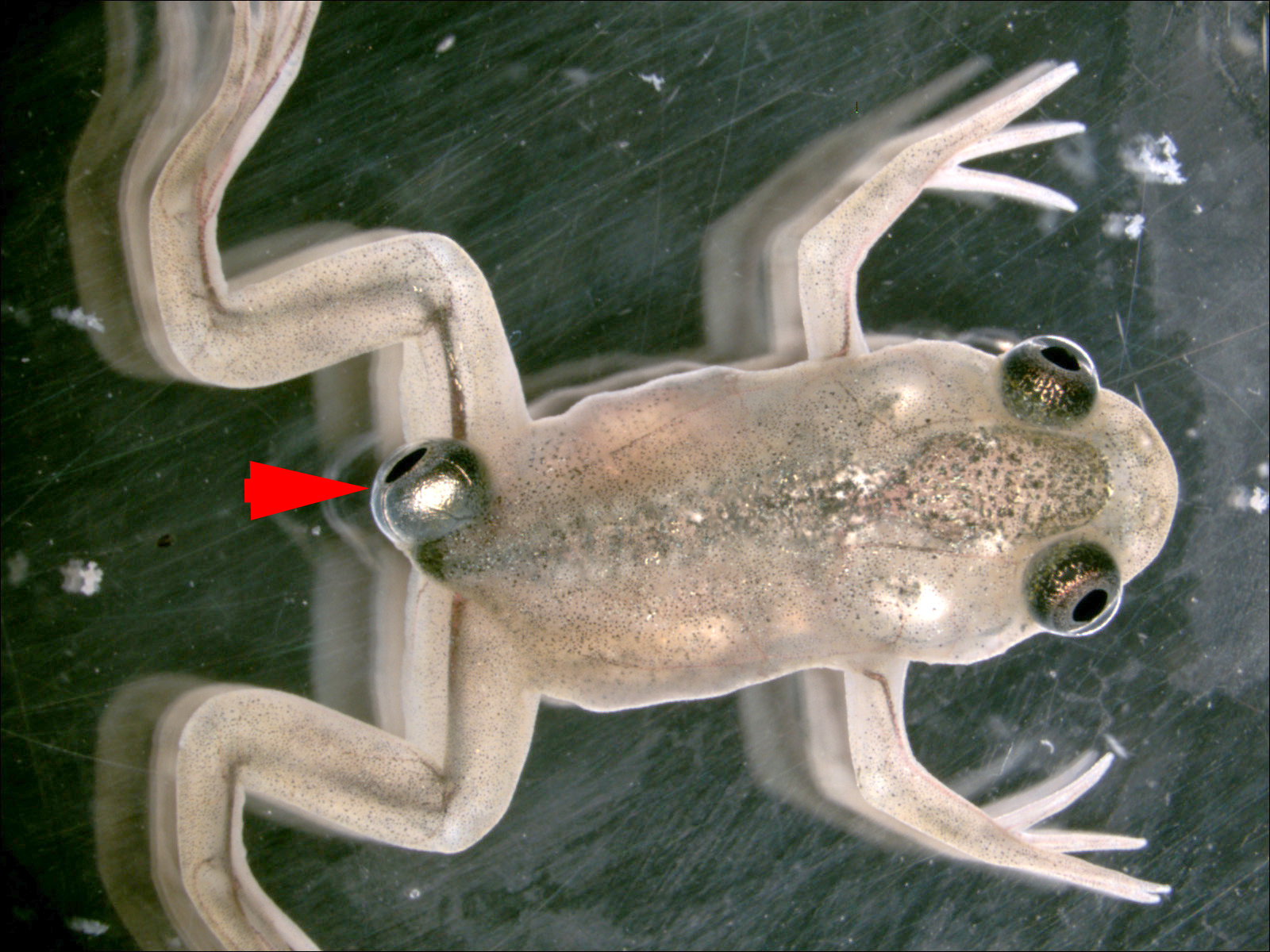
And the final piece of the story. One of the essential steps of tadpole development (into a frog) is to lose their tail: the tail cells are driven by hormonal signals to self-destruct. So now, the key question was: what would happen to the ectopic eye on a tail, as the tail around it degrades?

We had a poll in the lab, for guesses as to whether it would disappear or not. What would you guess? The actual answer? Here it is:

The eye ignores the programmed carnage around it – hormones and all – because apparently it knows that those death signals are not meant for it. It thrives, grows, and moves anteriorly as the tail shrivels, eventually finding its proper place on the mature frog’s posterior.
Have I received emails afterward, from people asking me to give them an eye on their butt? Yes, yes I have.


Leave a Reply to Ben Moskowitz Cancel reply