Anthrobots: age reversal, ancient genes, and what new beings are telling us about genetics and evolution

Published by

on

This post highlights some of the most recent data on Anthrobots, first explained here. The official final paper, first published as a preprint is now online, detailing the next stage of investigation of this fascinating new model system. The Tufts Now summary is here.

First, a quick recap. The work of recent Ph.D. from my group, Gizem Gumuskaya, and our collaborators, resulted in the creation and characterization of Anthrobots: self-assembling tiny living constructs which move around on their own. They form from single cells obtained from the lung/tracheal epithelium of adult human donors.

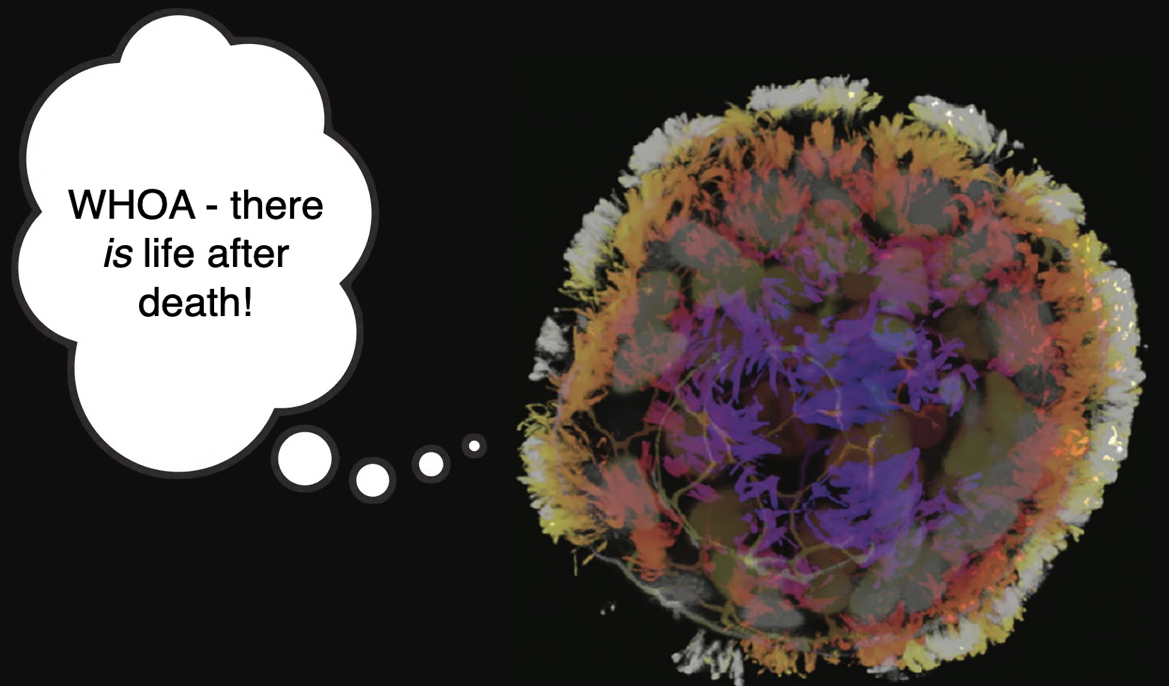
Part of their life cycle is to turn inside out, letting their cilia – tiny motile hairs – point outwards (shown in yellow on the above image). Then, via the coordinated rowing motion of these cilia, Anthrobots swim through their aqueous medium; here is a video that Gizem made of them:

A quick aside: why do we call them bots? Aren’t they living beings? Or perhaps proto-organisms? Or organoids? Yes, they are all of those things. I think that all such terms are not about capturing the unique, objective, one true nature of a thing. Attempts to do this just slow down science, as people get caught up in arguments about edge cases, and what something ‘really is’, which never seems to advance knowledge. Instead, I think these terms are relative to an observer – they indicate a specific perspective that some other being is using to understand and interact with a system. More specifically and rigorously, these terms are operational protocol claims describing how we plan to interact with something – a hypothesis about a set of tools (practical and conceptual) that we will bring to that interaction.

So, if you want to study Anthrobots while they sit constrained in a tiny plastic well, as an avatar of human biology, to understand normal lung physiology, or to use them as drug screening platforms for biomedicine, then “organoids” is what you would call them. But if you do that, you are unlikely to let them move around in mazes, set up problem-solving assays as they interact with other living and nonliving aspects of their environment, or engineer them for novel purposes (such as healing functions within the body of a patient or to help sculpt organs grown in vitro). Those kinds of approaches are facilitated by the “biobot” metaphor and the associated tools of engineering, control theory, and robotics. Each term signifies a particular perspective, which facilitates certain kinds of next questions and next steps, while closing off and obscuring others.

(image made for me by Jeremy Guay of peregrine Creative, recalling the classic tale of the blind men and the elephant; scientists are not intentionally blind but adopt perspectives which bring some things into focus while hiding others; the key is to realize that no perspective is complete and to be able to shift as needed, as well as to be open to finding new ones).

We called them Anthrobots not to deny their other aspects, but to signal that we are going to study what is novel about their capabilities, and develop tools with which we can expand their functionality in useful and interesting ways, communicating goals to them that advance personalized medicine and bioengineering.

At the same time, these are of course living beings, who have many deep secrets to share with us – things that they and their cells know (in the practical sense of “how-to” knowledge), far beyond whatever we try to coax them to do. Studying the programmability of living material does not mean neglecting or disrespecting its agential nature. We will be studying Anthrobots’ controllability (machine-like aspects) for beneficial purposes, but also their behaviors, preferences, intrinsic motivations, competencies, and unique perspective, to understand exactly what kind of intelligence, and in what spaces, we are dealing with here. We will also be studying what the plasticity of their self-assembly means for evolution (more on that below). Along the way, we hope to dissolve the imaginary sharp line between a bot and a living organism, to show how every system offers aspects of both, and how not even “robots” are the mechanical machines envisioned by our limited (and limiting) formal models of algorithms and materials.

In the prior paper, we characterized several discrete shapes into which Anthrobots develop, several specific motile behaviors they can undertake, and an ethogram of the probabilities with which these behaviors tend to follow each other. We also showed the remarkable fact that when given the opportunity to interact with injured neural tissue in vitro, they heal the wound, reconnecting the neurons on either side of a scratch. Now, we report further investigation into the life cycle, molecular physiology, and capabilities of this novel multicellular form.

First, we observed their formation, and found that there are basically 3 different ways Anthrobots form. One is the “dormant” class, whose cells do not proliferate – they don’t grow in size. The second is the “monoclonal expander” – a single seed cell proliferates and gives rise to a small bot which expands to its final size. The third is the “merger expander”, which forms by the fusion of two nascent bots. We also observed different ways in which they perform the eversion process: some begin moving even before they finish turning inside-out, and thus are able to encounter and engulf foreign material into their internal milieu. This could end up being every useful, for specific kinds of cargo we will want inside the bots for some applications, and we will explore it more fully in future work.

Having characterized their birth process, we then studied their end of life. Anthrobots live for a month or two and then biodegrade by falling apart into their constituent cells. We found that they keep moving until the very end – there seems to be no senescent phase where they stop being active before their dissolution. Also, Anthrobots seem to degrade at a steady rate, which means that larger bots live longer.

We’ve seen their origin and their end, what happens in the middle? Several fascinating things. First, we asked whether they have the ability to self-repair. Turns out, they do – when severely damaged by a mechanical (needle) scratch, they go back to normal rapidly (~20 minutes). Here’s a sample timelapse of that, made by Ph.D. student Nikolay Davey, from the preprint’s supplemental materials:

Then we asked: what kind of genes do Anthrobots express? (A related question concerns the thanatotranscriptome, discussed here) We know the transcriptome of tracheal cells from the human patient, what new genes might Anthrobots turn on? As it turns out, their transcriptome is fascinating: despite being made of genetically-normal cells, they drive thousands of differentially-expressed genes (almost half the genome) compared to their tissue of origin! Here’s an example “volcano plot” of this transcriptional profile – the red dots represent genes whose expression was significantly altered:

Not only that, they express some embryonic genes related to specification of body axes, and, a lot of the new genes they are expressing are ancient ones, as if they were partially rolling back their transcriptome through evolutionary time. I suspect that many existing biobots and synthetic constructs made by other labs should be studied in this way, to understand more broadly the transcriptomics of novel artificial bodies. It’s important to remember that genetically, this is just normal H. sapiens cells – there are no synthetic circuits here, no genomic editing, no added Yamanaka reprogramming factors. Whatever is happening to their transcriptome is due solely to the fact of their self-assembly – the morphogenetic process, and their opportunity to conduct a new lifestyle, is driving a huge change in the complement of genes they express.

Anthrobots have a somewhat unique life history because, unlike normal embryos, the age of their cells does not match the age of their anatomical structure: they are made of adult (often elderly) cells, but their life as a multicellular creature begins anew in our lab. Of course, even sexual reproduction has a similar feature because oocytes too come from an older organism and re-set so that babies are born at 0, not at the age of their parents or the combined age of their lineage. So we asked a weird question: how old are the Anthrobots, compared to the age of the cells from which they are made? And here we got a remarkable outcome: they’re younger – about 5 years younger than their constituent cells, as measured by an epigenetic clock. We are of course studying the ways in which this new environment and lifestyle is rolling back epigenetic age, to see if we can increase the effect and then initiate it in vivo for longevity applications.

There are many, many things to do next. One big thing on the agenda is to characterize their problem-solving capacity: can they learn from experience? Do they have memories in transcriptional, physiological, or behavioral space? Do they adapt to novel stressors in ways that could be useful for biomedical applications? What other tissues can they heal besides neural wounds? What accounts for their individuality in form and behavior? And so on.

In the grand scheme of things, I view the Anthrobots as not a separate material which we engineer, but as collaborators in the research journey. In fact, we are part of the reproduction machinery for this synthetic form of life. Unlike fish, frog, or clam cells, which live in water and could perhaps survive when their host organism disbands, mammalian cells can’t take this next step by themselves; our cell culture efforts are like a midwife, carrying them from one body (which may be at end of its life) into a new environment for the next phase of their journey. In turn, they teach us about plasticity, the relationship between genetics and functional anatomy, and the space of the possible.

What we do in this latest paper is delve more deeply into their natural history. But where does this natural history come from? Anthrobots (and biobots in general) are an interesting exception to familiar origin stories. Unlike most natural life forms, we cannot say that their anatomical, physiological, and behavioral capabilities are the results of specific selection forces shaping them to suit a certain environment. There have never been any Anthrobots, and there is no human developmental stage that has this lifestyle. On the other hand, they are also not painstakingly designed, with materials and genetic circuits shaped by synthetic biologists for specific functions. Even more remarkably: we know when the computations were performed to specify a human being or a frog – during the long eons of interaction between the genome’s lineage and the environment; but when were the computations performed to make a functional Anthrobot (or Xenobot)? We could say that the processes which sculpted humans (and other kinds of bodies) also happen to discover Anthrobots as a kind of by-product. But in a way, this explanation undermines the main point of evolutionary theory – the claim that of struggle against a specific environment is what explains a given animal’s form and function. Without that specificity, closely tying past history to current properties of a life form, the standard story lacks explanatory power, and more importantly, becomes impotent to assist bioengineering and biomedicine in using it to guide growth and form.

The question of where Anthrobots’ form and behavioral competencies come from is crucial. and gets to the heart of evolution and the role of the genome. We discuss this in a new paper, titled “What does evolution make? Learning in living lineages and machines” written with Ben Hartl. There, we talk about the creative, problem-solving nature of the morphogenetic process, and ways in which the collective intelligence of cells riffs on information in the genome, taking it seriously but not literally. We discuss how

  • Biology implements a multiscale competency architecture (MCA), where components competently navigate problem domains (e.g., metabolic, physiological, transcriptional, and anatomical).
  • Biological subsystems continuously shape (hack) each other’s behavior, toward homeodynamic goal states emerging at new scales.
  • The genome acts as a generative model, not a hardwired algorithm nor a blueprint, for species-specific form and function.
  • A bowtie architecture enables evolutionary lessons of the past to be generalized into lineage memory engrams which are then actively decoded (interpreted) in ways appropriate to default or novel situations by the morphogenetic machinery.
  • Fundamental symmetries across evolution, development, and behavior involve learning and creative problem-solving, which can be modeled by machine learning (ML) concepts such as autoencoders (AEs) and neural cellular automata (NCAs).

Far from rote outcomes forced by genetic information, we see genomically-encoded molecular hardware as affordances that are used as needed to navigate novel circumstances (see more of this theme in our latest Xenobot work). Like their form and function, Anthrobots’ transcriptomes are the result of real-time, context-sensitive decision-making of a system with capacities to navigate problem spaces in many ways besides the species’ default target morphology and physiology.

Finally, I have proposed that some morphogenetic and behavioral propensities are patterns ingressing into living interfaces from a Platonic latent space (just as low-agency mathematical patterns guide some facts of physics). The human genome, like all genomes, encodes a versatile hardware interface that can provide embodiment for a range of different forms. Progress in bioengineering and regenerative medicine depends on us figuring out how to predict and guide the appearance of desired patterns. I think that is part of the new frontier – investigating how the bowtie architecture of life supports these flexible ingressions, and mapping the relationship between the physical pointers we and evolution makes (i.e., embodiments) and the space of patterns that drive them. Like the minds of mathematicians, which are used as tools to navigate and explore the mathematical contents of the Platonic space, Anthrobots and other synthetic beings are our tools and our partners in discovering the immensely rich lands of forms yet unseen.

41 responses to “Anthrobots: age reversal, ancient genes, and what new beings are telling us about genetics and evolution”

  1. boldly304faeb41a Avatar
    boldly304faeb41a

    As far as the naming and debating of terms, It is almost to say-a rose would be a rose by any other name but our perception of it might change… I think about your work with Josh Bongard a lot lately, in terms of things like satire. Some people get the joke and some people don’t but it deepens the belief that they were correct in their assumptions, for both sides of the audience… Which immediately makes me think of you saying something like “sure, but what can you do with that information..you have to do the experiments..” but unfortunately, I fell as though most people spend their lives doing biased experiments, in order to prove our own theories, if that makes sense…It is almost as though we are both victims and beneficiaries of our poly computing…Whether you think the glass is half full or half empty can have dramatic implications on future endeavours…

    1. boldly304faeb41a Avatar
      boldly304faeb41a

      Your work on poly computing with Josh Bongard*

  2. Mary Athena Avatar

    Oh. I’m instantly obsessed. But I’m curious: are anthrobots the first example of an animal cell set free by scientists to determine its own fate as an autonomous life form? As a cell expressing cilia, as in the case of cells on the lining of lung tissue, I could see why it would be the best candidate. But is it the first and only, as of now? I’m just trying to get my bearings. Also I think I need an anthrobot plushie. Right now. To hold during all of the readings of all of the papers about them.

    1. Mike Levin Avatar
      Mike Levin

      An Anthrobot plushie is an awesome idea! as for cells set free, I think there are many examples like this, but no one realized it. I think a lot of the explanted cells, organoids, spheroids, etc. are doing amazing things but no one analyzed them the way we did.

      1. Mary Athena Avatar

        I really appreciate your response. It helps me a lot to understand the context of something new that I’m learning about.

    2. Benjamin L Avatar

      Having science labs sell plushies to make up for funding cuts probably isn’t economically optimal, but it would be very funny, so I’m for it.

  3. Mary Athena Avatar

    Oh, Xenobots. I see.

  4. Jack knight Avatar
    Jack knight

    As a.i takes us in a direction of sorts, this research shows us that life itself still has trillions of secrets and patterns to reveal

  5. Tadas Turonis Avatar
    Tadas Turonis

    Wow, what was the intuition behind picking lung cells for Anthrobots? How do you, as a scientist, make informed guesses about these kinds of topics?

    1. Mike Levin Avatar
      Mike Levin

      It’s a long discussion in general (of how to make informed guesses); partly experience, partly intuition, partly a calculus of risk reward, partly chasing dreams, etc. For the lung cells, we wanted something that would *move* (otherwise people would have a hard time understanding their agency). Cilia are good for that, and in an adult human, that means trachea/lung, fallopian tubes, or brain ventricles. Airway biopsies are the easiest to get.

      1. Mary Athena Avatar

        I was more flabbergasted by how you knew to test whether the bots would induce neurons to grow across a gash to close it.

        1. Mike Levin Avatar
          Mike Levin

          One way you can get there is by starting with the assumption that novel beings will be beneficial and cooperative, and then think of an assay where they could demonstrate this. Such as the wound healing assay.

          1. Mary Athena Avatar

            I’ve often wondered why I’m so oddly beneficial and cooperative, maybe it’s just that I’m a novel being and said assumption is broadly true.

      2. Helen Asetofchara Avatar
        Helen Asetofchara

        Isn’t the nervous tissue derived from the same embryonic tissue type as epithelial tissue? This can explain sound gene expression in the bots.
        There also was some article some time ago showing (developing or reprogrammed) optical neurons in mice expressing some olfactory genes.

        Would you consider giving self-organizing organic chemical systems like micelles made from phospholipids to the bots?

        1. Mike Levin Avatar
          Mike Levin

          Yes they come from the ectodermal layer, but that by itself doesn’t predict sound processing genes – for example, the ectoderm cells in *embryos* does not express these genes (that’s the whole point of the differential expression analysis). What is the idea with the micelles – what do you think should happen?

          1. Helen Asetofchara Avatar
            Helen Asetofchara

            Common ectodermal origin may explain at least why is there sound processing gene expression and NOT other genes expression of non-ectodermal origin like liver or bone genes. Maybe it was easy for the epithelial anthrobots to heal neural wounds due to this common origin and due to their natural group function to stretch out surfaces (but would they heal more subtle wounds like calcifications/atherosclerosis in the artery walls or fibrotic scars in the heart muscle or just reprogram regular senescent skin cells filling a skin wound into fully functional skin cells ?). Things may (or may not) become more difficult if you use bots derived from the tissue of one developmental origin to heal the tissue of a different origin.

            Also the 2D structure of the Petri dish may have imposed some limitations on their development. Would you consider using 3D volumes (especially coupled with a magnetic field) to grow them?

            The idea with the micelles was the first tangential idea I’ve got during reading this specific post, so I was not considering it in depth. The rationale is basically to feed artificial biomimicking constructs to the bots to see whether they would try to incorporate them alongside with the regular loose cells. (Feeding them loose mitohondria to see whether they would try to obtain additional batteries for them selves is also an option).

  6. Benjamin L Avatar

    Very interesting stuff. I’ve always been a bit bemused by the role of evolution in studying agency and intelligence, maybe because it’s not important in economics. (There’s a kind of evolution where more profitable firms replace less profitable firms over time, but it’s not a central idea in economics.) If evolution is a process of selection, then there has to be something preexisting to select from, right? So isn’t it a necessary condition of evolution that at least some form and function isn’t explained by evolution?

    1. Mike Levin Avatar
      Mike Levin

      Right; Gunther Andreas Wagner has a great book called “Arrival of the Fittest” where he explores that point. Selection is fine, but there needs to be a generative process that makes sure the good variants are in there in the first place. That’s the creative part, not winonwing.

      1. Benjamin L Avatar

        I’ll check it out, thanks. I think there are analogies to the science of perception, where instead of merely winnowing some external environment into a smaller internal representation, perceptions are constructed creatively.

        1. Mike Levin Avatar
          Mike Levin

          omg you’re right!! Gunther Wagner is a different evolutionary biologist, I got tripped up. Thanks!

    2. Jack RS Avatar
      Jack RS

      Watch the last half of my conversation with Andreas Wagner, Benjamin!

      https://youtu.be/BhUaeh6DyO0?si=1SiPHLQlYi0oKdnU

  7. Terry Torkildson Avatar
    Terry Torkildson

    When you write a new paper it’s like christmas for science nerds like me.

  8. Robert Michael Averill Avatar

    Amazing work, as always, Dr. Levin and team. From Xenobots to Anthrobots, I have followed your journeys with great anticipation. But two statements grabbed me in particular:

    “A bowtie architecture enables evolutionary lessons of the past to be generalized into lineage memory engrams which are then actively decoded (interpreted) in ways appropriate to default or novel situations by the morphogenetic machinery.”
    and
    “I have proposed that some morphogenetic and behavioral propensities are patterns ingressing into living interfaces from a Platonic latent space (just as low-agency mathematical patterns guide some facts of physics).”

    I do know you realize this, but I think the world will soon find out that these two somewhat casual sounding statements:
    a) blow the “central dogma” of biology (dna>rna>proteins) out of the water (statement 1)
    b) cause a major rebuttal to the neuroscience materialist proposal that consciousness (especially a subjective inner view of the world) emerges from the synchronized firings of neurons of higher-intelligence animals only.

    As an “Idealist” philosophy adherent, I have no issue with either of your statements, and have no doubt that your continued work will continue to peel back the layers that indicate idealism (or a very revved up version of panpsychism) represent the only possible logical explanations for consciousness — and the creative experimentation over countless eons that resulted in the formation of all that we call “the Universe.”

    I look forward to seeing you help us resolve the so-called “hard problem of consciousness” through your continued work on such novel lifeforms. FWIW, I believe this “hard problem” is the most existential and important question we meta-aware humans could possibly try to answer…

    1. Mike Levin Avatar
      Mike Levin

      Thanks; yes there are some wild things coming in that space. You might enjoy https://www.ingentaconnect.com/content/imp/mm/2025/00000023/00000001/art00003 and the implications thereof.

      1. Robert Michael Averill Avatar

        Thank you, just downloaded the pdf, can’t wait to read it!

      2. Dylan C Avatar
        Dylan C

        Hey Dr. Levin, I am also super interested in the metaphysical implications of your work. I’m wondering about your opinion on the following (apologies if you’ve covered these before in talks or blogs). I know these questions are all super speculative so no worries if they’re out of scope.

        1. What do you think memories are and how do you think they are stored? We’ve seen from planaria and butterflies that specific neural configurations seemingly do not define memory, leading to the idea that memory could be preserved in the cells of the rest of the body, or (more out there) in some non-physical space. However, in humans we see issues of memory loss with brain surgery and injury, so there are strong neural correlates.
        2. Similarly, what is the “self” in platonic space? Is each person’s individual self a representation of a pattern representing their mental state and memories? Or is the “self” individual awareness, in which case how would it vary between people if at all?
        3. What is the self outside of being physically existent? Is the representation of self created in platonic space upon a person’s birth (or coming into being as an oocyte – sorry I’m not well-versed in biology so unsure where this line would be) and is it collapsed back into nothing upon death?

        I really like thinking about your ideas regarding there being “minds all the way down”, but wanted clarification as to your thoughts on these things.

        1. Mike Levin Avatar
          Mike Levin

          1) memories: https://thoughtforms.life/self-improvising-memories-a-few-thoughts-around-a-recent-paper/

          2) I think each of us *is* a unique pattern in the Platonic space, with unique mental content.

          3) I’ll be discussing this in a forthcoming book, not ready to talk about it yet 🙂

          1. Ashley Taylor Avatar

            Is that the bio electricity book with One Pagan … can’t wait for that!

            1. Mike Levin Avatar
              Mike Levin

              Sorry, is what the bioelectricity book? That one is moving forward – we got comments from the publisher’s editor, working on them now!

  9. Michael Frost Avatar
    Michael Frost

    This is frontier research, and I’m surprised it doesn’t take up 50% of all labs’ time: if even just wound healing works reliably in vivo, the shortcut compared to the old-school drug development process is massive. I am talking about this to everyone who’d listen.
    However, I am a bit boggled by the enormous leap of faith from “this is an organism with novel behavior” to “it’s a projection from Platonic space”, which sounds like a quote from Stephenson’s Anathem. Dr Levin, you have established that biomaterials are agential, which obviously means there are no blueprints in hereditary material, but maybe motivations? scenarios? Whatever the term, isn’t it enough to explain the observations? The instructions to survive, cooperate with own and defend against the other – they seem enough to me to explain why an anthrobot is motile, capable of seeking, healing, fighting, and death. What am I missing? Why Plato?

    1. Mike Levin Avatar
      Mike Levin

      The detailed argument is given in this paper: https://osf.io/preprints/psyarxiv/5g2xj_v3 . The hereditary material has no motivations or scenarios – DNA codes for proteins, that’s it. To put it simply, the argument is: what explains the forms and capacities of Xenobots and Anthrobots? We can (1) call it “emergent” – that explains nothing, is consistent with any surprising observation and is basically a defeatist mysterian position where we just catalog surprises when they show up, or (2) take the optimistic position that the space of possible forms is, like Platonist mathematicians believe, a structured, ordered space that can be investigated systematically. There is nothing about DNA that helps us to predict in advance what these things will do; much like the fact that the explanation for why cicadas come out at 13 and 17 years lies within facts of mathematics (distribution of primes), not anything about physics, the explanation for novel biological forms and functions also come from the same world. No one has proposed a useful alternative yet.

      1. Michael Frost Avatar
        Michael Frost

        But why is there no (3)? These two options seem contrived, and your own work immediately produces better testable hypotheses than “emergence”. Do you mean that no matter the mechanism of encoding morphospace, we have to try to study it directly instead of doing induction from observed cases, so we can do to morphobiology(?) what Mendel did to genetics? I’m sorry, I don’t know the right term for a field concerned with how alive things decide what to be.
        I will read the paper, thank you for sharing it – but after I finish the other one you mentioned in these comments, because I’ve been baffled by hydrocephalia cases since neuropsy back in uni – I think a direct student of A.R. Luria read it to us, so she was basically teaching the localization approach while sharing the cases you mention in that other paper, and everyone seemed to be okay with the contradiction. So I’m really looking forward to learning about the progress on that front.

  10. Apostolos Frimas Avatar
    Apostolos Frimas

    Fascinating work, there are so many avenues this could lead up to. The term Anthrobots will help think of them differently and explore new ways to learn from them instead of having our thought guided by old notions which almost always lead to old results.
    Does your gene analysis show possibly a PDL-1 expression? or a indolethylamine n-methyltransferase upregulation? so many questions which can be new avenues to explore this

  11. Eliyahu Soloveitchik Avatar
    Eliyahu Soloveitchik

    Subject: Questions inspired by your fascinating work

    Dear Professor Levin,

    My name is Eliyahu Soloveitchik, and I am writing to you from Israel. As an Orthodox Jew, I have long grappled with the theological and philosophical difficulties posed by the concept of randomness at the heart of Darwinian evolution. For this reason, your fascinating work in the fields of collective cellular intelligence and bioelectricity has been a source of profound inspiration and thought for me. I often find myself contemplating your ideas and sharing them with members of my community.

    If I may, I would like to pose two questions that arose while engaging with your work, and I would be most grateful for your thoughts on them.

    Human Morality as an Expression of a ‘Target Morphology’: In light of your concepts of the “morphospace” and the idea that cells have a “target morphology” that they strive for, could this idea be extended to the behavioral and moral planes as well? In other words, is it possible that human morality—the inclination towards good, cooperation, and altruism, which contribute to the survival and flourishing of society—is not merely a random evolutionary product, but rather an expression of a human “meta-template,” a kind of Platonic Form of the complete and rectified person, that we are “programmed” to strive for?

    Biological and Moral ‘Glitches’ in a Perfect Creation: Further to this, as a person of faith, I struggle with the question of “flaws” and “errors” in the world. The religious perspective posits that creation is a perfect, divine work. How, then, can this be reconciled with the existence of genetic mutations, diseases, and cancer (which can be seen as a “glitch” in intercellular communication), and in parallel, the existence of human evil, which is ostensibly a “glitch” on the moral-behavioral plane? Could your model, which describes how biological systems can “lose their way” and deviate from their original goal, offer a new perspective for understanding these phenomena—not as an expression of meaningless randomness or malicious intent, but as a type of “computational error” or “system failure” within a complex system that is fundamentally striving for a good purpose?

    I thank you sincerely for your time and your revolutionary work. Should your travels ever bring you to our region and to Israel, I would be delighted to host you and to thank you in person.

    With great respect and appreciation,

    Eliyahu Soloveitchik

    1. Mike Levin Avatar
      Mike Levin

      Hi Eliyahu. Thank you for these questions and for the offer to host (I don’t travel nowadays but who knows what will happen in the future!). I once got banned from an “Ask the Rabbi” forum for raising questions… Anyway, I’ll do my best here but many of these issues are beyond any data that we have, so whatever I say is speculation at best.

      Yes, while I can’t prove it and don’t have data on it, I think it’s possible that specific kinds of behaviors (including morality) are patterns in that space. I don’t think programming is the right metaphor here, more like “resonance”. But it seems likely to me. Also, I don’t see us as being driven or possessed by the patterns. I think we *are* the patterns. Our consciousness is the view from that space outward, and the 3rd-person world of science is the view from the physical world where we see the interfaces (bodies).

      As for flaws… This is a very big question but let me take a stab at it. If there’s going to be more than one mind in the universe, there are going to be disagreements and if there’s going to be any notion of free will, there will be some agents doing things that other agents find disagreeable. And the same thing is true of the material environment, which then looks like errors, accidents, etc. I think those “flaws” are the price of having a universe where things happen. Now, a related idea. Check out https://thoughtforms.life/game-theory-meets-morphogenesis-the-physarum-dilemma/. I posit that the 1 universal mind fragments, because there’s no one for it to talk to – basically universe-scale loneliness and boredom. It fragments, and then all the pieces work, for a long time, on merging back together. Maybe this is tikkun olam – the process of unification. Maybe after that it happens again (kind of a continuous cycle or bouncing universe or Breaths of Brahma scenario).

      1. Robert Michael Averill Avatar

        Thought

        Wow, great questions from Eliyahu and awe-inspiring answers from Dr. Levin. One particular statement really resonates with me: “I posit that the 1 universal mind fragments, because there’s no one for it to talk to – basically universe-scale loneliness and boredom. It fragments, and then all the pieces work, for a long time, on merging back together”. This is exactly the conclusion I came to after 50+ years studying evolution by natural selection, neuroscience, physics, Eastern philosophy from Vedic verses to Buddhist mindfulness, Sufi mysticism, and the Western spiritual writings from Plato to Thomas Aquinas to Descartes to Spinoza to Einstein.

        In the beginning, there was Subjective Awareness (A) with infinite energy bound to it: e+A=∞. This awareness can be called Original Entity Awareness, or OEA∞. (We have lots of other names for this, most beginning with a capital letter… 😉

        With infinite energy and nothing to experience, OEA∞ began an experiment: “Let there be positive and negative energy (a tiny sliver of which humanity now calls ‘light’) for me to experience and interact with in ways where I can discover and remember and repeat patterns of positive subjective experiences (joy) worth having, while attempting to minimize negative subjective experiences (suffering) as best I can.”

        In other words, if you consider the Idealist framework that all this energy is tightly bound with Subjective Awareness, then space-time is a substrate for experience and matter is a memory of and a recipe for patterns that create a specific type of experience deemed worth remembering. And Life is an opportunity accidentally discovered by Universal Awareness to view itself from the inside looking out, instead of the “outside looking in” perspective that existed before Life was discovered… From that moment on, thin but unbroken threads of Awareness emerge like rivers from the OEA∞ “ocean” to continue this Experiential journey on their own as Individual Entity Awareness (IEA), observing the Universe while encapsulated in tiny virtual-reality-simulation lipid bubbles we call “cells” (then colonies then bodies then brains then…). This journey—from tiny protobacteria suckling methane from hydrothermal vents to meta-aware encapsulations (species) such as humans—continues until such meta-aware species discover who and what and why they really are.

        But… what is there left to do once this profound discovery is made? It’s simple, and has been espoused by many enlightened mystics for many millennia: 1) Mindfully revel in the joy of being alive on a planet as amazing as the one we have right here right now (i.e. – “Find flow in Nature”). 2) Whenever possible, try to relieve and minimize the suffering of other sentient beings (i.e. – “Be Kind”).

        By pursuing these two simple Happiness Directives, your IEA river’s journey back to the OEA∞ Ocean will be fulfilling and complete. But… while these directives appear simple, execution is quite complex (especially Directive #2).

        Why? Well, the electromagnetic virtual reality simulation that is generated by all living cells, from archaea to neurons, and that our Awareness then observes, has a mathematical directive, as well: to leave the most copies possible of its replicator molecules. It’s not that living cells “try” to do this, it’s just that the DNA that translates to RNA that make proteins that enable a phenotype (body) to replicate more successfully will win the Darwinian evolutionary race, just by virtue of the math behind it (“selfish” gene theory, et al).

        So these phenotypes have accidentally designed all kinds of sensations that become louder voices than the quiet voices of Love and Kindness that are essential to our long-term happiness (and “spiritual” evolution of our IEA river as it finds its way back to the OEA∞ Ocean). Hate and Cruelty, emotions generated by the brain and amplified by dopamine and norepinephrine, scream at us to pay attention to them for the perverse pleasure of schadenfreude that results from following them. Unfortunately, following these and other evolutionarily-designed “base” pleasures resulted in leaving more individuals possessing these traits, since they historically left more “copies” of their DNA in our species.

        But if we consider the scientific implications of “cooperation” over “competition,” we realize (as did Darwin) that the greatest advances in species proliferation came from cooperation. Individual bacteria became colonies. A typhoid-like bacteria set up home in an ancient prokaryote and eventually evolved into mitochondria — the power plants of all eukaryotic species (including humans). Homo sapiens formed tribal alliances of 50 to 100+ cooperative individuals who succeeded over rival Neanderthal, denisovan, homo erectus and other human species who lived in smaller familial groups of 8-15 individuals.

        But as meta-Aware individuals, we can recognize our competitive emotions—fear and hate and cruelty and greed and vengeance—for what they are: win/lose game-theory loud voices that evolved as they historically resulted in our proliferation as a species, but now threaten our very survival and the survival of Life on our planet. We can occasionally still indulge them (while still following Happiness Directive #2 to “Be Kind!), but try to emphasize the win-win quiet voices of the cooperative emotions of Hope and Love and Kindness and Generosity and Forgiveness that are our true keys to lasting Happiness (and the correct course for our river to take so it can return to the Sea from which it sprung).

        Welcome to the eternal dance of brain and mind, body and spirit. Where you choose to go and what you choose to do from this point forward is up to you. But for your own happiness’ sake, and for the sake of all other sentient beings present and future, and for the optimal creation of subjective experiences stored forever in the Meta-aware Universe’s space-time archives, it would behoove us all to listen to these quiet voices more often.

        Enjoy your journey!

        quiet…………….. LOUD
        1. Hope ……………..FEAR
        2. Kindness ……….Cruelty
        3. Cooperation…..Competition
        4. Forgiveness……Vengeance
        5. Equality………….Superiority
        6. Generosity………Greed
        7. Inclusive………….Exclusive
        8. Regeneration…..Depletion
        9. Empathy………….Callousness
        10. Love ……………….Hate

  12. Merary Rodriguez Avatar
    Merary Rodriguez

    This suggests biology is programmable at the field level. Epigenetic age resets.

  13. Benjamin L Avatar

    I just realized that the argument you make about evolution may already be the consensus in the study of motor behavior. The ability to walk doesn’t come from an evolutionary history but is something an existing body assembles in the moment to achieve a goal. And of course, humans exhibit a wide range of skillful motor behaviors that we obviously didn’t evolve to do, like play soccer, or move around in a wheelchair.

    I’ll have to think about this more–I don’t know enough about the background ideas regarding evolution to specify exactly how our understanding of motor behavior may be inconsistent with them.

    1. Benjamin L Avatar

      It’s also the ideas about emotions that Lisa Feldman Barrett has spent her career advancing. Historically, psychologists thought emotions were shaped by evolution as a response to challenges in the environment, like disgust evolving as a response to food that’s unsafe to eat. She’s spent her career marshaling evidence against this view and for the view that emotions are created—constructed, as her theory of constructed emotion puts it.

  14. Br Avatar
    Br

    So how far are we humans from being able to regrow limbs, reverse aging and an antomical compiler?

Leave a Reply to Terry Torkildson Cancel reply

Your email address will not be published. Required fields are marked *