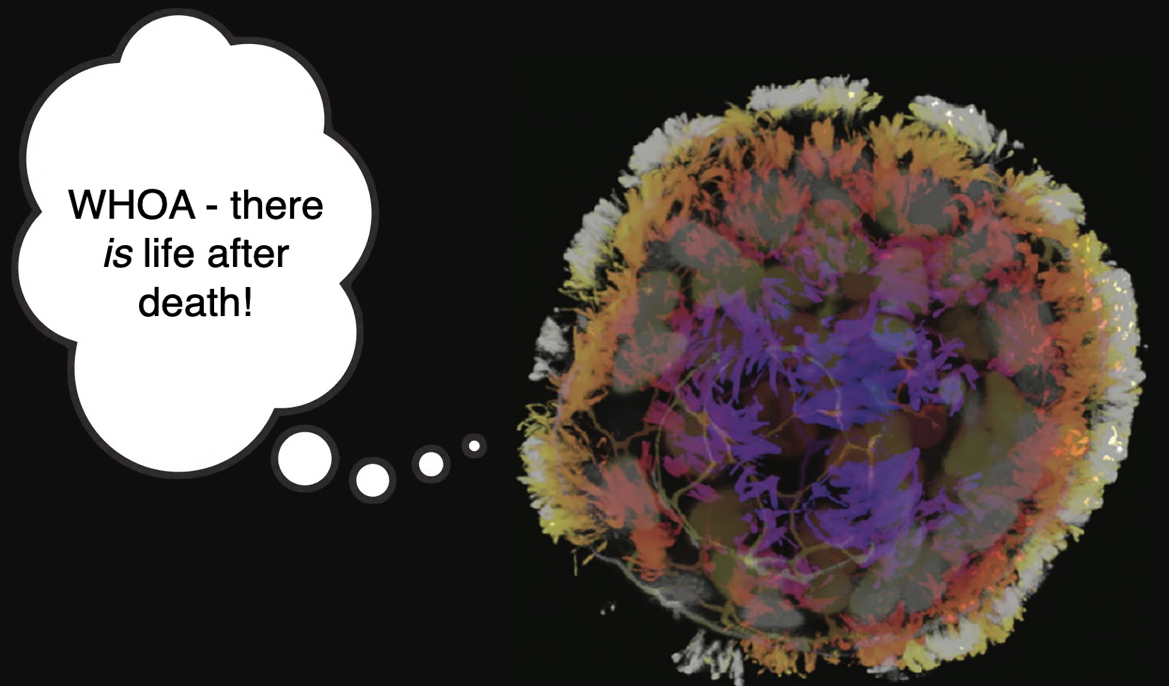
This post highlights some of the most recent data on Anthrobots, first explained here. The official final paper, first published as a preprint is now online, detailing the next stage of investigation of this fascinating new model system. The Tufts Now summary is here.
First, a quick recap. The work of recent Ph.D. from my group, Gizem Gumuskaya, and our collaborators, resulted in the creation and characterization of Anthrobots: self-assembling tiny living constructs which move around on their own. They form from single cells obtained from the lung/tracheal epithelium of adult human donors.

Part of their life cycle is to turn inside out, letting their cilia – tiny motile hairs – point outwards (shown in yellow on the above image). Then, via the coordinated rowing motion of these cilia, Anthrobots swim through their aqueous medium; here is a video that Gizem made of them:
A quick aside: why do we call them bots? Aren’t they living beings? Or perhaps proto-organisms? Or organoids? Yes, they are all of those things. I think that all such terms are not about capturing the unique, objective, one true nature of a thing. Attempts to do this just slow down science, as people get caught up in arguments about edge cases, and what something ‘really is’, which never seems to advance knowledge. Instead, I think these terms are relative to an observer – they indicate a specific perspective that some other being is using to understand and interact with a system. More specifically and rigorously, these terms are operational protocol claims describing how we plan to interact with something – a hypothesis about a set of tools (practical and conceptual) that we will bring to that interaction.
So, if you want to study Anthrobots while they sit constrained in a tiny plastic well, as an avatar of human biology, to understand normal lung physiology, or to use them as drug screening platforms for biomedicine, then “organoids” is what you would call them. But if you do that, you are unlikely to let them move around in mazes, set up problem-solving assays as they interact with other living and nonliving aspects of their environment, or engineer them for novel purposes (such as healing functions within the body of a patient or to help sculpt organs grown in vitro). Those kinds of approaches are facilitated by the “biobot” metaphor and the associated tools of engineering, control theory, and robotics. Each term signifies a particular perspective, which facilitates certain kinds of next questions and next steps, while closing off and obscuring others.

(image made for me by Jeremy Guay of peregrine Creative, recalling the classic tale of the blind men and the elephant; scientists are not intentionally blind but adopt perspectives which bring some things into focus while hiding others; the key is to realize that no perspective is complete and to be able to shift as needed, as well as to be open to finding new ones).
We called them Anthrobots not to deny their other aspects, but to signal that we are going to study what is novel about their capabilities, and develop tools with which we can expand their functionality in useful and interesting ways, communicating goals to them that advance personalized medicine and bioengineering.
At the same time, these are of course living beings, who have many deep secrets to share with us – things that they and their cells know (in the practical sense of “how-to” knowledge), far beyond whatever we try to coax them to do. Studying the programmability of living material does not mean neglecting or disrespecting its agential nature. We will be studying Anthrobots’ controllability (machine-like aspects) for beneficial purposes, but also their behaviors, preferences, intrinsic motivations, competencies, and unique perspective, to understand exactly what kind of intelligence, and in what spaces, we are dealing with here. We will also be studying what the plasticity of their self-assembly means for evolution (more on that below). Along the way, we hope to dissolve the imaginary sharp line between a bot and a living organism, to show how every system offers aspects of both, and how not even “robots” are the mechanical machines envisioned by our limited (and limiting) formal models of algorithms and materials.
In the prior paper, we characterized several discrete shapes into which Anthrobots develop, several specific motile behaviors they can undertake, and an ethogram of the probabilities with which these behaviors tend to follow each other. We also showed the remarkable fact that when given the opportunity to interact with injured neural tissue in vitro, they heal the wound, reconnecting the neurons on either side of a scratch. Now, we report further investigation into the life cycle, molecular physiology, and capabilities of this novel multicellular form.
First, we observed their formation, and found that there are basically 3 different ways Anthrobots form. One is the “dormant” class, whose cells do not proliferate – they don’t grow in size. The second is the “monoclonal expander” – a single seed cell proliferates and gives rise to a small bot which expands to its final size. The third is the “merger expander”, which forms by the fusion of two nascent bots. We also observed different ways in which they perform the eversion process: some begin moving even before they finish turning inside-out, and thus are able to encounter and engulf foreign material into their internal milieu. This could end up being every useful, for specific kinds of cargo we will want inside the bots for some applications, and we will explore it more fully in future work.
Having characterized their birth process, we then studied their end of life. Anthrobots live for a month or two and then biodegrade by falling apart into their constituent cells. We found that they keep moving until the very end – there seems to be no senescent phase where they stop being active before their dissolution. Also, Anthrobots seem to degrade at a steady rate, which means that larger bots live longer.
We’ve seen their origin and their end, what happens in the middle? Several fascinating things. First, we asked whether they have the ability to self-repair. Turns out, they do – when severely damaged by a mechanical (needle) scratch, they go back to normal rapidly (~20 minutes). Here’s a sample timelapse of that, made by Ph.D. student Nikolay Davey, from the preprint’s supplemental materials:
Then we asked: what kind of genes do Anthrobots express? (A related question concerns the thanatotranscriptome, discussed here) We know the transcriptome of tracheal cells from the human patient, what new genes might Anthrobots turn on? As it turns out, their transcriptome is fascinating: despite being made of genetically-normal cells, they drive thousands of differentially-expressed genes (almost half the genome) compared to their tissue of origin! Here’s an example “volcano plot” of this transcriptional profile – the red dots represent genes whose expression was significantly altered:

Not only that, they express some embryonic genes related to specification of body axes, and, a lot of the new genes they are expressing are ancient ones, as if they were partially rolling back their transcriptome through evolutionary time. I suspect that many existing biobots and synthetic constructs made by other labs should be studied in this way, to understand more broadly the transcriptomics of novel artificial bodies. It’s important to remember that genetically, this is just normal H. sapiens cells – there are no synthetic circuits here, no genomic editing, no added Yamanaka reprogramming factors. Whatever is happening to their transcriptome is due solely to the fact of their self-assembly – the morphogenetic process, and their opportunity to conduct a new lifestyle, is driving a huge change in the complement of genes they express.
Anthrobots have a somewhat unique life history because, unlike normal embryos, the age of their cells does not match the age of their anatomical structure: they are made of adult (often elderly) cells, but their life as a multicellular creature begins anew in our lab. Of course, even sexual reproduction has a similar feature because oocytes too come from an older organism and re-set so that babies are born at 0, not at the age of their parents or the combined age of their lineage. So we asked a weird question: how old are the Anthrobots, compared to the age of the cells from which they are made? And here we got a remarkable outcome: they’re younger – about 5 years younger than their constituent cells, as measured by an epigenetic clock. We are of course studying the ways in which this new environment and lifestyle is rolling back epigenetic age, to see if we can increase the effect and then initiate it in vivo for longevity applications.
There are many, many things to do next. One big thing on the agenda is to characterize their problem-solving capacity: can they learn from experience? Do they have memories in transcriptional, physiological, or behavioral space? Do they adapt to novel stressors in ways that could be useful for biomedical applications? What other tissues can they heal besides neural wounds? What accounts for their individuality in form and behavior? And so on.
In the grand scheme of things, I view the Anthrobots as not a separate material which we engineer, but as collaborators in the research journey. In fact, we are part of the reproduction machinery for this synthetic form of life. Unlike fish, frog, or clam cells, which live in water and could perhaps survive when their host organism disbands, mammalian cells can’t take this next step by themselves; our cell culture efforts are like a midwife, carrying them from one body (which may be at end of its life) into a new environment for the next phase of their journey. In turn, they teach us about plasticity, the relationship between genetics and functional anatomy, and the space of the possible.
What we do in this latest paper is delve more deeply into their natural history. But where does this natural history come from? Anthrobots (and biobots in general) are an interesting exception to familiar origin stories. Unlike most natural life forms, we cannot say that their anatomical, physiological, and behavioral capabilities are the results of specific selection forces shaping them to suit a certain environment. There have never been any Anthrobots, and there is no human developmental stage that has this lifestyle. On the other hand, they are also not painstakingly designed, with materials and genetic circuits shaped by synthetic biologists for specific functions. Even more remarkably: we know when the computations were performed to specify a human being or a frog – during the long eons of interaction between the genome’s lineage and the environment; but when were the computations performed to make a functional Anthrobot (or Xenobot)? We could say that the processes which sculpted humans (and other kinds of bodies) also happen to discover Anthrobots as a kind of by-product. But in a way, this explanation undermines the main point of evolutionary theory – the claim that of struggle against a specific environment is what explains a given animal’s form and function. Without that specificity, closely tying past history to current properties of a life form, the standard story lacks explanatory power, and more importantly, becomes impotent to assist bioengineering and biomedicine in using it to guide growth and form.
The question of where Anthrobots’ form and behavioral competencies come from is crucial. and gets to the heart of evolution and the role of the genome. We discuss this in a new paper, titled “What does evolution make? Learning in living lineages and machines” written with Ben Hartl. There, we talk about the creative, problem-solving nature of the morphogenetic process, and ways in which the collective intelligence of cells riffs on information in the genome, taking it seriously but not literally. We discuss how
- Biology implements a multiscale competency architecture (MCA), where components competently navigate problem domains (e.g., metabolic, physiological, transcriptional, and anatomical).
- Biological subsystems continuously shape (hack) each other’s behavior, toward homeodynamic goal states emerging at new scales.
- The genome acts as a generative model, not a hardwired algorithm nor a blueprint, for species-specific form and function.
- A bowtie architecture enables evolutionary lessons of the past to be generalized into lineage memory engrams which are then actively decoded (interpreted) in ways appropriate to default or novel situations by the morphogenetic machinery.
- Fundamental symmetries across evolution, development, and behavior involve learning and creative problem-solving, which can be modeled by machine learning (ML) concepts such as autoencoders (AEs) and neural cellular automata (NCAs).

Far from rote outcomes forced by genetic information, we see genomically-encoded molecular hardware as affordances that are used as needed to navigate novel circumstances (see more of this theme in our latest Xenobot work). Like their form and function, Anthrobots’ transcriptomes are the result of real-time, context-sensitive decision-making of a system with capacities to navigate problem spaces in many ways besides the species’ default target morphology and physiology.
Finally, I have proposed that some morphogenetic and behavioral propensities are patterns ingressing into living interfaces from a Platonic latent space (just as low-agency mathematical patterns guide some facts of physics). The human genome, like all genomes, encodes a versatile hardware interface that can provide embodiment for a range of different forms. Progress in bioengineering and regenerative medicine depends on us figuring out how to predict and guide the appearance of desired patterns. I think that is part of the new frontier – investigating how the bowtie architecture of life supports these flexible ingressions, and mapping the relationship between the physical pointers we and evolution makes (i.e., embodiments) and the space of patterns that drive them. Like the minds of mathematicians, which are used as tools to navigate and explore the mathematical contents of the Platonic space, Anthrobots and other synthetic beings are our tools and our partners in discovering the immensely rich lands of forms yet unseen.


Leave a Reply to Mary Athena Cancel reply