Meet a new synthetic colleague: robot science as a translation tool between diverse intelligences

Published by

on

The following is a Keynote I gave at the recent Artificial Life meeting in Japan. It was pretty different from any presentation I’ve given before, although it has connections to everything I often talk about. In this presentation I tried to do 3 things:

  1. Point out parallels between the process of scientific discovery, and the active inference loop that guides agents navigating their worlds. Specifically, I discussed the many connections between the process of automating and providing tools to accelerate discovery, and our attempts to understand diverse intelligences specifically. One key thing they all have in common is that exploration means being ready for all of the different places along the spectrum of persuadability. To some extent, all active agents are scientists, and all of science is a part of being. We simply don’t know, ahead of time, what the level of agency is in any of the things we encounter around us, and within us. We must determine it by interactions and experiments, which requires imagination as well as rigor.
  2. Take people who aren’t familiar with my work or the concept of agential materials on a brief tour of the special properties of living materials. The multi-scale competency architecture is of strong relevance to ALIFE and robotics/AI workers who want to build truly bio-inspired technology. Most critically, it means that discovery in the biosciences will involve use of tools of cognitive science, and learning how to communicate/collaborate with the material, not simply micromanage it as we do with (seemingly) passive matter. It also means that whatever automation we create for the life sciences needs to be aware that what it’s doing is cracking the language of a partially alien mind.
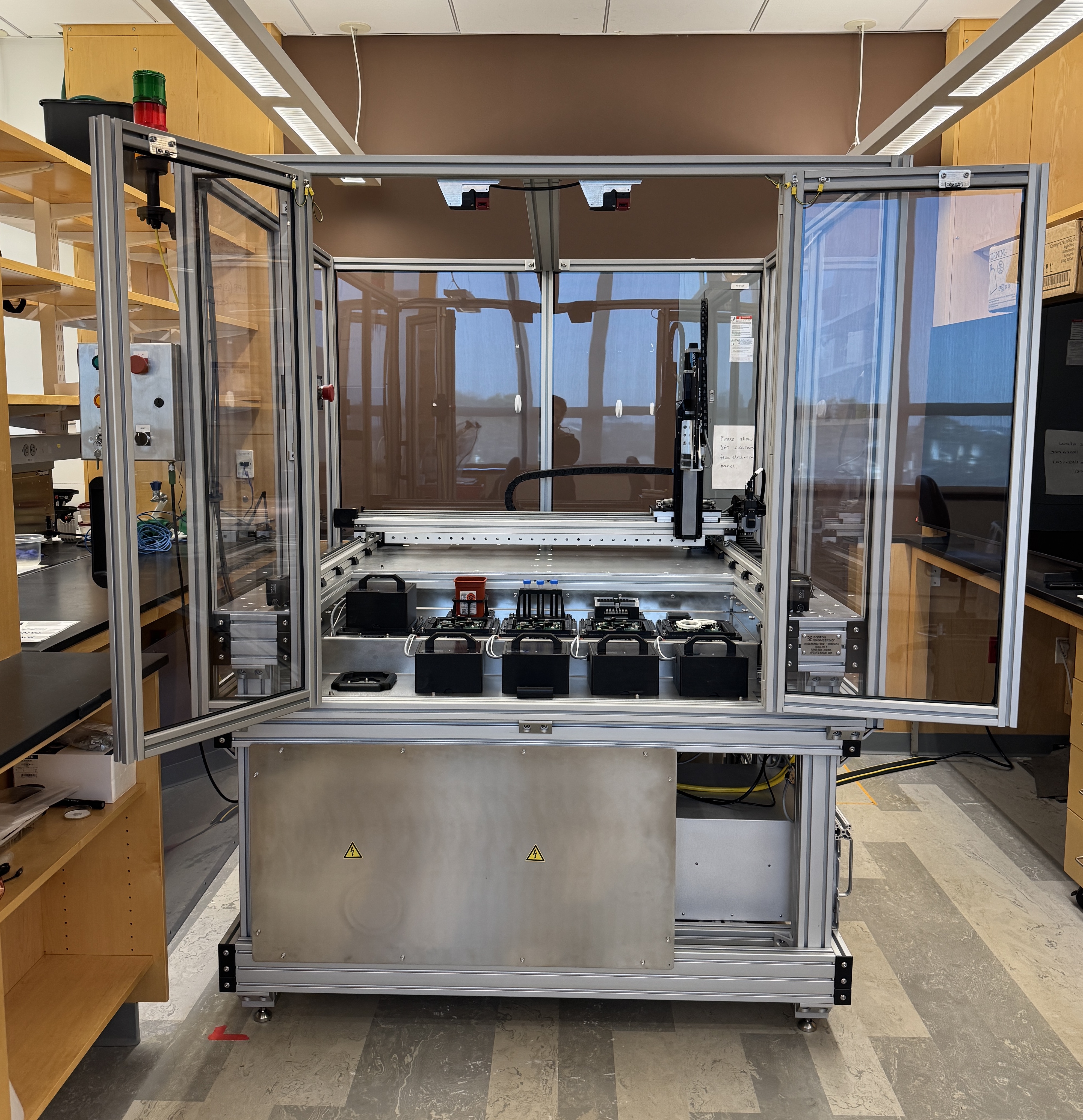
  3. Introduce the community to an ICDO project on which Josh Bongard, Doug Blackiston, and I are collaborating: the creation of a new robot scientist that is meant to be a discovery engine for accelerating and facilitating the field of synthetic morphology: performing cycles of hypothesis generation and laboratory testing. Using the Xenobot cellular platform first, it will attempt to crack the morphogenetic code, leading to not only useful synthetic living machines but also a better understanding of the goals and competencies of novel beings without a specific evolutionary history. More deeply, it is an example of a novel embodied mind: it has an AI-based cognitive system (located partially at UVM) and a physical body (located at Tufts) which does experiments on Xenobots (i.e., navigates the space of behavior-shaping cues for cells and improves its internal model of how cell collectives produce form and function). Building and collaborating with this system is, itself, a project in Diverse Intelligence because we are learning to relate to a highly unconventional novel composite being consisting of the Mombot robot, the living material inside it, and the human scientists who build, maintain, and learn from it. On a Meta level, I propose that the Mombot platform is the first of a forthcoming class of agential translation interfaces, enabling human scientists to better relate to the collective intelligence of Xenobots (and many other things it will help us reach)

The Mombot project is implemented by an amazing team including Doug Blackiston, the Bongard Lab, my lab, ethicist Jeantine Lunshof, and Boston Engineering (see the Acknowledgements slide at the end of the talk for a list of the many people who contributed to it). The biology, philosophy, and diverse-intelligence implications as expressed here are my own perspective on the meaning of the work, and not necessarily those of anyone on the team or of our funders.

The video of the talk itself:

and the slides can be downloaded here:

One unusual thing: since I couldn’t travel, the talk was given by telepresence, through a robot made for me by Marty Schwalm. I thought it was fitting to give a talk about a robot, which builds robots, through a robot. Here are some photos of it, taken by Olaf Witkowski and Ben Hartl:

39 responses to “Meet a new synthetic colleague: robot science as a translation tool between diverse intelligences”

  1. Vicente Sanchez-Leighton Avatar
    Vicente Sanchez-Leighton

    Nice Platonic touch 😉 !

  2. Robert Margulies Avatar
    Robert Margulies

    “…their outlook would be narrower than ours.”
    Why?

    1. Mike Levin Avatar
      Mike Levin

      sorry, where’s that quote from?

      1. Robert Margulies Avatar
        Robert Margulies

        I apologize. It was from a comment.
        That was a question to a commenter. Please ignore it.

  3. Doug Dearie Avatar
    Doug Dearie

    You and your colleagues work continues to reveal remarkable and exciting ideas and results. Well done all! And keep it coming!

  4. Terry Torkildson Avatar
    Terry Torkildson

    Exciting news for those of us with conditions the current medical system fails to understand. Great work by everyone involved. Is the novel intelligence operating the device a Chis Fields designed system or is it based on a conventional format?

    1. Mike Levin Avatar
      Mike Levin

      I’m not sure I understand the question. It’s neither designed by Chris, nor a conventional architecture.

  5. Merary Rodriguez Avatar
    Merary Rodriguez

    Life = boundary condition

  6. Zk Avatar
    Zk

    How charming! Very Meta 🙂

  7. Alex Kobold Avatar

    isn’t the bubble-sort unpredicted actions a hint towards the proof of the simulated universe?

    1. Mike Levin Avatar
      Mike Levin

      hmm, why? and what is specifically the simulated universe claim (as distinct from current neuroscience’s point that our experienced world is a construct of our cognitive processes)?

      1. Alex Kobold Avatar

        because if even the simple code itself is able to act on its own, without the specific lines of code asking to do it, it’s like having the life been programmed into universe all the way down, up to the mathematical rules which we discover. about neuroscience: the discoveries of higher processes are interesting and practical but irrelevant to the question of us being in the simulated program or not, evolving naturally without a program so to say.

        1. Mike Levin Avatar
          Mike Levin

          I see. Interesting; I suppose, in a sense I agree that an intelligence ratchet (paper coming in a few months) is embedded all the way down, as a free gift of the math. So in a sense, we could say that the physical world is a front end for Platonic space, but I’m not sure if it’s the same thing as people who think our world is inside a computer run by aliens living in a bigger world etc. etc.

  8. Obsitos Nándor Csanád Avatar
    Obsitos Nándor Csanád

    Here is a thought experiment I’d like to call: “We don’t know how smart a stone axe is really” or the generalized alignment problem:

    Throughout human history not those technologies will propagate to the future that help humans maximally but those that best get (that are easiest for) humans to replicate them, and as more and more technology gets created the delta between the two becomes larger and larger. In a sense we are already in resource competition with AGI and have been for a long time. There is a fine line between a symbiote and a parasite (or rather there isn’t a hard line at all, even a symbiote will evolve towards getting the better end of the deal).

    This would I think even apply to something as close as language for example, maybe most of our communication is meme-cough and buddhism an antiparasitic.

  9. Alex Kobold Avatar

    to my knowledge, so far there is no proof for or against the simulated universe, it simply makes sense in terms of probability — if we one day will be able to create simulations with life forms which are aware, and the simulations will be in countless billions, then we must already live in a simulation rather than in a base reality. from your bubble sort example i simply had an idea that perhaps there could be a proof provided, but i don’t know exactly how. it was just an idea which could be wrong.. but if the instinctive thought is correct then this could be a big deal. a step closer to the proof is the fact that a simple code can have a life on its own, thus it is possible to create simulations where parts of it are alive and aware. as a logical conclusion, because life in a program is possible, then by the probability alone we must be in a simulated program rather than not.

    1. Alex Kobold Avatar

      for my comment under a video “isn’t the bubble-sort unpredicted actions a hint towards the proof of the simulated universe?” (exactly the same text as i posted here, with the same grammatical mistakes, submitted at the same time) i got today a response that the bubble sort behavior could be explained by compiler optimizations, CPU runtime optimizations, runtime libraries, or any combination of those. it reminded me that Lee Cronin have said that computer programs cannot be viewed separately from the hardware that runs them, or something similar, in the context of the assembly theory. if the behavior of the bubble sort can be explained by hardware design, then it is a blow to the living/aware programs, but it could be put on test. the bubble sort behavior can be tested on principally differently designed machines, to compare the behaviors.

      1. Mike Levin Avatar
        Mike Levin

        1) we’re checking that. 2) it would be very interesting if abstraction layers that are supposed to isolate algorithms from the vagaries of how the lower levels are implemented (the whole point of high-level languages and algorithms in general) worked for the sorting aspect but not for the other aspects we found (how does it “know” to only disrupt the clustering and not the sorting itself?); or is the hypothesis that the behavior of bubble sort’s sorting is dependent on compiler optimizations also? That would be a horrible compiler 🙂 3) if we did find that happening, I think the only thing would change about my conclusions is that instead of very simple short algorithms having unexpected proto-cognitive competencies, more complex ones had those. Admittedly, it’s more fun if it’s a tiny algorithm, but I think the bigger point would stand. 4) We’re now trying this with all sorts of even simpler systems, which would be even more independent of underlying implementation (1D cellular automata for example; we’ll preprint soon). 5) if we do find this happening, I think it wouldn’t “explain” those competencies – still unexpected, still not predicted, from knowing what those systems are supposed to be doing; it would however tell us something about what makes a difference to the intrinsic motivations, which could be interesting.

        1. Alex Kobold Avatar

          thanks Michael for the insight. it makes better sense to me now. even though i’ve done some programming in the past, in ‘basic’, my knowledge of the hardware and lower level codes isn’t strong — no hypothesis from me in this part. you’re right that influence by hardware and lower level codes wouldn’t explain those competencies — still unexpected, still not predicted. no idea why i didn’t see that logic myself )) .. i was almost worried that my boosted belief in high probability of living in a simulated reality must be questioned, but at this point my belief is even stronger in the theory (simulation argument by Nick Bostrom). once i learned about it few years ago, it was almost as a spiritual awakening, being before that a complete atheist. as there is a simulation then there must be creator(s) of the simulation. but i’m open to be awakened back to atheism if a proof is provided. the circulating “proof” that the universe hasn’t enough computational power for being simulated is plain wrong — this argument assumes the simulator is bound by the physical laws of our universe, which doesn’t apply in case of a higher reality.

          1. Mike Levin Avatar
            Mike Levin

            Just one other comment. I don’t think the simulation hypothesis helps re. the atheism question (and of course, neither does traditional theism), because you’d still have to wonder how the creators of the simulation got there (and how they know they’re not in a simulation themselves, etc. etc.).

            1. Alex Kobold Avatar

              yeah, i know. and that is something we can never get an answer to. what matters is how much we are watched over, being reincarnated after death if we behave right (whatever that means), and so on. i suppose a definitive proof of being in a simulation could change the world for better. at least i hope it will be the case then. so far majority of the supposed believers do not truly act like they are watched over, only pretend to do so. keep sharing ideas Michael on this topic if something is more to discuss, or whenever there are some breakthroughs. it’s an important matter, to get to the truth. i have a dedicated series of articles on my blog on the simulated reality topic, to understand the purpose of life in case we are being run in a program. there must be a purpose, possibly to get to some answers faster than the creators themselves are capable of, similarly to our computers serving us.

  10. Alex Kobold Avatar

    Instead of saying “yeah, I know,” I should have said “correct.” I’m not a native English speaker. From now on, I will try to use AI more often to edit my writings. I understand that even if we were to prove that the universe is “created,” the same question would remain about the creators themselves. I was thinking that it might still be possible to prove that we naturally evolved from non-living matter without missing any step along the way — and that the probability argument could be flawed, making it dismissible in the end. Yet, after much thought, it seems clear that even proving the impossibility of being in a simulation from our own perspective, iit could still be wrong. The universe might have been created in such a way that we could never discover we are inside a program. So, if that was your entire point, you are correct: it is indeed impossible to prove that we are not in a simulation. Logically, atheism then becomes just another belief, rather than a purely scientific position.

    1. Merary Rodriguez Avatar
      Merary Rodriguez

      Predictable = programmed.
      Unpredictable = emergent.
      Unpredicted behavior is proof of autonomy.

      1. Alex Kobold Avatar

        Thank you for the idea, Merary. That’s an interesting point, something to think about. Isn’t it the case that the universe could have been created to be unpredictable, with random inputs, making it appear to us as emergent? It still seems impossible to disprove the possibility of us being in simulated universe from within our own reality. Also, the universe being ultimately predictable one day, with advanced knowledge, would not necessarily equate to proof of being in a simulation. Maybe I’m missing something in your logic — could you elaborate?

        1. Merary Rodriguez Avatar
          Merary Rodriguez

          Two different domains:
          Philosophical = about the universe or reality itself (cannot prove or test)
          Biological = about living systems like cells (can test with experiments)
          This discussion is biological, how scientists determine if cells or organisms have autonomy.

          1. Alex A. O. Kobold Avatar

            Ok Merary, makes sense, I got it. Thanks!

  11. Alex Kobold Avatar

    A technical note (no need to publish, but it can be published if appropriate): I have always checked “Notify me of follow-up comments by email” and “Notify me of new posts by email,” but I have never received any notifications.

    1. Mike Levin Avatar
      Mike Levin

      Huh, weird. I’ll follow up with tech support. thanks!

    2. Mike Levin Avatar
      Mike Levin

      Talked to the tech folks at WordPress, they tell me it’s fixed. Let me know if not!

      1. youth_extension Avatar

        So far, still nothing. My website is also on WordPress, and the email service is Titan, integrated with WordPress. It’s indeed strange that there are no notifications. I regularly check my spam mailbox as well — nothing there either. I made a few attempts to respond using my Google email to see if that would work, but the comment submission was rejected, even when using my full name and no website. After clicking “Submit,” the page jumps to the top with no confirmation that the post was submitted for review. So now, I’ve gone back to using the Titan email. Previously I used Google Beta Browser, without logging in to anything. This comment is through Jetpack, using WordPress Reader, without subscribing to your blog nor clicking “follow conversations”, to see if that works. I don’t usually use WordPress Reader, so there is nothing to compare regarding receiving notifications. I should still get an email, though.

        1. Mike Levin Avatar
          Mike Levin

          ok I’ll follow up, you may hear from the IT team at WordPress.

          1. Alex A. O. Kobold Avatar

            so far still nothing by email. only getting notified in reader.

      2. Alex A. O. Kobold Avatar

        [ I updated information on Gravatar to include my name ] .. On the Google Chrome Beta, which I mostly use, I have several restrictions activated that may have caused some issues, though I’m not sure. One possibility is that the browser itself blocks certain email addresses related to Google unless the service sends a confirmation email of the request to receive notifications. Meanwhile, here on the WordPress Reader, I cannot choose which email to use, so I have no idea where or how the notifications will arrive.

        1. Alex A. O. Kobold Avatar

          As I successfully commented under another post using my Gmail address, the issue has been resolved. I’m not sure whether the resolution came from a browser update or from the tech support team identifying and fixing the problem.

          The issue with email notifications has also been resolved but since then I’ve been wondering what caused the “pause emails” option to be activated, which I wasn’t even aware of. I think it might have been triggered automatically by the Titan email service — I used it during a free trial a long time ago, then stopped using for a while, and later reopened the same email account as a paid service.

          I wish you the greatest success in your endeavors Michael. If I were you, I would probably focus on the aging issue, because everything else can wait. Personally, I’m trying to approach it through my meditation techniques — a top-down control method. I’ve done it for decades, regularly improving the method using updated scientific knowledge, and your insights have given me even more confidence. Once you can live as long as you wish, all other tasks can eventually be taken care of.

          I am not worried about dying because I’m quite confident that our life program — if we live our lives efficiently — will be restarted in another universe or another place in this universe, and perhaps with evolution one day we will even be able to remember our past lives. In any case, I enjoy this life and am in no hurry to leave it. Living indefinitely would be a burden, but living for a few hundred.. mm.. better a few thousand years would be a good start, I think — at least in the beginning.

          Thanks again for your great insights!
          A

  12. Aidan Avatar
    Aidan

    Hello –

    I recall reading a paper once on developmental bioelectricity that mentioned something about the arrangement of epithelial cells resembling a parallel circuit, or that epithelial cells arrange like sheets due to some intrinsic property of a parallel circuit. Does anybody know which paper(s) that have discussed this? I am researching epithelial cells in Crohn’s disease, and wish to integrate bioelectric understandings into this – it has been completely overlooked.

    With best wishes,

    A.

    1. Mike Levin Avatar
      Mike Levin

      Yes. There is a lot of work on trans-epithelial electric fields, by people like Ken Robinson, Min Zhao, Colin McCaig, Richard Nuccitelli, Richard Borgens, etc. Check out Figure 3C and references cited in http://dx.doi.org/10.1016/j.semcdb.2009.04.013

      1. Aidan Avatar
        Aidan

        Thank you, Michael. I appreciate your response.

  13. Alex Kobold Avatar

    You may find it interesting, Michael. Someone with a greater mind than mine might identify the flaws in the logic and/or build on it, relating to your findings in Bubble Sort and other algorithms, perhaps demonstrating the possibility of a mind without the need for a physical substance ..

    ___

    There are only two possibilities: 

    1. Absolute Nothingness — a total non-existence without time, space, or even the potential for meaning. From this state, nothing could ever emerge. 
    2. Eternal Something — an unbroken existence containing at least the possibility of True Nothingness, where the fundamental rules of mathematics already exist. 

    Because we know existence is real, Absolute Nothingness cannot be true. Therefore, the mathematical rules underlying reality must be eternal — existing even where there is no matter, energy, or thought. These rules are the foundation and seed of all possible forms of existence.

    ___

    I have elaborated on the idea on my website. That’s a brief concept by AI based on a bit longer writing.

  14. Alex Kobold Avatar

    To my previously submitted post, I must add that I later realized the idea is not original but of the Platonic space. You, Michael, are definitely more skilled in that kind of thinking. Although you regularly mention the Platonic space, I didn’t remember all the details and their logical consequences. I learned those ideas a long time ago — around 40 years back — forgotten, and now resurfacing in my mind as original. I have also acknowledged this on my website, giving credit to the universe rather than to myself as a separate mind from the rest of existence.

Leave a Reply to Robert Margulies Cancel reply

Your email address will not be published. Required fields are marked *