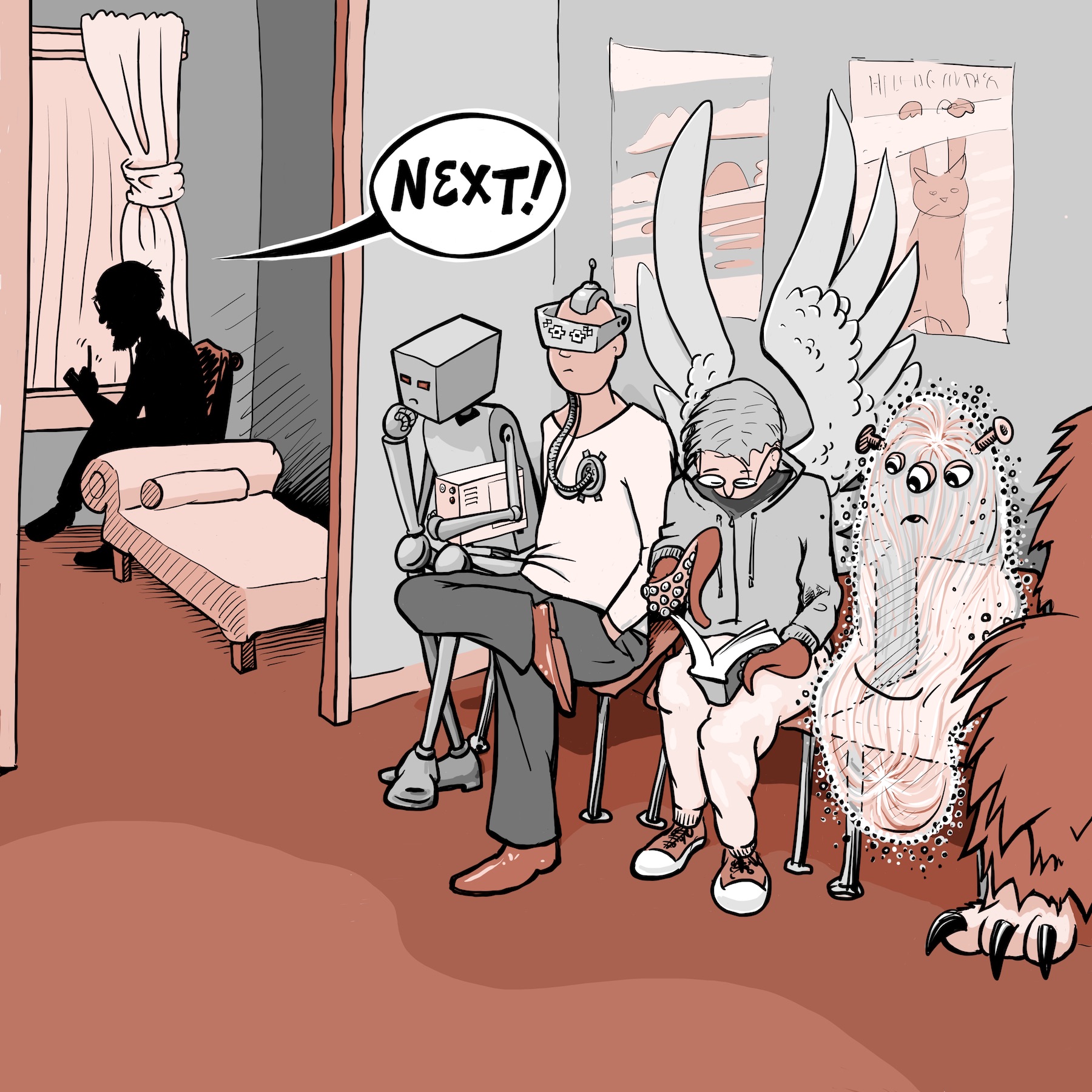
A talk for mental health professionals:

Published by

on

Here is a talk I gave recently focusing on the implications of diverse intelligence research for the future of the mental health field (and its future impact on somatic medicine).

And here are the downloadable slides:


Featured image by Jeremy Guay of Peregrine Creative.

5 responses to “A talk for mental health professionals:”

  1. Jan Cavel Avatar
    Jan Cavel

    To push back against the (required and funny) cliché of the old wise father-Freud analyzing the child-patient, a post-Freudian image of the psychologist might be less about ordering authority and more about accompaniment. Not the man who knows your hidden truth before you do, but a careful mirror, a temporary shelter where a some-one can discover what is truly theirs and what has been formed into them by genotype, phenotype, family, fear, institutions, technology, or the world. The therapist not being there to reduce every embodiment to a childhood wound, but to help each one become more legible to itself, to discover what is the latent space freedom the algorithm their running on allows.

  2. Leah Avatar
    Leah

    Interesting to think about all this from a clinical perspective. I love the fractal nature of top-down influence… and thinking from this perspective the implications of planting bad metaphysical beleifs in a human. Wish we could have heard the Q and A.

    1. Mike Levin Avatar
      Mike Levin

      They will put up the entire talk, including Q&A, at some point. I can only put up my own content here, and I have no control of when (or whether they restrict access) others do it, so I try to make it available asap. Hopefully the Q&A will be out soon.

  3. R O T O R Avatar
    R O T O R

    sometimes Mike reminds of a kind of Thomas Dolby of biology, just sayin.

  4. Sarah Daniel Avatar
    Sarah Daniel

    I was on that talk until my internet connection quit just as the Q&A was about to start. I think your discoveries will be immensely valuable for psychotherapeutic clinicians. Particularly in opening up possibilities and encouraging clinicians to look beyond their training whenever it has shut their minds to the unusual. (in a way, some of those exotic patients are already in the waiting room.) whenever the commonly accepted training says x or y phenomenon is “impossible”, a door closes. – Looking forward to experiencing the Q&A. Thanks for giving the talk.

Leave a Reply

Your email address will not be published. Required fields are marked *